Learn how a structured vendor onboarding process helps B2B marketplaces verify suppliers, improve product data, control quality, streamline China sourcing, and support reliable dropshipping fulfillment. Explore a practical supplier onboarding checklist, KPIs, workflow stages, and operational best practices for global sellers.
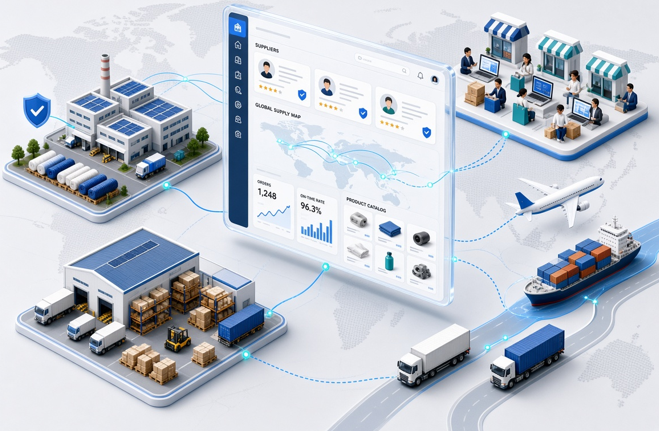
A well-designed vendor onboarding process is the foundation of a trustworthy B2B marketplace. For a China sourcing and dropshipping platform such as Looperbuy, onboarding is not simply about approving a seller account—it is the process of verifying suppliers, standardizing product information, aligning fulfillment expectations, and giving global merchants the confidence to sell without holding inventory.
When vendors are onboarded effectively, marketplace operators can expand product availability while controlling quality, compliance, order accuracy, and delivery risk. More importantly, overseas B2B sellers can access Chinese products and fulfillment capabilities without managing factory relationships, warehouse inventory, payments, or cross-border shipping on their own.
Table of Contents
What Is Vendor Onboarding in a B2B Marketplace?
Vendor onboarding—also called supplier onboarding—is the structured process of bringing suppliers, manufacturers, wholesalers, or service providers into a marketplace ecosystem.
In a traditional procurement environment, the buyer company evaluates and integrates suppliers into its own purchasing workflow. In a multi-vendor B2B marketplace, however, onboarding has a broader role: the platform must qualify vendors, organize their product data, establish commercial rules, and prepare them to serve multiple buyers or resellers.
For Looperbuy, the process may involve two connected groups:
– Upstream suppliers: Chinese manufacturers, wholesalers, trading companies, and product sources.
– Downstream B2B sellers: Global merchants, ecommerce sellers, wholesalers, and businesses seeking sourcing and dropshipping support.
A successful onboarding workflow connects these parties through standardized product data, transparent order processes, quality-control checkpoints, warehouse operations, payment support, and logistics coordination.
Supplier onboarding is a critical process in marketplace operations because it determines how quickly sellers can start offering products, the reliability of marketplace operations, and buyers’ perception of the platform’s quality and reputation.
Why Vendor Onboarding Matters for Global Sourcing
In cross-border commerce, supplier onboarding is more complex than collecting a company name and bank details. The marketplace must reduce uncertainty before products reach an overseas customer.
A strong process helps Looperbuy and similar B2B sourcing platforms:
– Reduce supplier and product risk before listings go live.
– Improve catalog quality with consistent titles, descriptions, images, specifications, and pricing.
– Protect seller margins by clarifying sourcing, packing, shipping, and service fees early.
– Avoid inventory pressure because merchants can source products on demand instead of pre-purchasing bulk stock.
– Strengthen fulfillment reliability through defined handling, quality-check, and dispatch procedures.
– Create scalable operations as supplier and SKU volumes grow.
– Improve buyer confidence through clear order status, product information, and responsive support.
International logistics performance depends not only on transport but also on customs processes, logistics service quality, shipment tracking, and the ability to meet expected delivery times. These factors are among the core dimensions measured by the World Bank’s Logistics Performance Index.
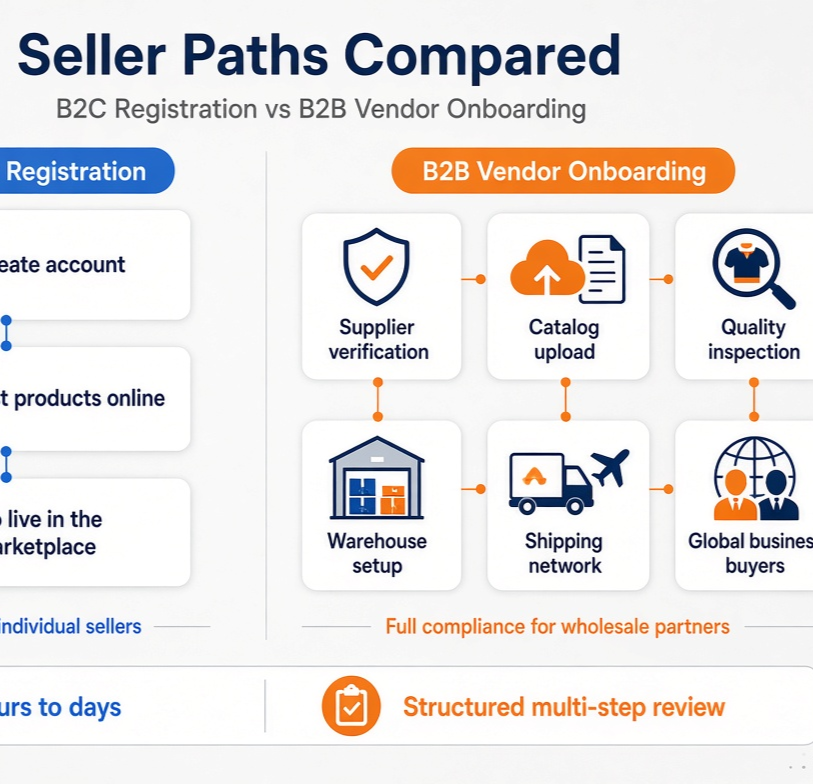
B2B Vendor Onboarding vs. B2C Seller Registration
Many marketplace teams make a costly mistake: they apply a simple B2C seller-registration model to a B2B environment. While both models require seller information and product listings, B2B onboarding typically involves larger orders, negotiated terms, repeated supplier relationships, technical integration, and greater operational risk.
| Area | B2C Marketplace Seller Setup | B2B Marketplace Vendor Onboarding |
| Verification level | Often basic identity and payment checks | Business registration, factory or supplier validation, certifications, capability review, and risk checks |
| Product information | Consumer-oriented titles, photos, and retail prices | Detailed specifications, MOQs, packaging data, lead times, wholesale tiers, and compliance information |
| Relationship type | High-volume, more transactional | Long-term, operationally connected supplier relationships |
| Pricing | Usually standardized retail pricing | Tiered, negotiated, MOQ-based, or quotation-driven pricing |
| Order flow | Individual consumer orders | Bulk orders, repeat orders, dropshipping orders, or mixed fulfillment workflows |
| Integration | Often platform-native tools | API, ERP, EDI, inventory feeds, warehouse systems, and order synchronization |
| Compliance needs | Marketplace rules and consumer protection | Product regulations, trade documentation, certifications, quality controls, and contractual obligations |
| Support requirements | Listing and customer-service support | Sourcing coordination, catalog management, fulfillment training, logistics support, and performance management |
B2B marketplaces generally require more comprehensive seller checks because the commercial relationship may involve recurring purchasing, larger financial exposure, industry-specific requirements, and shared operational dependencies.
The Complete Vendor Onboarding Process
The best onboarding systems are structured but flexible. A small supplier with a limited catalog may complete onboarding quickly, while a manufacturer with thousands of SKUs, custom packaging, and integrated inventory data may require a more detailed setup.
Below is a practical seven-stage framework for a B2B sourcing and dropshipping platform.
1. Supplier Application and Initial Registration
The first step is collecting the basic information needed to identify the supplier and determine whether the relationship is worth pursuing.
At this stage, suppliers should provide:
– Legal company name and registration location.
– Business license or registration documentation.
– Primary contact information.
– Product categories and sourcing capabilities.
– Factory, warehouse, or trading-company status.
– Export experience and target markets.
– Main product catalog or sample SKU list.
– Typical minimum order quantities.
– Estimated production or dispatch lead times.
– Available payment methods.
– Existing certifications, if relevant.
For Looperbuy, the application form should not be unnecessarily long. Ask only for information required for a first-level decision, then request deeper documentation based on the supplier category and risk profile.
For example, a supplier of low-risk general merchandise may need a different approval path from a seller of cosmetics, electronics, children’s products, food-contact goods, batteries, or branded merchandise.
Practical UX recommendation: Show a visible progress bar, such as “Step 1 of 4,” and allow suppliers to save incomplete applications. A supplier should never lose entered information because of a document-upload issue or poor connection.
2. Due Diligence, Risk Review, and Approval
After registration, the platform should review the supplier’s legitimacy, operational capacity, and suitability.
This stage protects both the platform and its global seller base. Vendor due diligence is commonly defined as assessing the risk associated with a relationship with a third-party organization before or during onboarding.
A practical review can include:
– Confirming the business entity and registration details.
– Checking ownership or representative information where appropriate.
– Reviewing product categories and prohibited-product exposure.
– Evaluating supplier history, reputation, and communication quality.
– Reviewing manufacturing or sourcing capacity.
– Checking certifications and test reports for regulated products.
– Confirming bank-account ownership and payment information.
– Reviewing packaging, labeling, and export-readiness capabilities.
– Assessing willingness to support quality inspection and order tracking.
A Simple Supplier Risk Scorecard
Instead of treating every supplier identically, use a risk-based approval model.
| Risk Factor | Low Risk | Medium Risk | High Risk |
| Business identity | Verified legal entity | Some information needs clarification | Identity documents are incomplete or inconsistent |
| Product category | General, low-regulation goods | Moderate product or quality sensitivity | Regulated, safety-sensitive, or counterfeit-prone products |
| Order capability | Proven dispatch process and stable capacity | Capacity needs validation | Unclear lead times or unstable fulfillment ability |
| Documentation | Complete and current | Partial documentation | Missing or questionable documents |
| Communication | Fast, clear, consistent | Occasional delays | Evasive, inconsistent, or unresponsive |
| Quality control | Accepts platform checks | Limited cooperation | Rejects inspection or cannot define quality standards |
This approach helps marketplace teams avoid excessive manual review for low-risk suppliers while applying more controls where failure would have a higher business impact.
Cybersecurity and third-party governance also deserve attention when suppliers or service partners receive system access. NIST recommends using supply-chain risk-management practices to improve how organizations acquire and manage technology suppliers, while guidance associated with the framework stresses planning and due diligence before formal supplier relationships begin.
3. Commercial Terms and Service-Level Expectations
Once a supplier passes initial review, both parties should document how the partnership will work in practice.
This is where many sourcing platforms create avoidable disputes. A supplier may believe “in stock” means available within two weeks, while the marketplace may interpret it as ready for dispatch within 48 hours. Clear definitions prevent this problem.
The vendor agreement or operating policy should clarify:
– Product pricing and price-change notification rules.
– MOQ requirements and sample-order rules.
– Order-confirmation deadlines.
– Production and dispatch lead times.
– Inventory-update expectations.
– Packaging requirements.
– Quality-check permissions and standards.
– Return, refund, replacement, and dispute procedures.
– Shipping-label and warehouse-delivery requirements.
– Restricted-product policies.
– Confidentiality and data-use terms.
– Consequences of repeated late shipment, quality failures, or inaccurate listings.
For dropshipping-oriented operations, define who is responsible for each stage: supplier, platform warehouse, sourcing agent, inspection team, shipping partner, and merchant.
4. Supplier Profile and Product Catalog Setup
A supplier is not truly ready to sell until buyers can understand what it offers. Catalog setup should therefore be treated as a commercial-quality process, not merely a data-upload task.
Each product listing should include:
– Clear English product title.
– Product category and searchable attributes.
– SKU or supplier product code.
– Product dimensions and net weight.
– Materials, colors, sizes, variants, and package contents.
– MOQ and tiered pricing where applicable.
– Product images from multiple useful angles.
– Compliance information or warnings when relevant.
– Inventory status or sourcing availability.
– Processing time and expected dispatch time.
– Customization, private-label, or OEM/ODM options.
– Packaging dimensions and shipping weight.
Catalog Quality Rules That Improve Conversion
For global B2B sellers, vague listings create support tickets, returns, and abandoned orders. Require suppliers to avoid unclear phrases such as “high quality,” “best seller,” or “same as picture” unless supported by specific product details.
A better product description answers practical buyer questions:
> Weak description: “Fashionable stainless steel water bottle, high quality.”
>
> Better description: “Double-wall stainless steel insulated bottle, 500 ml capacity, screw-top lid, available in black, white, blue, and pink. Individual kraft-box packaging. Custom logo printing available from 100 units. Sample lead time: 3–5 business days.”
The second version reduces uncertainty and makes it easier for a seller to reuse the information on a storefront, marketplace listing, or wholesale catalog.
5. Inventory, Order, Warehouse, and Logistics Integration
The technical setup should match the supplier’s maturity.
Some small suppliers can manually confirm orders and update stock through a vendor portal. Larger factories, distributors, and sourcing partners may need API, CSV, ERP, warehouse-management-system, or EDI connections.
The goal is not to force every supplier into the same technology model. The goal is to create reliable data flow.
Key integration priorities include:
1. Inventory synchronization: Reduce overselling by keeping available stock updated.
2. Order routing: Send confirmed orders to the right supplier, sourcing team, or warehouse.
3. Status updates: Track order confirmation, procurement, inspection, packing, dispatch, and delivery.
4. Shipping data: Capture carrier, tracking number, parcel dimensions, and shipment milestones.
5. Exception handling: Flag stockouts, price changes, delayed orders, failed inspections, or address issues.
6. Data security: Limit system access to only the data and functions necessary for each supplier role.
The World Bank notes that cross-border supply chain performance relies on infrastructure, customs, logistics services, the ability to track consignments, and the frequency of on-time delivery. For Looperbuy, that means order visibility should be designed into onboarding—not added only after customers complain about a delayed package.
6. Training, Pilot Orders, and Go-Live
A supplier should not move directly from approval to full-scale selling. A pilot phase is one of the most effective ways to identify operational gaps early.
During pilot onboarding, test:
– A small set of product listings.
– Stock and price updates.
– A sample or live order.
– Order-confirmation speed.
– Quality-check requirements.
– Warehouse receiving or pickup procedures.
– Packaging quality.
– Tracking-number generation.
– Exception-resolution communication.
Training should be short, role-specific, and easy to revisit. Suppliers do not need a 50-page manual before they can start; they need concise instructions at the moment of action.
Useful training formats include:
– Short onboarding videos.
– Downloadable product-listing templates.
– Order-processing checklists.
– Warehouse delivery guides.
– Packaging standards.
– A searchable supplier knowledge base.
– Dedicated support chat or ticket channels.
– Monthly product, policy, and shipping updates.
7. Performance Monitoring and Continuous Improvement
Onboarding does not end when a supplier receives approval. The best marketplaces continuously monitor supplier performance and use the results to improve both supplier outcomes and buyer trust.
Track metrics such as:
| KPI | Why It Matters |
| Order confirmation time | Shows whether suppliers respond quickly enough for real-time selling |
| Stock accuracy | Reduces cancellations and customer disappointment |
| On-time dispatch rate | Measures fulfillment reliability |
| Quality inspection pass rate | Indicates product consistency and packaging quality |
| Refund or dispute rate | Identifies listing, quality, or process issues |
| Tracking upload time | Supports transparent delivery communication |
| Response time to exceptions | Shows how well suppliers resolve problems |
| Repeat-order rate | Signals supplier reliability and product-market fit |
Create a simple supplier scorecard that vendors can understand. High-performing suppliers should receive practical benefits, such as priority product promotion, faster onboarding for new SKUs, access to more sales opportunities, or dedicated account support.
Suppliers with recurring issues should receive improvement plans, not just penalties. For example, a supplier with good products but slow order confirmations may need a clearer internal workflow, automated alerts, or a designated operations contact.
A Vendor Onboarding Checklist for Looperbuy
Use the following checklist as a repeatable operating framework.
Supplier Verification
– Company registration details collected and reviewed.
– Primary business contact confirmed.
– Product categories assessed.
– Supplier type identified: factory, wholesaler, distributor, or trading company.
– Payment and banking information verified.
– Required certifications or test reports reviewed.
– Restricted-product and intellectual-property risks assessed.
– Risk level assigned.
Commercial Setup
– Supplier agreement accepted.
– Pricing model confirmed.
– MOQ and sample-order policy defined.
– Lead times documented.
– Packaging requirements agreed.
– Quality-check process approved.
– Return, refund, and replacement responsibilities clarified.
– Service-level expectations documented.
Catalog Readiness
– Supplier profile completed.
– Product titles and descriptions reviewed.
– Images meet quality requirements.
– SKU, variant, size, material, weight, and dimensions provided.
– Pricing and MOQ uploaded.
– Inventory or sourcing availability defined.
– Compliance information added where required.
– Product listings approved before publishing.
Operational Readiness
– Order-routing method configured.
– Inventory-update process established.
– Warehouse delivery or pickup method tested.
– Quality-control workflow defined.
– Shipping-label process confirmed.
– Tracking-data process tested.
– Support contact assigned.
– Pilot order completed successfully.
How Looperbuy Can Create a Better Supplier Experience
A marketplace should protect buyers without making legitimate suppliers feel like they are navigating a bureaucratic obstacle course. The most effective supplier experience combines firm standards with clear guidance.
Here are practical improvements Looperbuy can apply:
– Use conditional forms. Show additional compliance questions only when a supplier’s category requires them.
– Explain why information is needed. A short note beside each document request increases completion rates.
– Offer localized support. Chinese suppliers may need Chinese-language instructions, while overseas merchants need clear English product and fulfillment information.
– Give real-time status visibility. Suppliers should see whether they are awaiting review, missing documents, catalog approval, integration testing, or launch approval.
– Create one source of truth. Avoid managing supplier data through disconnected spreadsheets, chat histories, and email threads.
– Build feedback loops. Ask suppliers where the onboarding process caused delays, then improve the workflow based on recurring patterns.
– Separate low-risk from high-risk workflows. Not every supplier needs the same approval time or document burden.
The central principle is simple: make the correct action easier than the incorrect action. If product attributes, package weights, lead times, and shipping requirements are required in the right format from the beginning, both supplier operations and merchant fulfillment become easier to manage later.
Build a More Reliable Global Sourcing Network
For global sellers, China sourcing and dropshipping should not mean accepting opaque supply chains, uncertain stock, unpredictable packaging, or limited order visibility. A structured vendor onboarding process creates the operating discipline needed to turn supplier relationships into dependable fulfillment capacity.
Looperbuy can help B2B sellers access Chinese products without tying up capital in inventory, building a warehouse operation, negotiating with multiple logistics providers, or manually coordinating every supplier order. The key is to combine verified supplier access with clear product information, quality-control processes, warehouse support, and transparent shipment tracking.
Ready to reduce sourcing complexity and scale your product offering without holding more inventory? Partner with Looperbuy to connect your business with structured China sourcing, product fulfillment, and dropshipping support designed for global B2B sellers.
Frequently Asked Questions
1. What is vendor onboarding in a B2B marketplace?
Vendor onboarding is the process of registering, verifying, approving, and preparing suppliers to sell products or provide services through a B2B marketplace. It usually includes business verification, agreement setup, product catalog creation, operational testing, training, and performance monitoring.
2. Why is supplier verification important for China sourcing?
Supplier verification helps reduce the risk of unreliable business information, poor-quality goods, inaccurate product listings, counterfeit products, delayed fulfillment, and unclear payment arrangements. It gives the platform a structured way to assess whether a supplier can support international B2B orders.
3. What documents should a supplier provide during onboarding?
The required documents vary by product category and risk level, but may include a business license, company registration details, tax information, bank details, product certifications, quality reports, export-related information, and brand authorization documents where applicable.
4. How can dropshipping sellers avoid holding inventory?
Dropshipping sellers can list products for sale without purchasing stock in advance. When an end customer places an order, the seller submits the order to a sourcing or fulfillment partner, which procures, checks, packs, and ships the product. This can reduce upfront inventory and warehouse costs, although sellers still need to manage product quality, margins, customer expectations, and delivery times.
5. What KPIs should a B2B marketplace track for suppliers?
Useful supplier KPIs include order-confirmation time, inventory accuracy, on-time dispatch rate, quality-check pass rate, cancellation rate, refund or dispute rate, tracking upload speed, and response time to operational exceptions.
6. How does a supplier portal improve onboarding?
A supplier portal centralizes supplier registration, document collection, product uploads, order management, invoice or payment information, support resources, performance data, and communications. This reduces manual follow-up and gives suppliers clearer visibility into what they need to complete.
7. What happens after a supplier is approved?
Approval should be followed by catalog setup, order-flow testing, training, a pilot order, and ongoing performance review. Suppliers should continue updating product data, inventory availability, lead times, and compliance documents as their business changes.
References
1. Virto Commerce. “[Vendor Onboarding Explained: Process, Checklists & Best Practices].”
2. World Bank. “[World Bank Releases Logistics Performance Index 2023].”
3. World Bank. “[International LPI 2023 Report].”
4. National Institute of Standards and Technology. “[NIST Cybersecurity Framework 2.0 Quick-Start Guide: Cybersecurity Supply Chain Risk Management].”
5. BitSight. “[The Vendor Due Diligence Checklist: A 5-Step Guide].”
6. Ivalua. “[Supplier Onboarding 101: Essential Tips for a Smooth Process].”