Explore Southeast Asia e-commerce opportunities for global sellers in 2026. Learn how to source products from China, test demand with low inventory risk, improve cross-border fulfillment, localize payments, choose products, and build repeat customer trust with Looperbuy.
Southeast Asia e-commerce is no longer a single “emerging market” opportunity. It is a fast-moving collection of mobile-first, platform-led, and highly localized consumer markets where global sellers can build leaner businesses by sourcing products from China, testing demand with smaller batches, and using reliable fulfillment partners instead of committing capital to large inventories.
For merchants selling through Shopee, Lazada, TikTok Shop, independent stores, or local social-commerce channels, the opportunity is substantial—but execution depends on more than finding a low unit price. Product selection, localized payments, platform compliance, inventory control, and delivery reliability now determine whether a cross-border business can scale profitably.
Table of Contents
Why Southeast Asia E-Commerce Still Matters
Southeast Asia includes diverse markets with different languages, consumer preferences, income levels, infrastructure conditions, and regulatory systems. Yet several regional characteristics make it attractive for cross-border sellers:
– Consumers are highly comfortable shopping through mobile apps.
– Marketplaces play a central role in product discovery and purchase.
– Social video, livestreaming, and creator-led recommendations strongly influence buying decisions.
– Digital wallets, QR payments, cards, cash-on-delivery, and installment products coexist.
– Many merchants operate with small teams and seek low-risk ways to expand product catalogs.
– China remains an important sourcing base for competitively priced consumer products, accessories, home goods, electronics, fashion items, and seasonal merchandise.
The earlier version of the Southeast Asia market story focused heavily on the pandemic-driven acceleration of online shopping, early marketplace growth, and mobile adoption. Those trends remain important, but the market has changed. The question for sellers is no longer whether consumers will shop online. The more useful question is:
How can a merchant enter or expand in Southeast Asia without tying up too much cash in stock, warehouses, and complicated cross-border operations?
That is where a sourcing and dropshipping model can create a practical advantage.
According to the 2025 e-Conomy SEA report from Google, Temasek, and Bain & Company, Southeast Asia’s digital economy was projected to surpass $300 billion in gross merchandise value (GMV) in 2025, representing 15% year-over-year growth. E-commerce alone was projected to reach $185 billion in GMV. Importantly, growth is increasingly driven by repeat customers rather than only first-time online shoppers, which suggests that service quality, product value, and customer retention matter more than ever.
Southeast Asia Is Not One Market
Treating Southeast Asia as one unified market is one of the most expensive mistakes an international seller can make. Regional scale is useful for strategic planning, but market-entry decisions must be country-specific.
Indonesia offers the region’s largest consumer opportunity, while Singapore is a more mature, higher-income, digitally sophisticated market. Vietnam has a young, mobile-oriented population and strong e-commerce momentum. Thailand, Malaysia, and the Philippines each have their own marketplace ecosystems, payment expectations, language requirements, and delivery realities.
| Market | Commercial Opportunity | Key Operating Consideration | Sourcing and Fulfillment Implication |
| Indonesia | Largest e-commerce and digital-economy market in Southeast Asia | Archipelagic geography can make delivery coverage and cost more complex | Start with lightweight, margin-friendly products and validate delivery performance by location |
| Vietnam | Fast-growing mobile and social-commerce environment | Localized content, pricing, and consumer trust are crucial | Test trend-led, visually demonstrable products with localized product pages |
| Thailand | Established marketplace culture and strong social selling activity | Thai-language communication and local campaign calendars matter | Use local-ready visuals, accurate variants, and campaign-based inventory planning |
| Philippines | Mobile-first consumers and strong social-media engagement | Delivery experience and payment preferences may vary by location | Offer clear shipping expectations and consider products that tolerate longer delivery windows |
| Malaysia | Digitally connected market with cross-border purchasing potential | Buyers expect transparent pricing and reliable fulfillment | Position products with clear value, product specifications, and predictable shipping |
| Singapore | Affluent, highly competitive, service-sensitive market | Buyers generally expect speed, quality, and trust | Focus on differentiated products, reliable packaging, and fast issue resolution |
Indonesia remains particularly important because of its scale. In 2025, Indonesia’s digital economy was projected to approach $100 billion in GMV, up 14% year over year and remaining the largest digital economy in Southeast Asia, according to the e-Conomy SEA 2025 report.
However, a large addressable market does not automatically mean easy profitability. Indonesia’s geography includes thousands of islands, making logistics design a core commercial decision rather than a back-office detail. A seller should avoid assuming that one shipping promise, one product price, or one promotional message will perform equally well across Jakarta, Surabaya, Bali, Medan, and smaller cities.
The New Growth Engine: Repeat Buyers
The Southeast Asian e-commerce market has matured. New users still matter, but customer retention has become more valuable.
According to the 2025 e-Conomy SEA report by Google, Temasek, and Bain & Company, Southeast Asia’s e-commerce GMV is projected to reach $185 billion in 2025, while e-commerce revenue is expected to reach $41 billion. Today, three in five people across the region shop online, highlighting just how deeply e-commerce has penetrated the market. This is an important operational signal: sustainable growth increasingly comes from convincing previous buyers to purchase again, not merely acquiring traffic at a discount.
For B2B sellers, resellers, and online store operators, this shifts the business model toward the following priorities:
– Consistent product quality across repeated orders.
– Accurate product photos, measurements, materials, and specifications.
– Fast replacement handling when damaged, incorrect, or missing items occur.
– Reliable inventory visibility for popular variants.
– Bundles, add-ons, and replenishable products that increase repeat order frequency.
– Transparent delivery tracking and realistic shipping communication.
A seller may generate a successful first order with an attractive price or viral video. But repeat orders usually depend on whether the delivered item matches the listing and whether the post-purchase experience feels dependable.
What This Means for Product Selection
Products should not be chosen solely because they are inexpensive at the factory gate. A more useful framework evaluates a product across the full customer journey.
| Product Evaluation Area | Questions to Ask Before Listing |
| Demand | Does the item solve a clear problem, match a seasonal trend, or work well in short-form video? |
| Margin | Does the expected selling price still leave room for product cost, shipping, platform fees, advertising, refunds, and customer service? |
| Shipping | Is the item compact, lightweight, durable, and unlikely to be damaged in transit? |
| Variation risk | Are colors, sizes, plug types, materials, or bundles clearly controlled by the supplier? |
| Compliance | Does the category require safety testing, labels, permits, trademarks, or local registration? |
| Return risk | Could customer expectations differ significantly from the actual product? |
| Repeat potential | Can buyers return for refills, accessories, upgrades, or complementary products? |
For example, a lightweight desk organizer with multiple compartments may be easier to test cross-border than a bulky low-margin furniture item. It is cheaper to ship, less fragile, easier to demonstrate in video, and can be bundled with related workspace accessories.
Mobile, Social Commerce, and Live Selling
Mobile commerce remains central to Southeast Asia’s digital retail environment. Consumers frequently discover products on social platforms, review creators’ videos, compare marketplace listings, and place orders through their phones.
This behavior creates an advantage for products that are easy to demonstrate visually. Before a seller invests in advertising or inventory, they should ask whether the product can be understood in five to 15 seconds of video.
Products tend to perform better in social and live-commerce environments when they have one or more of these characteristics:
– A clear before-and-after effect.
– A surprising or satisfying visual demonstration.
– A simple problem-solution story.
– A practical use case for home, work, beauty, travel, pets, fitness, or family life.
– Strong bundle potential.
– An affordable impulse-buy price point.
– A seasonal, gifting, or event-related use case.
Live commerce and “shoppertainment” are not simply entertainment features added to a marketplace. They compress discovery, product education, social proof, urgency, and checkout into one experience. The earlier Southeast Asia market analysis correctly identified livestreaming, influencer partnerships, and interactive shopping as major forces. Today, the practical lesson is more specific: sellers need product content that answers objections quickly.
A high-converting short video should show:
1. The customer problem in the first few seconds.
2. The product being used in a realistic setting.
3. Size, material, capacity, compatibility, or other decision-critical details.
4. The product’s result or benefit.
5. A clear offer, bundle, or reason to purchase now.
For merchants sourcing from China, this means supplier assets should be reviewed carefully. Never assume factory images are ready for a Southeast Asian storefront. Request original videos, material details, dimensions, packaging photos, variant information, and product-use demonstrations. Then localize the content for the target country.
Payments and Trust Are Conversion Factors
A checkout experience that supports only one payment method may lose otherwise qualified buyers. Across Southeast Asia, consumers use a mix of cards, e-wallets, bank transfers, QR payment systems, cash-on-delivery, and buy-now-pay-later options.
Payment preference is not merely a technical integration issue. It affects customer confidence. A shopper may abandon a purchase because the store lacks a familiar payment choice, does not display local currency clearly, or provides unclear delivery and return information.
Cross-border merchants should therefore prioritize:
– Local-currency price display where possible.
– Payment options familiar to the target market.
– Transparent tax, duty, and shipping communication.
– Clear order confirmation and shipment tracking.
– Responsive customer support in an appropriate language.
– Product pages that show exactly what is included.
Trust is built before checkout and tested after delivery. In categories with higher fraud concerns, unclear specifications, or counterfeit risk, trust signals matter even more. Use accurate photos, verified supplier information, realistic delivery estimates, and a visible process for addressing quality issues.
Cross-Border E-Commerce Is Growing, but Complexity Remains
Cross-border commerce is a meaningful part of the Southeast Asian online retail ecosystem. The Southeast Asia cross-border e-commerce market was valued at approximately $45.4 billion in 2025 and is projected to reach around $50.4 billion in 2026, reflecting the region’s continued growth in cross-border online trade.
That opportunity comes with real operating complexity:
– Import rules vary by country and product category.
– Some goods require local registration, labeling, testing, or certification.
– Trademark and intellectual-property risks can create account suspensions or seized shipments.
– Shipping timelines can vary by destination and carrier.
– Duties, taxes, and customs clearance procedures may affect final landed cost.
– Product returns can be expensive when inventory is overseas.
A dropshipping or on-demand fulfillment model can reduce the capital risk associated with these challenges. Rather than buying a large inventory order before proving demand, merchants can begin with a controlled catalog, use product testing to identify winners, and scale purchasing decisions based on actual sales data.
However, dropshipping is not a shortcut around quality control. It works best when sellers create a disciplined process for supplier vetting, sample checking, order tracking, and customer communication.
A Lean Sourcing Model for Global Sellers
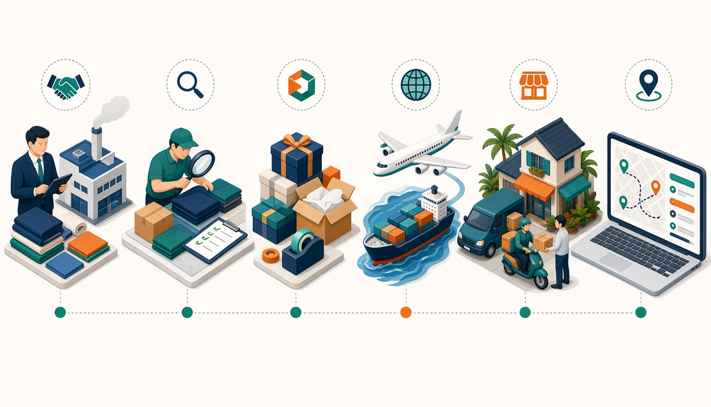
For a platform such as Looperbuy, the most valuable proposition is not simply access to Chinese products. It is helping global B2B sellers turn sourcing into a managed operating system.
A reliable sourcing and fulfillment workflow can help merchants avoid four common cost burdens:
– Large up-front inventory purchases.
– Long-term warehouse commitments.
– Fragmented supplier communication.
– Complex order fulfillment and international shipping coordination.
Step 1: Start With a Focused Product Test
Do not launch hundreds of unrelated products. Begin with a narrow collection built around a clear customer segment or use case.
For instance, instead of listing generic home products, a seller could test a “small-space kitchen organization” collection with drawer dividers, sink storage racks, spice organizers, reusable food containers, and cable clips. This creates a more coherent storefront and more opportunities for bundling.
Step 2: Vet Suppliers Beyond Price
Ask for:
– Product specifications and material details.
– High-resolution product images and original videos.
– MOQ requirements and sample availability.
– Lead times for standard and peak seasons.
– Packaging dimensions and shipment weight.
– Quality-control process and defect handling.
– Certifications or test reports where relevant.
– Proof that branded or patented designs are authorized.
The cheapest supplier can become the most expensive choice if the product arrives late, differs from the listing, or produces a high refund rate.
Step 3: Order Samples Before Scaling
Samples reveal issues that listing photos cannot show: thin materials, poor finishing, inaccurate color, weak packaging, missing accessories, incorrect plug standards, or difficult assembly.
When evaluating a sample, assess it as a customer would:
– Would the item meet the promise made in the product title?
– Is the packaging suitable for international transit?
– Are instructions understandable?
– Does the product look premium enough for the intended price?
– Can its key benefit be shown convincingly in video?
Step 4: Use Quality Checks Before Dispatch
For high-volume or higher-value orders, quality inspection should verify product appearance, quantity, variant accuracy, basic functionality, packaging, and labeling before shipping.
A practical inspection process can prevent a small supplier error from becoming hundreds of customer-service cases. If a supplier accidentally sends the wrong color or omits a component, catching the issue before international dispatch is significantly cheaper than handling individual refunds later.
Step 5: Build a Clear Customer Communication System
Customers should receive timely information at each stage:
1. Order confirmation.
2. Processing update.
3. Dispatch notification.
4. Tracking information.
5. Delivery confirmation.
6. Post-purchase support contact.
This is especially important for cross-border orders, where delivery may take longer than local fulfillment. Clear communication does not eliminate delays, but it reduces uncertainty and support pressure.
Common Market-Entry Mistakes
New sellers often fail not because Southeast Asia lacks demand, but because their operational assumptions are too broad.
Assuming One Regional Strategy Fits Every Country
A product title, ad creative, price, or payment method that works in Malaysia may not work in Vietnam or the Philippines. Localize your approach market by market.
Scaling Before Validating Fulfillment
A viral product can create a rush of orders. If suppliers cannot maintain stock, product quality, or dispatch speed, the seller may lose marketplace ratings and repeat buyers. Scale in phases.
Ignoring Landed Cost
The product purchase price is not the final cost. Include inspection, packaging, storage, shipping, platform fees, advertising, taxes, duties, payment fees, refunds, and customer-service costs in your profitability model.
Listing Restricted or High-Risk Products
Cosmetics, supplements, medical items, children’s goods, batteries, branded products, wireless devices, and safety-related items may face additional requirements. Always check platform and country-level rules before listing.
Treating Customer Service as an Afterthought
A strong product cannot compensate indefinitely for unanswered messages, unclear tracking, or unresolved disputes. Create service standards before sales volume grows.
Building a More Resilient Southeast Asia Strategy
The best Southeast Asia e-commerce businesses will not necessarily be those with the largest catalogs. They will be the ones that combine local market understanding with disciplined sourcing, accurate fulfillment, and customer trust.
The regional market continues to expand, but it is becoming more competitive and more operationally demanding. Southeast Asia’s digital economy reached an estimated $305 billion in GMV in 2025, with e-commerce accounting for approximately $185 billion. This is a sizable opportunity, yet success increasingly depends on repeat purchases, execution quality, and sustainable unit economics.
For global B2B sellers, sourcing from China can support a more flexible expansion model. Instead of committing heavily to stock before knowing what local customers want, merchants can test products, verify quality, fulfill orders more efficiently, and scale the categories that produce repeatable demand.
Looperbuy can help your business source Chinese products, consolidate orders, inspect quality, manage packaging, and arrange fulfillment—so you can focus more resources on product selection, marketplace growth, and customer relationships.
If you are planning to sell into Southeast Asia, start with a small, well-validated product range. Build reliable sourcing processes first. Then scale with confidence.
Frequently Asked Questions
1. Which Southeast Asian country should a new seller enter first?
The right choice depends on product category, budget, language capability, fulfillment model, and platform strategy. Indonesia offers significant scale, while Singapore may suit premium or service-sensitive products. Vietnam, Thailand, Malaysia, and the Philippines can also offer strong opportunities when a seller localizes content, payments, and delivery expectations.
2. What products are suitable for sourcing from China for Southeast Asia?
Products with a clear use case, manageable shipping weight, low damage risk, reliable specifications, and strong video demonstration potential are often good starting points. Common examples include home organization products, phone accessories, beauty tools, pet accessories, kitchen products, travel accessories, and practical lifestyle goods. Sellers must still check category-specific regulations and intellectual-property risks.
3. How can dropshipping reduce inventory risk?
Dropshipping enables sellers to fulfill customer orders after demand is generated rather than purchasing large quantities of stock in advance. This can reduce capital tied up in inventory and warehousing. It does not remove the need for supplier verification, quality checks, accurate listings, and dependable shipping management.
4. Why is product quality control important in cross-border fulfillment?
Cross-border returns are usually more expensive and slower than domestic returns. A pre-shipment quality check can identify incorrect variants, damaged packaging, missing components, and obvious defects before the product enters the international delivery chain.
5. Which marketplaces are important in Southeast Asia?
Shopee, Lazada, TikTok Shop, Tokopedia and other local or regional channels can be important depending on the target country. Platform relevance changes by market, so merchants should evaluate local traffic, category fit, seller rules, advertising tools, fulfillment requirements, and payment options before choosing where to launch.
6. How should sellers calculate profitability for Southeast Asia?
Use landed cost rather than supplier unit price alone. Include product cost, domestic China shipping, inspection, packaging, international freight, customs-related charges, marketplace fees, payment fees, advertising spend, discounts, refunds, customer-service costs, and expected return losses.
References
1. Virto Commerce. “[The State of Global eCommerce: Southeast Asia].”
2. Google, Temasek. “[e-Conomy SEA 2025].”
6. Temasek. “[e-Conomy SEA 2025 Report: ASEAN’s Digital Economy Poised to Surpass $300 Billion].”