The antique pearl necklace stands as a testament to timeless elegance, carrying within its lustrous spheres stories from bygone eras. For centuries, pearls have been regarded as the ultimate symbol of purity, status, and refined taste. Unlike faceted gemstones that rely on human intervention to reveal their brilliance, pearls are masterpieces crafted by nature alone, emerging from the depths of the ocean with an iridescent glow that requires no cutting or polishing to capture the eye. To own an antique pearl necklace is to possess a fragment of history, a wearable legacy that transcends fleeting fashion trends and speaks to an appreciation for enduring beauty. In an age dominated by mass-produced accessories, the singular character of an antique strand offers a connection to the craftsmanship of the past, inviting us to slow down and appreciate the subtle complexities of nature and the artistry of the jewelers who once set them.
Table of Contents
A Journey Through Historical Eras
The history of the pearl is as vast as the oceans from which they are harvested, with records of their adoration stretching back to ancient civilizations. Throughout the centuries, they have adorned the necks of royalty, graced the crowns of monarchs, and served as the centerpiece of aristocratic portraits. When we look at antique pearl necklaces, we are often traversing through distinct stylistic periods that defined the aesthetic sensibilities of their time. The fascination with pearls has never truly waned, but the way they were presented has evolved alongside the shifting cultural landscapes of each generation.
The Georgian era, spanning the eighteenth century, often featured pearls in ornate, hand-crafted settings, frequently combined with closed-back gemstone arrangements. These pieces were often whimsical and highly personalized, reflecting the romanticism of the age. During this time, the setting itself was as important as the gem, with intricate metalwork acting as a stage for the pearls. As we move into the Victorian period, the style shifted toward sentimentality and mourning. Influenced by Queen Victoria’s own deep affection for pearls, which she considered suitable for both joyous occasions and times of grief, the era saw them used not only in delicate, feminine designs but also as symbols of remembrance, often incorporated into intricate jewelry meant to honor lost loved ones or commemorate significant milestones.
The Edwardian era brought a lighter, more ethereal aesthetic to the antique pearl necklace. Using platinum and white gold, jewelers created lace-like, delicate filigree designs that perfectly complemented the opulence of the time. These pieces often featured pearls in combination with diamonds, creating a sophisticated monochromatic palette that remains the height of elegance today. This period represented the zenith of technical refinement, where the mountings became almost invisible to allow the natural light to play off the pearls and diamonds in perfect harmony. Following this, the Art Deco period introduced a dramatic contrast. Geometric shapes, bold lines, and strong symmetrical patterns dominated, moving away from the soft, fluid designs of the past and embracing the modern, energetic spirit of the Roaring Twenties. The use of pearls in Art Deco jewelry often prioritized contrast, pairing the organic, creamy spheres with striking black onyx, vibrant emeralds, or fiery rubies, reflecting a world that was rapidly industrializing and looking toward the future with newfound boldness.
The Anatomy of an Antique Strand
To truly understand the value and allure of an antique pearl necklace, one must look past the surface and consider the complex assembly of the piece. An antique necklace is not merely a string of pearls; it is a carefully curated collection, where each component contributes to the final harmony. The process of gathering enough pearls of similar size, shape, and luster to form a single, uniform strand was a task of immense dedication, often taking years of sourcing.
The silk thread used for stringing is a critical component that links the past to the present. Traditionally, jewelers used high-quality silk, which provided the necessary flexibility for the necklace to drape elegantly around the neckline. Furthermore, the practice of knotting between each pearl—a technique that became more common in the early twentieth century—served a dual purpose. It prevented the pearls from rubbing against one another, which could cause surface damage over time, and it ensured that should the strand break, the owner would not lose every pearl in the collection. The knots represent a quiet, functional beauty, a testament to the foresight of antique jewelers who valued the longevity of their creations.
The clasp of an antique pearl necklace is frequently a hidden masterpiece. In many instances, the clasp was designed to be as beautiful as the pearls themselves, often serving as a brooch that could be detached and worn separately. These clasps were frequently crafted from gold or platinum and embellished with diamonds, sapphires, or intricate enamel work. The level of detail present in these clasps often provides clues about the period of manufacture and the status of the original wearer. A heavy, intricately engraved box clasp might suggest a formal evening piece, while a more modest, delicate hook might indicate a necklace intended for daytime wear. Examining these elements allows us to piece together the lifestyle and the fashion requirements of the women who wore these necklaces decades or even centuries ago.
Distinguishing Natural from Cultured Treasures
Understanding the nature of the pearls in an antique piece is fundamental to both its valuation and its historical significance. For the majority of human history, all pearls were natural, formed by chance when an irritant entered a mollusk. These natural gems were incredibly rare and commanded astronomical prices, often reserved solely for the ultra-wealthy, the ruling classes, and the aristocracy. The sheer rarity of finding a perfectly round, well-matched natural pearl meant that owning a multi-strand necklace was a sign of immense power and financial standing.
The early twentieth century saw a seismic shift with the widespread development of cultured pearl technology. By human-assisted insertion of an irritant into the mollusk, pearls could be produced more reliably, making them accessible to a broader audience. When evaluating an antique pearl necklace, one must determine whether the pearls are natural or cultured. Natural pearls, particularly those from the era before the widespread adoption of culturing, often exhibit unique characteristics such as slight irregularities in shape or subtle variations in orientation, which add to their charm and authenticity. They often possess a deeper, more complex luster that reflects the longer, more gradual growth process within the mollusk. Distinguishing between these requires the trained eye of a specialist or specialized gemological testing, as the difference in value between a natural pearl strand and a high-quality cultured strand from the same era can be substantial. Modern collectors often find themselves in a pursuit of historical accuracy, seeking to confirm whether their piece represents the last generation of purely natural treasures or the beginning of the cultured era.
The Geographical Diversity of Pearl Sources
The provenance of an antique pearl necklace is often tethered to the geography of its origin. Historically, different regions were prized for the specific characteristics of their pearls. Pearls sourced from the Persian Gulf were long considered the gold standard, favored for their exceptional luster and warm, cream-colored overtones. These pearls were traded along ancient silk roads and maritime routes, eventually gracing the jewelry boxes of European monarchs and the aristocracy of the Middle East.
Similarly, the coastal waters of Venezuela and the Caribbean were significant sources of pearls during the colonial era, offering a slightly different spectrum of color, ranging from soft pinks to deep silvers. In Asia, specifically the waters off Japan and China, the pearl trade developed a unique identity that eventually led to the birth of the cultured pearl industry. Understanding where a pearl likely originated adds a layer of depth to the appreciation of an antique strand. It provides context to the trade history, the economic conditions of the time, and the global interconnectedness that allowed these treasures to travel across continents to find their way into a final, elegant setting. Collectors who research the origin of their pearls are engaging in a form of detective work that reveals the true, global scope of these organic wonders.
Key Factors in Assessing Value and Quality
When one seeks to acquire or appraise an antique pearl necklace, several critical factors must be evaluated to determine its worth. While the historical provenance of a piece—such as ownership by a notable figure—can drastically inflate its value, the intrinsic quality of the pearls themselves remains the foundation. One must approach the evaluation with a balanced perspective, considering both the physical attributes and the intangible historical appeal.
Luster is arguably the most vital attribute. It refers to the depth and intensity of the light reflecting from the surface of the pearl, giving it that characteristic inner glow. A pearl with high luster appears almost lit from within, whereas one with poor luster can look dull or chalky. Surface quality is equally important. While few pearls are perfectly flawless, those with fewer blemishes, pits, or irregularities command higher interest. In the context of antique jewelry, however, minor imperfections are often accepted as evidence of the pearl’s organic origin, and collectors have learned to embrace the “character” of these natural imperfections.
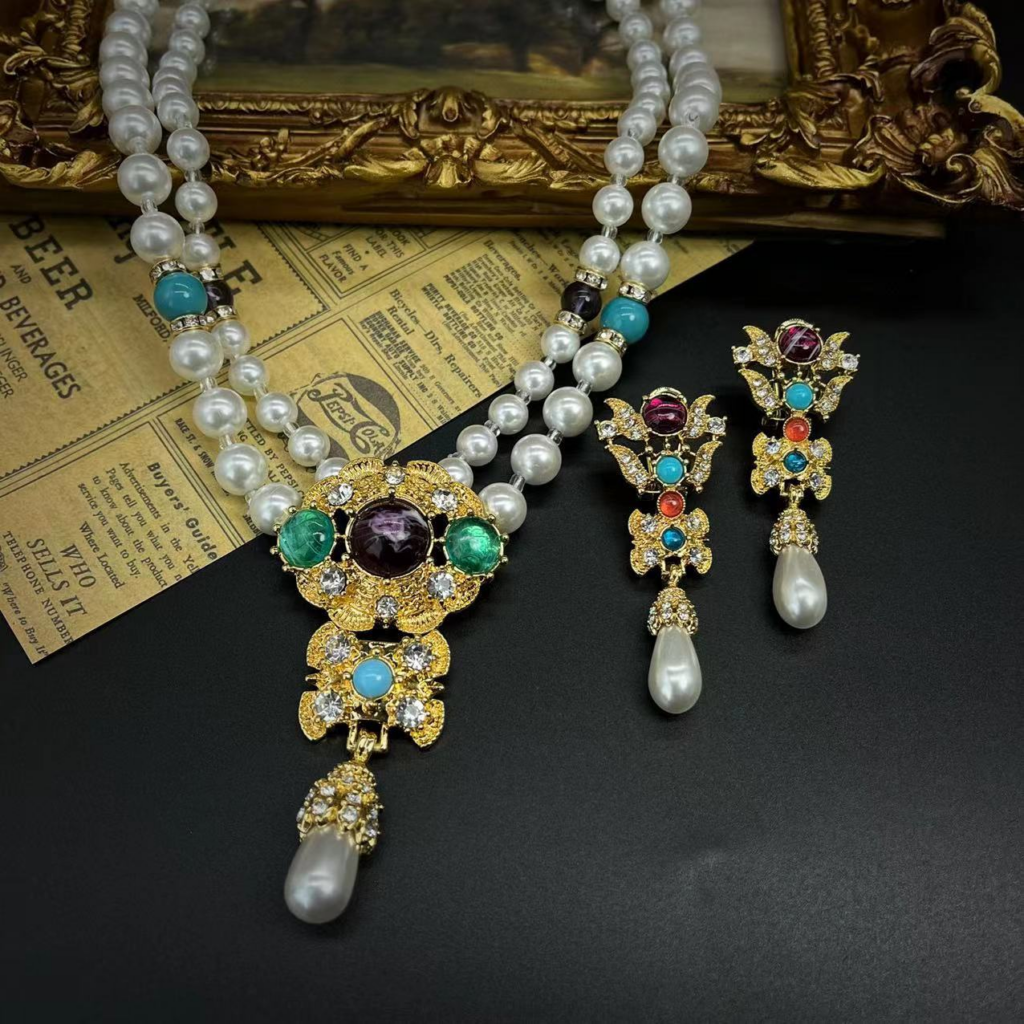
The matching of the pearls in a necklace is a hallmark of skilled craftsmanship. A superior antique strand will feature pearls that are well-matched in size, shape, color, and overtone. This requires an immense amount of time and patience, as each pearl must be carefully selected to complement its neighbors. Furthermore, the thickness and integrity of the nacre—the substance the mollusk secretes—determine the durability and beauty of the pearl over time. A necklace with thick, healthy nacre will retain its beauty for generations, while thin nacre may degrade, dulling the luster and compromising the piece’s integrity. Finally, the setting, whether it be an intricate diamond-set clasp or a simple silk stringing, contributes significantly to the overall aesthetic and historical value of the piece. When these factors align—high luster, excellent matching, thick nacre, and a secure, artistic clasp—the result is an item of immense, enduring worth.
The Evolution of Pearl Trends and Fashion
The history of the pearl necklace is inseparable from the history of fashion itself. At various points in history, the length and style of the necklace were dictated by the prevailing silhouette of women’s garments. The dramatic high necklines of the Victorian era favored shorter, more intimate chokers that sat snugly against the throat. As fashion transitioned into the Edwardian and later the Flapper era, the silhouette became more fluid, favoring longer, multi-strand necklaces that could be draped or knotted, emphasizing the elegance of the neckline and the movement of the fabric.
In the mid-twentieth century, the classic single strand of pearls became an iconic staple of the “ladylike” wardrobe, a style popularized by silver-screen legends and societal figures. However, these later trends were often influenced by the classic designs that preceded them. An antique pearl necklace acts as a record of these shifting trends. It captures the social aspirations and the style mandates of the women who chose to wear them. Whether it was the somber, respectful elegance of the Victorian period or the carefree, liberated style of the 1920s, the antique necklace remains a silent witness to the evolution of feminine identity throughout the modern age.
The Investment of Emotion and History
Beyond the purely objective metrics of quality and rarity, there is an emotional investment in acquiring an antique pearl necklace. These objects have lived through world wars, societal revolutions, and the intimate life events of their former owners. When a modern wearer puts on a strand that has survived a century, they are engaging in a form of continuity. The pearls carry the warmth of skin and the memories of celebrations and quiet moments from the past. This historical narrative adds a layer of value that cannot be quantified in a lab report. It transforms the necklace from an object of luxury into a family heirloom, meant to be passed down through generations.
Collecting antique pearls also allows for a unique engagement with history. By studying the progression of styles, one learns about the changing roles of women in society, the evolution of trade routes, and the advancements in jewelry design. For many, the thrill is in the hunt—searching through estate sales, specialized auctions, and boutique antique dealers for that perfect, elusive piece. It is a hobby that demands patience, curiosity, and a respect for the past. As we move further into a digital future, the tactile, organic beauty of a centuries-old pearl necklace serves as a grounding reminder of the enduring nature of true quality and the human desire to adorn ourselves with the wonders of the natural world.
Preserving Elegance for Future Generations
Caring for an antique pearl necklace is a delicate responsibility, as pearls are organic gems that react to their environment. Unlike diamonds or other hard stones, pearls are relatively soft and porous. They are sensitive to chemicals, including hairspray, perfumes, lotions, and even the natural oils on the skin. Because they are products of a biological process, they require a living environment that is free from harsh elements that might dry them out or erode their delicate surface layers.
To maintain the longevity of such a piece, it is recommended to wipe the pearls gently with a soft, damp cloth after each wear to remove any residue. Proper storage is also essential; they should be kept separately from other jewelry to prevent scratching and stored in a soft pouch or a lined box to allow the organic material to “breathe” while staying protected from harsh conditions. It is also wise to have antique necklaces periodically inspected and professionally restrung, as the silk thread holding the pearls together can weaken and stretch over time, increasing the risk of breakage and loss. By observing these careful practices, one ensures that these timeless treasures remain as radiant for future generations as they were the day they were crafted. Investing the time in maintenance is a small price to pay for the preservation of history.
The Role of Provenance in Valuation
When discussing antique jewelry, the term “provenance” is often used, but its implications are sometimes misunderstood. Provenance refers to the documented history of ownership. For a pearl necklace, having a clear lineage—such as original receipts, photographs of the necklace being worn by a previous owner, or records from a major auction house—can significantly enhance its market value. Provenance transforms the object from an anonymous antique into a specific piece with a unique story.
However, even for pieces without a storied past, the craftsmanship and the physical condition remain paramount. It is important to remember that not every antique necklace belonged to royalty, and that is perfectly acceptable. The beauty of an antique necklace lies in the fact that it was likely worn and loved by someone who appreciated its grace, just as the current owner does. Every piece of jewelry has a story, even if the names of the past owners have been lost to time. The focus should always be on the quality of the pearls and the joy the piece brings to the person who wears it today.
Conclusion
The antique pearl necklace is more than just an accessory; it is a bridge to the past, a vessel of artistic achievement, and a celebration of natural beauty. From the romanticism of the Georgian and Victorian eras to the sleek sophistication of Art Deco, these pieces capture the evolving spirit of their times. Whether worn for their historical narrative, their aesthetic grace, or their enduring value, they remain one of the most cherished categories of antique jewelry. By understanding the complexities of their history, distinguishing their origins, and adhering to diligent care practices, collectors and enthusiasts can continue to celebrate the quiet, luminescent power of pearls for years to come. These treasures deserve our respect and protection, ensuring they continue to shine for centuries to follow.
How to purchase:Online B2B sourcing platform, China purchase, Chinese suppliers – LooperBuy
Frequently Asked Questions
1. How can I tell if my antique pearl necklace is made of natural or cultured pearls?
Distinguishing between the two often requires professional equipment. Generally, natural pearls may show slight variations in growth patterns when examined under X-ray or high-magnification tools. A jeweler or gemologist can perform these tests to provide a definitive identification, which is critical for valuing older, potentially historic pieces.
2. Does the brand of the necklace significantly affect its value?
Yes, provenance and brand carry significant weight. Pieces from legendary houses, such as Mikimoto, carry a premium, especially if they are well-preserved early examples. Additionally, if an antique necklace has a documented history of belonging to a notable historical figure or royalty, its auction value can be significantly higher than a comparable piece without such a background.
3. Why is restringing important for antique pearl necklaces?
Over time, the natural silk thread used to string antique pearl necklaces can weaken, fray, or stretch due to age and exposure to the environment. Restringing not only prevents the accidental breakage of the strand and the loss of individual pearls but also allows for a professional cleaning, which restores the necklace’s proper drape and appearance.
4. What are the most important factors when purchasing an antique pearl necklace?
The key factors include the luster of the pearls, the uniformity of the strand in terms of size, shape, and color, the thickness of the nacre, and the overall craftsmanship of the setting or clasp. Additionally, the historical era and the condition of the stringing are essential considerations that influence both the price and the long-term desirability of the piece.
5. Can I safely clean my antique pearl necklace at home?
It is best to avoid any harsh chemicals, ultrasonic cleaners, or steam cleaning, as these can permanently damage pearls. The safest approach is to gently wipe the pearls with a soft, slightly damp cloth after wearing them. If the piece is heavily soiled or the thread is compromised, it should be taken to a professional jeweler who specializes in antique jewelry restoration.
HOT TAG:
antique,pearl,necklace,vintage,jewelry,heirloom,collection,history,luster,natural,cultured,fashion,timeless,elegant,gemstone,craftsmanship,luxury,finejewelry,appraisal,care,restoration,edwardian,artdeco,victorian,georgian,style,authentic,heritage,investment,accessory,beauty,design,collectible,classic,opulence,sophistication,precious,nacre,preowned,exclusive,legacy,radiance,refinement,adornment,provenance,jewelryhistory