The landscape of global ecommerce is undergoing a profound transformation. For B2B buyers—whether you are a brand owner, a wholesale distributor, or a production manager—finding the right sourcing partner is no longer just about the lowest price. It is about balancing cost-efficiency, supply chain reliability, and scalability. While platforms like Temu, Shein, and AliExpress have become household names for consumer shopping, their roles in the B2B sector are complex and distinct.
As an industry expert, I have analyzed these platforms to help you determine which best aligns with your sourcing strategy. While AliExpress remains a veteran player in connecting global buyers with Chinese suppliers, the rise of specialized B2B sourcing platforms offers more tailored solutions for professional procurement.
Table of Contents
Understanding the Marketplace Ecosystem
Before selecting a platform, it is essential to understand their operational DNA and how they function in a global supply chain.
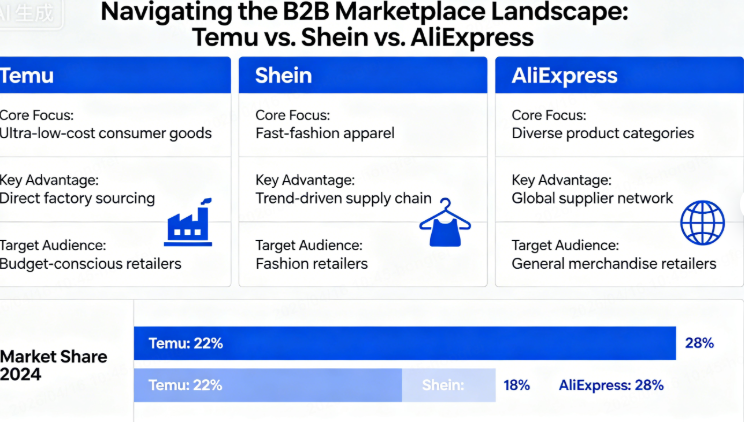
- AliExpress: A retail-focused subsidiary of Alibaba Group, AliExpress connects international buyers directly to Chinese manufacturers and small-to-medium suppliers. It is a vast, open marketplace best suited for smaller orders or initial product testing.
- Temu: Since its 2022 launch, Temu has aggressively pursued a high-volume, low-margin model. While tempting for budget buyers, its structure is heavily weighted toward B2C, often lacking the robust supply chain transparency required by professional B2B entities.
- Shein: Initially a fast-fashion B2C disruptor, Shein operates with a vertically integrated, demand-driven model. It is highly efficient for specific niche fashion procurement but offers limited flexibility for buyers looking to build a diverse, multi-category inventory.
Strategic Comparison: Key Metrics for B2B Sourcing
For professional buyers, the decision-making process should hinge on several critical factors rather than just the retail price tag.
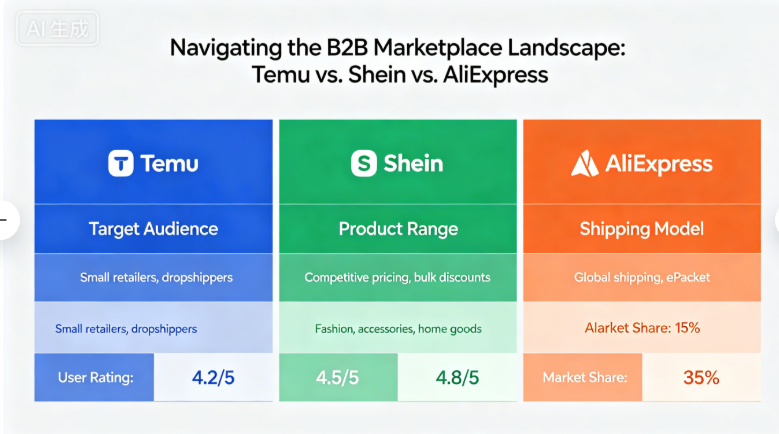
| Feature | AliExpress | Temu | Shein |
|---|---|---|---|
| Primary Focus | B2C/Small B2B | Ultra-low price B2C | Fast Fashion B2C |
| Inventory Scale | Massive/Diverse | Broad/Budget-focused | Niche/Trend-driven |
| B2B Capabilities | Moderate (Retail focused) | Low (B2C optimized) | Low (B2C optimized) |
| Logistics Control | Flexible | Limited (Marketplace-led) | Limited (Centralized) |
The Reality of “Direct from Factory” Claims
A common misconception in the B2B space is that accessing a massive consumer marketplace is equivalent to sourcing “direct from factory.” While platforms like AliExpress do host manufacturers, they operate on a platform-wide algorithm designed to prioritize retail conversion rates, not industrial procurement needs.
The Middleman Dilemma
On many consumer-focused platforms, the “supplier” listed is often a trading company or an aggregator rather than the actual factory. This adds layers of cost and potential miscommunication. In professional procurement, this lack of direct line-of-sight creates significant risks regarding:
- Product Specifications: Misunderstandings in technical requirements.
- Compliance: Failure to meet international safety or material standards (e.g., RoHS, CE).
- Intellectual Property (IP): Lack of clear agreements to protect your unique designs.
Why Professional Buyers Need More Than Consumer Platforms
While AliExpress is a useful tool for sourcing niche items or evaluating potential suppliers, it often falls short for large-scale, professional procurement. Here is why industry leaders are shifting toward dedicated B2B sourcing platforms like LooperBuy:
1. The Quality Assurance Gap
Consumer platforms are optimized for fast delivery and low prices, not quality control. In B2B, a slight defect rate of 2% can devastate a retailer’s reputation. Dedicated B2B platforms typically offer pre-shipment inspections and verified supplier audits, which are rare on platforms like AliExpress. Professional platforms provide a structured QC process, ensuring that what was manufactured matches the buyer’s stringent requirements.
2. Supply Chain Transparency
Professional buyers need to know the origin of their goods to meet compliance, sustainability, and ethical standards. Consumer-focused marketplaces often obscure the actual manufacturer to prevent buyers from going direct. A One-Stop B2B Sourcing Platform provides the visibility you need to ensure supply chain integrity—from raw material sourcing to final assembly.
3. Logistical Complexity at Scale
Shipping one item is easy; shipping a container of goods with appropriate customs documentation, duty handling, and hazardous materials certification is complex. Professional sourcing platforms provide end-to-end logistics management, ensuring your goods move efficiently from the factory floor in China to your warehouse globally. They navigate the complexities of Incoterms, freight forwarding, and local customs regulations that retail platforms simply do not support.
Deep Dive: Scaling Your Sourcing Infrastructure
To build a resilient B2B operation, you must move beyond tactical purchasing and adopt a strategic framework.
The Lifecycle of Professional Sourcing
- Phase 1: Discovery & Sampling: This is where you might utilize a platform like AliExpress to identify potential manufacturers or test niche product viability.
- Phase 2: Supplier Verification: Move to a B2B-centric model. Conduct virtual factory tours, check business licenses, and verify ISO certifications.
- Phase 3: Production Management: This requires a dedicated platform that allows for Work-In-Progress (WIP) tracking. You should be able to see exactly when raw materials are sourced, when production begins, and when the QC milestones are hit.
- Phase 4: Logistics and Fulfillment: Move high-volume goods through established B2B logistics channels that offer real-time tracking, optimized freight rates, and guaranteed port-of-entry support.
Expert Insights: Optimizing Your Sourcing Strategy
To maximize your ROI, implement these advanced strategies:
- Diversify Channels: Use platforms like AliExpress for sampling and product validation, but move established, high-volume SKUs to dedicated B2B platforms for better pricing and contract security.
- Leverage Data: Move beyond superficial product listings. Analyze supplier responsiveness, historical manufacturing capacity, and compliance certifications.
- Negotiate Terms, Not Just Price: In B2B, payment terms (e.g., Net 30/60) and intellectual property protections are often more valuable than a marginal unit cost reduction.
- Cultivate Long-term Relationships: The best B2B buyers treat their suppliers as partners. Consistent, clear, and professional communication builds the trust required to get priority during peak production seasons.
The Future of B2B Sourcing
The future belongs to platforms that bridge the gap between “easy to use” and “enterprise-ready.” As the global market evolves, brands that leverage platforms offering global logistics convenience, product variety, and price transparency will gain a significant competitive advantage.
Whether you are looking to scale your inventory or launch a new product line, remember that successful sourcing is a partnership, not just a transaction. If your goal is to bridge the gap between Chinese manufacturing excellence and your global retail operation, evaluate your options not just by the platform’s consumer popularity, but by its ability to act as your supply chain backbone. Dedicated B2B platforms, by streamlining the connection between global demand and Chinese supply, are setting the new gold standard for professional procurement.
References
- Global Sources, “Temu vs. Shein vs. AliExpress,” https://www.globalsources.com/knowledge/temu-vs-shein-vs-aliexpress/
- Global Sources, “Sourcing Elite Board | Going Global: The Edge, Pitfalls, and Pathways for Chinese Brands,” https://www.globalsources.com/knowledge/the-edge-and-pitfalls-of-chinese-brands-going-global/
FAQ
1. Is AliExpress suitable for wholesale B2B procurement?
While AliExpress is convenient for small quantities, it is primarily designed for retail. For professional, high-volume B2B needs, dedicated sourcing platforms offer better supplier verification, quality control, and logistics support.
2. How do Temu and Shein differ for B2B buyers?
Both are heavily optimized for consumer-facing, fast-turnover models. They do not offer the contract stability, IP protection, or customization options required by most serious B2B importers.
3. What is the main advantage of using a dedicated B2B sourcing platform?
A dedicated B2B platform typically provides comprehensive supply chain management, including vendor auditing, quality inspection, and complex cross-border logistics, which standard consumer marketplaces lack.
4. Can I get better prices on a B2B platform compared to consumer apps?
Yes. By cutting out retail-level marketing costs and negotiating directly with manufacturers for bulk volumes, B2B platforms can secure more competitive unit costs and transparent pricing structures.
5. How do I ensure quality when sourcing from China?
Always prioritize platforms that offer verified supplier credentials and third-party inspection services. Never rely solely on product descriptions or photos provided on retail-heavy platforms.
Brief Summary:
This comprehensive guide evaluates the limitations and appropriate use cases for consumer-focused platforms like AliExpress, Temu, and Shein within a B2B context. It underscores the critical differences between retail-centric and B2B-specialized sourcing platforms, offering actionable strategies for brand owners to enhance supply chain transparency, quality control, and logistical efficiency when sourcing from China.
Hot tags: B2B sourcing platform, wholesale from China, global supply chain management, B2B procurement strategies, Chinese manufacturing sourcing, international wholesale suppliers, bulk product sourcing, B2B ecommerce solutions, cross-border trade logistics, factory direct procurement.