Protect your brand when working with overseas suppliers by combining clear standards, strict vetting, strong contracts, multi-layer quality control and inventory-light sourcing. Learn how platforms like LooperBuy help global B2B sellers source from China with less risk and more control.
Working with overseas suppliers can unlock huge growth for your brand—but it also exposes you to serious risks around quality, compliance, reputation, and customer trust. As someone who has spent years helping global B2B sellers source from China, optimize their supply chains, and scale without heavy inventory, I’ve seen strong brands damaged overnight by the wrong supplier decision—and protected long term by the right framework. This guide walks you through a practical, step‑by‑step approach to protecting your brand when working with overseas suppliers, with a special focus on China sourcing and inventory‑light models powered by platforms like LooperBuy.
Table of Contents
Understanding Brand Risk in Overseas Sourcing
When you source from overseas suppliers, you’re not just buying products—you’re outsourcing parts of your brand promise. If something goes wrong in production, packaging, or fulfillment, your customer blames you, not the factory.
Key brand risks include:
– Product quality inconsistency and defects
– Compliance issues (safety, labeling, certifications)
– Late deliveries and logistics disruption
– Unethical practices (labor, environmental impact)
– Intellectual property leakage and copycats
From my experience advising B2B sellers importing from China, brands that treat overseas suppliers like strategic partners—not just low‑cost vendors—consistently outperform competitors on retention, reviews, and margin.
Step 1 – Define Your Brand Standards Before You Source
Before you talk to a single overseas supplier, you need a clear internal definition of what your brand will—and will not—accept.
Create a Brand Standards Sheet that includes:
– Product quality benchmarks (materials, tolerances, durability)
– Visual standards (color codes, branding elements, packaging rules)
– Compliance requirements (target market regulations, certifications)
– Customer experience expectations (delivery timelines, return policies)
– Non‑negotiables (banned materials, forbidden claims, ethical rules)
When we help international merchants source from China through LooperBuy, the most successful projects start with a clear brand spec; it becomes the baseline for supplier selection, contract terms, and QC checklists.
Step 2 – Vet Overseas Suppliers Beyond Price
Price is visible; brand risk is hidden. To protect your reputation, you need a structured supplier vetting process, especially when working with factories and wholesalers in China.
Evaluate suppliers on:
– Track record: Years in operation, export markets, existing brand clients
– Production capability: Capacity, technology, ability to scale without quality drop
– Quality systems: Certifications, documented QC processes, inspection reports
– Communication quality: Response speed, clarity, problem‑solving attitude
– Transparency: Willingness to share factory details, audit access, sample revisions
Many global sellers now rely on sourcing platforms that pre‑screen suppliers and consolidate quality information, instead of doing cold outreach to random vendors. LooperBuy, for example, connects overseas buyers with vetted Chinese suppliers and consolidates procurement data, which reduces the chance of “unknown factory” risk.
Practical vetting checklist
Ask every potential overseas supplier:
1. What is your main export market and product niche?
2. Can you share recent shipment records and defect statistics?
3. What certifications do you hold for my target market?
4. Who handles quality control and how is it documented?
5. How do you manage production peaks to avoid quality drops?
Step 3 – Use Contracts and Clear SLAs to Protect Your Brand
Working with overseas suppliers without a clear contract is like selling without a brand guideline—everything is negotiable when something goes wrong. Strong contracts and service level agreements (SLAs) turn vague expectations into measurable obligations.
Critical clauses to include:
– Product specifications: materials, dimensions, performance, testing methods
– Quality tolerances and defect thresholds
– Delivery timelines, shipment frequency, and penalties for delays
– Packaging, labeling, and branding requirements
– Intellectual property protection and non‑competition terms
– Dispute resolution mechanism and jurisdiction
Global merchants using LooperBuy often embed these standards into purchase agreements, combined with ongoing inspection and warehouse checks to ensure suppliers meet the contract over time, not just on the first shipment.
Step 4 – Build a Multi‑Layer Quality Control System
Protecting your brand means assuming that something will eventually go wrong—and designing checks so problems are discovered before they reach your customer.
A robust QC system typically includes:
– Pre‑production sample approval (golden sample stored and referenced for each batch)
– In‑production inspections (random checks at key stages)
– Pre‑shipment inspections (finished goods tested against the standard)
– Incoming warehouse inspections (spot checks when goods arrive)
– Ongoing performance monitoring (customer feedback, return and defect data)
Platforms like LooperBuy integrate quality inspection and warehousing into the sourcing workflow, allowing overseas merchants to store goods in China, inspect them, and consolidate shipments before global dispatch—reducing the chance of defective items reaching end customers.
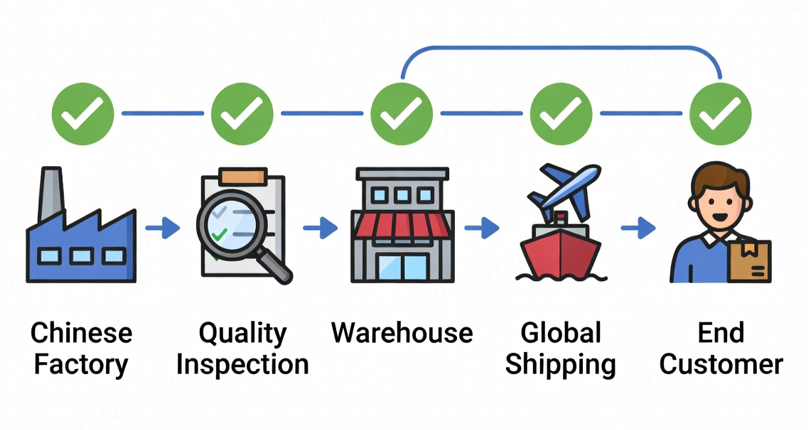
Example QC flow from China to your market
1. Approve samples from selected supplier.
2. Place production order with quality clauses.
3. Use third‑party or platform‑managed inspection before goods leave the factory.
4. Store, consolidate, and re‑check in a China warehouse.
5. Ship to end market using reliable logistics lanes.
Step 5 – Protect Your Brand Through Smart Logistics and Fulfillment
Your brand reputation doesn’t stop at the factory gate. Late deliveries, damaged packages, or inconsistent shipping times can hurt your brand as much as a defective product.
Key logistics strategies to protect your brand:
– Use reliable shipping routes with known transit times instead of ultra‑cheap, unpredictable lanes.
– Consolidate shipments in warehouses close to production to reduce damage and customs surprises.
– Implement track‑and‑trace for every order so your customers feel informed, not anxious.
– Define packaging standards that survive long‑distance transport and reflect your brand.
LooperBuy supports global B2B sellers with warehouse consolidation, multi‑route logistics, and unified order management, enabling brand owners to scale globally without running their own warehouses or freight teams. This inventory‑light model is particularly powerful for dropshippers, marketplace sellers, and growing brands that want global reach without fixed logistics overhead.
Step 6 – Manage Compliance and Certifications Proactively
If you sell into regulated markets (EU, US, UK, Middle East), your brand must align with local compliance rules, even when sourcing from overseas suppliers.
Key compliance considerations:
– Product safety (e.g., CE marking, FDA rules, electrical safety tests)
– Chemical and material restrictions (e.g., RoHS, REACH)
– Labeling requirements (language, origin, warnings, age recommendations)
– Data protection and documentation (technical files, test reports, declarations)
International buyers often work with Chinese suppliers that already serve similar markets, then verify existing certifications and test reports instead of starting from scratch. A sourcing platform that understands these regulations and can help interpret them—like LooperBuy in the context of ce 0543 and European trade codes—adds another layer of protection.
Step 7 – Safeguard Your Brand’s Intellectual Property
When you share designs, packaging concepts, or brand assets with overseas suppliers, you’re exposing your competitive edge. Protecting that IP is essential if you want to avoid copycat products or brand dilution.
Practical IP protection steps:
– Register trademarks and designs in your main selling markets and key production countries.
– Use NDAs and IP clauses in supplier contracts.
– Limit the number of suppliers who see full product and brand details.
– Monitor marketplaces for suspicious copycat listings.
– Work with partners who can help respond to IP violations quickly.
Many B2B sellers now combine factory sourcing with centralized order execution and after‑sales support through platforms like LooperBuy, which improves visibility and reduces the need to expose brand data to multiple fragmented vendors.
Inventory‑Light Sourcing as Brand Insurance
One of the most overlooked ways to protect your brand when working with overseas suppliers is to reduce your inventory risk. The more stock you lock into a risky supplier relationship, the harder it is to pivot when problems emerge.
Inventory‑light models, such as dropshipping or flexible warehousing in China, give you:
– Faster reaction to quality issues (you aren’t stuck with months of bad stock)
– Better cash flow to invest in branding and customer experience
– Freedom to test multiple suppliers and products before scaling
– Lower exposure when regulations or logistics costs suddenly change
LooperBuy is built around this concept: overseas merchants can source from 1.2B+ products, store in China, and ship worldwide, without building their own warehouse or logistics team. Used correctly, this approach becomes a brand protection strategy, not just a cost‑saving tactic.
Choosing the Right Overseas Partner: LooperBuy as a Case in Point
To protect your brand when working with overseas suppliers, you don’t just need good factories—you need a reliable sourcing and fulfillment partner that integrates procurement, QC, warehousing, and global shipping.
Here’s how platforms like LooperBuy support brand protection for global B2B sellers sourcing from China:
| Brand Protection Need | How LooperBuy Helps |
| Stable supply and reduced stockouts | Centralized sourcing from vetted Chinese suppliers and large product pools. |
| Quality control and defect reduction | In‑warehouse inspection, product consolidation, and structured QC workflows. |
| Lower logistics and warehousing risk | Free warehousing in China and smart shipping routes to 200+ countries. |
| Clear payment and reduced financial friction | Integrated cross‑border payment via partners like LianLian Global. |
| Flexible scaling across marketplaces | Unified order management for sellers on platforms like Shopify, Amazon, and TikTok. |
For brand owners, this means you can focus on strategy, positioning, and customer experience, while your sourcing partner reduces operational risk in the background.
Practical Checklist – Protecting Your Brand With Overseas Suppliers
If you’re about to start or scale overseas sourcing, use this quick checklist:
1. Define your brand standards: quality, compliance, packaging, service.
2. Shortlist overseas suppliers via a reliable sourcing platform.
3. Vet suppliers with structured questions and reference checks.
4. Sign contracts with clear specs, SLAs, and IP clauses.
5. Implement multi‑layer QC from factory to warehouse to customer.
6. Choose predictable logistics routes and packaging standards.
7. Verify compliance and certifications for target markets.
8. Use inventory‑light models to stay agile and reduce risk.
9. Continuously monitor reviews, defect rates, and delivery times.
10. Be ready to switch or diversify suppliers when performance drops.
Keep this near your desk whenever you evaluate a new overseas partner—it turns complex risk into actionable steps.
Build a Brand‑Safe Overseas Supply Chain
If you’re ready to scale globally without sacrificing your brand reputation, don’t try to manage overseas suppliers entirely on your own. Combine clear brand standards with a sourcing and fulfillment partner that understands China supply chains and global B2B realities.
Explore how LooperBuy can help you source reliably from China, cut warehousing and logistics costs, and protect your brand with integrated quality control and fulfillment. Start by mapping your current supplier risks, then test a pilot project with inventory‑light sourcing through LooperBuy to experience the difference.
Next step: Review your top three SKUs and ask yourself: *”If my current supplier failed tomorrow, would my brand still be safe?”* If the answer is “no,” it’s time to upgrade your overseas sourcing strategy.
FAQs
1. How do I know if an overseas supplier is safe for my brand?
Look beyond price and check their export history, quality systems, certifications, and communication habits. Using a vetted sourcing platform that pre‑screens suppliers gives you an extra layer of protection.
2. What’s the biggest mistake brands make when importing from China?
Many brands lock into large inventory orders with untested suppliers, then discover quality or compliance issues too late. Starting with smaller batches and inventory‑light models reduces this risk.
3. Can I protect my brand if I’m dropshipping from overseas?
Yes—if you combine strict product standards, reliable QC, and stable logistics. Dropshipping via platforms that handle warehousing and inspection in China helps maintain consistency without owning a warehouse.
4. How important are contracts when working with overseas suppliers?
Contracts with clear specs, SLAs, and IP clauses are essential. They set expectations, create accountability, and give you leverage when something goes wrong in production or delivery.
5. Why use a sourcing platform like LooperBuy instead of going directly to factories?
A platform consolidates vetted suppliers, warehousing, logistics, and payments in one place, reducing complexity and brand risk. It’s especially valuable if you sell across multiple marketplaces and don’t have an in‑house supply chain team.
References
– LooperBuy – B2B China Goods Sourcing Platform: [looperbuy]
– LianLian Global – LooperBuy product page (cross‑border payments and sourcing): [global.lianlianpay]
– LooperBuy Blog – “Logistics Surcharge Decoded: A B2B Expert’s Guide to Cost-Effective Global Sourcing from China”: [looperbuy]
– LooperBuy Blog – “ce 0543: Your Complete B2B Guide to Sourcing Chinese Goods Globally with LooperBuy”: [looperbuy]
– LooperBuy Instagram – Global sourcing, dropshipping and logistics content: [instagram]
– LooperBuy LinkedIn – Cross-border sourcing and supply chain insights: [linkedin]
– LooperBuy Blog – “How to Start a B2B Marketplace: A One-Stop Sourcing Expert’s Guide to Direct China Sourcing for Global Sellers”:[looperbuy]
– LooperBuy Blog – “Top 10 Strategic Sourcing Company in China”: [looperbuy]
– LooperBuy Blog – “How Global B2B Sellers Can Confidently Import Wholesale Products from China and Cut Inventory Risk With LooperBuy”: [looperbuy]
-700x490.jpeg)