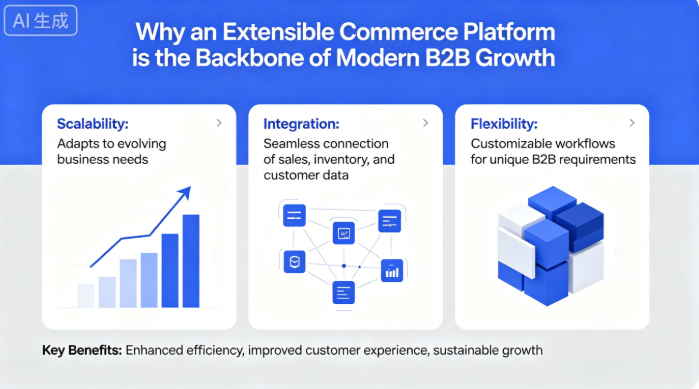
In today’s volatile global market, the definition of success for B2B brands, wholesalers, and manufacturers has shifted. It is no longer enough to simply have a standard online storefront; you need a digital ecosystem that evolves at the speed of your customers. For global players like LooperBuy, which bridges the gap between massive Chinese manufacturing capacities and international B2B fulfillment, the underlying technology is the primary driver of agility.
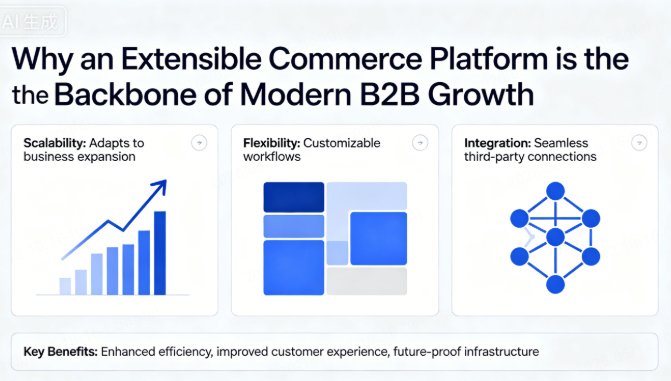
At the heart of this agility lies the extensible commerce platform. Unlike monolithic systems that trap businesses in rigid, “one-size-fits-all” workflows, an extensible platform acts as a foundation—a composable architecture—that allows you to build, modify, and scale unique functionalities without the fear of breaking your core business logic 1.
Table of Contents
Understanding Extensible Commerce Platforms
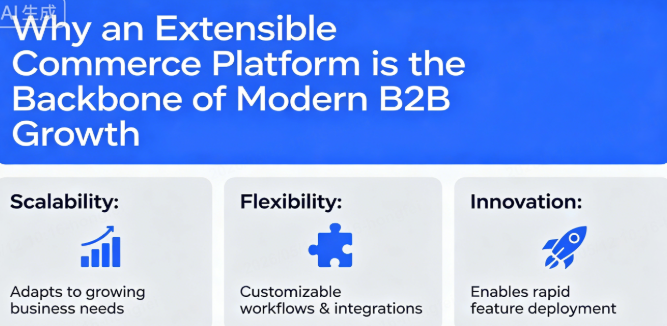
Extensibility in the context of enterprise commerce is not merely “customization.” It is the architectural capability of a system to grow beyond its initial, out-of-the-box (OOTB) functionality through seamless, modular updates 1.
Defining the Core Components
To truly understand why extensibility matters, we must distinguish it from simple configuration. Configuration is changing settings; extensibility is changing the nature of the application itself.
- Modular Design: Extensible platforms use microservices or modular components that can be replaced or enhanced independently 1.
- API-First Strategy: Every action, from calculating a complex B2B shipping rate to updating a product catalog, is exposed via APIs. This allows your team to connect specialized sourcing tools without hacking the core engine.
- Data Schema Flexibility: In B2B, you are dealing with complex attributes—SKU variants, bulk pricing tiers, and regional compliance data. An extensible platform allows you to add these fields dynamically as your business requirements change.
The Strategic Advantage of Extensibility in B2B
For global B2B platforms, the advantages are quantifiable and direct.
| Benefit | Impact on B2B Operations |
|---|---|
| Faster Time-to-Value | Deploy new sourcing features or local payment methods in weeks, not months [1](#toolu_2026-05-12T02:15:20Z]. |
| Lower Cost of Innovation | Avoid expensive, high-risk “replatforming” cycles by extending existing code [1](#toolu_2026-05-12T02:15:20Z]. |
| Seamless Upgradability | Ensure that custom features survive vendor version updates, maintaining system stability [1](#toolu_2026-05-12T02:15:20Z]. |
| Total CX Control | Build unique portal experiences tailored to regional wholesalers and international buyers [1](#toolu_2026-05-12T02:15:20Z]. |
The “Maintenance Tax” of Monoliths
Industry experts emphasize that “The cost of innovation” is the hidden metric that kills stagnant businesses [1](#toolu_2026-05-12T02:15:20Z]. When you choose a platform that is not truly extensible, you pay a “maintenance tax” every time you want to introduce a new B2B procurement feature. You essentially have to “fight” your own platform to get it to do what the market demands.
Expert Insight: From Monoliths to Composable Sourcing
The shift toward composable commerce is, at its core, a shift toward modularity. Instead of a single vendor providing all tools, a composable approach lets you choose the best-of-breed solution for each part of your business:
- Product Information Management (PIM): Manage thousands of Chinese product variants.
- Global Logistics Integration: Automatically feed shipping data into the customer dashboard.
- Automated Procurement: Use APIs to sync stock levels directly from factory floors to your storefront.
Why LooperBuy’s One-Stop Approach Demands Extensibility
For a platform like LooperBuy, where global sourcing must be integrated with diverse logistics and varied local regulations, a rigid platform would be a bottleneck. By leveraging a truly extensible framework, your team can:
- Integrate diverse logistics providers via headless API connections as you expand to new regions.
- Tailor the frontend experience for different user roles (e.g., procurement managers vs. independent shop owners) while keeping the backend data unified.
- Automate supply chain transparency by pulling real-time data from Chinese manufacturing partners directly into your platform’s dashboard, providing users with the confidence of knowing exactly where their goods are.
Building for Global Scale: A Deep Dive into Practical Execution
When transitioning to an extensible commerce platform, the strategy should focus on decoupling.
Step 1: Audit Your Current Technical Debt
Before any code is written, document where your current system forces you to “work around” the software. If you have to export data to Excel to calculate shipping or perform manual updates to product pricing, these are the immediate areas that an extensible platform can automate 1.
Step 2: Prioritize “Headless” Capabilities
A headless architecture separates the frontend (what the user sees) from the backend (the commerce engine). This is vital for B2B brands that need to deploy different portals for different regions or customer segments without disrupting the backend, which contains the critical logic for sourcing, logistics, and pricing.
Step 3: Future-Proofing Through Modular APIs
Never build a feature inside the platform if you can build it outside and connect it via API. This ensures that when the platform provider releases a version update, your proprietary sourcing tools and logistics integrations remain functional, saving thousands in refactoring costs 1.
Checklist: Evaluating Your Platform’s Extensibility
Before committing to a vendor, your engineering team should audit the following to ensure you aren’t walking into a “black box” trap:
- Architecture Transparency: Are all frameworks documented, and is the core code accessible for custom development? 1
- API-First Design: Can third-party services (logistics, payments, CRM, ERP) be integrated without modifying the core engine? 1
- Updateability: Can you perform major version upgrades without breaking your bespoke custom features? 1
- Innovation Velocity: Ask for a benchmark: How long does it typically take to implement a new, custom field or validation rule at the checkout level? 1
Conclusion: Future-Proofing Your Business
The move toward composable and extensible commerce is not a passing trend; it is a fundamental shift in how the world’s most successful B2B platforms operate. For companies like LooperBuy that aim to scale globally while keeping logistics and sourcing costs low, the choice of technology serves as the primary lever for growth. By prioritizing extensibility today, you avoid the massive, recurring costs of future replatforming projects. You ensure that your business remains a leader rather than a follower in the global marketplace, ready to integrate the next wave of logistics and AI-driven procurement tools the moment they become available.
References
- [1] Virto Commerce, Discover the Game-Changer: Platform Extensibility in eCommerce Explained (2023). https://virtocommerce.com/blog/extensible-ecommerce-platform
Frequently Asked Questions (FAQ)
1. Is an extensible commerce platform the same as an open-source platform?
Not necessarily. While some open-source platforms are extensible, many are monolithic “black boxes.” True extensibility relies on a well-architectured, modular framework that allows for updates without breaking existing integrations.
2. How does an extensible platform impact total cost of ownership (TCO)?
While the upfront investment in an extensible system might seem higher, the long-term TCO is significantly lower. You eliminate the need for periodic, costly, and disruptive replatforming projects as your business grows.
3. Why is “Headless” critical for B2B extensibility?
Headless architecture decouples the front end from the back end. This allows your team to innovate on the user experience—such as building custom portals for specific B2B wholesalers—without disrupting the core commerce engine or data integrity.
4. Can I convert a non-extensible platform to an extensible one?
Typically, no. Rigid, monolithic platforms usually require a full migration to a modern, extensible solution. This is why investing in the right architecture from the very beginning of your digital transformation is so critical.
5. How does LooperBuy specifically benefit from this approach?
By using an extensible platform, LooperBuy can rapidly integrate new global logistics partners and supply chain data feeds. This allows the platform to offer lower prices and faster delivery, maintaining a competitive edge that rigid, closed-source platforms simply cannot match.
Article Summary:
Discover why an extensible commerce platform is essential for B2B success. This guide explains how moving beyond monolithic systems allows companies like LooperBuy to leverage composable architectures, accelerating global sourcing, reducing long-term costs, and ensuring scalable growth.
Hot tags: Extensible commerce platform, B2B e-commerce solutions, Composable commerce architecture, B2B procurement software, Global B2B sourcing platform, Digital transformation for wholesalers, Headless commerce for B2B, Enterprise commerce scalability, Supply chain automation tools, B2B digital ecosystem.