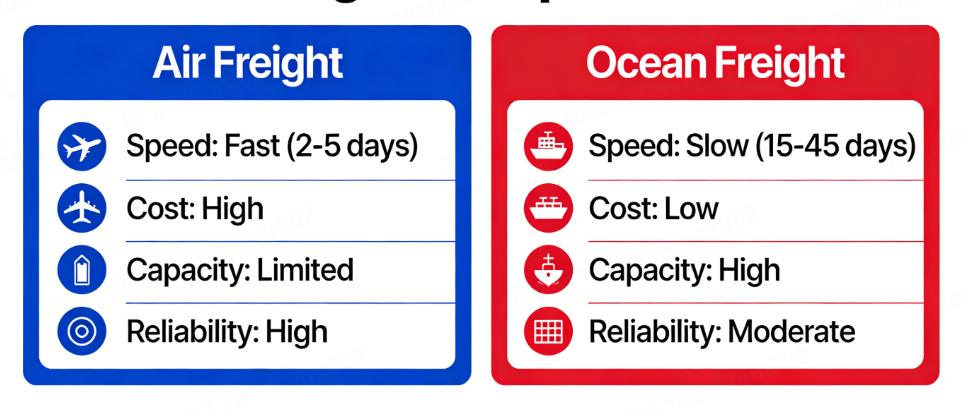
As a B2B sourcing and logistics strategist with over 15 years of experience helping global brand owners, wholesalers, and manufacturers move products from China, I’ve watched the air vs ocean freight debate paralyze more supply chain decisions than any other topic. Air freight offers speed measured in days. Ocean freight offers savings measured in containers. But the real question isn’t which is “better”—it’s which is right for your specific shipment, timeline, and margin structure in the volatile 2026 landscape.
In this guide, I’ll give you the raw 2026 numbers, the hidden costs no one talks about, market trends shaping both modes, and a practical air vs ocean freight decision framework that I’ve used to help clients save over $2 million in logistics spend.
Table of Contents
The Real Cost Difference in 2026: Air vs Ocean Freight
Let’s start with the numbers that matter. In 2026, the air vs ocean freight cost gap remains substantial—but the exact figures have shifted compared to previous years.
Ocean Freight Rates (March 2026, China to USA)
- FCL 20ft container: $1,944–$2,376 (up 16% from February)
- FCL 40ft container: $2,205–$2,695 (down 16% from February)
- LCL (Less than Container Load): ~$110 per cubic meter
- Ocean DDP all-in: $1.80–$3.20 per kg[reference:0]
Air Freight Rates (March 2026, China to USA)
- Bulk air (≥1000 kg): ~$4.85 per kg across US gateways (up 13% from February)[reference:1]
- General air freight: $4.50–$8.50 per kg
- Express courier: $8.50–$12.00 per kg[reference:2]
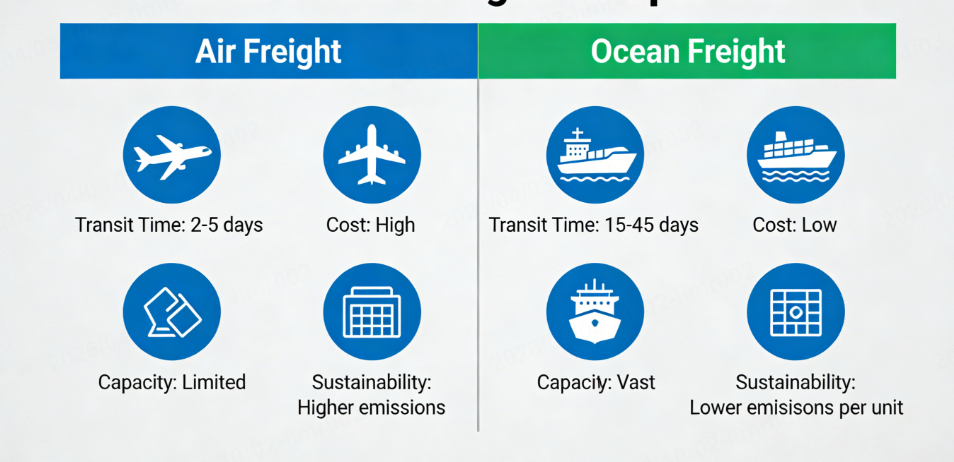
Global air freight demand is expected to grow by approximately 2.7% year-over-year in 2026, following 4% annual growth in 2025[reference:3][reference:4]. Meanwhile, ocean fleet growth is moderating after several years of aggressive expansion, with nominal global capacity forecast to rise by only 4% in 2026—down from approximately 7% in 2025 and below the long-term average of around 6%[reference:5].
The raw gap: For a 1,000 kg shipment, ocean DDP costs roughly $1,800–$3,200 total. Air costs $4,850–$8,500. That’s a 2.5–3.5x premium for speed. For smaller shipments, the gap widens further.
Transit Time: What You’re Actually Paying For
Here’s the real air vs ocean freight transit picture for 2026. These are door-to-door estimates:
| Route | Ocean Freight | Air Freight |
|---|---|---|
| China to US West Coast | 25–35 days | 3–7 days |
| China to US East Coast | 35–50 days | 4–8 days |
| China to Europe (North) | 30–45 days | 3–5 days |
Ocean freight comes with significant uncertainty—port congestion, customs holds, and inland trucking can add another 5–15 days. Air freight is far more predictable, but you pay a steep premium for that reliability.
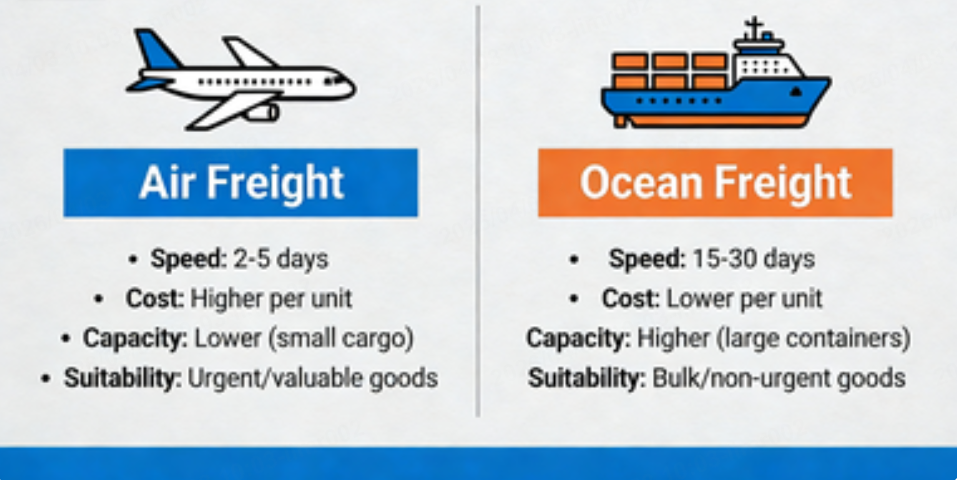
The trade-off: Shipping 10,000 kg of furniture by air costs ~$48,500 and takes 5 days. By sea, it costs ~$3,000 and takes 35 days. You’re paying 16x more to compress 30 days into 5.
The Hidden Costs That Most Guides Ignore
A true air vs ocean freight comparison must account for factors that silently inflate your bill.
Air Freight Hidden Costs:
- Dimensional weight pricing: Carriers use the formula (L×W×H in cm)÷6000. If the volumetric weight exceeds actual weight, you pay the higher figure. Bulky lightweight goods like apparel or pillows can see their bills double or triple.
- Express surcharges: FedEx, DHL, and UPS add $2–$4/kg for priority service.
- Minimum charges: Even a 10 kg box pays a minimum of $150–$300.
Ocean Freight Hidden Costs:
- Demurrage: $200–$500 per day after free time expires
- Detention: $100–$300 per day for using the container beyond agreed time
- Port congestion fees: $150–$500 during peak season
- Inland trucking: Often $300–$800 from port to your warehouse
These fees can quickly erode ocean’s cost advantage. A container stuck at a congested port for 10 days racks up $2,000–$5,000 in demurrage alone.
Market Outlook: What’s Driving Air and Ocean Freight in 2026?
Understanding air vs ocean freight market trends helps you time your shipments. Here’s what’s happening now:
Ocean Freight Outlook: Global container markets entered 2026 on a very different footing from the past two years. Rates are expected to ease as vessel capacity expands and global trade growth cools to about 1.7%[reference:6]. Freight rates are expected to stabilize at the level of the second half of 2025, with basic forecasts predicting a 30–35% decrease in average freight rates compared to 2025—down to approximately $2,200–3,200 for 40’HC from Asia to the US West Coast[reference:7].
However, volatility remains firmly embedded. Escalating military activity in the Middle East is materially disrupting global transportation networks, with impacts extending far beyond the region[reference:8]. DHL Global Forwarding is ramping up use of its in-house air capacity as disruption linked to the Iran conflict continues to squeeze global cargo supply. Some 30% of Asia-Europe air freight typically transits via the Middle East, meaning disruption has had an outsized impact on available lift[reference:9].
Air Freight Outlook: Air cargo demand remains resilient in select sectors, particularly semiconductors, cryptocurrency-related cargo, and artificial intelligence equipment[reference:10]. E-commerce will remain one of the strongest drivers of air cargo demand in 2026, with global air cargo volumes expected to reach over 71.6 million tons[reference:11].
The broader supply chain landscape is also shifting. Nearshoring is moving from strategy presentations to concrete decisions. An estimated 80% of executives expect to enhance their nearshoring efforts in response to geopolitical instability and global supply chain risks[reference:12]. “China +1” strategies, including near-shoring to Southeast Asia or Mexico, will become standard to mitigate geopolitical and operational risks[reference:13].
The Break-Even Calculator: When Does Air Make Financial Sense?
After analyzing hundreds of shipments, here’s my air vs ocean freight decision framework for 2026:
| Shipment Scenario | Recommended Mode | Why |
|---|---|---|
| Under 200 kg, urgent restock | Air or Express | Minimal cost difference at low weights |
| 200–1,000 kg, high margin (>40%) | Consider Air | Speed may justify premium |
| 200–1,000 kg, low margin | Ocean LCL | Bulk savings outweigh speed |
| 1,000–5,000 kg, routine | Ocean LCL or FCL | Ocean is 3–8x cheaper |
| Over 5,000 kg, any margin | Ocean FCL | Even 15-day delay cheaper than air |
| Bulky, lightweight goods | Ocean | Air dimensional weight penalty |
| Perishable goods | Air | Ocean transit risks spoilage |
Real example: A LooperBuy client shipping 800 kg of high-margin smart home devices (65% margin) chose air freight. The $4,000 premium eliminated a $25,000 stock-out penalty during Black Friday. Air paid for itself in 2 days.
New Section: The Middle East Disruption Impact on Air vs Ocean Freight
As of March–April 2026, the escalating conflict in the Middle East has created a “new peak of disruption” for both air and ocean freight[reference:14]. On March 2, 2026, Maersk suspended all cargo acceptance to and from the UAE, Oman, Iraq, Kuwait, Qatar, Bahrain, and Saudi Arabia. Hapag-Lloyd introduced a War Risk Surcharge of $1,500 per container[reference:15].
For B2B buyers evaluating air vs ocean freight, this means:
- Ocean freight via Middle East routes now carries significant risk and surcharges. Some European shippers report $1 million in unexpected costs for containers stuck in transit[reference:16].
- Air freight capacity on Asia-Europe lanes has been squeezed, with DHL and other carriers ramping up in-house capacity to compensate[reference:17].
- Lead times for goods rerouted through Omani gateways or the UAE East Coast have extended by 14–21 days[reference:18].
Actionable advice: If your supply chain relies on Middle East transshipment hubs, consider rerouting through alternative gateways (e.g., Tanger Med in Morocco or Southeast Asian ports) or shifting some volume to air for critical shipments[reference:19].
New Section: The Hidden Costs of Dimensional Weight in Air Freight
One of the most common budgeting mistakes in air vs ocean freight comparisons is ignoring dimensional weight pricing.
The formula: (Length × Width × Height in cm) ÷ 6000 = Volumetric Weight in kg
Carriers charge the greater of actual weight or volumetric weight. For example, a 50 cm × 40 cm × 30 cm box of lightweight pillows weighing only 5 kg has a volumetric weight of 10 kg (50×40×30÷6000). Your air freight bill just doubled.
Which products are most vulnerable?
- Apparel and textiles (high volume, low weight)
- Pillows, cushions, and bedding
- Toys and stuffed animals
- Empty or partially filled containers
- Electronics in bulky protective packaging
How to mitigate:
- Optimize packaging to reduce empty space
- Consider sea freight for bulky items
- Use LooperBuy’s cost calculator to compare dimensional vs actual weight pricing before booking
How LooperBuy Simplifies Your Air vs Ocean Freight Decision
At LooperBuy, we’ve built our one-stop B2B sourcing platform to eliminate the guesswork from air vs ocean freight decisions.
When you source from China through LooperBuy, you get:
- Side-by-side cost comparisons showing air, ocean, and rail costs in one dashboard—including fuel surcharges and handling fees
- Real-time rate tracking that monitors market fluctuations and alerts you when rates drop
- Multi-modal optimization that recommends the optimal mode based on your timeline, budget, and product characteristics
- Direct carrier relationships with no middleman markups on either mode
- End-to-end shipment visibility from Chinese factory to your warehouse door
Client result: A LooperBuy client shipping industrial components from Shanghai to Houston reduced their logistics costs by 28% in nine months—simply by switching 65% of their volume from air to ocean using our comparison tools.
Call to Action: Stop Guessing – Start Comparing
You don’t have to choose between speed and savings blindly. With LooperBuy, you get transparent air vs ocean freight comparisons, real-time rates, and expert guidance—all in one platform.
Ready to optimize your shipping from China? Sign up for LooperBuy—free account, no commitment, transparent pricing across all freight modes.
[Get Your Free Freight Quote Now] – compare air, ocean, and rail costs for your next shipment.
Frequently Asked Questions (FAQ)
1. What is the main cost difference between air and ocean freight in 2026?
Air freight typically costs $4.50–$8.50 per kg from China to the US, while ocean freight costs $1.80–$3.20 per kg for door-to-door DDP shipments. Air is roughly 2.5–5x more expensive depending on volume[reference:20].
2. How much faster is air freight than ocean freight?
Air freight from China to the US West Coast takes 3–7 days; ocean takes 25–35 days. To the US East Coast, air takes 4–8 days versus ocean’s 35–50 days.
3. What is dimensional weight and why does it matter for air freight?
Dimensional weight converts package volume into an equivalent weight using the formula (L×W×H in cm)÷6000. Carriers charge the higher of actual weight or dimensional weight. Bulky lightweight goods can see their bills double or triple.
4. How are Middle East disruptions affecting air vs ocean freight in 2026?
Escalating conflict has led Maersk to suspend cargo acceptance to multiple Gulf countries, Hapag-Lloyd to impose $1,500 per container war risk surcharges, and DHL to ramp up in-house air capacity as 30% of Asia-Europe air freight typically transits via the Middle East[reference:21][reference:22].
5. When does it make sense to use air freight despite higher costs?
Air is worth the premium for: shipments under 200 kg, urgent restocks or emergency orders, high-margin products (>40%), perishable goods, and situations where stock-out costs exceed the freight premium.
6. Does LooperBuy offer both air and ocean freight options?
Yes. LooperBuy integrates with major carriers across both air and ocean freight—plus rail as a hybrid option. Our platform shows you side-by-side costs, transit times, and recommended modes based on your specific shipment.
Article Summary
Air vs ocean freight 2026: real costs (air $4.50–8.50/kg, ocean $1.80–3.20/kg), transit times (3–7 days vs 25–50 days), dimensional weight explained, Middle East disruption impacts, decision framework, and LooperBuy integration.
Hot Tags
air vs ocean freight, air freight cost per kg 2026, ocean freight container rates 2026, shipping from China cost comparison, air vs sea freight decision framework, dimensional weight air freight, landed cost calculation, LooperBuy logistics, B2B freight optimization, China to US shipping 2026, ocean freight FCL LCL rates, air freight dimensional weight formula, Middle East shipping disruption 2026, international freight comparison, supply chain diversification
References
- Sino-Shipping. (2026). Shipping from China to US – Updated March 2026. Retrieved from https://www.sino-shipping.com[reference:23]
- Unicargo. (2026). Amazon FBA Shipping Costs 2026: China to USA Rates. Retrieved from https://www.unicargo.com[reference:24]
- Forest Leopard. (2026). Air Freight China to USA 2026: Fast FBA Shipping Guide. Retrieved from https://es.forestleopard.com[reference:25]
- Freightos. (2026). What 2025 Means for 2026: Ocean and Air Freight Forecast. Retrieved from https://www.freightos.com[reference:26]
- Xeneta via IndexBox. (2026). 2026 Air Cargo Outlook: Spot Market Growth & E-commerce Impact. Retrieved from https://www.indexbox.io[reference:27][reference:28]
- StatTimes. (2026). Global air freight in 2026: Slower growth, stronger structural demand. Retrieved from https://www.stattimes.com[reference:29]
- Air Cargo News. (2026). Positive outlook for e-commerce. Retrieved from https://www.aircargonews.net[reference:30]
- IATA via Cargo Trends. (2026). Asia Pacific Leads Global Air Cargo Growth as Demand Jumps 8%. Retrieved from https://cargotrends.in[reference:31]
- S&P Global. (2026). 2026 Ocean Freight Outlook: Softer Rates Ahead, but Volatility Isn’t Going Anywhere. Retrieved from https://www.spglobal.com[reference:32]
- IndexBox. (2026). Freight Rate Decline & 2026 Overcapacity Outlook. Retrieved from https://www.indexbox.io[reference:33]
- SeaRates. (2025). 5 Key Factors of Container Costs in 2026: Pay $2,200 or $9,500? Retrieved from https://www.searates.com[reference:34]
- The Loadstar. (2026). DHL taps own air fleet as Middle East disruption squeezes cargo capacity. Retrieved from https://theloadstar.com[reference:35]
- RSAdei. (2026). When Insurers Closed the Gulf: What the Hormuz Crisis Means for the UAE. Retrieved from https://rsdi.ae[reference:36]
- IAMovers. (2026). “New Peak of Disruption” in Middle East. Retrieved from https://iamovers.org[reference:37]
- FreightAmigo. (2026). Air vs Ocean for Electronics: 2026 Decision Framework. Retrieved from https://www.freightamigo.com[reference:38]
- International Trade Council. (2026). Ship It Right – The SME‘s Guide to Choosing Between Air, Sea, and Courier. Retrieved from https://tradecouncil.org[reference:39]
- Leman. (2026). From China to the world: Five shifts shaping 2026 and future supply chains. Retrieved from https://leman.com[reference:40]
- KPMG. (2026). Supply chains in a changing world: Top 3 trends to watch out for in 2026. Retrieved from https://kpmg.com[reference:41]
- LooperBuy. (2026). Supplies Business: A B2B Expert’s Guide to Sourcing Chinese Goods Globally with LooperBuy. Retrieved from https://blog.looperbuy.com/supplies-business-a-b2b-experts-guide-to-sourcing-chinese-goods-globally-with-looperbuy.html[reference:42]
- C.H. Robinson. (2026). Ocean Delivery Freight Market Update – March 2026. Retrieved from https://www.chrobinson.com[reference:43]