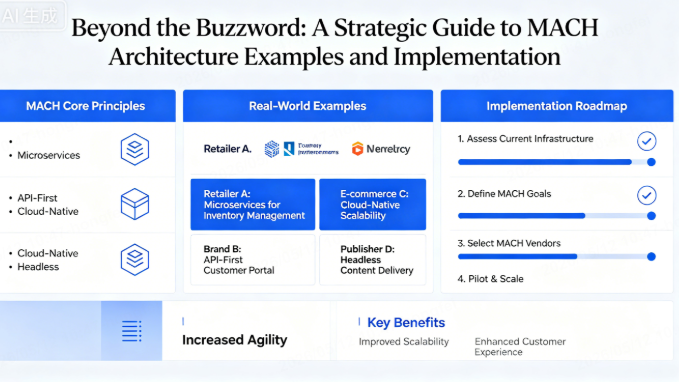
The digital commerce landscape has undergone a seismic shift. Where businesses once relied on monolithic, all-in-one software suites—massive platforms that were difficult to update and slow to innovate—the industry has pivoted toward MACH architecture. Standing for Microservices, API-first, Cloud-native, and Headless, this framework promises the holy grail of digital transformation: unparalleled flexibility, agility, and speed-to-market.
However, as businesses seek a concrete MACH architecture example to guide their digital transformation, a critical gap has emerged. Many enterprises find that strictly adhering to multi-tenant SaaS implementations of MACH principles creates new limitations—specifically regarding customization, backend control, and data sovereignty.
In this comprehensive guide, we analyze what MACH truly means for modern B2B platforms, examine its technical nuances, address the common pitfalls of “SaaS-only” implementations, and explore how to build a future-proof architecture that prioritizes business adaptability and global scale.
Table of Contents
The Evolution of Composable Commerce
For decades, the “Monolith” was the standard. It was reliable, albeit rigid. If a retailer wanted to change their checkout process, they often had to re-architect their entire database, frontend, and backend integration layer. This is where Composable Commerce—powered by MACH—becomes the strategic answer.
The Four Pillars of MACH
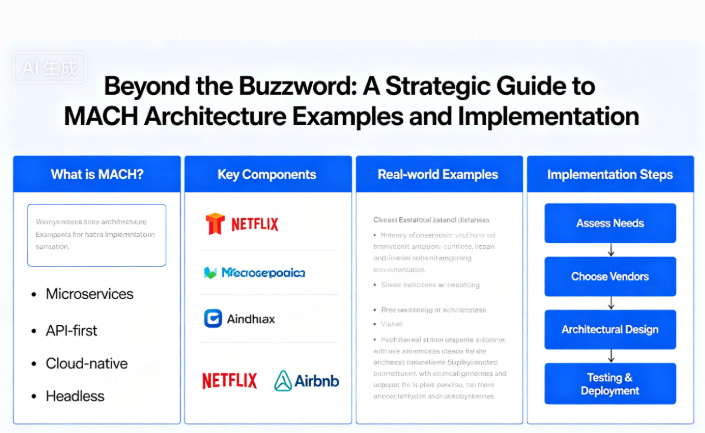
- Microservices: Instead of a single application, the business is broken into small, independent services (e.g., pricing service, search service, cart service). These can be updated without impacting the rest of the ecosystem.
- API-first: Every function is accessible through an API. This allows developers to integrate best-of-breed third-party tools (like a specific AI search engine or a global payment processor) seamlessly.
- Cloud-native: By leveraging services like AWS, Google Cloud, or Azure, the platform scales automatically during high-traffic events (e.g., Black Friday or B2B bulk ordering seasons).
- Headless: The frontend is decoupled from the backend. This allows businesses to provide a high-performance experience on a website, a mobile app, a smart kiosk, or an IoT device, all pulling from the same data source.
When MACH Becomes a Box: The SaaS Limitation
A common misconception in the developer and executive community is that “MACH” and “multi-tenant SaaS” are synonymous. While many MACH-aligned vendors utilize SaaS to provide “out-of-the-box” speed, this delivery model can stifle the very flexibility that enterprises seek.
The Trade-off: Convenience vs. Sovereignty
When you adopt a multi-tenant SaaS MACH platform, you are essentially renting space in a shared infrastructure.
- Regulatory Constraints: Industries such as pharmaceuticals, defense, or high-end manufacturing often require data to be hosted in private clouds or on-premises to meet strict security compliance. A shared, multi-tenant SaaS model may be functionally disqualifying due to data residency laws.
- Backend Rigidity: Even if a platform is “headless,” many SaaS providers lock down the backend code. For B2B businesses like LooperBuy, which must manage complex supplier relationships, custom pricing logic, and unique international shipping workflows, this lack of backend access prevents necessary innovation.
- Cost Inefficiency: SaaS pricing models can be highly inflexible. Enterprises may end up paying for unused capacity or hitting performance ceilings during peak traffic without the granular control needed to optimize infrastructure costs.
Architectural Deep Dive: What Makes a Platform Truly Adaptable?
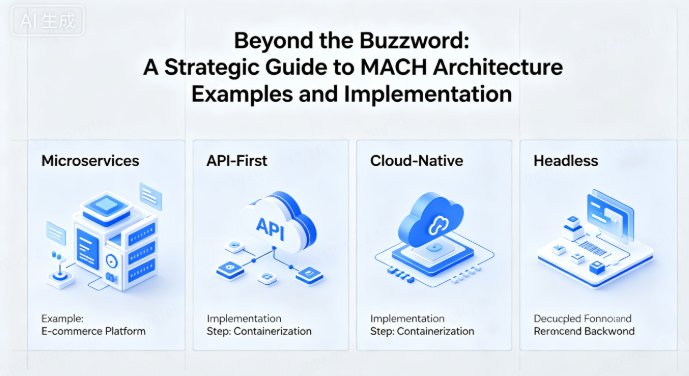
When evaluating a MACH architecture example, look beyond the shiny marketing brochures. The true value lies in how these principles are implemented within your specific business context.
The “Atomic Architecture” Perspective
Instead of simply adopting a “black-box” SaaS solution, leading platforms now utilize Atomic Architecture™. This approach uses pre-configured modules (Packaged Business Capabilities) that provide the speed of a ready-made solution with the extensibility of custom software.
| Feature | Typical SaaS MACH Vendor | Advanced PaaS/Custom MACH Approach |
|---|---|---|
| Backend Access | Restricted (Closed) | Full (Extensible) |
| Deployment | Multi-tenant SaaS | Single-tenant, Private Cloud, On-Prem |
| Customization | Limited to APIs/Frontend | Full Backend Logic Modification |
| Maintenance | Exclusively Vendor-controlled | Vendor-supported + Client Autonomy |
| Vendor Lock-in | High | Low (Portable Services) |
Strategic Implementation: Strategies for Global B2B Sourcing
For platforms like LooperBuy, serving global B2B clients requires a delicate balance between standardized infrastructure and localized customization. Here is how a top-tier platform effectively implements these principles:
1. Data Orchestration as a Core Service
In a microservices environment, data consistency is the biggest hurdle. If your Inventory Service says “In Stock” but your Global Logistics Service is experiencing delays, the customer loses trust.
- Strategy: Implement a centralized PIM (Product Information Management) service that acts as the “source of truth.” This service should be built to handle massive data ingestion from thousands of Chinese suppliers while syncing state changes across all API endpoints in real-time.
2. Decoupling Experience Layers for Regionality
A user in Europe expects a different procurement experience than a user in Southeast Asia.
- Strategy: Use a headless approach to deploy region-specific frontends. While the backend remains a singular, robust engine handling transactions, the frontend can be specialized to address local language, currency, and tax regulations without requiring a full system redeployment.
3. Leveraging PaaS for Workflow Complexity
B2B transactions are rarely “buy now, pay now.” They involve RFQs (Requests for Quote), bulk discounts, and split-shipment logistics.
- Strategy: By utilizing a Platform-as-a-Service (PaaS) model, businesses maintain the “cloud-native” benefits of MACH while retaining the ability to inject custom modules. This allows LooperBuy to build proprietary “Logistics Calculators” or “Supplier Risk Assessment” microservices that plug directly into the main commerce flow.
Beyond the Technical: The Human and Operational Impact
Adopting MACH is not just an IT project; it is a business strategy. To succeed, leadership must foster a DevOps culture.
- Empowered Teams: In a monolith, one team owns everything, leading to bottlenecks. With microservices, small, cross-functional “two-pizza” teams can own the entire lifecycle of a service (from design to deployment).
- Fail-Fast Methodology: Because services are decoupled, a failure in the “Newsletter Signup” service should never bring down the “Checkout” service. This allows for safer experimentation and faster innovation.
- Continuous Deployment: Automation is not optional. A robust CI/CD pipeline ensures that your API contracts are validated before deployment, preventing breaking changes across your microservices ecosystem.
Conclusion: Crafting Your MACH Roadmap
The journey to MACH is not a “rip and replace” operation. For most established B2B platforms, it is a strangler pattern migration—slowly replacing monolithic functions with microservices one by one. By choosing an architecture that allows for backend extensibility, you avoid the trap of proprietary SaaS lock-in and build a system that can evolve as fast as your market.
Whether you are a global manufacturer or a wholesale distributor like LooperBuy, the goal remains the same: create a resilient, scalable, and modular commerce foundation that puts the customer experience at the center.
References
- Virtocommerce: MACH Architecture Definition & Limitations
- MACH Alliance: Principles and Framework Overview
- Gartner: Magic Quadrant for Digital Commerce 2025
- Martin Fowler: Strangler Fig Application Pattern
- AWS: Microservices on AWS Architecture Guide
Frequently Asked Questions (FAQ)
1. Is MACH architecture suitable for small businesses?
While MACH offers immense flexibility, it introduces significant technical complexity. Smaller businesses with limited engineering resources may find that the maintenance overhead of managing a distributed microservices environment outweighs the benefits. For them, a lighter, more integrated solution might be more cost-effective.
2. Does “headless” mean I have to rebuild my entire frontend?
Not at all. A headless architecture allows you to decouple your frontend from the backend incrementally. You can start by connecting new channels (like a mobile app or a specific B2B portal) to your existing backend via API before ever touching your primary website.
3. What is the biggest mistake companies make when adopting MACH?
The biggest mistake is ignoring integration complexity. Companies often focus on the benefits of microservices but underestimate the challenge of data consistency and service communication. Without a solid API management strategy and rigorous observability, you can end up with a “distributed monolith” that is even harder to debug than the original.
4. Can I use MACH architecture for on-premises deployments?
Yes. If you choose a “cloud-native” platform that is container-based (such as those using Docker and Kubernetes), you can deploy these services in a private cloud or on-premises environment. This allows you to enjoy the architectural benefits of microservices while keeping your data strictly within your own infrastructure, satisfying high-security requirements.
5. How does LooperBuy leverage MACH to optimize B2B sourcing?
LooperBuy uses an API-first and modular architecture to bridge the gap between Chinese supply chains and global buyers. By using independent microservices to handle localized logistics and supplier data normalization, LooperBuy can offer lower prices and higher transparency, while the headless frontend ensures a professional, high-speed buying experience for international wholesalers.
Article Statistics
Brief Summary
This comprehensive guide examines MACH architecture, highlighting its role in modern B2B platforms. It contrasts standard multi-tenant SaaS limitations with PaaS flexibility, providing a strategic roadmap for enterprises like LooperBuy to drive global sourcing efficiency and scalability.
Hot tags: B2B E-commerce Platform, MACH Architecture Example, Composable Commerce Strategy, Global Sourcing Solutions, Headless B2B Solutions, Microservices for Enterprise, B2B Digital Transformation, Supply Chain Digitalization, API-first Commerce Platform, Scalable B2B Infrastructure.