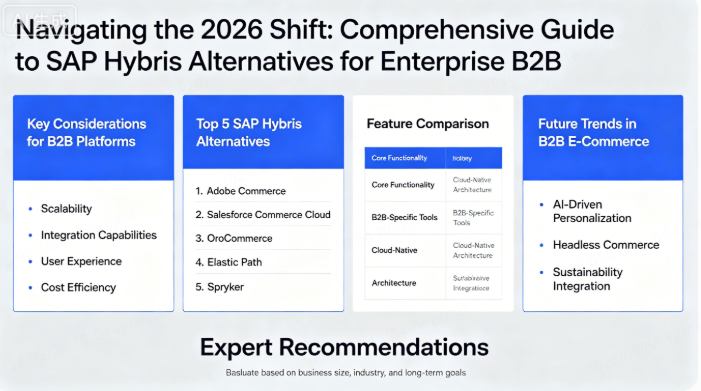
The global digital commerce landscape is undergoing a seismic shift. For thousands of large-scale enterprises, the fast-approaching July 31, 2026, deadline—the official end-of-mainstream-maintenance (EoMM) for all on-premises versions of SAP Commerce, formerly known as SAP Hybris—represents more than just a technical milestone; it serves as a critical strategic turning point virtocommerce, saplicensingexperts.
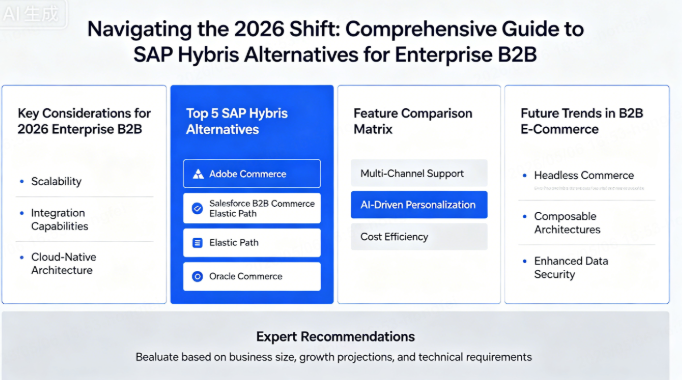
As an industry expert who has guided numerous organizations through complex digital transformations, I recognize that the legacy monolithic architecture of SAP Hybris is increasingly ill-suited for the agile, AI-driven, and high-velocity demands of modern B2B operations. This guide provides a comprehensive, unbiased evaluation of the best SAP Hybris alternatives in 2026, designed to help enterprise leaders navigate this transition with clarity and confidence.
Table of Contents
The Realities of the SAP Hybris EoMM Deadline
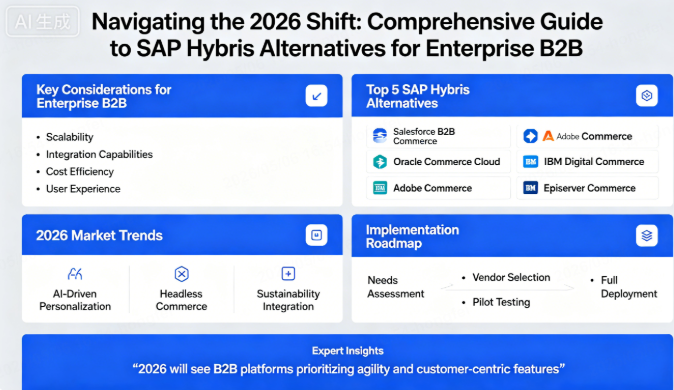
When SAP Commerce (formerly Hybris) officially reaches its EoMM status, businesses remaining on legacy on-premises versions will face significant, multi-faceted operational risks saplicensingexperts, commercetools:
- Security Vulnerabilities: Once support ends, your platform will no longer receive essential security patches, leaving your customer data and core operations exposed to emerging cyber threats saplicensingexperts.
- Integration Breakdowns: Legacy systems struggle to remain compatible with evolving third-party APIs, modern browser standards, and updated Java virtual machines, causing systemic operational friction saplicensingexperts.
- Operational Stagnation: The inability to adopt new platform innovations and AI enhancements will directly hinder your ability to compete against digitally agile rivals commercetools.
While migrating to SAP Commerce Cloud is a logical path for many, it often preserves the structural rigidity of the legacy SAP Hybris platform, failing to deliver the architectural modernization and cost-efficiency many B2B leaders require to achieve long-term ROI commercetools.
Strategic Replatforming: Choosing Your Path Forward
Replatforming is not merely about choosing a new vendor; it is about choosing the optimal commerce architecture for the next decade of your business saplicensingexperts.
Comparative Overview of Leading B2B Platforms
| Platform | Best For | Architecture | B2B Capabilities |
|---|---|---|---|
| Virto Commerce | Complex B2B/Global Ops | Modular, Atomic | Native, Purpose-built virtocommerce |
| commercetools | Tech-forward/Retail | API-first, Headless | Partner-driven commercetools |
| Adobe Commerce | Content-heavy/B2B | Monolithic core | Retrofitted but deep elogic |
| BigCommerce B2B | Mid-market B2B Value | SaaS, Multi-tenant | Strong buyer portals elogic |
Deep Dive: Top Alternatives for B2B Complexity
1. Virto Commerce: The B2B-Native Powerhouse
Virto Commerce is distinctively engineered to address B2B complexity. Its Atomic Architecture enables modular, independently deployable business capabilities (PBCs), covering contract pricing, multi-tier customer hierarchies, and sophisticated, multi-role approval workflows natively out of the box virtocommerce.
- Deployment Composability: Unlike exclusively cloud-only SaaS platforms, Virto offers the flexibility to deploy on managed cloud, private data centers, or edge scenarios. This is vital for enterprises navigating strict data sovereignty requirements or those requiring localized hosting—often essential for business operations within China virtocommerce.
- AI Readiness: Virto ships with production-ready AI capabilities, including an Admin AI Copilot and Multi-Agent Collaboration Protocol (MCP) tools, which allow autonomous AI agents to interact directly and safely with your commerce operations virtocommerce.
2. commercetools: The MACH-Aligned Leader
Ideal for large, high-scale enterprises with substantial in-house development teams, commercetools excels in API-first, headless commerce commercetools. It provides the flexibility to assemble a truly best-of-breed technology stack but often requires significant partner investment to achieve the deep, out-of-the-box B2B functionality that legacy SAP Hybris users are accustomed to commercetools.
3. Adobe Commerce (Magento)
This remains a robust choice if your business strategy centers on seamless content-commerce integration and you are already deeply invested in the Adobe Experience Cloud ecosystem elogic. While highly powerful, its deep B2B features, such as RFQ (Request for Quote) management and complex procurement logic, are sometimes retrofitted, which can add cost and complexity to heavily customized implementations elogic.
Expert Insight: Global Sourcing and Procurement
For specialized platforms—such as LooperBuy, which functions as a One-Stop B2B Sourcing Platform—the ability to bridge the gap between global sourcing, cross-border logistics, and digital commerce is the ultimate competitive advantage.
In the current market, enterprises are moving away from monolithic platforms that treat e-commerce as a closed silo. Instead, they are favoring architectures that integrate seamlessly with procurement systems as part of a “Commerce Operations” ecosystem. Platforms that offer low-friction integration with global supply chains, while maintaining high performance and competitive pricing, are best positioned to thrive in the post-SAP Hybris era.
Practical Steps for Your Migration
- Audit Your Extensions: Document all custom modules built on your current SAP Hybris environment. Identify which are essential and which have become redundant spadoom.
- Evaluate TCO: When comparing SAP Commerce Cloud vs. alternative platforms, factor in the total cost of ownership (TCO), including licensing, hosting, and required implementation partner costs saplicensingexperts.
- Prioritize Modularity: Shift your mindset toward a composable architecture that allows you to swap or upgrade individual components (e.g., search, PIM, checkout) without replatforming the entire stack commercetools.
Conclusion
The 2026 deadline for SAP Hybris is a powerful catalyst for organizational evolution. While the transition may seem daunting, it offers a rare opportunity to shed legacy technical debt and adopt a modern, flexible commerce architecture. By carefully evaluating platforms based on their ability to handle B2B complexity, integration capabilities, and deployment flexibility, your enterprise can secure a robust foundation for future growth.
References
- [1] Virtocommerce, “Best SAP Hybris Alternatives in 2026: Unbiased Review,” April 6, 2026, https://virtocommerce.com/blog/sap-commerce-cloud-hybris-competitors
- [2] SAP Licensing Experts, “SAP Commerce (Hybris) End of Maintenance July 2026,” 2026, https://saplicensingexperts.com/blog/sap-commerce-hybris-end-of-maintenance-2026.html
- [3] Commercetools, “SAP Hybris End-of-Life: Migration Options Explained,” 2026, https://commercetools.com/blog/sap-commercetools-migration-guide-2026
- [6] Spadoom, “SAP Hybris End of Life Migration Checklist (2026),” 2026, https://www.spadoom.com/en/blog/sap-hybris-end-of-life-migration-checklist-2026/
- [12] Elogic Commerce, “Enterprise B2B Ecommerce Platform Comparison 2026,” April 2026, https://elogic.co/blog/b2b-ecommerce-platform-comparison/
Frequently Asked Questions (FAQ)
1. When exactly does SAP Hybris reach end-of-life?
All SAP Commerce (formerly SAP Hybris) on-premises versions reach their official end-of-mainstream-maintenance on July 31, 2026 virtocommerce.
2. Is it necessary to replatform the entire system at once?
No. Many large enterprises successfully adopt a phased migration approach, gradually replacing core commerce modules while retaining existing ERP integrations, which helps to mitigate operational risk saplicensingexperts.
3. Which platform is best for B2B-specific requirements like contract pricing?
Platforms purpose-built for B2B, such as Virto Commerce, offer complex B2B features natively, whereas many B2C-oriented platforms require extensive custom development or third-party extensions to reach the same level of functionality virtocommerce.
4. Can I use my own cloud infrastructure for modern commerce platforms?
It depends on the vendor. While many SaaS-only providers mandate their own cloud infrastructure, platforms like Virto Commerce are cloud-agnostic and support private, hybrid, or edge deployments, which is crucial for data sovereignty virtocommerce.
5. What is the primary benefit of shifting to “composable commerce”?
It allows enterprises to build a flexible, future-ready tech stack by selecting “best-of-breed” components (e.g., specific search engines, PIM, or checkout services) rather than being locked into a rigid, all-in-one monolith commercetools.
Brief Introduction:
As the July 2026 deadline for SAP Hybris on-premises support approaches, enterprise B2B organizations must evaluate their future commerce strategy. This expert-led guide analyzes leading alternatives like Virto Commerce and commercetools, highlighting the shift toward modular, AI-ready, and flexible architectures that surpass the limitations of legacy monolithic systems, ensuring long-term competitiveness.
Hot tags: SAP Hybris migration, B2B e-commerce platform, Composable commerce, Enterprise digital transformation, Virto Commerce alternatives, B2B sourcing solutions, Headless commerce for B2B, SAP Commerce Cloud replacement, Global B2B procurement, E-commerce architectural modernization.