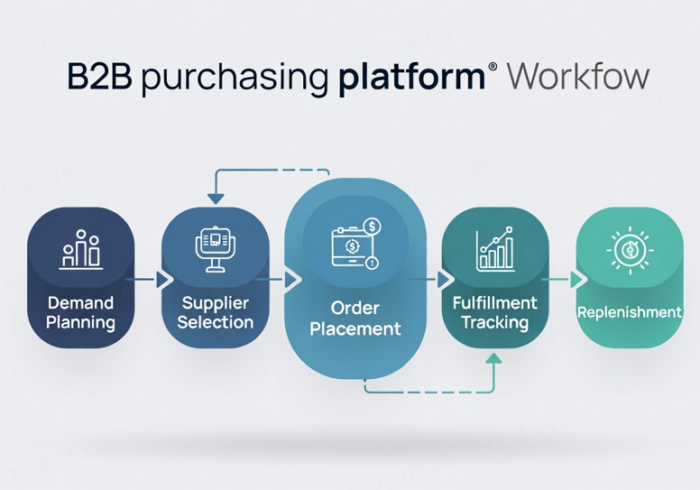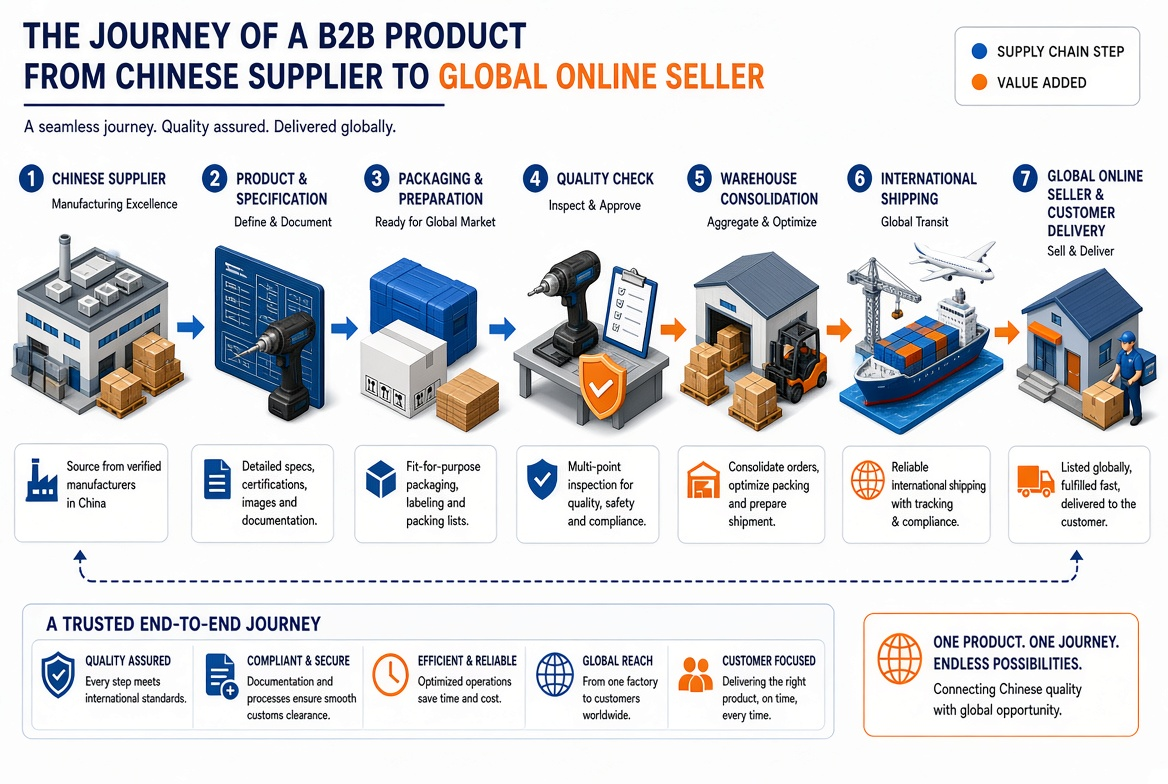
Explore the leading B2B e-commerce trends shaping global sourcing, dropshipping, and fulfillment in 2026. Learn how sellers can source Chinese products, reduce inventory risk, improve product data, consolidate shipments, and build a scalable cross-border purchasing workflow with Looperbuy.
B2B e-commerce is no longer simply an online catalog with a checkout page. For global merchants, distributors, and marketplace sellers, it has become the operating layer that connects product sourcing, supplier communication, order processing, inventory visibility, cross-border fulfillment, and customer service.
For sellers sourcing from China, the most important B2B e-commerce trends in 2026 are not abstract technology ideas. They directly affect how quickly a business can test products, reduce inventory risk, automate replenishment, manage global shipping, and give buyers the self-service experience they increasingly expect. Platforms such as Looperbuy can play a practical role by helping sellers source Chinese goods, consolidate orders, and arrange fulfillment without requiring them to hold large amounts of stock themselves.
> Key takeaway: The strongest B2B sellers are building flexible sourcing and fulfillment systems—not simply adding more products to their catalogs.
Table of Contents
Why B2B E-Commerce Is Becoming an Operating System
Traditional B2B trade often depends on long email threads, manual quotations, spreadsheets, payment follow-ups, fragmented supplier communication, and separate logistics providers. That process may work at a small scale, but it becomes difficult to manage when a seller handles hundreds of SKUs, multiple suppliers, several destination markets, and changing customer demand.
Modern B2B e-commerce changes this model. It brings commercial activity into a connected digital environment where buyers can research products, compare options, place orders, track fulfillment, and reorder with less manual involvement.
This shift is being driven by buyer behavior. Gartner reported in 2026 that 67% of B2B buyers prefer a rep-free purchasing experience for at least some parts of their buying journey. Buyers increasingly want to search, compare, review specifications, check pricing, and place routine orders without waiting for a sales representative.
For global sellers, this does not mean sales teams are no longer valuable. Instead, it means human support should focus on higher-value work:
– Complex sourcing requirements
– Custom packaging and branding
– Quality-control coordination
– Product compliance questions
– Bulk-order negotiations
– Supplier risk management
– Exception handling during shipping
Routine work—such as product discovery, order updates, repeat ordering, and shipment tracking—should be easier to complete digitally.
What makes B2B buying different?
B2B buyers rarely make decisions the same way as retail consumers. A business buyer may need approval from a procurement manager, finance team, warehouse lead, product manager, or business owner. They may also need specific payment terms, technical specifications, product certifications, branded packaging, or delivery commitments.
| Consumer commerce | B2B commerce |
| Usually one buyer | Often multiple stakeholders |
| Standard retail pricing | Negotiated, tiered, or account-specific pricing |
| One-off purchases | Recurring orders and replenishment cycles |
| Simple product choices | Technical, compliance, and customization requirements |
| Basic delivery expectation | Inventory, customs, freight, and fulfillment coordination |
A successful B2B e-commerce experience must support this complexity while still feeling simple for the buyer.
The Most Important B2B E-Commerce Trends in 2026
Several B2B commerce trends are shaping how international sellers buy from China, manage suppliers, and serve customers worldwide. The common theme is clear: businesses want fewer manual steps, better visibility, and more control over working capital.
1. Self-Service Purchasing Is Becoming the Default
B2B buyers increasingly expect the speed and convenience they experience in consumer e-commerce. They want to search products, check specifications, compare options, access order history, and reorder items without needing to exchange multiple messages with a supplier.
For a seller sourcing products from China, an effective self-service workflow may include:
– Searching for products using keywords, images, SKU references, or specifications
– Comparing supplier quotations and minimum order quantities
– Viewing product dimensions, materials, variants, and packaging details
– Requesting samples before placing larger orders
– Checking order progress and shipping status
– Reordering proven products quickly
– Managing multiple product requests in one dashboard
The strongest self-service experiences do not remove human support. They make human support more useful. A buyer should be able to handle normal tasks independently, then quickly reach an experienced sourcing specialist when they need help with supplier verification, custom manufacturing, quality inspection, or logistics exceptions.
Practical example: A seller operating an online home-goods store may receive an increase in demand for reusable food-storage products. Instead of committing immediately to a large container order, the seller can source several variations, request samples, evaluate packaging quality, and test demand with smaller quantities or fulfillment-based shipping.
This approach helps reduce the financial risk of choosing the wrong product too early.
2. Low-Inventory Models Are Reshaping Global B2B Trade
Inventory has always been necessary in commerce, but excessive inventory is expensive. It ties up cash, requires warehouse space, creates handling costs, and increases the chance that products become obsolete or unsellable.
For many B2B sellers, the goal is not to eliminate inventory entirely. The goal is to hold inventory only when it creates a clear advantage.
That is why sourcing support, order consolidation, and dropshipping fulfillment are increasingly important. A platform that connects sellers to Chinese goods and shipping services can help merchants test products before committing to larger purchase volumes.
A low-inventory sourcing model can help sellers:
– Launch new products faster
– Test demand in new regions
– Reduce upfront purchasing risk
– Avoid overstocking slow-moving SKUs
– Lower warehousing costs
– Consolidate products from multiple suppliers
– Improve cash-flow flexibility
– Expand catalogs without buying every SKU in advance
The market context is significant. One 2026 market report estimated global B2B e-commerce GMV at USD 36.86 trillion in 2026, following USD 33.02 trillion in 2025. The report also estimated that cross-border transactions represented 44.32% of 2025 B2B e-commerce volume.
While market-size estimates vary by research methodology, the direction is clear: digital procurement and cross-border B2B trade are becoming structurally more important.
3. AI Is Moving From Marketing Language to Daily Operations
Artificial intelligence is increasingly useful in B2B commerce when it removes repetitive work, improves product discovery, or helps teams make better decisions faster.
The most useful AI applications are practical rather than theatrical. They can support:
– Natural-language product search
– Product-title and description generation
– Multilingual product-content adaptation
– SKU categorization
– Demand forecasting
– Supplier and quotation comparison
– Purchase-order data extraction
– Customer-service automation
– Order-status assistance
– Product recommendation and replenishment reminders
For example, a buyer may search for “private label stainless steel insulated water bottle with custom logo, 500 ml.” An intelligent sourcing workflow should help translate that request into more structured buying criteria:
– Material: stainless steel
– Capacity: 500 ml
– Branding: custom logo required
– Target market: overseas retail or wholesale
– Packaging: potentially customized
– Order type: sample, trial order, or bulk purchase
This reduces the back-and-forth that often slows cross-border sourcing.
Forrester’s 2025 Buyer Journey research found that 64% of business buyers at manager level and above were Millennials or Gen Z, highlighting why digital-first, self-guided research has become more central in B2B purchasing.
4. Product Data Matters More Than Product Volume
A large catalog does not automatically create a good B2B buying experience. A seller can list thousands of products and still lose customers if those listings are inaccurate, incomplete, or difficult to compare.
Product data is especially important when buyers source internationally. They need clear information before they commit money, shipping time, and customer expectations to a product.
High-quality B2B product content should include:
– Accurate product names and searchable keywords
– Materials and technical specifications
– Product dimensions and weight
– Packaging details
– Minimum order quantity
– Customization options
– Production lead times
– Product images from multiple angles
– Compliance or certification details where applicable
– Intended use cases
– Variant information
– Shipping constraints, such as batteries, liquids, or oversized dimensions
For Looperbuy users, reliable product information can help reduce sourcing misunderstandings before an order is placed. It also gives overseas merchants better material for their own online stores, marketplace listings, product catalogs, and sales documents.
> Expert insight: Better product content reduces not only conversion friction but also operational friction. Every missing specification can become a support ticket, a return risk, a fulfillment mistake, or a customer complaint later.
How Global Sellers Can Build a Smarter China Sourcing Workflow
A flexible sourcing model needs more than a product-search tool. It requires a repeatable process that balances product opportunity, supplier reliability, quality control, logistics cost, and buyer expectations.
Step 1: Start With Product Validation, Not Large Purchase Orders
Many new sellers make the same mistake: they identify a popular product, order too much inventory, and discover later that the product does not convert well in their target market.
A better approach is to validate demand first.
Ask the following questions before placing a large order:
1. Is there consistent search and marketplace demand?
2. Can the product be differentiated through branding, bundles, materials, or packaging?
3. Does the product have high return risk?
4. Is it fragile, oversized, restricted, or expensive to ship?
5. Are there certifications required in the destination market?
6. Can the margin still work after sourcing, shipping, platform fees, advertising, and returns?
7. Is it a repeat-purchase product or a one-time purchase?
8. Can the supplier support stable quality if demand grows?
Testing with samples, limited quantities, or fulfillment-supported shipping can produce better information than making assumptions based on a single product trend.
Step 2: Evaluate Suppliers Beyond the Lowest Unit Price
The lowest quotation is not always the lowest total cost.
A cheap product can become expensive if it arrives late, has poor packaging, fails quality checks, creates high return rates, or requires costly customer service. Supplier evaluation should therefore include commercial and operational factors.
| Supplier-evaluation factor | Why it matters |
| Unit price | Determines baseline product margin |
| Minimum order quantity | Affects cash flow and inventory exposure |
| Production capacity | Indicates whether the supplier can scale |
| Communication speed | Helps prevent delays and misunderstandings |
| Sample quality | Reveals likely production quality |
| Packaging quality | Protects goods and shapes customer perception |
| Customization ability | Supports branding and differentiation |
| Lead time | Influences stock planning and launch timing |
| Compliance documentation | May be necessary for target markets |
| Quality consistency | Reduces refunds, disputes, and reputation damage |
A sourcing partner or platform can add value when it helps buyers coordinate supplier communication, manage product requests, inspect goods, consolidate parcels, and select suitable shipping options.
Step 3: Consolidate Orders Before International Shipping
When products come from multiple Chinese suppliers, shipping each order separately can increase logistics costs and complicate receiving. Consolidation can create a more efficient process.
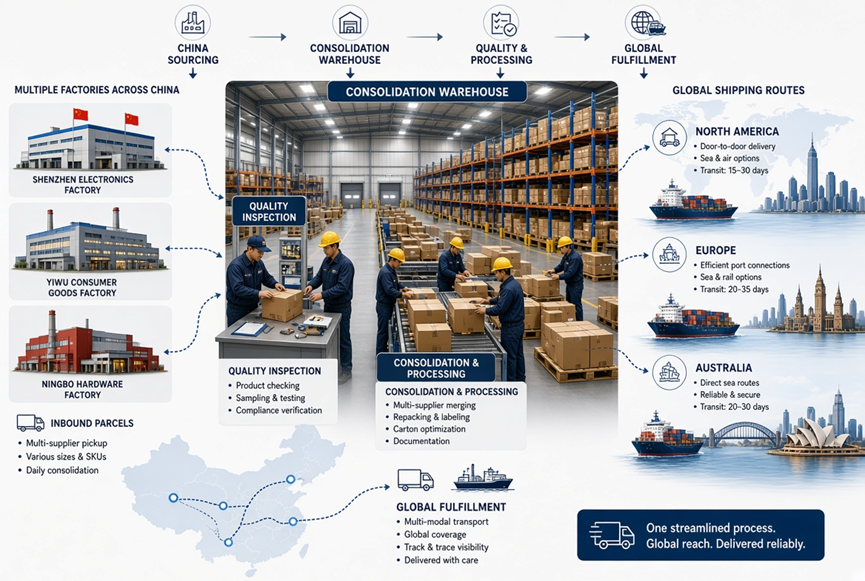
A typical consolidation workflow may look like this:
1. Source products from several suppliers.
2. Send items to a central warehouse.
3. Check quantities, packaging, and visible product condition.
4. Combine eligible goods into a single shipment.
5. Select shipping methods based on destination, cost, speed, and product type.
6. Track the shipment until final delivery.
For B2B sellers, this can support better inventory planning and reduce the operational burden of dealing with multiple parcels.
Unified Commerce: Connecting Sourcing, Inventory, and Fulfillment
One of the biggest problems in global B2B commerce is fragmentation. Product data may live in one system, supplier communication in another, warehouse records in spreadsheets, fulfillment updates in email, and customer orders in a separate storefront.
This fragmentation creates avoidable mistakes:
– Incorrect product specifications
– Manual order entry errors
– Delayed fulfillment updates
– Conflicting inventory information
– Inconsistent pricing
– Lost supplier messages
– Difficulty tracking profitability by product
– Poor customer communication
The broader B2B commerce trend is moving from disconnected channels toward a shared operational view. This represents a transition from basic omnichannel sales to unified commerce, where catalog data, pricing, inventory visibility, customer history, and order logic are all managed by a common commerce core.
For a global seller, the principle is highly relevant even if they do not operate an enterprise commerce platform. The business should aim to connect the critical parts of the workflow:
– Product research and sourcing
– Supplier quotations
– Samples and quality checks
– Inventory planning
– Warehouse consolidation
– Shipping and tracking
– Marketplace or storefront listings
– Customer support
– Returns and reorder data
The more reliable this data flow becomes, the easier it is to scale without increasing operational chaos.
What Buyers Expect From a Modern B2B Sourcing Partner
A B2B sourcing and dropshipping platform should not be judged only by how many products it can locate. Its real value is how effectively it helps sellers make safer, faster, and more profitable purchasing decisions.
Modern buyers generally expect the following:
Transparent Product and Order Information
Buyers want access to clear product specifications, quotation details, order stages, and shipping updates. Transparency reduces uncertainty, especially when goods are moving across borders.
Flexible Fulfillment Options
Different sellers need different fulfillment models. Some may want to ship individual orders directly to customers. Others may want to consolidate goods, store inventory temporarily, or ship cartons in bulk to a local warehouse or fulfillment center.
Practical Human Support
Automation is valuable, but complex sourcing still requires people. Sellers may need help with:
– Finding non-standard products
– Negotiating custom packaging
– Communicating technical specifications
– Managing factory samples
– Solving order exceptions
– Selecting shipping methods
– Coordinating inspection requirements
Reliable Quality-Control Processes
The most damaging sourcing problems often happen after payment: incorrect colors, missing quantities, weak packaging, defective products, or specifications that do not match the listing.
A stronger process includes clear requirements before purchase, sample approval where appropriate, quality checks before dispatch, and documentation for any exceptions.
Faster Reordering
Once a seller finds a product that performs well, reordering should be straightforward. Historical purchase data, supplier records, packaging requirements, and shipping preferences should help reduce the time needed to repeat a successful order.
How Looperbuy Can Support Lean Global Growth
For merchants who want to source Chinese products without carrying unnecessary inventory, Looperbuy can fit into a lean B2B commerce model.
Rather than treating sourcing, warehousing, and fulfillment as completely separate tasks, sellers can use a coordinated workflow to identify products, purchase from China, consolidate goods, and arrange delivery to customers or business locations.
Looperbuy may be especially relevant for:
– E-commerce sellers testing new product categories
– Marketplace merchants expanding SKU ranges
– Wholesale buyers sourcing small-to-medium batches
– Dropshipping sellers who want lower inventory exposure
– Brand owners seeking customizable products
– International sellers needing China-based order consolidation
– Businesses that need support with purchasing and global shipping coordination
The strongest use case is not simply “find the cheapest product.” It is to create a more controlled sourcing process that protects cash flow, supports faster experimentation, and reduces the operational complexity of managing many suppliers independently.
> Build a sourcing system, not a one-time purchase process. The right workflow can help a seller move from uncertain product testing to repeatable cross-border growth.
If you are looking for a more flexible way to source Chinese products, reduce inventory pressure, and coordinate global fulfillment, explore how Looperbuy can support your next product request, sample order, consolidation shipment, or dropshipping workflow.
Frequently Asked Questions
1. What are the biggest B2B e-commerce trends in 2026?
The most important trends include digital self-service, AI-assisted product discovery, low-inventory fulfillment models, better product data, unified commerce systems, cross-border sourcing, supply-chain visibility, and automated reorder workflows. These trends help B2B sellers reduce friction while improving speed and operational control.
2. Why is self-service important in B2B e-commerce?
Self-service helps business buyers search products, compare specifications, check order information, and reorder without waiting for a sales representative. Gartner reported that 67% of B2B buyers prefer a rep-free experience, showing that many buyers want to complete routine tasks independently.
3. How can dropshipping reduce inventory risk?
Dropshipping can reduce inventory risk because sellers do not need to purchase and store large quantities before confirming demand. They can test products, process customer orders, and arrange fulfillment with less upfront stock exposure. However, sellers still need to manage product quality, lead times, shipping reliability, and customer expectations carefully.
4. What should I check before sourcing products from China?
Before sourcing products from China, check supplier reliability, product specifications, samples, minimum order quantity, customization capability, packaging quality, production lead time, compliance requirements, shipping restrictions, and total landed cost. The unit price alone does not show the true profitability or risk of a product.
5. What is order consolidation?
Order consolidation means combining products from multiple suppliers into one warehouse shipment before sending them internationally. This can simplify receiving, reduce the number of parcels, and potentially lower shipping costs compared with sending each supplier order separately.
6. Can AI help B2B sellers source products more efficiently?
Yes. AI can help sellers search product requirements in natural language, structure sourcing requests, generate product content, compare product attributes, translate information, identify repetitive buying patterns, and support customer-service tasks. Its best role is to reduce routine work while allowing people to focus on decisions that require commercial judgment.
7. Is holding no inventory always the best strategy?
Not always. A low-inventory model is useful for testing products, reducing cash-flow pressure, and avoiding overstock. However, holding inventory can still make sense for fast-moving products, seasonal demand, high-margin items, or products where faster local delivery creates a competitive advantage. The goal is not zero inventory; it is intentional inventory.
References
1. Virto Commerce. “[B2B eCommerce Trends: What’s Changing Now and the Future of B2B Commerce].”
2. Gartner. “[Gartner Sales Survey Finds 67% of B2B Buyers Prefer a Rep-Free Experience].”
3. Forrester. “[Digital Natives Are Rewriting B2B Buying—and It’s Impacting Your Revenue Performance].”
4. Mordor Intelligence. “[B2B E-commerce Market Size, Share & 2031 Growth Trends Report].”
5. 6sense. “[The B2B Buyer Experience Report for 2025].”
6. Elastic Path. “[B2B eCommerce Trends 2026: The Definitive Guide].”