Learn how to build a stable supply chain with a worldwide sourcing company. Explore supplier diversification, quality control, inventory planning, China sourcing, global fulfillment, shipping visibility, and practical steps for B2B sellers to reduce risk and scale efficiently.
Building a stable supply chain is no longer only about finding the lowest factory price. For online B2B sellers, wholesalers, retailers, and marketplace businesses, stability comes from combining reliable product sourcing, supplier verification, quality control, inventory flexibility, shipment visibility, and responsive fulfillment.
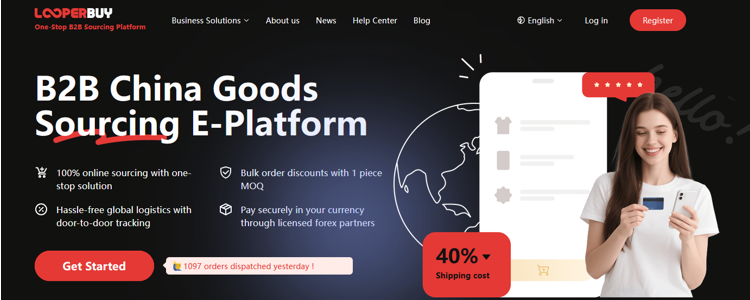
A capable worldwide sourcing company can help businesses turn fragmented China sourcing and cross-border delivery into one coordinated operating system. Instead of managing separate factories, freight contacts, warehouses, payment arrangements, and fulfillment tasks, sellers can work through a central partner such as Looperbuy to source products, consolidate orders, inspect goods, store inventory when needed, and ship orders worldwide.
This guide explains how to build a more resilient supply chain with a worldwide sourcing company—without overstocking products or taking on unnecessary warehousing, operational, and logistics costs.
Table of Contents
Why Supply Chain Stability Matters for Global B2B Sellers
A stable supply chain enables a business to keep selling when demand changes, suppliers experience delays, freight rates rise, or a product line needs to be adjusted quickly. It protects both revenue and customer experience.
For a B2B seller, instability may look like this:
– A supplier misses a production deadline.
– Product quality varies between batches.
– Inventory is trapped in the wrong country or warehouse.
– Freight costs suddenly increase.
– A best-selling SKU runs out during a peak sales period.
– The seller pays for too much stock before knowing whether demand is real.
– Orders are shipped late because sourcing, inspection, packaging, and dispatch are handled by disconnected providers.
These are not theoretical risks. Global trade remains highly exposed to shipping-route disruption, port congestion, regulatory changes, and cost volatility. UN Trade and Development notes that more than 80% of global trade volume moves by sea, which makes maritime disruptions especially important for internationally sourced products. In 2024, rerouting and congestion contributed to substantial freight-rate volatility on key global routes.
The goal is not to eliminate every risk. That is neither realistic nor economical. The goal is to design a supply chain that can identify problems early, absorb disruption, and recover quickly.
A worldwide sourcing company can play an important role because it connects critical functions that are often managed separately:
| Supply Chain Function | Common Challenge for Sellers | Value of a Worldwide Sourcing Company |
| Supplier sourcing | Too many unverified supplier options | Supplier discovery, communication, and preliminary validation |
| Product procurement | Language, payment, and negotiation barriers | Centralized purchasing and order coordination |
| Quality control | Inconsistent specifications or batch quality | Pre-shipment checks and issue escalation |
| Inventory management | Overstocking or stockouts | Flexible consolidation and inventory planning |
| Warehousing | High fixed storage costs | Use storage only when it supports demand and delivery goals |
| Order fulfillment | Manual processing across multiple tools | Consolidated pick, pack, labeling, and dispatch |
| International shipping | Complex route, carrier, and customs choices | Shipment coordination and tracking visibility |
What a Worldwide Sourcing Company Actually Does
A worldwide sourcing company is not simply a middleman that finds low-priced products. At its best, it acts as an operational bridge between product suppliers in China and sellers serving customers in multiple markets.
For a platform like Looperbuy, the value is in helping B2B sellers reduce the operational burden of cross-border sourcing and fulfillment. This may include product sourcing, supplier coordination, purchase support, consolidation, inspection, packaging, storage, and international delivery.
The strongest sourcing relationships are based on process discipline, not informal promises.
Key Services to Look For
When evaluating a worldwide sourcing company, look beyond its product catalog or quoted price. Ask whether it can support the end-to-end workflow that matters to your business.
A reliable partner should be able to help with:
– Product and supplier sourcing based on your specifications, target market, and budget
– Supplier communication to clarify materials, dimensions, packaging, branding, and delivery schedules
– Sample management before larger orders are approved
– Purchase-order coordination across one or multiple suppliers
– Quality inspection based on documented product requirements
– Order consolidation to reduce unnecessary separate shipments
– Custom packaging or labeling where applicable
– Warehouse handling for products that need temporary storage or staged fulfillment
– International shipping coordination based on cost, transit time, and destination requirements
– Tracking and exception handling after goods leave the warehouse
The right sourcing company should make the process easier to control. If it creates another opaque layer between you and your goods, it may increase rather than reduce risk.
Start With a Supply Chain Risk Map
Before selecting suppliers or placing larger orders, map where your current supply chain can fail. This is one of the most useful exercises for any B2B seller, especially when sourcing from overseas.
Create a simple risk map for each core product or SKU.
Questions to Ask for Every Product
– Is there only one supplier capable of producing this item?
– Does the supplier depend on a specific raw material, component, or factory location?
– How long does it take to replace the supplier?
– Do you have an approved product sample and clear written specifications?
– What happens if the supplier’s lead time doubles?
– What happens if freight costs rise by 30%?
– Which products generate the most revenue or customer complaints?
– Which SKUs have the longest replenishment cycle?
– Can stock be stored or shipped from a more suitable location?
– Is your packaging optimized for international delivery costs and damage prevention?
A useful way to prioritize is to score each product across four dimensions:
| Risk Area | What to Measure | Example Warning Sign |
| Revenue dependency | Share of sales generated by the SKU | One product generates 40% of sales |
| Supplier dependency | Number of qualified suppliers | Only one approved factory exists |
| Lead-time exposure | Production plus shipping duration | Replenishment takes 60–90 days |
| Quality sensitivity | Impact of defects or inconsistency | Returns are costly or damage reputation |
Products with high revenue dependency, limited supplier alternatives, long replenishment cycles, and strict quality requirements should receive the most attention.
This is where a worldwide sourcing company can add practical value: it can help organize supplier alternatives, support sample comparisons, coordinate inspection checkpoints, and give the seller one operating view across purchasing, warehousing, and outbound fulfillment.
Build Supplier Redundancy Without Creating Chaos
Supplier diversification does not mean placing small orders with dozens of factories. It means reducing dangerous dependency where it matters most.
A business with ten suppliers can still have a fragile supply chain if all factories rely on the same region, raw-material source, shipping port, or logistics route. True resilience requires examining the entire dependency chain.
McKinsey’s recent supply-chain research found that companies are responding to disruption through measures such as inventory adjustments, dual sourcing, and changes to sourcing footprints. In one survey, 39% of respondents affected by tariffs said they were pursuing dual sourcing for components or raw materials.
A Practical Supplier Structure
For important products, consider a structured supplier model:
1. Primary supplier: Handles most of the normal production volume and has proven quality and delivery performance.
2. Qualified backup supplier: Has approved samples, documented specifications, and the ability to accept production if the primary supplier cannot perform.
3. Development supplier: A potential future supplier being tested through samples, small orders, or capability reviews.
This approach is more useful than searching for replacements after a disruption has already occurred.
Do Not Diversify Only by Supplier Name
A primary and backup supplier may still share the same hidden risks. For example, they may:
– Operate in the same industrial region.
– Purchase from the same component manufacturer.
– Use the same port or freight route.
– Depend on the same seasonal labor pool.
– Face the same export-policy or weather-related disruption.
Ask your sourcing partner to identify meaningful differences between supplier options. A backup source is more valuable when it reduces the specific risk that threatens your business.
Use Product Specifications as a Control System
Many sourcing problems begin before production starts. A seller may describe a product informally, approve a photo, and assume the factory understands every expectation.
That assumption can become expensive.
For every repeatable product, create a product specification sheet. It should be detailed enough that a new supplier, inspector, or warehouse team can verify the product against the same standard.
Include These Details in Your Specification Sheet
– Product name and internal SKU
– Materials and component requirements
– Dimensions, tolerances, weight, and color references
– Approved sample photos or physical sample reference
– Functionality requirements
– Branding, logo placement, and artwork files
– Packaging materials and carton specifications
– Barcode, labeling, and bundle requirements
– Defect definitions and acceptance criteria
– Required inspection quantity and process
– Target production lead time
– Destination-market compliance requirements where relevant
For example, “black travel bottle” is not a sufficient specification. A usable specification would clarify the material grade, capacity, height, lid type, logo position, packaging, carton quantity, leakage standard, and barcode location.
A worldwide sourcing company can help translate these requirements into operational instructions for suppliers, inspectors, and warehouse teams. This reduces ambiguity between the product idea and the product that reaches the buyer.
Add Quality Control Before Goods Enter Fulfillment
Quality control should not be treated as a final emergency step. It is a decision point that protects your inventory, shipping budget, and brand reputation.
If defective goods are discovered only after they have been shipped internationally, the cost can multiply quickly. You may face returns, replacement shipments, negative reviews, customer-support costs, and inventory write-offs.
A stronger process uses multiple checkpoints.
A Four-Stage Quality-Control Workflow
1. Sample approval
Review a sample before approving larger production. Confirm product features, materials, colors, dimensions, and packaging expectations.
2. Pre-production confirmation
Reconfirm the approved specifications, production quantity, artwork, packaging details, and timeline before mass production begins.
3. Pre-shipment inspection
Inspect selected units before goods are released for consolidation or export. Focus on appearance, dimensions, function, labeling, and packaging integrity.
4. Warehouse receiving check
Confirm quantities, visible carton condition, SKU separation, and basic labeling when goods arrive at the sourcing company’s warehouse.
Not every product needs the same inspection intensity. A low-cost accessory may require a basic receiving check, while a branded, regulated, fragile, or high-ticket product may justify deeper inspection.
The key is to match inspection effort to business impact.
Balance Inventory Flexibility and Stock Availability
One of the largest advantages of working with a worldwide sourcing company is the ability to reduce the gap between purchasing inventory and fulfilling demand.
Traditional international procurement often forces sellers to choose between two costly options:
– Buy a large volume and hold inventory for months.
– Buy small quantities repeatedly and accept high unit costs, delayed availability, or frequent stockouts.
A more flexible sourcing and fulfillment model can create a third option: maintain only the inventory needed to support forecast demand while using consolidated warehousing and fulfillment to respond to real orders.
Use Inventory Tiers
Divide products into tiers rather than applying the same inventory policy to every SKU.
| Inventory Tier | Typical Product Type | Recommended Approach |
| Core products | Consistent demand and healthy margins | Maintain planned replenishment stock and backup supply options |
| Growth products | Increasing but uncertain demand | Use smaller replenishment cycles and review performance frequently |
| Seasonal products | Demand concentrated in a short period | Order against a calendar, with conservative buffer stock |
| Test products | New or unproven items | Start with small batches and validate demand before scaling |
| Slow-moving products | Low velocity or declining demand | Avoid over-ordering; consider made-to-order or clearance strategies |
The objective is not maximum stock. It is appropriate stock in the right location at the right time.
The World Economic Forum’s 2026 outlook describes global value chains as operating under structural volatility and emphasizes orchestration, distributed scale, and optionality as important ways to build agility.
For sellers, “optionality” may mean having approved suppliers, alternative shipping methods, flexible fulfillment capacity, and a clear view of where inventory is located.
Improve Visibility From Factory to Final Delivery
Visibility is the difference between reacting to a late order and managing risk before it becomes a customer problem.
You do not need an overly complex control tower to improve visibility. You need consistent, usable information at key stages.
For each purchase order, track:
– Supplier name and contact owner
– Product SKU and approved version
– Ordered quantity
– Payment status
– Production start date
– Estimated completion date
– Inspection status and results
– Warehouse arrival date
– Available inventory quantity
– Shipment method and tracking number
– Destination country
– Delivery status
– Exception or claim status
This information should be accessible enough to support decisions. If the seller has to search through emails, chat logs, spreadsheets, and several carrier portals to understand one order, the supply chain is too fragmented.
A worldwide sourcing company should help centralize this information and communicate exceptions promptly. The important question is not whether every shipment is perfect. The important question is whether you learn about exceptions early enough to protect customers and make informed decisions.
Choose Logistics Based on Product Economics
The cheapest shipping option is not always the lowest-cost option for the business.
A slower route can create stockouts, lost marketplace rankings, cancelled orders, or expensive emergency replenishment. A faster route can protect revenue but may destroy margin if used without a clear reason.
Use landed-cost thinking rather than comparing freight quotes alone.
Your Landed-Cost Calculation Should Include
Landed Cost=Product Cost+Packaging Cost+Inspection Cost+Domestic China Transport+International Freight+Duties and Taxes+Fulfillment Cost+Expected Returns or Damage Cost
This does not need to be mathematically perfect on day one. It needs to be consistent enough to compare sourcing and delivery options.
For example, a product that costs $4 at the factory may look attractive. But if it requires expensive packaging, occupies too much carton volume, has a high damage rate, and needs costly air shipping to prevent stockouts, it may produce a worse contribution margin than a $5.50 alternative that ships more efficiently and generates fewer customer complaints.
The OECD’s Supply Chain Resilience Review emphasizes agile, adaptable, and aligned supply chains, including the role of digitalization and trade facilitation in improving responsiveness.
Create a 90-Day Supply Chain Stabilization Plan
Supply-chain resilience is built through routines, not a one-time supplier search. The following 90-day plan gives B2B sellers a practical starting point.
Days 1–30: Diagnose and Document
– List your top 20 revenue-driving SKUs.
– Identify single-source products and long-lead-time items.
– Gather existing supplier, pricing, quality, and lead-time data.
– Document product specifications for your priority SKUs.
– Review current shipping costs, delivery times, returns, and stockouts.
– Define the service levels you expect from your sourcing and fulfillment partner.
Days 31–60: Validate and Build Options
– Request or approve product samples from priority suppliers.
– Identify backup suppliers for critical SKUs.
– Establish product-specific quality-control checklists.
– Test warehouse receiving, consolidation, and shipping workflows.
– Compare shipping methods by total cost, delivery reliability, and destination.
– Set reorder points for core products.
Days 61–90: Test, Measure, and Improve
– Run a controlled order or small batch through the full process.
– Review inspection findings and supplier communication quality.
– Measure actual production and delivery performance against estimates.
– Update lead times and safety-stock assumptions.
– Create an exception-handling process for delays, defects, or missing inventory.
– Schedule a monthly supply-chain review with your sourcing company.
This is where a service provider should become a working partner, not merely a transactional vendor. A useful sourcing company helps you identify recurring problems, clarify ownership, and improve the operating process over time.
How Looperbuy Can Support a More Stable Supply Chain
For global B2B sellers sourcing from China, Looperbuy can support a more coordinated path from supplier discovery to international fulfillment.
Rather than requiring sellers to independently manage product sourcing, purchasing, quality follow-up, warehousing, and delivery, an integrated sourcing and dropshipping workflow can help reduce operational fragmentation.
Looperbuy may be especially useful for businesses that want to:
– Source Chinese products without building a large in-house procurement team.
– Test products before committing to large inventory purchases.
– Reduce the burden of communicating with multiple suppliers.
– Consolidate products from different factories.
– Use inspection and warehouse handling before international dispatch.
– Ship products to global customers without personally managing each logistics step.
– Scale order fulfillment while maintaining clearer oversight of product availability and shipment status.
The best starting point is a small, controlled sourcing project. Select a limited number of SKUs, define product specifications, approve samples, set inspection requirements, and evaluate actual delivery performance. Once the workflow proves reliable, expand systematically.
Ready to make your sourcing process more stable? Start by reviewing your highest-risk products, documenting your quality and packaging requirements, and discussing a tailored sourcing and fulfillment workflow with Looperbuy. A stable supply chain begins with clear standards, verified partners, and a process designed for change.
FAQ
1. What is a worldwide sourcing company?
A worldwide sourcing company helps businesses find, purchase, inspect, consolidate, store, and ship products from suppliers to international markets. Depending on its service model, it may also provide supplier communication, quality checks, packaging support, inventory handling, and global fulfillment coordination.
2. How does a sourcing company reduce supply chain risk?
It can reduce risk by centralizing supplier communication, helping verify product requirements, coordinating inspections, consolidating goods, providing inventory visibility, and offering alternative shipping or supplier options. Risk is reduced most effectively when the seller also maintains clear specifications and backup plans for critical products.
3. Should I use one supplier or multiple suppliers?
For low-risk, non-critical products, one reliable supplier may be sufficient. For high-revenue, long-lead-time, or quality-sensitive products, it is usually safer to develop at least one qualified backup supplier. The best choice depends on the cost of disruption and the time required to switch suppliers.
4. How much inventory should an online B2B seller hold?
The right level depends on demand predictability, lead time, product margin, storage cost, and stockout risk. Core products with stable demand usually need planned safety stock, while new or seasonal products should be ordered more conservatively until demand is proven.
5. What should I check before approving a supplier?
Review product samples, production capability, communication speed, lead-time reliability, quality-control processes, packaging ability, minimum order requirements, payment terms, and relevant export or destination-market requirements. It is also important to confirm whether the supplier relies on vulnerable upstream materials or production locations.
6. Why is product specification important in international sourcing?
A product specification creates a shared standard for suppliers, inspectors, and warehouse teams. It reduces misunderstandings about materials, size, color, functionality, branding, packaging, and acceptable defects. Clear specifications are essential for consistent repeat orders.
7. Is dropshipping suitable for B2B sellers?
It can be suitable for B2B sellers that want to test demand, reduce upfront inventory commitments, serve international customers, or expand product ranges without operating their own warehouse. It works best when the sourcing and fulfillment process has clear quality checks, accurate inventory records, and dependable shipping options.
References
1. McKinsey & Company. “Supply Chain Risk Pulse 2025: Tariffs Reshuffle Global Trade Priorities.”[Read the McKinsey supply-chain risk survey]
2. McKinsey & Company. “Decoding Disruption to Reshape Manufacturing Footprints.”[Read the manufacturing-footprint analysis]
3. World Economic Forum. “Global Value Chains Outlook 2026: Orchestrating Corporate and National Agility.”[Read the World Economic Forum report]
4. OECD. “OECD Supply Chain Resilience Review: Navigating Risks.”[Read the OECD Supply Chain Resilience Review]
5. UN Trade and Development (UNCTAD). “Review of Maritime Transport 2024.”[Read the UNCTAD maritime transport report]
6. UN Trade and Development (UNCTAD). “High Freight Rates Strain Global Supply Chains, Threaten Vulnerable Economies.”[Read the UNCTAD analysis of freight-rate volatility]