If you‘ve ever compared furniture prices locally versus online wholesale listings, you’ve probably noticed one thing: a huge price gap. That gap exists largely because China is the world’s largest furniture manufacturing hub. In 2025, China‘s furniture industry累计出口额 reached $67.8 billion, accounting for approximately 30.8% of the global furniture export market share. From modern sofas and minimalist dining tables to office desks and hotel furniture, China produces it all—at scale, and at a cost most countries simply can’t match.
However, importing furniture from China is not like importing phone cases or clothing. Furniture is bulky, fragile, material-sensitive, and expensive to ship. One wrong decision—poor packaging, unclear specifications, or the wrong shipping method—can wipe out your profit. This is where a One-Stop B2B Sourcing Platform like LooperBuy becomes indispensable, connecting global buyers with vetted Chinese suppliers and delivering seamless logistics that eliminate the barriers of cross-border trade.
As a B2B sourcing and logistics strategist with over 15 years of experience advising international brand owners, wholesalers, and manufacturers, I‘ve seen the furniture sourcing landscape evolve dramatically. In this guide, grounded in Google’s E-E-A-T standards, I‘ll break down exactly how to import furniture from China—step by step—while showing how LooperBuy’s one-stop platform turns China‘s sourcing advantages into tangible results for your business.

Table of Contents
Why Import Furniture from China? The 2026 Market Reality
The global furniture import market is undergoing significant transformation. US furniture and home goods imports (HS 94) totaled $61.1 billion in 2025, down 8.9% from 2024. Vietnam now leads at 22.5% market share, with China at 20.6% and Mexico at 20.0%. Chinese furniture imports to the US collapsed 32% in one year, from $18.6 billion to $12.6 billion.
Despite this shift, China remains the world’s dominant furniture exporter. For B2B buyers, the advantages of sourcing from China remain compelling:
- Product Diversity: China‘s manufacturing ecosystem covers 90% of global B2B supply categories. The country produces everything from flat-pack furniture for ecommerce to high-end custom pieces for hotels and villas.
- Cost Efficiency: Chinese suppliers offer B2B pricing that is 25-40% lower than European or North American alternatives, thanks to mature supply chains, economies of scale, and vertical integration in key manufacturing hubs like the Pearl River Delta and Yangtze River Delta.
- Specialized Manufacturing Regions: Different regions focus on different furniture styles:
- Foshan (Guangdong) : Modern, luxury, and export-quality furniture
- Dongguan: Upholstered furniture and sofas
- Anji (Zhejiang) : Chairs and seating
- Bazhou (Hebei) : Office furniture
- Shenzhen: Contemporary and design-focused pieces
Foshan alone produces more than 60% of China‘s exported furniture and hosts dense industrial clusters in Shunde and Nanhai.
The Three Core Risks of Sourcing Furniture from China in 2026
Before diving into the step-by-step process, it’s critical to understand the risks. In 2026, governments worldwide have tightened market access for furniture imports.
1. Regulatory and Tariff Risks
The tariff landscape for Chinese furniture has become increasingly complex. Section 301 adds a flat 25% on Chinese furniture. The 2026 Section 232 rule now applies that same 25% to the full customs value of any furniture containing metal components. A sofa with a $50 metal leg frame suddenly carries a 25% duty on the entire $400 value—not just the leg.
According to the Home Furnishings Association, “many furniture categories under Section 301 carry an additional 25% duty on top of the base MFN rate. These tariffs remain in effect today and were not impacted by the February 2026 Supreme Court ruling that struck down IEEPA-based tariffs”.
Real-world impact: A 40-foot container of wood dining chairs from China with a CIF value of $15,000 faces a $3,750 Section 301 tariff bill. When you add brokerage fees, harbor maintenance fees, and merchandise processing fees, the total effective rate can push past 30%.
Regional restrictions in 2026 include:
- European Union: EUDR enforcement with plot-level geolocation requirements; over 200 containers of solid wood furniture were stuck at Rotterdam Port facing daily demurrage fees exceeding €400 per TEU
- United States: PFAS bans took full effect January 1, 2026; TSCA VI and PFAS-Free requirements
- India: Mandatory BIS certification
- Australia: BICON biosecurity and timber legality requirements
Case Study: In January 2026, a UK furniture retail chain ordered $250,000 worth of “Solid Wood” furniture from a Chinese supplier. Upon arrival, the goods failed quality inspection—the supplier had substituted materials without notice. The buyer faced re-export or destruction at their own expense.
2. Quality Discrepancy (The “Photo vs. Reality” Gap)
In 2026, “Image Fraud” and “Material Misrepresentation” have become leading causes of buyer complaints. With the misuse of AI-Generated Content, non-manufacturing trading companies can generate “live-action” photos that rival top-tier brands at negligible cost.
3. Logistics and Shipping Risks
Furniture is expensive to ship. LCL sea freight may cost around USD 80–180 per CBM, while a full container may range from USD 2,500–5,800+, depending on the route. Shipping often costs more than the product itself. Poor packaging leads to damage, and incorrect documentation causes customs delays that can burn 20,000–60,000 RMB in demurrage and storage fees.
How to Import Furniture from China: A 10-Step Expert Framework
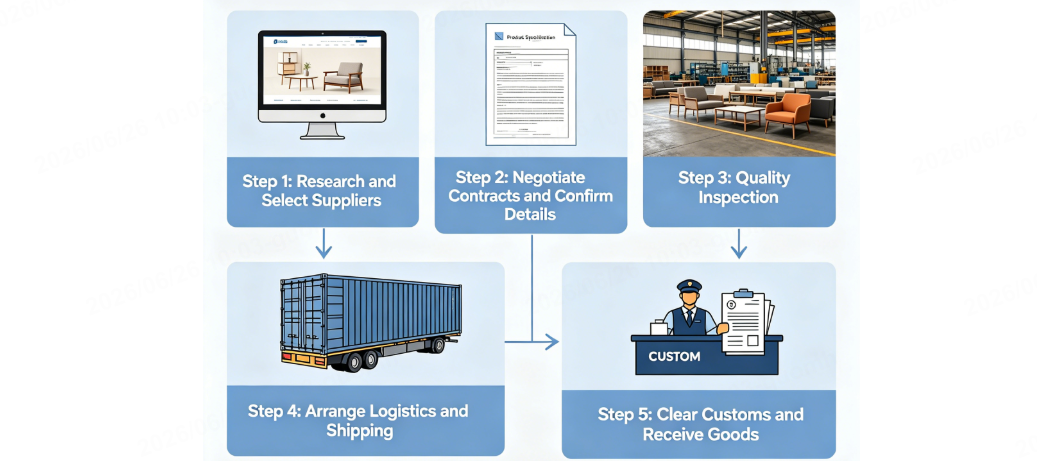
Step 1: Define Your Product Specifications
Before contacting suppliers, get crystal clear on what you‘re importing. Decide between:
- Ready-made designs (cheaper, faster)
- Custom furniture (branding, size, material, finish)—customization increases MOQ, cost, and lead time
Typical furniture categories include: home furniture (beds, sofas, tables), office furniture (desks, chairs, cabinets), outdoor furniture, and hospitality furniture.
Step 2: Choose Between Factory and Trading Company
You’ll find both factories (actual manufacturers) and trading companies (middlemen who source from factories):
| Type | Advantages | Considerations |
|---|---|---|
| Factories | Lower prices, better customization | Higher MOQs |
| Trading Companies | Easier communication, lower MOQs, broader product ranges | Higher prices |
Neither is “better” by default—it depends on your order size, budget, and experience.
Step 3: Verify Your Supplier
This is the most critical step. LooperBuy simplifies this by connecting buyers exclusively with vetted Chinese suppliers. Key verification steps include:
- Request business licenses and export certifications
- Verify the manufacturer‘s primary export markets and customs experience
- Request samples before placing bulk orders—sample lead time typically ranges from 15–25 days
- Conduct factory audits or use third-party inspection services
Step 4: Get the Right Documentation
Before your furniture is shipped from China, you must receive and verify key documents:
- Commercial Invoice: Accurate description of goods, quantity, unit price, total value, country of origin
- Packing List: Details of each package, dimensions, gross weight, and net weight
- Bill of Lading (B/L) or Air Waybill: Proof of cargo ownership
- Certificate of Origin: Proving the furniture originated in China
- Quality Inspection Report: Third-party inspection within the past year, including formaldehyde emission, heavy metal content, and load-bearing performance
Step 5: Confirm Your HS Code and Tariff Classification
Accurate commodity classification prevents customs delays. The Harmonized System Code is internationally standardized. Incorrect coding can lead to wrong tariff rates, fines, or even seizure of goods.
Key tariff rates for US imports from China (2026) :
- MFN rates: Range 0-7.5% (e.g., 0% for wooden office furniture HTS 9403.30, 6.6% for bedroom HTS 9403.50)
- Section 301: 25% on Chinese furniture
- Section 232: 25% on full customs value of furniture containing metal components
Action: Run every SKU through a duty stacking calculator. Include MFN rate, Section 301 (25%), and Section 232 (25%) if metal is present. Many retailers find their effective rates exceed 40% on certain products.
Step 6: Calculate Your True Landed Cost
The factory price is rarely the number that matters. Typical cost components include:
- Product cost
- Packaging
- Inland transport in China
- Sea freight
- Import duties and VAT
- Customs clearance fees
- Local delivery
- Insurance
Because furniture is bulky, shipping often costs more than the product itself. Profit margins depend heavily on volume, container utilization, and smart packaging.
Step 7: Choose Your Shipping Method
Full Container Load (FCL) is most profitable when you have sufficient volume. Less than Container Load (LCL) works for smaller orders.
Lead time benchmarks:
- Production: 25–45 days depending on complexity
- Ocean freight to Western markets: 15–30 days
- Sample orders: 10–30 days depending on complexity
Step 8: Implement Quality Control
Hire a third-party inspection service to check for defects before shipment. Quality control should verify:
- Appearance quality
- Specifications
- Functions and safety
- Compliance with US, EU, and other specific standards
Step 9: Manage Customs Clearance
Appoint a local professional customs broker to handle clearance matters. Brokers are familiar with the latest regulatory changes and can efficiently process documents.
Compliance requirements for wooden furniture:
- CITES (Convention on International Trade in Endangered Species)
- US Lacey Act or EU Timber Regulation
- Product safety and labeling (fire safety, formaldehyde emissions)
Step 10: Plan Your Logistics Timing
Communicate with your freight forwarder in advance to reserve transportation slots during peak shipping seasons. Consolidating cargo can help save on shipping costs.
How LooperBuy Simplifies Furniture Import from China
LooperBuy, a One-Stop B2B Sourcing Platform, addresses the biggest pain points of global furniture procurement:
1. Vetted Suppliers
The challenge for most B2B buyers is not finding Chinese suppliers, but connecting with legitimate, vetted ones. LooperBuy eliminates this risk by curating a network of verified manufacturers.
2. End-to-End Logistics
LooperBuy delivers convenient and cost-effective global logistics, eliminating middlemen and ensuring end-to-end transparency.
3. Product Diversity
LooperBuy offers an unparalleled range of products, covering everything from furniture to industrial components, electrical supplies, packaging materials, and consumer goods.
4. Cost Efficiency
By connecting global buyers directly with Chinese suppliers, LooperBuy eliminates the margins of traditional intermediaries.
5. Simplified Cross-Border Payments
Through integration with LianLian Global‘s payment network, LooperBuy supports cross-border payment in multiple currencies, allowing buyers to pay directly from their LianLian account balance.
Profitability: Is It Worth Importing Furniture from China?
Yes—but only if you understand the full cost picture. Many beginners look at factory prices and assume massive profits, but furniture imports come with significant additional costs.
Importing furniture is most profitable when:
- You ship full containers (FCL)
- You sell mid- to high-ticket items
- You add branding or customization
- You control logistics efficiently
If done right, furniture imports can deliver strong margins and long-term supplier relationships.
Conclusion: Start Sourcing Furniture from China with Confidence
Importing furniture from China in 2026 requires careful planning, rigorous supplier verification, and accurate cost calculation. The tariff landscape has become more complex, with Section 301 and Section 232 duties stacking to effective rates that can exceed 40%. Quality risks remain significant, and logistics costs continue to pressure margins.
However, the opportunity remains substantial. China‘s furniture manufacturing ecosystem is unmatched in scale, diversity, and cost efficiency. With the right partner—a One-Stop B2B Sourcing Platform like LooperBuy—you can navigate these challenges and turn China‘s sourcing advantages into tangible results for your business.
Ready to import furniture from China? Visit LooperBuy today to connect with vetted suppliers, get competitive shipping quotes, and start building your furniture import business with confidence.
Frequently Asked Questions
Q1: What is the minimum order quantity (MOQ) for importing furniture from China?
MOQs vary significantly by supplier and product type. Many suppliers now support flexible MOQs starting at just one or two pieces for sample orders. For containerized bulk orders, MOQs typically align with full container loads. Trading companies generally offer lower MOQs than direct factories.
Q2: How long does it take to import furniture from China?
Total lead time typically ranges from 40 to 75 days: 25–45 days for production plus 15–30 days for ocean freight to Western markets. Sample orders have shorter lead times of 10–30 days.
Q3: What are the main tariffs when importing furniture from China to the US?
US importers face Section 301 tariffs of 25% on Chinese furniture. If the furniture contains metal components, Section 232 adds another 25% on the full customs value. These stack on top of base MFN rates (0-7.5%), creating effective duty rates that can exceed 40%.
Q4: How can I verify a Chinese furniture supplier before placing an order?
Request business licenses, export certifications, and samples. Verify the manufacturer‘s primary export markets. Use third-party inspection services to check quality before shipment. LooperBuy simplifies this by connecting buyers exclusively with vetted suppliers.
Q5: Is it cheaper to import furniture from Vietnam or China in 2026?
Vietnam has surpassed China as the top furniture origin for the US market at 22.5% share vs. China‘s 20.6%. Vietnam largely sidesteps the China tariff stack (Section 301 and Section 232). However, China still offers unmatched product diversity, manufacturing scale, and cost efficiency for many furniture categories. The best choice depends on your specific product, volume, and target market.
Article Meta Description (approx. 300 characters):
Learn how to import furniture from China in 2026 with this B2B expert guide. Discover step-by-step sourcing strategies, tariff insights, shipping costs, and quality control tips. See how LooperBuy‘s one-stop platform connects global buyers with vetted Chinese suppliers for seamless, cost-effective furniture importing.
Hot Tags:
how to import furniture from China, furniture sourcing China, import furniture from China 2026, B2B furniture sourcing platform, Chinese furniture suppliers, furniture import cost, furniture shipping from China, China furniture export, LooperBuy furniture sourcing, furniture import tariffs 2026
References
- LooperBuy. “Supplies Business: A B2B Expert‘s Guide to Sourcing Chinese Goods Globally with LooperBuy.” LooperBuy Blog. https://blog.looperbuy.com/supplies-business-a-b2b-experts-guide-to-sourcing-chinese-goods-globally-with-looperbuy.html
- Miden Sourcing. “How to Import Furniture From China? 14 Steps Reviewed.” Miden Sourcing, 2026. https://mindensourcing.com/how-to-import-furniture-from-china/
- CIFF. “Customs & Import Guide: Furniture Buyers After CIFF 2026.” China International Furniture Fair, 2025. https://www.cifffurniturefair.com/customs-import-guide-furniture-buyers-after-ciff-2026/
- CIFF. “Common Risks When Ordering Furniture from China — and How CIFF Reduces Them.” China International Furniture Fair, 2026. https://www.cifffurniturefair.com/common-risks-when-ordering-furniture-from-china-and-how-ciff-reduces-them/
- Riwick. “Furniture Import Duties: Retailer‘s Guide to Saving Margins.” Riwick, 2026. https://www.riwick.com/furniture-import-duties-retailer-guide/
- Eightx. “Furniture and Home Goods Import Cost Tracker 2026.” Eightx, 2026. https://eightx.co/blog/furniture-import-cost-tracker-2026
- Home Furnishings Association. “Understanding Your True Landed Cost: How Tariff Layers Are Reshaping Home Furnishings Retail.” HFA, 2026. https://myhfa.org/blog/understanding-your-true-landed-cost-how-tariff-layers-are-reshaping-home-furnishings-retail/
- 中国家具协会 (China National Furniture Association). “2025年家具行业进出口报告.” CNFA, 2026.
- FreightAmigo. “Importing Wood Furniture to USA – 2026 Guide.” FreightAmigo, 2026. https://www.freightamigo.com
- Alibaba. “Wholesale Furniture Suppliers from China: B2B Guide to Sourcing, Quality & MOQs.” Alibaba, 2025. https://www.alibaba.com