
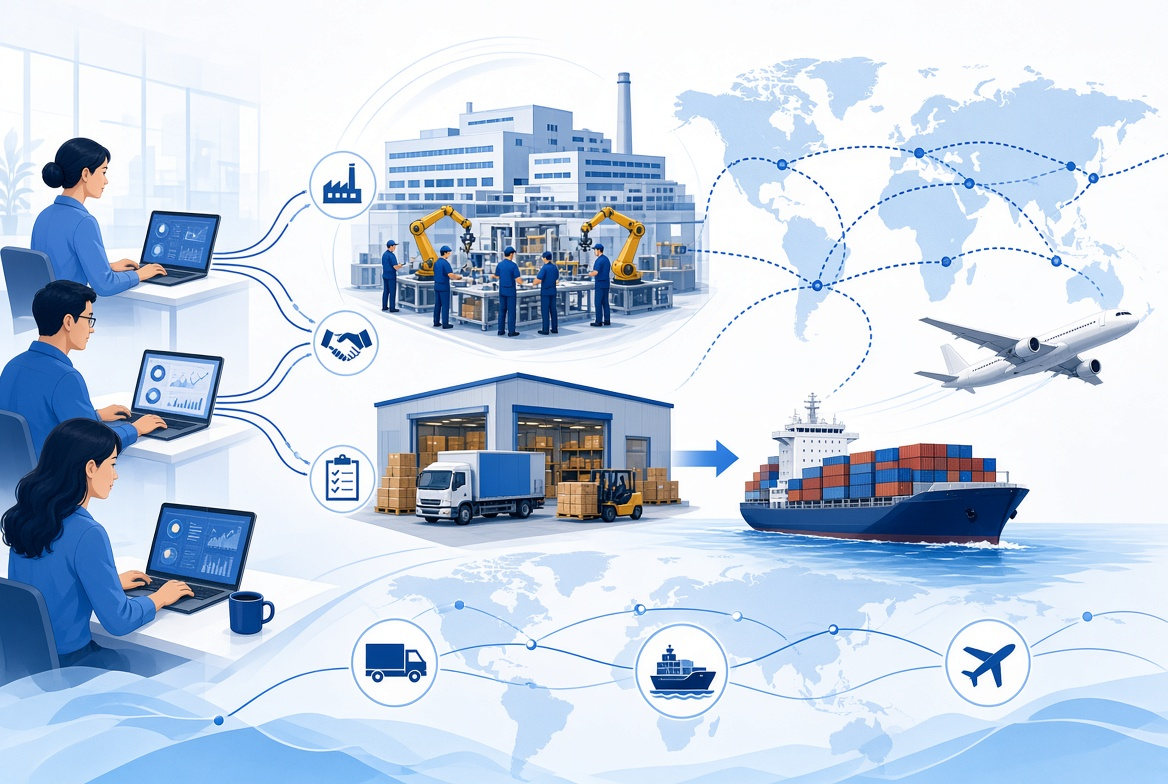
This article explains the three major B2B online marketplace models—partner, private, and public marketplaces—and shows how global merchants can combine marketplace access with China sourcing and dropshipping services. It provides a practical framework for reducing inventory risk, evaluating suppliers, managing cross-border fulfillment, calculating landed cost, and building a more scalable sourcing operation with Looperbuy.
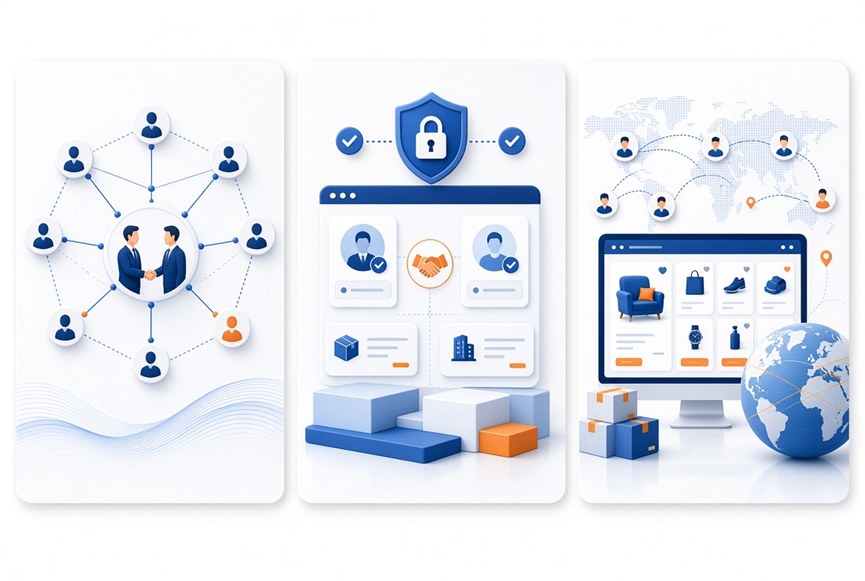
For modern merchants, choosing the right B2B online marketplace model is no longer only about finding suppliers or listing products. It is about controlling inventory exposure, protecting cash flow, improving delivery reliability, and building a repeatable global sourcing operation.
A China sourcing and dropshipping platform such as Looperbuy can help B2B sellers access products from Chinese suppliers while reducing the need to pre-purchase large volumes, manage warehouse space, handle fragmented supplier payments, or coordinate international shipping independently. The most effective approach is often not choosing between a marketplace and an owned sales channel, but using each model for the work it does best.
Table of Contents
What Is a B2B Online Marketplace?
A B2B online marketplace is a digital platform where businesses discover suppliers, compare products, request quotations, place wholesale orders, arrange payment, and sometimes manage fulfillment or logistics.
Unlike a traditional business website, a marketplace usually serves multiple parties at once:
– Buyers looking for products, suppliers, or sourcing services.
– Suppliers seeking qualified business customers.
– Marketplace operators managing product discovery, transaction rules, supplier access, payment processes, and sometimes delivery workflows.
– Service partners providing inspection, warehousing, customs support, fulfillment, or cross-border logistics.
For global sellers, the value of a marketplace is not simply product variety. The real value is operational simplification. A well-designed sourcing platform can reduce the number of separate suppliers, invoices, payment steps, warehouse contacts, and shipping providers a merchant must manage.
This is particularly relevant for merchants selling through independent ecommerce websites, Amazon, eBay, Walmart Marketplace, TikTok Shop, regional marketplaces, social commerce stores, or wholesale distribution channels. These sellers often need to test demand quickly, add products without overcommitting capital, and fulfill international orders with fewer manual processes.
The Three Main B2B Marketplace Models
1. Partner B2B marketplaces
A partner B2B marketplace is usually operated by a major manufacturer, technology vendor, distributor, or platform owner. Participation is generally limited to approved partners, resellers, dealers, integrators, or certified service providers.
The purpose is to expand the core company’s ecosystem. Instead of offering only the operator’s own products, the marketplace may include complementary products, software, services, spare parts, accessories, or implementation support.
For example, a machinery manufacturer may allow authorized dealers to list compatible accessories. A software company may invite certified partners to sell integrations, implementation services, or industry-specific applications.
Partner marketplaces are useful when product compatibility, technical knowledge, brand consistency, and channel governance matter more than open supplier access.
| Strengths | Limitations |
| Supports bundled solutions and cross-selling | Entry is usually restricted to approved partners |
| Builds trust through formal partner relationships | Sellers may have limited control over marketplace rules |
| Helps buyers find compatible products and services | Direct competitors may be excluded |
| Can improve after-sales support and service coordination | The marketplace owner may have limited visibility after a lead is passed to a partner |
The key commercial issue is lead ownership. In many partner marketplace models, a buyer submits an inquiry through the platform but completes the deal directly with a partner. The platform owner may not see the final order value, additional services, negotiated terms, or future repeat purchases.This as a structural challenge for operators that rely on marketplace commissions.
2. Private B2B marketplaces
A private B2B marketplace provides a controlled environment for approved buyers and suppliers. It is usually industry-specific, account-based, or limited to verified members.
This model is common in sectors where purchasing is complex, product specifications matter, or commercial relationships require a higher level of control. Examples include industrial components, medical supplies, construction materials, electronics, automotive parts, food ingredients, packaging, and enterprise software.
Private marketplaces can offer benefits that open public marketplaces may struggle to provide:
– Approved supplier access.
– Contract pricing for specific buyer groups.
– Product catalogs with technical specifications.
– Request-for-quotation workflows.
– Minimum order quantity management.
– Compliance documentation.
– Credit terms or negotiated payment processes.
– More structured purchasing approval workflows.
For B2B buyers, private marketplaces can make procurement more consistent because suppliers, products, documentation, and order records are centralized. For suppliers, they can offer access to more qualified buyers than an entirely open marketplace.
However, the model also has a trade-off: suppliers may receive limited customer data. If the marketplace controls the buyer relationship, sellers may be unable to build direct remarketing, loyalty, or account-development programs with end customers. Lack of access to customer data is a common problem faced by vendors operating in private marketplaces.
3. Public marketplaces and direct-to-consumer channels
Public marketplaces are the most open model. Sellers list products where buyers can search, compare prices, read reviews, and place orders. In the original framework, this is described as a direct-to-consumer marketplace model because manufacturers or suppliers can reach end customers more directly, bypassing some traditional offline reseller channels.
For smaller suppliers and new sellers, public marketplaces can create immediate market access. A merchant may not need to build a fully developed ecommerce site before testing whether a product has demand.
But public marketplaces also introduce intense competition. Sellers often compete on:
– Unit price.
– Delivery speed.
– Product ratings and reviews.
– Product photography and listing quality.
– Inventory availability.
– Marketplace advertising spend.
– Return policies.
– Response time.
A public marketplace can generate visibility, but it should not automatically become a company’s only route to market. Sellers who depend entirely on a third-party marketplace may have limited access to buyer data, fewer opportunities to personalize offers, and reduced control over brand presentation.
Why Marketplace Choice Matters for Global Sellers
The best marketplace model depends on a seller’s size, product category, customer type, and operational maturity. The biggest mistake is assuming that a marketplace is simply a sales channel.
It is also a data, fulfillment, and risk-management decision.
A small seller may prioritize speed: identify a product, test demand, source a small quantity, and ship without building a large warehouse operation. A mid-sized seller may need stable suppliers, branded packaging, inventory visibility, and a reliable fulfillment workflow. A larger enterprise may need custom pricing, supplier governance, integrations, procurement controls, and ownership of its buyer relationship.
McKinsey reports that B2B ecommerce businesses have outperformed peers in growth, customer-acquisition efficiency, and EBIT growth. It also notes that buyers now use an average of ten channels during their purchasing journey, making consistent product information, service, and channel coordination increasingly important.
That means sellers should think beyond “Where can I sell?” and ask:
1. Who owns the customer relationship?
2. Who holds inventory?
3. Who checks supplier quality?
4. Who manages payment and currency complexity?
5. Who prepares and ships the order?
6. Who handles tracking, returns, and delivery exceptions?
7. Can the process scale if order volume increases quickly?
How a China Sourcing Platform Reduces Operating Burden
For merchants sourcing from China, supplier discovery is only one part of the process. The harder challenge is managing the operational chain after a product is selected.
A typical cross-border sourcing workflow may involve finding a supplier, confirming specifications, negotiating price, arranging payment, checking quality, consolidating goods, storing inventory, selecting a shipping line, managing customs documents, providing tracking, and resolving delivery problems.
When each stage is handled by a different party, the merchant takes on more coordination work and more risk.
Looperbuy’s role can be positioned as a practical bridge between global B2B sellers and China’s supply ecosystem. Rather than forcing merchants to buy large amounts of stock upfront, an integrated sourcing and dropshipping service can help sellers create a lighter operating model.
Core value for B2B merchants
– Reduced upfront inventory exposure: Sellers can test products and demand before committing to large stock purchases.
– Simplified supplier coordination: A sourcing partner can reduce the need to communicate separately with multiple factories or trading companies.
– Consolidated procurement: Products from different suppliers can potentially be managed through a more unified sourcing workflow.
– Warehouse and fulfillment support: Sellers can avoid building or operating their own warehouse in China.
– Cross-border shipping coordination: International logistics can be handled through a defined shipping process instead of fragmented courier arrangements.
– Lower administrative burden: Centralized purchasing and fulfillment can reduce the time spent on payments, order follow-up, tracking, and shipment coordination.
A sourcing platform does not remove all commercial risk. Sellers still need to validate products, understand regulations, set clear quality requirements, and choose shipping options carefully. But it can substantially reduce the operational friction that prevents small and mid-sized merchants from scaling.
A Practical Marketplace Strategy for Looperbuy Users
The strongest approach for most global sellers is a hybrid channel strategy. Use marketplaces for visibility and demand discovery, while building operational control through a sourcing and fulfillment partner.
Step 1: Define the products you can sell responsibly
Before sourcing, identify products that fit your commercial capabilities. Consider product size, breakability, seasonality, compliance requirements, return risk, and delivery expectations.
Products with a low unit price but high shipping weight may look attractive until logistics costs are included. Products with many size or color variations may create inventory complexity. Regulated products may require documentation, testing, labeling, or country-specific compliance checks.
Step 2: Start with product validation, not bulk purchasing
Use small-scale testing to understand real demand. Review competitor listings, price ranges, buyer reviews, shipping expectations, and product complaints.
Focus on questions such as:
– Is the product differentiated enough to avoid pure price competition?
– Can the product be shipped safely and profitably?
– Are customers likely to reorder it?
– Can branding, bundling, packaging, or accessories increase value?
– Does the product have a high return risk?
The goal is to avoid treating a supplier quotation as proof of a viable business opportunity.
Step 3: Create a clear supplier brief
A reliable sourcing request should include more than a product link or image. It should specify:
– Product name and reference images.
– Target material, dimensions, color, and variants.
– Expected quantity or testing quantity.
– Branding, private-label, or packaging requirements.
– Acceptable quality standard.
– Target market and compliance needs.
– Preferred shipping destination and delivery speed.
– Required inspection points.
Clear specifications reduce misunderstandings and help sourcing teams compare suppliers more accurately.
Step 4: Choose a fulfillment model that matches demand
There are three common options:
| Fulfillment model | Best for | Main risk |
| Direct dropshipping | New product testing and low-volume orders | Longer fulfillment time or inconsistent stock |
| Small-batch stocking | Products with predictable demand | Capital tied up in inventory |
| Bulk purchasing | High-volume, stable sellers | Overstocking and cash-flow pressure |
For many emerging sellers, direct dropshipping or a limited inventory position offers a better balance between flexibility and cost control. Once sales become predictable, moving best-selling products into managed warehouse stock may improve delivery speed and unit economics.
Step 5: Track the metrics that reveal operational health
Do not judge sourcing performance only by product cost. Review the full landed cost and customer experience.
Monitor:
– Product purchase price.
– Packaging cost.
– Inspection or handling cost.
– Shipping cost per order.
– Order processing time.
– Delivery time by destination.
– Tracking availability.
– Refund and return rate.
– Damage rate.
– Customer-service tickets.
– Gross margin after all fulfillment costs.
A product can appear profitable before fulfillment but become unprofitable after reshipments, refunds, delivery delays, and customer-support work are included.
Marketplace Risks and How to Control Them
A marketplace can accelerate growth, but it should not become a black box. Sellers should actively manage the risks that affect margin, reputation, and customer retention.
Supplier consistency
The first supplier found is not always the best long-term supplier. Product samples, production capacity, material consistency, packaging standards, and communication quality should be evaluated before significant scaling.
Ask for clear quotations, sample verification, realistic lead times, and defined quality expectations. For repeatable products, document approved specifications so future orders can be checked against the same standard.
Inventory and stock accuracy
Many suppliers operate across multiple channels, which can make inventory availability change quickly. A product shown as available today may be unavailable when a customer order arrives.
Sellers should use realistic stock rules, avoid overpromising delivery dates, and build backup sourcing options for important SKUs.
Shipping and customs uncertainty
International delivery is not fully within the control of any single seller or sourcing partner. Customs inspections, carrier capacity, destination-country rules, and seasonal volume can affect transit times.
The best practice is transparency: show reasonable processing and shipping expectations, provide tracking where possible, and communicate quickly when an exception occurs.
Customer-data dependence
Third-party marketplaces can be excellent for customer acquisition, but they often restrict access to buyer information and repeat-marketing opportunities. This is why growing merchants should gradually develop owned assets such as a branded website, email list where permitted, product content library, social audience, and customer-support process.
An owned ecommerce channel gives a business more room to build repeat purchasing, customized offers, and long-term brand equity.
Build a More Flexible Global Sourcing Operation
The future of B2B commerce is not about choosing a single channel. It is about creating a supply and fulfillment system that lets a seller test products, serve customers reliably, and scale without taking unnecessary inventory risk.
For global merchants, Looperbuy can support that objective by connecting China product sourcing, order processing, warehouse services, and dropshipping logistics in a more manageable workflow. This gives sellers more time to focus on product selection, branding, customer acquisition, and market expansion instead of coordinating every supplier and shipment manually.
If your business wants to source products from China without carrying excessive inventory or building a complex fulfillment operation, start by evaluating a small group of high-potential products and establish a clear sourcing brief with Looperbuy. Test demand, measure landed cost, improve the process, and scale only when the numbers support it.
Frequently Asked Questions
1. What is the difference between a B2B marketplace and a B2B ecommerce website?
A B2B marketplace connects multiple buyers and suppliers on one platform, while a B2B ecommerce website is usually owned by one seller or brand. A marketplace can improve product discovery and supplier access, while an owned website gives the business more control over branding, customer relationships, pricing, and customer data.
2. Which B2B marketplace model is best for small sellers?
Small sellers often benefit from public marketplaces or sourcing platforms because they can access products and sales channels without making a large upfront investment. However, they should avoid relying on one marketplace alone and should gradually build independent sales assets.
3. Can I use dropshipping for B2B orders?
Yes. B2B dropshipping can work for low-volume wholesale orders, product testing, sample shipments, corporate gifting, niche catalogs, and small business customers. Sellers should confirm minimum order quantities, packaging requirements, processing times, and shipping methods before listing products.
4. How can I reduce inventory risk when sourcing from China?
Start with low-volume testing, compare suppliers carefully, use samples where appropriate, track actual product demand, and avoid bulk purchases until sales are consistent. A sourcing and fulfillment partner can also help merchants use direct shipping or small-batch storage rather than holding large inventory quantities.
5. What should I include in a China sourcing request?
Include product images or links, specifications, material requirements, variants, estimated quantity, quality expectations, branding needs, packaging requirements, destination countries, and expected delivery timeframe. The more specific the brief, the easier it is to compare supplier options accurately.
6. Why is supplier verification important in a B2B marketplace?
Supplier verification helps reduce risks involving false business identities, inconsistent product quality, missing documents, or unreliable fulfillment. Modern procurement platforms commonly centralize supplier information, certifications, tax documents, payment details, and performance history to improve oversight.
7. Should a growing seller use both marketplaces and an independent website?
In most cases, yes. Marketplaces can help sellers discover demand and reach new customers, while an independent website helps build a direct relationship with buyers. Using both channels can reduce dependence on a single marketplace and create more opportunities for repeat business.
References
1. Berezin, Sergey. “[Partner and Private B2B Marketplace Models for Enterprise and Mid-Sized Suppliers].”
2. McKinsey & Company. “[The Surprising Economics of B2B Growth: The New Survival Threshold and What It Takes to Thrive].”
3. Shopify. “[Global B2B Marketplace: Types, Examples, and Tips].”
4. CS-Cart. “[B2B Procurement Platform: What It Is and Why It Matters].”

-2-700x490.jpeg)