In today’s hyper-competitive digital economy, selecting the right enterprise eCommerce solution is no longer just an IT decision—it is a foundational business strategy. For global brands, wholesalers, and manufacturers, the platform you choose dictates your ability to scale, your operational efficiency, and, ultimately, your bottom line. As industry consultants frequently observe, the cost of a “wrong” choice—characterized by rigid monoliths or outdated legacy systems—far outweighs the initial investment of a modern, flexible architecture.
This guide provides a deep dive into the pros and cons of different approaches to enterprise eCommerce solutions, offering actionable insights to help you make an informed decision for your organization.
Table of Contents
Understanding the Enterprise eCommerce Evolution
Enterprise-level eCommerce is defined by complexity, global integration, and the need to manage massive product catalogs and diverse sales channels. According to recent industry data, the demand for enterprise-grade digital infrastructure is surging, as businesses shift away from basic storefronts toward comprehensive, cloud-integrated ecosystems 1.
However, many organizations fall into the trap of choosing platforms based solely on brand recognition, only to discover later that they are locked into restrictive ecosystems that stifle innovation and increase technical debt.
Strategic Approaches: The Core Architectures
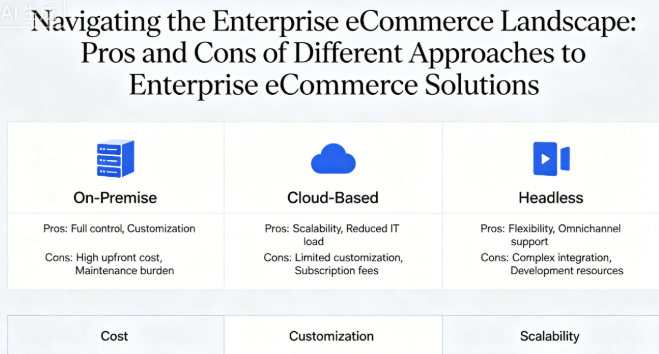
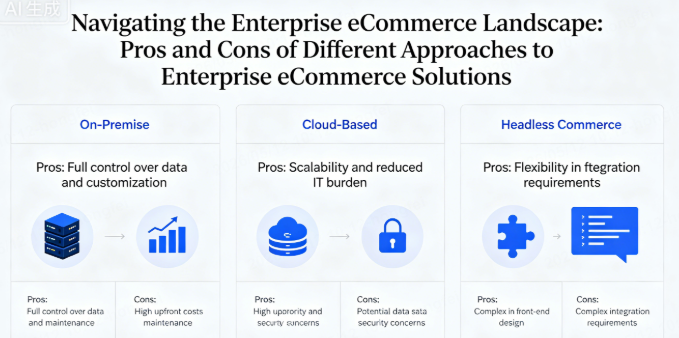
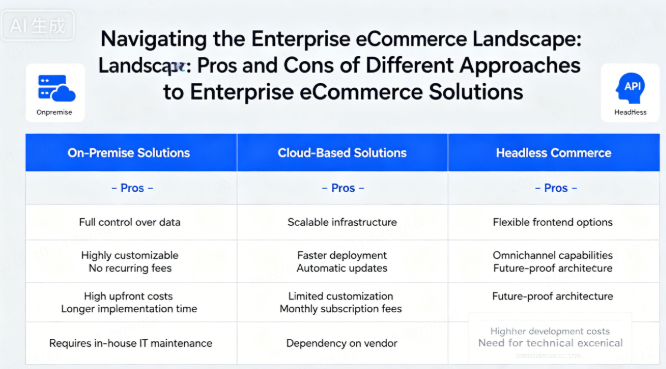
Understanding the pros and cons of different approaches to enterprise eCommerce solutions requires a look at the three primary architectural models dominating the market today.
| Architecture Type | Best For | Pros | Cons |
|---|---|---|---|
| Monolithic | Traditional, slow-changing businesses | Integrated, all-in-one suite | Rigid, difficult to update, high risk |
| SaaS | Companies requiring fast “out-of-the-box” launch | Low maintenance, predictable cost | Limited customization, vendor lock-in |
| Modular / Headless | Agile, high-growth, global enterprises | High flexibility, rapid scaling, API-driven | Requires technical expertise to manage |
1. The Monolithic Dilemma
Monolithic platforms offer an “all-in-one” experience. While convenient, the drawback is that every part of your web store is tightly coupled. Updating a single feature—such as a payment module—often requires a comprehensive rebuild of the entire system.
- Key Risk: Scaling becomes a bottleneck. As your business grows, the “monster” monolith becomes increasingly expensive to maintain and nearly impossible to replace without massive operational disruption.
2. The SaaS Limitations
Software-as-a-Service (SaaS) platforms, such as Salesforce or BigCommerce, provide ease of use and reduced operational overhead. They are excellent for companies that need to hit the market quickly.
- Key Risk: “As-is” functionality. When you need a feature that the vendor doesn’t support natively, you are often stuck. Re-platforming from a closed SaaS model is notoriously painful and costly [1](#virtocommerce.com/blog/enterprise-ecommerce-solutions].
3. The Power of Modular/Headless Architectures
The modern enterprise standard is shifting toward Headless and API-first modular architectures. This approach decouples the front end (the customer interface) from the back-end (commerce logic and data).
- Strategic Advantage: You can update the front-end experience without touching the core commerce engine. This modularity allows for the “atomic” design of your digital ecosystem, where each component connects via API, significantly reducing risk during system upgrades or integrations.
Bridging the Gap: The Role of Global Sourcing
For brands and wholesalers, the value of a digital platform is magnified by the efficiency of their supply chain. Platforms that enable direct procurement from global hubs—like China—provide a distinct competitive advantage in pricing and product variety.
Pro Tip: If your enterprise relies on diverse global sourcing, prioritize platforms that offer seamless integration with B2B sourcing platforms (such as LooperBuy). By automating the procurement data flow directly into your eCommerce back-end, you eliminate manual data entry, reduce order cycle times, and ensure real-time inventory visibility.
5 Essential Questions for Potential Vendors
Before committing to any enterprise solution, ask these strategic questions to avoid future pitfalls:
- What is the “Plan B” if the vendor encounters financial trouble? Ensure your data is exportable in a standard, usable structure.
- How does the system scale? Will doubling your capacity require an expensive, forced server upgrade, or does it scale automatically?
- Is the architecture truly API-first? If all components don’t communicate via API, you will face integration challenges later.
- What is the cadence of security patches? Delays in security updates can be catastrophic for enterprise-level operations.
- How does the platform handle regional variability? Ensure you can manage multiple storefronts (different languages, currencies, tax laws) from a single administrative center.
Expert Conclusion
Choosing the right enterprise eCommerce solution is about balancing immediate operational speed with long-term agility. While monolithic and SaaS solutions offer a simplified start, they often introduce hidden costs and technical limitations as your enterprise scales. The most resilient path forward is a modular, headless architecture that provides the flexibility to innovate while maintaining the stability required for global B2B operations.
Ready to modernize your B2B sourcing and sales operations? Evaluate your existing workflows and identify where your current platform hinders your global growth. For those looking to streamline global procurement alongside their sales, integrating with a comprehensive, API-driven sourcing platform is the next logical step in digital transformation.
References
Frequently Asked Questions (FAQ)
1. Is headless eCommerce really necessary for every enterprise?
Not necessarily, but it is highly recommended for enterprises expecting to scale, operate globally, or require deep customization. If your business model is static and simple, a traditional platform might suffice, but for most modern enterprises, the flexibility of headless is a core competitive advantage.
2. How does API-based architecture improve business agility?
It allows you to swap out or upgrade specific system components—such as your payment gateway, CRM, or search engine—without rebuilding the entire platform. This modularity drastically reduces the time and risk associated with system updates.
3. What is the biggest mistake companies make when replatforming?
Underestimating the complexity of data migration and organizational change. Companies often focus on the platform features but fail to account for how the new system will integrate with legacy ERPs and internal team workflows.
4. Why is B2B procurement integration important?
For B2B wholesalers and brands, your eCommerce store is only as effective as your supply chain. Automating the flow of product data and procurement from global suppliers into your platform ensures you can offer better prices, maintain consistent stock levels, and respond faster to market changes.
5. How do I know if my current platform is a “monolithic monster”?
If simple UI updates take weeks, if your vendor requires a massive re-implementation to add basic features, or if your system struggles to scale during high-traffic events, your platform is likely suffering from monolithic rigidness.
Summary
This article examines the critical trade-offs between monolithic, SaaS, and modular enterprise eCommerce architectures. It emphasizes that while convenience attracts businesses to rigid platforms, high-growth enterprises require the agility and risk mitigation provided by headless, API-first solutions. By integrating global sourcing strategies, businesses can further enhance their efficiency and competitiveness.
Hot tags: Enterprise eCommerce platforms, B2B digital transformation, Headless commerce solutions, Global wholesale sourcing, Scalable B2B architecture, API-first commerce, Multi-channel B2B sales, Supply chain integration, Enterprise SaaS vs custom, B2B procurement automation.