Wholesale hunting apparel is a growing B2B category where sourcing quality, supplier reliability, and seasonal planning directly affect profit. This guide breaks down where to source, what to stock, how to assess suppliers, and how to reduce inventory risk while building a stronger outdoor product line.
Wholesale Hunting Apparel: The 2026 Buyer’s Guide to Sourcing, Quality, and Profit
The wholesale hunting apparel market is no longer just about camo jackets and cold-weather bibs. For B2B buyers, it is now a strategic category shaped by performance fabrics, seasonal demand, customization, and tighter expectations around supplier reliability and delivery speed.
Table of Contents
Why This Category Still Matters
Outdoor recreation participation reached a record 181.1 million people in the U.S. in 2024, which supports continued demand for hunting-related and outdoor performance apparel. At the same time, the hunting apparel market itself continues to expand, with recent estimates placing the market around USD 1.30 billion in 2024 and projecting growth to USD 1.84 billion by 2032.
For buyers, that means the opportunity is not just in selling more products. It is in stocking the right products, at the right time, from the right suppliers, with enough margin to handle freight, defects, and seasonality. In other words, wholesale hunting apparel is a category where procurement quality directly affects retail performance.
What Today’s Buyers Need
Modern hunting apparel buyers usually want more than a low unit price. They need reliable moisture protection, quiet fabrics, durable stitching, and sizing that fits real users in the field. They also need suppliers who can support private label, custom camouflage, or seasonal replenishment without creating inventory risk.
A strong sourcing strategy should balance four things:
– Product performance.
– Supplier trust.
– Order flexibility.
– Landed cost control.
If one of those fails, the whole buying decision becomes harder to scale.
Where To Source
Leading e-commerce platforms for wholesale hunting apparel include GlobalSources.com, Alibaba.com, and Faire, with each platform catering to different procurement models.
| Platform type | Best for | Typical buyer need |
| Verified manufacturer marketplace | Larger B2B orders, customization, stable sourcing | Reduce risk and compare factories |
| Broad global marketplace | Price comparison and large product variety | Find multiple suppliers fast |
| Curated wholesale platform | Boutique retailers and lower-risk opening orders | Easier onboarding and flexible terms |
| Brand outlet / closeout source | Opportunistic margins and lower entry volume | Discount inventory and fast turnover |
GlobalSources emphasizes verified wholesalers and manufacturers, and its hunting clothing listing shows factory-price products from suppliers in China, India, Korea, and other countries. Its hunting apparel guide also stresses product quality, MOQ, payment protection, and supplier verification as core selection factors.
Alibaba remains attractive for breadth, while Faire is better suited to retailers who want curated brand discovery and lower-risk onboarding. For buyers who need niche performance lines or premium closeouts, brand-specific and outlet-style sources can still be useful, but consistency may vary more widely.
Product Segments To Stock
A practical wholesale assortment usually starts with the core categories below. The goal is to build a line that works across climates, hunting styles, and price tiers.
1. Camo basics
These include shirts, hoodies, pants, and lightweight tops in woodland, snow, desert, and digital camouflage. Basic camo is often the entry-level product for retailers because it is easier to price and move.
2. Technical outerwear
This is where higher margins often live. Waterproof-breathable jackets, insulated parkas, and softshell systems appeal to buyers who want field performance, not just visual camouflage.
3. Base layers
Merino blends and synthetic moisture-wicking layers matter because hunters often buy in systems, not single pieces. Good base layers also raise average order value.
4. Hunting pants and bibs
Durability features matter here: reinforced knees, abrasion resistance, weatherproofing, and movement-friendly patterning. These are high-repeat items for serious users.
5. Accessories
Gloves, balaclavas, gaiters, face masks, and headwear are excellent add-ons. They are also helpful for bundling and margin lift.
How To Judge Supplier Quality
The most common mistake in wholesale hunting apparel is treating all listings as equal. They are not. A supplier can offer a good-looking catalog and still fail on stitching quality, fabric accuracy, packaging, or delivery reliability.
A better evaluation process includes:
1. Check whether the supplier is verified or audited.
2. Request samples from at least three suppliers.
3. Compare fabric weight, stitching, zippers, and waterproof claims.
4. Review MOQ, lead time, and payment terms.
5. Confirm defect handling and return rules before placing volume orders.
GlobalSources explicitly recommends checking quality indicators such as reinforced stitching, DWR coatings, fabric specs, branded hardware, and third-party testing for waterproofing or insulation. It also notes that payment protection and return/exchange policies vary, so those should be compared before committing to volume.
A Smarter Sourcing Workflow
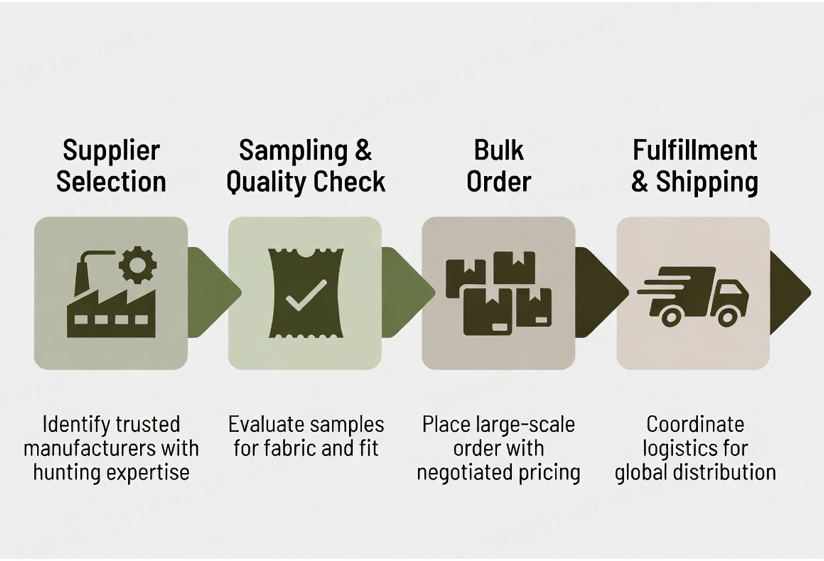
For B2B buyers, the best workflow is usually staged rather than aggressive. Start with shortlisting, then sampling, then a controlled first order, and only then move to a broader line expansion.
A practical workflow looks like this:
1. Define your target customer and climate zone.
2. Choose 2-3 product families first.
3. Request samples with the exact fabric, trim, and logo requirements.
4. Test comfort, noise level, weather resistance, and size accuracy.
5. Place a pilot order before scaling the assortment.
This approach reduces dead stock, especially in seasonal categories where demand spikes but also fades quickly.
Margin Drivers That Matter
Margin in this category depends on more than sourcing price. Freight, duties, sample costs, and product failure rates all influence the final result. Premium technical outerwear usually supports stronger pricing power than simple camo basics, while accessories can improve basket size without much complexity.
Buyers should watch these margin drivers:
– MOQ levels.
– Freight mode.
– Product complexity.
– Custom branding costs.
– Seasonal sell-through speed.
A low unit price is not always the best deal if the supplier has weak lead times, high defects, or a poor reorder structure. In many cases, a slightly higher-cost but more reliable supplier produces better net profit.
2026 Market Shifts
The reference article points to several trends shaping wholesale hunting apparel in 2026, including sustainable materials, smart fabrics, modular systems, inclusive sizing, and selective DTC-to-wholesale expansion. Those trends are important because they influence what buyers should stock now versus what they should only test in small quantities.
Sustainability is especially relevant as more outdoor consumers show interest in eco-friendly materials and lower-impact coatings. Inclusive sizing also matters because the participation base has broadened, with more women and more diverse consumer groups participating in outdoor recreation.
For buyers, the smart move is to test trend-led products without overcommitting. That means limited launches, clear sell-through targets, and strong sample validation before scaling.
How Looperbuy Fits
For buyers who want to reduce stock pressure, warehouse burden, and logistics complexity, a sourcing-and-fulfillment model is often more practical than buying inventory outright. That is where a platform like Looperbuy can add value by helping B2B sellers source from China and support dropship-style fulfillment instead of forcing heavy upfront inventory commitments.
This model is especially useful when:
– You want to test new hunting or outdoor SKUs.
– You want to launch without large warehouse costs.
– You need faster category expansion with lower risk.
– You want to simplify cross-border purchasing and logistics.
In a category as seasonal as hunting apparel, flexibility is often more valuable than overbuying.
Buying Checklist
Before placing a wholesale order, make sure you have confirmed:
– Fabric composition and weight.
– Waterproof or insulation claims.
– Sample quality versus bulk quality.
– MOQ and lead time.
– Payment terms and dispute policy.
– Packaging and labeling requirements.
– Reorder availability for best-sellers.
If a supplier cannot answer these clearly, the risk is probably too high.
Wholesale hunting apparel is a category where product knowledge and supplier discipline matter as much as pricing. Buyers who focus on quality, verified suppliers, and a staged sourcing process are far more likely to protect margins and build repeat sales.
The strongest opportunities now sit in performance outerwear, versatile layering systems, and customized product lines with clear market positioning. If your business wants to reduce inventory risk while still serving international buyers, a flexible sourcing and fulfillment model is often the most practical route.
FAQ
1. What is wholesale hunting apparel?
Wholesale hunting apparel refers to hunting clothing bought in bulk from manufacturers, distributors, or marketplaces for resale or business use.
2. What should I check before choosing a supplier?
Check product quality, MOQ, payment terms, return policy, delivery time, and whether the supplier is verified or audited.
3. Which products sell best in this category?
Common best-sellers include camo basics, technical jackets, hunting pants, base layers, and practical accessories like gloves and face masks.
4. Is private label possible for hunting clothing?
Yes. Many suppliers offer OEM or ODM services, including custom branding, design changes, and private-label development.
5. How can I reduce inventory risk?
Start with samples, place a pilot order, focus on core SKUs first, and avoid overbuying seasonal items before confirming demand.
6. Why does buyer protection matter?
Because wholesale transactions involve quality, delivery, and payment risks, especially in cross-border sourcing.
References
1. Global Sources. “Top 10 Ecommerce Websites for Wholesale Hunting Apparel.” [globalsources]
2. Global Sources. “4768 wholesale ‘Hunting Clothing’ products from 1083 suppliers.”[globalsources]
3. Outdoor Industry Association / Outdoor Foundation. “Outdoor Participation Hits Record Levels for Ninth Consecutive Year.”[outdoorindustry]
4. Outdoor Magazine. “How is the outdoor sector doing in the United States?” [outdoormagazine]
5. Data Bridge Market Research. “Global Hunting Apparel Market Size, Share and Trends.” [databridgemarketresearch]