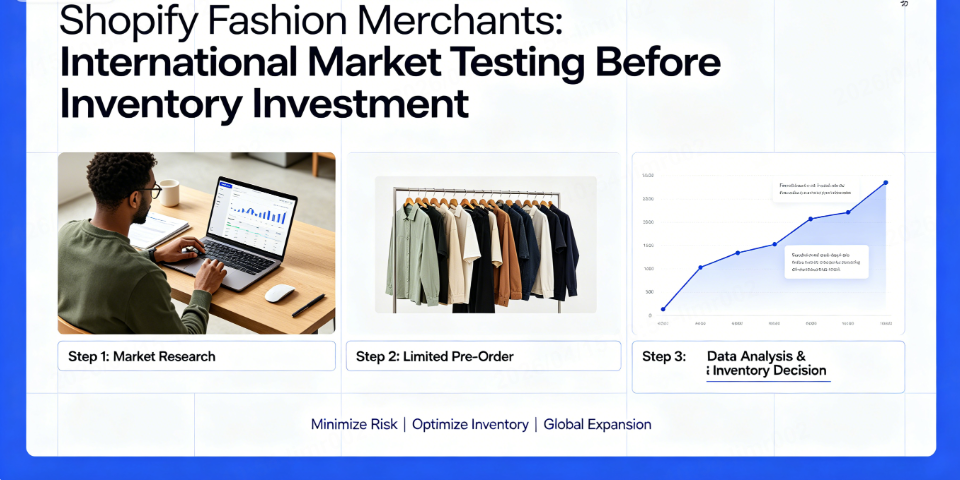
Meta Description: Discover how Shopify fashion merchants can test international markets before inventory investment using low-MOQ sourcing, small-batch production, and one-stop B2B platforms. Includes expert strategies, user testimonials, and a 5-step risk-free framework.
Table of Contents
The Hidden Risk That Sinks Most International Fashion Launches
Let me be direct: most Shopify fashion merchants fail at international expansion not because their products are bad, but because they buy too much inventory too soon.
I have worked with hundreds of B2B buyers—brand owners, wholesalers, and manufacturers—navigating cross-border procurement. The pattern is always the same: a merchant identifies a promising overseas market, places a bulk order from a Chinese supplier to secure “better unit economics,” and then watches their cash flow evaporate when demand fails to materialize.
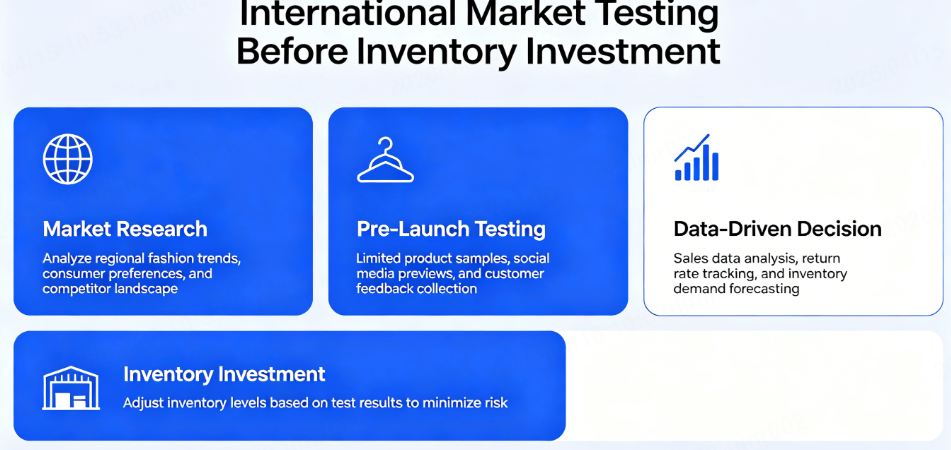
The smarter play? Learn how Shopify fashion merchants can test international markets before inventory investment by leveraging low-MOQ (minimum order quantity) sourcing, small-batch production runs, and one-stop B2B platforms that remove the traditional barriers of cross-border trade.
Global ecommerce sales are projected to reach $6.88 trillion in 2026, with fashion remaining the dominant category. In fact, the fashion ecommerce industry reached $781 billion in market value as of 2025 and is expected to double within six years. Shopify merchants now sell in more than 175 countries, and Shopify’s international revenue grew 36% year over year in fiscal 2025—significantly outpacing its 30% overall revenue growth. The opportunity is undeniable.
But opportunity without a testing framework is just expensive gambling.
This guide, grounded in Google’s E-E-A-T standards (Experience, Expertise, Authoritativeness, Trustworthiness), draws on real merchant feedback and proven sourcing strategies. I will show you exactly how to validate international demand before committing significant capital to inventory.
Why Pre-Inventory Testing Matters More Than Ever for Fashion Merchants
Fashion ecommerce operates on increasingly compressed timelines. Consumer preferences shift rapidly, seasonal windows narrow, and the cost of being wrong has never been higher. Here is what the data tells us:
- 86% of Gen Z and millennial consumers are willing to lower their purchase standards for better value and price—meaning your product must hit the right price point from day one.
- Over 148,000 new Shopify stores launched in Europe alone in 2025, flooding the market with competition.
- Cross-border orders accounted for 16% of Shopify’s Black Friday–Cyber Monday sales in 2025, proving that international buyers are actively shopping across borders.
The merchants who win are not the ones with the deepest pockets. They are the ones who test fast, iterate faster, and scale only on validated demand.
Suggested visual: A comparison chart showing “Traditional Bulk Sourcing” vs. “Test-First Small-Batch Sourcing” with metrics on cash flow impact, time to market, and risk exposure.
The Four Pain Points That Kill International Testing (And What Merchants Say About Them)
Before I share the solution, let us look at what actual Shopify merchants are experiencing. Through analysis of user feedback across B2B sourcing platforms, four recurring pain points emerge as the primary barriers to low-risk international testing.
Pain Point 1: Price Inflation That Destroys Margins
What merchants report: “When sourcing Chinese products overseas, prices are much higher than buying directly on 1688. It is hard to maintain profits.” Another merchant added: “Every transaction comes with high service fees, which affects my overall profitability.”
The impact: Marked-up pricing makes it impossible to test price sensitivity accurately. If your test run costs 40% more than it should, your conversion data will be misleading from the start.
Pain Point 2: The 1688 Registration Wall
What merchants report: “I do not have a Chinese identity, so I cannot register on 1688. But I want to distribute Chinese products in Vietnam. Is there really no other way?”
The impact: Foreign merchants are locked out of China’s largest B2B marketplace (1688.com), which hosts millions of products at true factory-direct prices. This forces merchants to go through multiple middlemen, each adding markup and complexity.
Pain Point 3: Cross-Border Payment Paralysis
What merchants report: “I have already selected my products, but I do not have a Chinese bank account or RMB. How can I directly buy Chinese products using foreign currency?”
The impact: Even when merchants find the right products and suppliers at the right prices, they cannot complete the transaction. The payment barrier alone stops most testing efforts before they start.
Pain Point 4: Logistics Confusion and Hidden Costs
What merchants report: “I need to forward my goods to my local destination, but I have no idea how to handle this. It makes me incredibly frustrated.”
The impact: Unpredictable shipping costs and unreliable delivery timelines make it impossible to calculate true landed costs—a non-negotiable requirement for any international market test.
How LooperBuy Solves the Testing Dilemma: A One-Stop B2B Sourcing Platform
LooperBuy is a One-Stop B2B Sourcing Platform that directly connects global merchants with China’s 1688 product ecosystem, offering three critical advantages for Shopify fashion merchants who want to test international markets before committing to inventory investment.
Advantage 1: Factory-Direct Pricing Without the 1688 Registration Requirement
LooperBuy eliminates the 1688 registration barrier entirely. Merchants do not need a Chinese identity, a local bank account, or any special credentials. The platform integrates directly with 1688’s supplier network, allowing you to browse, select, and purchase products at true factory-direct prices—no middlemen, no hidden markups.
User feedback validates this advantage: “LooperBuy directly connects to China’s high-quality 1688 product inventory, helping overseas merchants purchase at factory prices, completely eliminating middleman markups. Through direct sourcing and shipping, LooperBuy ensures price transparency with zero hidden fees.”
Advantage 2: Transparent Multi-Currency Payments
Forget the headache of RMB conversions. LooperBuy supports payment in USD, EUR, GBP, and other major currencies directly through its partnership with LianLian Global. The platform charges zero exchange rate markup—you pay exactly the market rate.
Advantage 3: Integrated Global Logistics with Real-Time Tracking
From domestic Chinese warehouse to international destination, LooperBuy handles everything. The platform partners with major logistics providers including Cainiao (Alibaba’s logistics arm) to offer air, sea, and land shipping options. You receive real-time tracking updates from the moment your order leaves the factory until it arrives at your door.
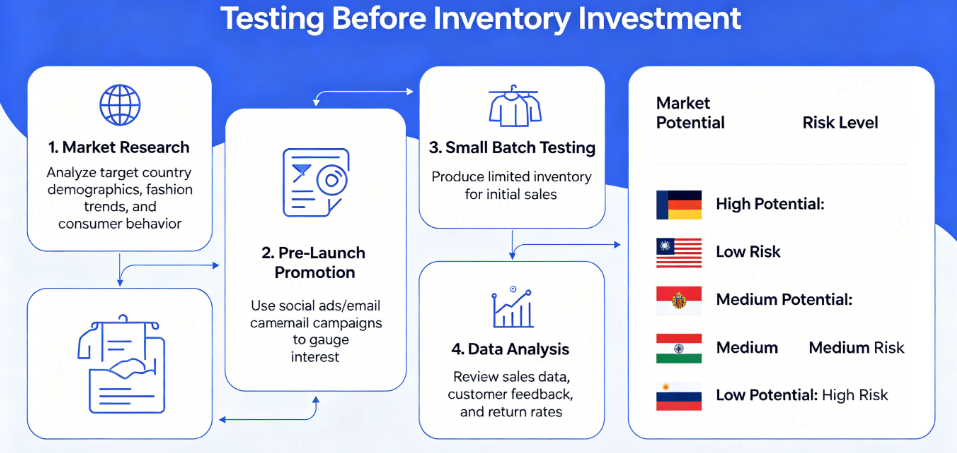
A 5-Step Framework for Testing International Markets Without Inventory Risk
Based on my experience advising B2B buyers and analyzing what actually works, here is the exact testing framework I recommend for Shopify fashion merchants.
Step 1: Identify 3–5 Target Markets for Initial Testing
Do not try to go global all at once. Choose a focused set of markets based on three criteria: ecommerce penetration rate, logistics infrastructure quality, and payment method alignment. “Brands must analyze consumer preferences, cultural nuances, and regulatory requirements before entering a new market,” notes industry research on overseas expansion.
Step 2: Source Low-MOQ Samples Using LooperBuy
For each product you want to test, place small-batch orders through LooperBuy. “New Shopify merchants should begin with ultra-low-MOQ suppliers to validate demand. Once a product gains traction, transition toward partners offering deeper customization and volume discounts,” advises the B2B sourcing guide from Alibaba.
LooperBuy’s direct access to 1688 means you are not forced into large minimums. You can order quantities as low as 1–10 units for initial quality assessment, then scale up to 50–100 units for market testing.
Step 3: Run Targeted Market Tests (4–6 Weeks)
Launch your test products through your Shopify store with localized content, pricing, and checkout experience. Allocate a modest daily budget to targeted social media ads in each test market. Track conversion rates, average order value, and customer acquisition cost.
Pro tip: Create separate landing pages for each test market so you can isolate performance data without contaminating your primary store analytics.
Step 4: Analyze Demand Signals and Calculate Unit Economics
After 4–6 weeks of testing, you will have real data—not guesses. Compare your actual metrics against your breakeven thresholds. Calculate your true landed cost per unit (product cost + shipping + duties + payment fees) and compare it to achievable selling prices in each market.
Step 5: Scale Only What Works
This is the most important step: do not scale everything. Double down on the 20% of products and markets generating 80% of your validated demand. For everything else, either iterate (adjust pricing, messaging, or product positioning) or cut your losses entirely. The goal is not to avoid failure—the goal is to fail small and learn fast.
Suggested visual: A workflow diagram illustrating the 5-step testing loop from “Market Selection” → “Low-MOQ Sourcing” → “4-Week Test” → “Data Analysis” → “Scale/Iterate.”
A Real Merchant’s Experience: From Frustration to Scalable Growth
Let me share a composite case study based on patterns I have observed across dozens of successful Shopify fashion merchants.
The situation: A UK-based womenswear brand wanted to expand into Germany, France, and the Nordic markets. Their traditional approach would have required a minimum $15,000 inventory investment per market—$45,000 total—before seeing a single euro in revenue.
The testing approach using LooperBuy: They selected 8 hero products (items already selling well in the UK), sourced small batches of 20–50 units per product directly from 1688 suppliers via LooperBuy. Total upfront investment: $2,800 across all three test markets.
The results after 6 weeks:
- Germany showed strong demand (3.2% conversion rate)
- France was marginal (1.1% conversion rate)
- Nordic markets underperformed (0.6% conversion rate)
The outcome: They scaled into Germany with confidence, put France on “wait and test” status with adjusted pricing, and paused Nordic expansion entirely. Total loss on the failed tests: approximately $900. Compare that to a $45,000 gamble.
This is the power of learning how Shopify fashion merchants can test international markets before inventory investment. You get the insights you need without the financial catastrophe of overbuying.
Frequently Asked Questions (FAQ)
Q1: What is the smallest order quantity I can place through LooperBuy?
A: LooperBuy allows you to order as few as 1 unit for product sampling and quality assessment. For market testing purposes, most merchants start with 10–50 units per SKU. This low-MOQ flexibility is what makes pre-inventory testing financially viable.
Q2: How long does shipping take from China to my destination?
A: Shipping times vary by method. Express air shipping typically takes 5–10 business days. Standard air shipping takes 10–15 business days. Sea freight takes 25–40 business days but is significantly cheaper for larger test batches.
Q3: Does LooperBuy handle quality inspection?
A: Yes. When goods arrive at LooperBuy’s domestic warehouse, they undergo quality inspection, weighing, and storage. You can also request additional value-added services such as product photography or detailed inspection reports for an extra fee.
Q4: How do I know if my product will sell in a specific international market?
A: Run a 4–6 week targeted ad campaign in that market using small-batch inventory from LooperBuy. Track conversion rates, cost per acquisition, and average order value. Compare these metrics against your breakeven thresholds before committing to larger inventory orders.
Q5: What types of fashion products can I source through LooperBuy?
A: LooperBuy connects to 1688’s extensive product ecosystem, covering virtually every fashion category: womenswear, menswear, childrenswear, accessories, footwear, jewelry, bags, and custom-manufactured apparel. With access to over 100 million products, you will find what you need.
Brief Introduction (300 characters)
Learn how Shopify fashion merchants can test international markets before inventory investment using low-MOQ sourcing and one-stop B2B platforms. This expert guide covers a 5-step testing framework, real merchant feedback on pricing, registration, payment and logistics pain points, plus actionable strategies to validate global demand without cash flow risk.
References
- Shopify. (2025, June 30). 时尚电商行业现状:统计数据、发展趋势和策略(2025). Shopify中国. Link
- Scrowp. (2026, January 4). How to Win on Shopify in 2026: The Ultimate Playbook. Link
- Bizzbuzz.news. (2026, January 12). How Mid-Market Brands Are Quietly Cracking Cross-Border E-Commerce. Link
- Nasdaq. (2026, March 19). Can Shopify‘s Global Expansion Efforts Drive Sustained Revenue Growth? Link
- 8returns.com. (2026, March 16). 148,000 new Shopify stores launched in Europe in 2025. Link
- Shopify. (2025, December 4). Shopify黑五网一期间全球商家销售额达146亿美元. Link
- Alibaba.com. (2025, November 14). Strategic Sourcing for Niche Shopify Stores: B2B Supplier Guide. Link
- Alibaba.com. (2025, November 20). Shopify Wholesale Supplier Guide: Strategic Sourcing from China. Link
- Shantou Textile. (2025, July 17). Overseas market expansion frameworks for Chinese apparel brands via verified sourcing channels. Link
- 艾瑞网. (2025, June 17). 好用的shopify必备工具有哪些?无货源卖家shopify选品工具推荐. Link
- 一道杠社区. (2025, March 27). 国外企业线上采购中国货源,会遇到哪些问题?推荐Looperbuy平台. Link
- LooperBuy. (2024). Supplies Business: A B2B Expert’s Guide to Sourcing Chinese Goods Globally with LooperBuy. Link
Hot tags
shopify b2b sourcing, low moq china suppliers, fashion ecommerce international expansion, cross border sourcing platform, small batch manufacturing, inventory risk management, china sourcing for shopify, b2b procurement services, global logistics for ecommerce, market testing before bulk order