This article provides a systematic guide on how to vet dropshipping suppliers before scaling up ad spend. It covers everything from sample testing, communication speed, and logistics performance to policy transparency and supplier comparisons, helping sellers verify fulfillment capabilities and minimize the risks of refunds, negative reviews, and wasted advertising budget.
How to test dropshipping suppliers before scaling ads is one of the smartest decisions you can make before increasing ad spend. If your supplier is slow, inconsistent, or unclear about policies, paid traffic will amplify those problems instead of fixing them. Before you scale, you need proof that the supplier can fulfill orders accurately, communicate fast, and support a customer experience that matches your brand promise.
For B2B sellers and cross-border merchants, this is even more important. A supplier that looks acceptable on a product page may still fail in real operations: delayed dispatch, weak packaging, missing tracking, or poor issue handling. When ad budgets increase, these weaknesses become expensive very quickly.
Table of Contents
Why supplier testing comes before ad scaling
Scaling ads should never be treated as a traffic decision alone. It is also an operational readiness decision. The stronger your supplier process, the safer your growth becomes.
Paid traffic compresses expectations. A store that receives five orders a week can survive a few mistakes. A store receiving fifty or five hundred orders a day cannot. If the supplier fails once, the customer may forgive it. If the supplier fails repeatedly under scaling pressure, refund rates rise, reviews drop, and ad efficiency weakens.
Google Merchant Center emphasizes shipping transparency and accurate fulfillment information, which means your store must reflect what your supplier can truly deliver. If your supplier says one thing and your website promises another, the customer experience breaks before the product even arrives.
What to test first
Before you think about advertising scale, test the supplier on the areas that affect conversion, retention, and support costs the fastest.
– Product quality. Check materials, finish, size accuracy, and packaging.
– Processing speed. Measure how long it takes from order placement to dispatch.
– Shipping consistency. Compare promised delivery time with real delivery time.
– Communication speed. Time how long they take to answer simple and specific questions.
– Tracking reliability. Confirm tracking numbers are generated promptly and remain active.
– Policy clarity. Review returns, replacement, refund, and cancellation rules.
A supplier can be strong in one area and weak in another. For example, a product may look excellent, but if the supplier takes three days to confirm dispatch or gives vague answers about damaged items, scaling ads is still risky. The goal is not to find a perfect supplier. The goal is to find one that is reliable enough to handle growth.
A practical testing framework
The best way to test suppliers is to use a repeatable framework. That prevents emotional decisions and makes comparisons much easier. A simple three-stage framework works well: verify, order, and stress test.
1. Verify basic legitimacy
Before you place any sample order, confirm that the supplier is a real operating business. Ask for business registration details, warehouse location, shipping methods, and policy documents. If the supplier hesitates to provide basic information, that is often the first warning sign.
Alibaba’s own supplier verification language is useful here because it makes an important distinction: verification confirms legal registration, but it does not guarantee reliable performance. In other words, a badge may prove the supplier exists, but it does not prove they can fulfill your customers properly.
At this stage, ask questions such as:
– Where do you ship from?
– How many orders do you process daily?
– What is your average handling time?
– Do you support branded or neutral packaging?
– What happens if an item is delayed or damaged?
– Can you provide replacement or refund terms in writing?
Clear suppliers usually answer quickly and consistently. Weak suppliers often give partial answers, generic replies, or overly optimistic claims.
2. Place a real test order
A test order is the most valuable proof you can get before scaling ads. It shows how the supplier performs under a live transaction. Do not treat it like a routine sample request. Treat it like a full customer order.
The order should mimic a real purchase as closely as possible. Use a real shipping address, a normal cart flow, and a customer-style payment method if possible. Check how long it takes to confirm the order, how the tracking is shared, and whether the item that arrives matches the listing.
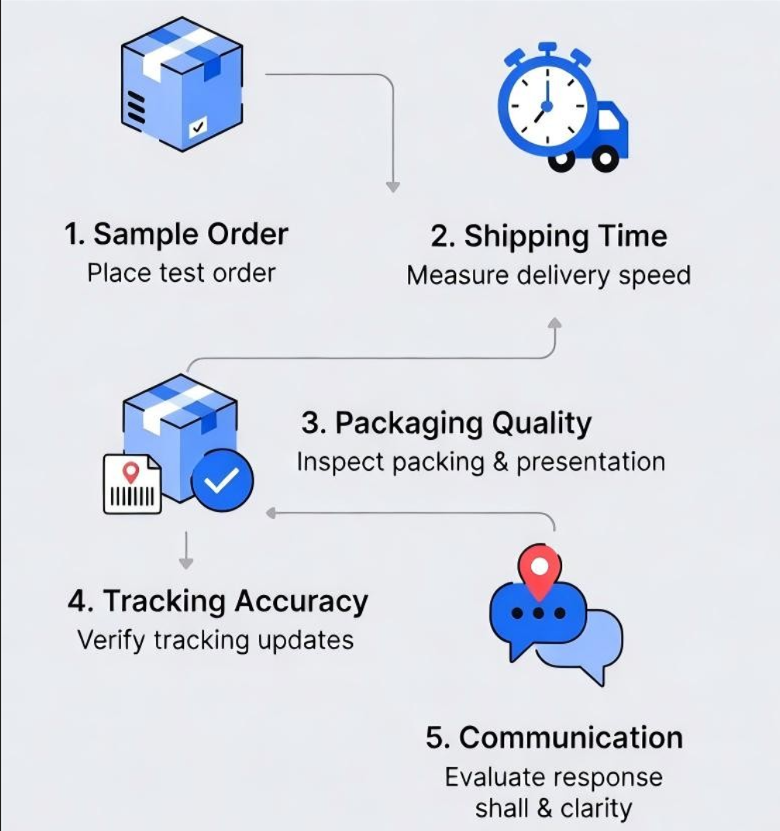
Your test order should evaluate:
– Order confirmation speed.
– Packaging quality.
– Product accuracy.
– Dispatch time.
– Tracking visibility.
– Delivery time.
– Customer support responsiveness.
If the product arrives with poor packaging, incorrect labeling, or visible damage, that is a serious signal. If the delivery time is much longer than promised, you should assume your ad campaigns will eventually inherit that problem.
3. Stress test the workflow
A supplier can sometimes perform well on a normal order but fail when the workflow becomes more complicated. That is why you need a stress test.
Try small operational scenarios such as:
– Changing the delivery address after checkout.
– Asking about a lost parcel.
– Requesting a partial cancellation.
– Inquiring about out-of-stock inventory.
– Requesting a replacement for a defective item.
– Checking whether tracking updates happen automatically or manually.
These tests reveal the supplier’s real operational maturity. Some suppliers look strong in sales conversations but become slow, defensive, or vague once a problem appears. That is exactly the kind of supplier you want to detect before your ad budget grows.
Supplier scorecard
A scorecard turns subjective judgment into a more objective decision. Instead of saying a supplier “feels good,” you can compare measurable factors. This is especially useful when testing several vendors for the same product.
Example scorecard factors
| Factor | What to measure | Strong result |
| Product quality | Material, finish, defects, consistency | Matches sample and listing |
| Processing speed | Order-to-dispatch time | Fast and stable |
| Shipping performance | Transit time, tracking accuracy | Predictable delivery window |
| Communication | Reply speed, clarity, professionalism | Clear replies within 24 hours |
| Policy quality | Refunds, returns, replacements | Written and practical policies |
| Scalability | Ability to handle more volume | No hesitation on capacity |
You can assign each category a score from 1 to 5, then weight the categories based on your niche. For example, if you sell cosmetic products, packaging and damage handling may matter more. If you sell auto parts or technical items, product consistency and replacement policies may be more important.
Using a scorecard also helps with supplier reviews later. When the business starts scaling, you can compare the original test results with actual performance and decide whether the supplier still deserves volume.
Red flags to watch for
Some supplier problems are visible immediately, while others appear only after the first few orders. Both types matter.
Watch for these warning signs:
– Unclear business identity. The supplier cannot confirm legal registration or warehouse location.
– Too-good-to-be-true promises. Delivery times or prices seem unrealistic.
– Slow responses. Simple questions take too long to answer.
– No test sample availability. The supplier refuses to ship samples.
– Inconsistent shipping answers. Different team members give different timelines.
– Weak policy language. No written return, replacement, or refund process.
– Branding mismatch. Packaging or inserts do not align with your store positioning.
Google’s shipping guidance reinforces the importance of transparent fulfillment information. If your supplier cannot support transparent shipping details, the risk of customer confusion and complaints rises quickly.
Another strong warning sign is overconfidence without proof. Some suppliers claim they are “the best” but cannot explain their process. Reliable suppliers usually sound structured, not exaggerated.
How to compare multiple suppliers
One of the best ways to protect your ad budget is to compare at least three suppliers before committing to one. This creates a practical benchmark and helps you avoid choosing the first supplier that looks acceptable.
A simple comparison process looks like this:
1. Shortlist three suppliers for the same product.
2. Ask each supplier the same set of questions.
3. Compare pricing, shipping method, and policy clarity.
4. Order one sample from each.
5. Record handling speed, packaging quality, and delivery time.
6. Send one follow-up question to test response time.
7. Choose the supplier that performs best in real conditions.
This process is useful because price alone is often misleading. A lower-cost supplier may actually cost more if they create more refunds, more support tickets, or more negative reviews. In many cases, the best supplier is not the cheapest one; it is the one that reduces hidden costs.
Testing for scale, not just for launch
A supplier that works for launch may not work for scale. That is why your testing should look beyond one-off delivery success and ask a bigger question: Can this supplier handle increased volume without breaking?
You can test scaling readiness by asking:
– How many orders can you process per day?
– What happens during peak periods?
– Do you have backup inventory?
– Can you prioritize fast-moving SKUs?
– How do you handle holiday delays?
– Do you offer bulk order support or consolidated fulfillment?
These questions matter because ad scaling usually reveals bottlenecks that were invisible during a small test. A supplier with weak inventory control may be fine for ten orders a week, but once traffic rises, out-of-stock issues may become frequent. That creates a painful mismatch between ad spend and fulfillment capacity.
The customer experience angle
A lot of merchants think supplier testing is only about logistics. In reality, it is also about customer experience. Every supplier decision shapes the way your brand feels to the buyer.
Fast replies reduce anxiety. Clean packaging improves perceived value. Accurate tracking builds trust. Clear policies reduce support friction. Each of these factors makes the purchase feel more professional.
This is especially important for B2B-oriented sellers or cross-border buyers, where customers often expect more reliability than they do from a typical low-ticket impulse store. If your brand promises convenience, the supplier must help you deliver it. A broken post-purchase experience can undermine even the best-performing ad campaign.
A deeper operational checklist
Before scaling ads, review this checklist with every supplier you are considering:
– Can they provide a sample without delay?
– Do they communicate in a clear, professional way?
– Do they have a stable shipping method for your target market?
– Are their handling times realistic?
– Do they offer order tracking quickly?
– Is their packaging acceptable for your niche?
– Are their returns and replacements written clearly?
– Can they support higher volume if demand rises?
– Do they show consistency across multiple test orders?
– Can they maintain quality under pressure?
If you cannot answer “yes” to most of these, you are not ready to scale ads. It is better to delay growth by a few days or weeks than to scale into a supplier problem that becomes expensive to fix.
Common mistakes sellers make
Many sellers make the same mistakes when evaluating suppliers. Avoiding them will save time and money.
Mistake 1: Choosing only by price
Cheap suppliers can create expensive problems. Low initial cost does not matter if the customer experience collapses.
Mistake 2: Testing only once
One sample order is useful, but it is not enough. A second test order often reveals consistency problems.
Mistake 3: Ignoring communication speed
Slow replies during testing usually become slower once order volume rises.
Mistake 4: Trusting badges without proof
Verification badges may prove identity, but they do not guarantee operational quality.
Mistake 5: Scaling before solving logistics
A working ad strategy cannot fix a broken fulfillment process.
Looperbuy advantage for B2B sellers
For B2B sellers, using a platform like Looperbuy can reduce sourcing friction because it is built around China purchasing and dropshipping support. That makes it easier to compare suppliers, test fulfillment quality, and manage logistics without carrying inventory.
This matters because the supplier selection stage is not only a procurement step. It is also a growth protection step. A better supplier improves not just product flow, but also margin stability, customer satisfaction, and operational confidence.
In practice, that means you can test more efficiently, manage multiple sourcing options, and reduce the chance that one weak fulfillment partner damages your paid traffic results.
When to scale ads
You should only scale ads after the supplier passes your baseline test. That means the sample arrived on time, matched expectations, and the supplier responded well during the entire process.
A good rule is to wait until you have:
– At least one clean sample order.
– At least one repeat order test.
– Clear written policies.
– Reliable tracking updates.
– A backup supplier for your best-selling item.
This gives you more control over cost per acquisition because you are not scaling into uncertainty. If your supplier can already handle pressure at a small level, the chance of failure is much lower when traffic increases.
Before scaling ads, prove that your supplier can deliver the customer experience your brand promises. Test the product, the process, the response time, and the policies before you invest heavily in traffic. The best campaigns are not only well-optimized; they are supported by suppliers that can handle growth.
A strong supplier test process protects your budget, your brand reputation, and your customer satisfaction. In dropshipping, that is not a side task. It is one of the core foundations of profitable scaling.
FAQ
1. How many suppliers should I test before scaling ads?
Test at least three suppliers for the same product so you can compare quality, delivery, and communication side by side.
2. What is the most important supplier metric?
Processing speed and communication speed usually matter most because they directly affect customer expectations and support workload.
3. Should I always place a sample order?
Yes. A sample order is the most reliable way to check product quality, packaging, delivery time, and tracking behavior.
4. How do I know if a supplier can handle scaling?
Ask about capacity, inventory control, tracking automation, and exception handling, then verify with repeat test orders.
5. What if the supplier looks good but replies slowly?
Slow replies are a serious warning sign because operational issues usually become worse as order volume rises.
6. Can I trust supplier badges alone?
No. Verification badges may confirm only a basic level of legitimacy and do not guarantee reliable fulfillment performance.
References
– Shopify Help Center. [Placing a test order].
– DHL Malaysia. [How to Evaluate Suppliers for Dropshipping].
– Google Merchant Center Help. [Operations and logistics].
– Alibaba. [Supplier Verification].
– 365 Dropship. [Supplier Vetting Checklist for Dropshipping Due Diligence].
– 365 Dropship. [Supplier Test Order Framework: 6 Rules Before Scaling].
– EcomBiz.AI. [How to Vet and Build Relationships with Reliable Ecommerce Dropshipping Suppliers].