Learn how to use Facebook Marketplace analytics for dropshipping to turn views, saves, shares, and buyer messages into smarter product decisions. This practical guide explains how to diagnose weak listings, run controlled tests, improve conversion, validate suppliers, and scale with reliable fulfillment.

Facebook Marketplace can be more than a place to post products and wait for buyers. For a disciplined dropshipper, it is a live source of customer intent. Every view, save, share, and message can reveal what shoppers want, where a listing creates doubt, and which products deserve more inventory attention.
The goal is not to chase vanity metrics. The goal is to use Facebook Marketplace analytics for dropshipping to make better decisions about product selection, pricing, listing creative, customer service, and supplier fulfillment.
For sellers using Chinese sourcing and fulfillment partners such as Looperbuy, this approach has an additional advantage: you can test demand before committing to bulk inventory. Instead of guessing what will sell, you can identify promising products with real buyer behavior, then build a faster and more dependable fulfillment workflow around them.
> Key principle: A listing does not fail simply because it has low sales. It fails when you cannot explain which stage of the buyer journey is causing the drop-off.
Table of Contents
Why Facebook Marketplace Data Matters for Dropshippers
Marketplace shoppers are usually closer to purchase intent than general social-media users. They are actively searching, comparing listings, asking delivery questions, and evaluating seller credibility. That makes the platform useful not only for selling, but also for learning.
A Marketplace listing can show several useful engagement signals:
– Views: People who opened the listing after seeing its title and main image.
– Saves: Shoppers who may be comparing options, waiting to buy, or sharing the decision with someone else.
– Shares: A sign that a product may be useful, giftable, unusual, or socially relevant.
– Messages: Direct questions that often expose the real reasons buyers hesitate.
These signals are akin to “breadcrumb” clues left by the customer. Views reveal whether your initial presentation works; saves can indicate consideration; shares can extend organic reach; messages contain language you can use to improve the listing itself.
However, one metric alone rarely tells the full story. A listing with 1,000 views and no messages has a very different problem from a listing with 50 views and 12 serious buyer questions.
Build a Simple Marketplace Listing Scorecard
Do not review listings randomly. Track each product weekly in a simple spreadsheet. This gives you a repeatable way to compare products, spot patterns, and decide what to test next.
| Metric | What It Can Signal | Likely Issue When Weak | First Action to Take |
| Views | Title and cover image attract attention | Weak product positioning or unappealing hero image | Test a new image or rewrite the title |
| Saves | Product has consideration value | Price, delivery promise, or trust barrier | Compare price and clarify delivery details |
| Shares | Product has emotional or practical appeal | Limited visibility or unclear use case | Create lifestyle content around the use case |
| Messages | Strong buyer intent or unresolved objections | Missing information or slow response | Add answers to the listing and reply quickly |
| Orders | Real commercial validation | Friction between interest and checkout | Audit price, shipping, and supplier reliability |
| Cancellation or delay rate | Operational health | Inventory, dispatch, or tracking problem | Pause scaling and fix fulfillment first |
Use ratios where possible. For example:
Save Rate=Saves÷Views×100
Message Rate=Messages÷Views×100
You do not need to compare your ratios with an arbitrary “perfect” industry benchmark. Compare a product against your own catalog, then watch whether the ratio improves after one controlled change.
Read the Patterns, Not Just the Numbers
High Views, Low Saves, and Few Messages
This is the classic “curiosity without confidence” pattern. Your title or first photo is doing its job, but buyers are leaving after they click.
In my experience, the most common reasons are:
– The price looks too high relative to similar listings.
– The main image promises more than the product details prove.
– Shipping time, dimensions, materials, or compatibility are unclear.
– The description sounds generic and does not answer practical questions.
– The listing lacks trust signals, such as clear returns, tracking, or realistic photos.
Start with a competitor scan. Search Marketplace for similar products and compare the first image, price range, bundle quantity, delivery statement, and review profile. Do not automatically become the cheapest seller. Instead, make your value easier to understand.
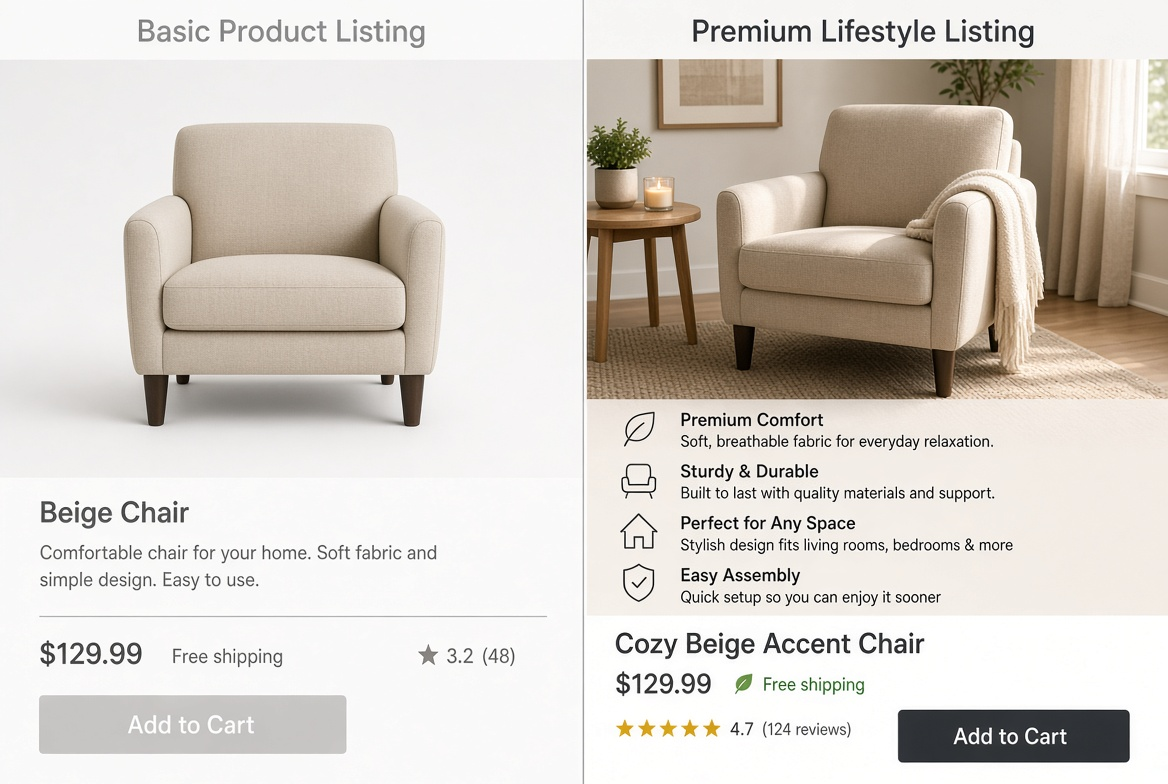
For example, “Portable Blender” is vague. “Rechargeable Portable Blender, 6-Blade, USB-C Charging, Includes Travel Lid” explains more value before the buyer even opens the listing.
Low Views, Strong Engagement
A low-view listing with meaningful saves or messages may be a hidden opportunity. The offer works for people who discover it, but discovery is weak.
Test one of the following:
1. Replace the main image with a clear lifestyle image that shows scale or use.
2. Rewrite the title around the buyer’s use case, not just the product name.
3. Add a relevant variation, bundle, color, or problem-solving feature to the title.
4. Review the category and product attributes for accuracy.
5. Renew or repost only after making a genuine improvement to the listing.
For a desk lamp, “LED Lamp” is too broad. “Dimmable LED Desk Lamp for Home Office, USB Charging Port” speaks to a clearer shopping need.
Many Messages, Few Orders
Messages are valuable, but they should not become a permanent manual sales process. If buyers repeatedly ask the same question, that question belongs in the first part of your listing.
Review the latest 10 to 20 messages for each product. Create a “question log” and group the questions into themes:
– “Does it include batteries?”
– “Will it fit a 15-inch laptop?”
– “When will it arrive?”
– “Is this item available in blue?”
– “Can I return it if it does not fit?”
Then rewrite the listing to answer the most frequent question before the buyer has to ask. This reduces friction, saves support time, and improves the quality of incoming conversations.
Use a 7-Day Product Testing System
The fastest way to waste time is to change five things at once and then assume you know why results changed. Instead, run short, controlled tests.
Day 1: Establish a Baseline
Record views, saves, shares, messages, orders, product cost, shipping cost, estimated delivery time, and customer questions. Also take a screenshot of the existing listing so you can review the original version later.
Days 2–3: Test the First Image
Change only the hero image. Test a product-in-use photo, a scale reference, or a clear benefit-focused visual. Avoid misleading imagery; the image should accurately represent what buyers receive.
Days 4–5: Test the Title
Keep the best image and rewrite the title. Use the product name, a high-value feature, and the primary use case. Do not overload it with every feature or repeated phrases.
Days 6–7: Improve the Offer
Keep the image and title stable. Test one offer-level variable:
– A bundle instead of a single unit.
– A clearly stated shipping estimate.
– A limited but truthful promotion.
– A stronger return or tracking statement.
– A better explanation of materials, sizing, or compatibility.
At the end of the week, keep the winner only if it improves a meaningful business outcome: more qualified messages, better order conversion, fewer support questions, or stronger margin.
Let Customer Messages Shape Your Product Research
Marketplace messages can reveal more than listing problems. They can help you find adjacent products to source.
Suppose a rechargeable closet light receives repeated questions about motion sensors, warm lighting, and magnetic mounting. That is not just feedback for one listing. It is evidence of a broader category opportunity.
You could expand into:
– Motion-sensor cabinet lights.
– Under-bed safety lights.
– Rechargeable stair lights.
– Magnetic light strips.
– Multi-pack home-organization bundles.
This is a better expansion method than adding random trending products. You are using language from real shoppers to identify related demand.
When sourcing from China, ask suppliers specific questions before listing a related product:
– What is the actual processing time?
– Is the product available consistently in the requested variants?
– Can the supplier provide quality-control photos before dispatch?
– Is trackable shipping available to the destination market?
– What packaging will the buyer receive?
– What is the return or defect-handling process?
A product that generates demand but cannot be delivered consistently is not a winning product. It is a future customer-service problem.
Protect Performance With Fulfillment Discipline
Analytics can improve a listing, but they cannot compensate for late shipments, invalid tracking, or inconsistent product quality. In dropshipping, fulfillment is part of the customer experience and part of your marketplace reputation.
Meta’s seller-protection terms state that sellers must provide valid tracking information and ship orders within the applicable handling period; the published policy notes that orders not shipped within seven calendar days may be automatically cancelled.
Before scaling a product, confirm these operational points:
– The supplier has current stock, not an outdated catalog listing.
– Product images and specifications match the actual item.
– The shipping method supports valid tracking.
– Handling and transit estimates are realistic.
– Your margin can absorb refunds, replacements, or damaged-item claims.
– You can answer buyers promptly when a delivery exception occurs.
Also review Meta’s Commerce Policies before listing. Products and listings that violate platform rules can be removed, and access to commerce features may be restricted.
For sellers using a sourcing partner, the ideal workflow is simple: validate the product with Marketplace signals, confirm supplier stock and quality, test fulfillment with a small order volume, then scale only after the delivery experience is stable.
A Practical 15-Minute Weekly Routine
You do not need hours of analysis every day. Use this weekly routine:
1. Open your five most-viewed listings and record their engagement signals.
2. Identify one listing with high interest but weak conversion.
3. Read recent buyer messages and find the most repeated objection.
4. Make one change only: image, title, price presentation, or description.
5. Check supplier stock and shipping reliability for your best-performing product.
6. Set a reminder to review results after seven days.
This routine turns Marketplace data into an operating system. It helps you move away from emotional product decisions and toward evidence-based product management.
Turn Marketplace Signals Into a Scalable Sourcing Plan
Facebook Marketplace analytics are most useful when they connect directly to action. High views may call for stronger listing details. High saves may justify a price or delivery test. Repeated messages may reveal a product bundle or category expansion. Consistent orders, paired with reliable fulfillment, may justify scaling.
The opportunity is not simply to get more clicks. It is to build a catalog of products that buyers understand, suppliers can deliver, and your business can support profitably.
Ready to reduce product-testing risk? Use your Marketplace signals to shortlist products, then work with Looperbuy to source, inspect, and ship validated Chinese products without committing to large inventory volumes upfront.
FAQ
1. Which Facebook Marketplace metrics matter most for dropshipping?
Start with views, saves, shares, messages, and completed orders. Then add operational metrics such as cancellation rate, dispatch speed, delivery performance, refund frequency, and net profit per order. Orders and fulfillment quality matter more than raw views.
2. What does high views but no sales mean on Facebook Marketplace?
It usually means the title or cover image is attractive, but the offer creates hesitation. Review your price, shipping estimate, product details, photos, seller credibility, and the accuracy of your claims. Read messages to identify the exact objection.
3. How often should I change a Marketplace listing?
Avoid changing a listing every day without a clear reason. Run one meaningful test at a time and give it enough time to collect signals. A seven-day testing cycle is practical for many products, although traffic volume may require a longer observation period.
4. Can I use Facebook Marketplace to test products before buying stock?
Yes. Marketplace engagement can help you assess product interest before committing to bulk purchases. However, do not scale based on views alone; validate supplier stock, quality, tracking capability, delivery time, and realistic margins first.
5. How can dropshippers reduce customer questions?
Review recurring messages and add the answers directly to the first lines of the description. Clearly state key details such as size, materials, included accessories, compatibility, delivery timeframe, tracking, and return conditions.
6. Should I boost a Marketplace listing?
Boosting can help a proven listing reach more potential buyers, and Meta provides insights for boosted-listing performance. Test paid reach only after the organic listing has a clear offer, accurate product information, and a supplier that can fulfill additional demand.
References
1. Doba. “[How to Leverage Facebook Marketplace Analytics to Boost Your Dropshipping Success].”
2. Meta. “[Commerce Policies].”
3. Meta. “[Facebook Marketplace Seller Protection Policy].”
4. Meta Business Help Center. “[About Insights in Meta Business Suite on Desktop].”
5. Meta Business Help Center. “[About Marketplace Boosted Listings].”
6. Meta Business Help Center. “[Objectives for Ads in Facebook Marketplace].”