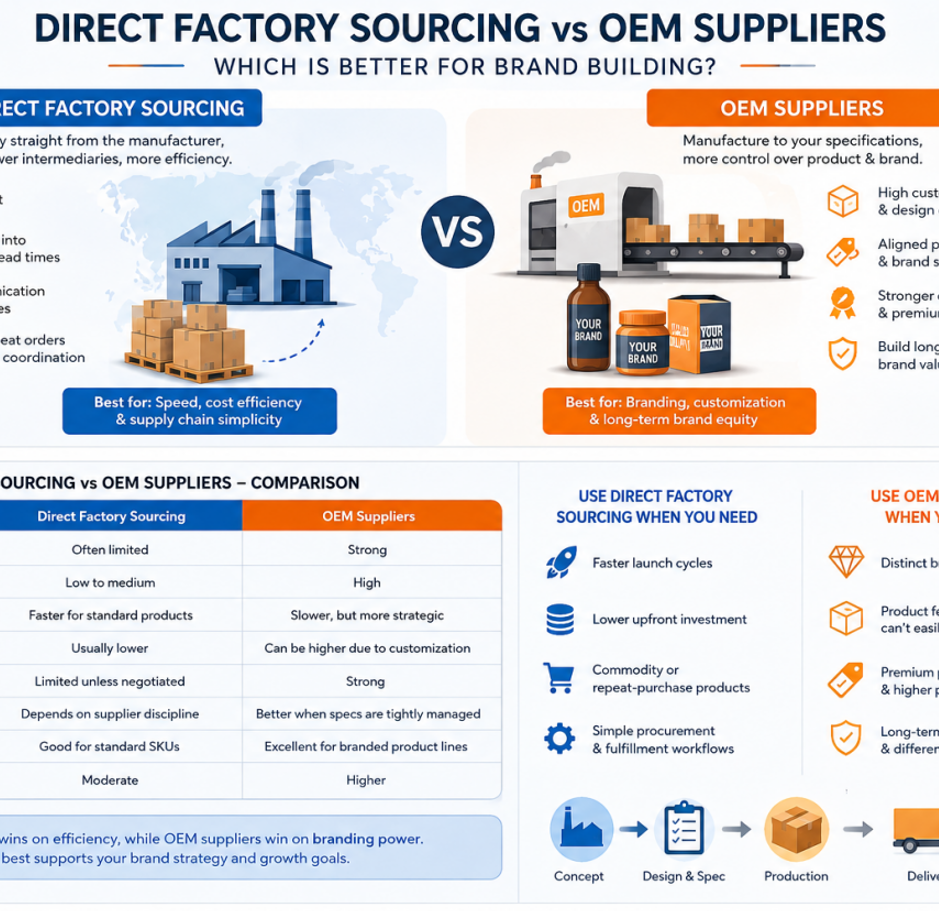
Direct factory sourcing and OEM suppliers serve different branding goals. This expert guide compares them side by side, showing when to prioritize cost and speed, and when OEM is the better path for customization, differentiation, and long-term brand building.

If you are building a brand, choosing between direct factory sourcing and OEM suppliers is not just a procurement decision. It is a branding decision. The right sourcing model affects your product differentiation, packaging control, quality consistency, lead time, and long-term brand equity.
From a B2B sourcing perspective, the answer is not always “one is better.” In my experience, direct factory sourcing often works best when speed, cost efficiency, and supply chain simplicity matter most. OEM suppliers are usually better when branding, customization, and proprietary product control are the priority.
For Looperbuy’s audience, this distinction matters because the goal is not only to buy products from China. It is to build a brand that can compete globally without carrying unnecessary inventory, logistics burden, or operational friction.
Table of Contents
What Is Direct Factory Sourcing?
Direct factory sourcing means buying straight from the manufacturer, with fewer intermediaries in the chain. In practical terms, you deal directly with the factory that produces the item, negotiates specifications, and manages production. This usually gives buyers stronger visibility into cost structure and production capacity.
For many importers and online sellers, direct factory sourcing is attractive because it can reduce markup layers, improve communication, and create a cleaner purchasing process. However, direct access alone does not guarantee brand differentiation.
Why Brands Choose Direct Factory Sourcing
– Lower unit cost through fewer intermediaries.
– Better visibility into production and lead times.
– Easier communication on order status and quality issues.
– More flexibility for repeat orders and supply chain coordination.
Where Direct Factory Sourcing Falls Short
– Limited product uniqueness if the factory sells similar items to many buyers.
– Weaker branding control if the factory offers standard products.
– More responsibility on the buyer for product development, packaging, and compliance.
– Higher risk of “me-too” products in crowded categories.
What Is an OEM Supplier?
An OEM supplier manufactures a product according to the buyer’s specifications, design requirements, or brand direction. In common sourcing usage, OEM relationships usually give the buyer more control over the final product identity, while the manufacturer handles production execution.
For branding, OEM is powerful because it supports customization, proprietary design, controlled quality standards, and stronger product storytelling. That is why many established brands prefer OEM when they want to protect differentiation and avoid selling a generic look-alike product.
Why OEM Is Strong for Branding
– You can create a product that reflects your brand position.
– Packaging, labeling, and specifications can be aligned with brand standards.
– Product design can better support premium pricing.
– Differentiation is more defensible than in a standard factory catalog model.
OEM’s Main Trade-Offs
– Higher development and tooling effort.
– More upfront planning and specification work.
– Longer lead time before launch.
– Greater dependence on supplier engineering and execution quality.
Direct Factory Sourcing vs OEM Suppliers
Below is the clearest way to compare the two models for branding strategy.
| Factor | Direct Factory Sourcing | OEM Suppliers |
| Brand differentiation | Often limited | Strong |
| Product customization | Low to medium | High |
| Speed to market | Faster for standard products | Slower, but more strategic |
| Unit cost | Usually lower | Can be higher due to customization |
| Control over design | Limited unless negotiated | Strong |
| Quality consistency | Depends on supplier discipline | Better when specs are tightly managed |
| Scalability | Good for standard SKUs | Excellent for branded product lines |
| Long-term brand value | Moderate | Higher |
The table makes one thing clear: direct factory sourcing wins on efficiency, while OEM suppliers win on branding power. If your brand competes mainly on price, direct sourcing may be enough. If your brand competes on perception, experience, and uniqueness, OEM usually creates more value.
Which Is Better for Branding?
If your goal is real brand building, OEM suppliers are usually the stronger choice. Branding is not just about placing a logo on a box. It is about controlling what the customer sees, feels, and remembers. OEM gives you more room to shape product features, appearance, packaging, and positioning.
That said, direct factory sourcing can still support branding in certain cases. For example, if you are launching a fast-moving catalog product, testing a new market, or building a dropshipping-style business model, direct sourcing may be the better operational fit. The branding challenge is that you may need to invest more effort in packaging, content, and customer experience to make the product feel unique.
Use Direct Factory Sourcing When You Need
– Faster launch cycles.
– Lower upfront investment.
– Commodity or repeat-purchase products.
– Simple procurement and fulfillment workflows.
Use OEM Suppliers When You Need
– Distinct brand identity.
– Product features competitors cannot easily copy.
– Premium positioning.
– Better control over user experience and margin.
New Insight: Branding Is Not Only Product Design
One common mistake is assuming branding starts and ends with the product. In B2B sourcing, branding is a full system. It includes supplier reliability, packaging quality, delivery consistency, response speed, and even how much operational stress your customer feels after buying from you.
This is where many brands underestimate the value of OEM. A strong OEM relationship can support a more stable brand promise because the supplier is working toward a defined product standard. By contrast, direct factory sourcing may be faster, but it often requires the buyer to act as the quality architect, brand manager, and logistics coordinator at the same time.
Brand Perception Is Built Across 5 Touchpoints
1. Product appearance.
2. Packaging and unboxing.
3. Quality consistency.
4. Delivery reliability.
5. Post-sale experience.
If one of these touchpoints is weak, the brand suffers. That is why sourcing strategy should always be evaluated through a customer-experience lens, not only a purchase-cost lens.
New Insight: The Hidden Cost of “Cheap” Sourcing
From a total-cost perspective, the cheapest sourcing option is not always the most profitable one. Direct factory sourcing may lower your initial procurement cost, but it can increase your hidden costs if the product is too generic, too easy to copy, or too dependent on manual coordination.
OEM often requires more upfront investment, but it can create stronger long-term economics through:
– Higher gross margins.
– Better customer retention.
– More defensible market positioning.
– Less price competition over time.
This is especially important for export-focused brands selling into competitive markets where product sameness drives price wars.
Practical Decision Framework
Use this simple framework to choose the right model.
Step 1 — Define your branding goal
Ask whether you want to:
– Launch fast.
– Compete on price.
– Build a premium brand.
– Own a unique product identity.
Step 2 — Check your product maturity
– If the product is still being tested, direct factory sourcing may be enough.
– If the product is core to your brand story, OEM is usually better.
Step 3 — Review your control needs
Ask how much control you need over:
– Materials.
– Product dimensions.
– Packaging.
– Logo placement.
– Quality standards.
– Compliance documentation.
Step 4 — Measure business risk
If copycat risk is high, OEM is safer.
If speed and simplicity matter more, direct sourcing may be smarter.
Best Practice for B2B Buyers
In real projects, the best approach is often not pure direct sourcing or pure OEM. It is a hybrid sourcing strategy. Many successful sellers use direct factory sourcing for test products, then move to OEM once a SKU proves market demand.
This approach gives you:
– Lower risk during validation.
– Stronger branding once demand is proven.
– Better cash flow control.
– More leverage when negotiating with manufacturers.
For Looperbuy’s audience, this is especially practical because it supports a low-inventory, low-warehouse, low-friction business model while still preserving a path to brand building.
Expert Takeaway
As a content operations professional working with export-oriented manufacturers, I would phrase the answer this way: direct factory sourcing is usually better for operational speed, while OEM suppliers are usually better for brand growth.
If your business is still validating demand, direct sourcing can reduce risk. If your business is trying to create a memorable, defensible, premium brand, OEM is the stronger long-term choice.
The Right Choice
If your main KPI is lower cost and faster procurement, direct factory sourcing is appealing. If your main KPI is brand differentiation and long-term value, OEM suppliers are usually better. The right answer depends on whether you are building a transaction business or a brand business.
For most serious B2B sellers, the smartest path is to start with direct factory sourcing for testing, then transition to OEM once the product proves demand. That gives you both speed and brand power without overcommitting too early.
Ready to source smarter? Contact Looperbuy to find reliable Chinese factories, compare OEM options, and build a sourcing structure that supports your brand growth from day one.
FAQ
1. Is direct factory sourcing cheaper than OEM?
Usually yes. Direct factory sourcing often removes intermediaries and can lower unit cost, while OEM usually adds development, tooling, and customization costs.
2. Which is better for private label branding?
OEM is usually better for private label branding because it gives you more control over product features, packaging, and brand identity.
3. Can a factory offer both direct sourcing and OEM?
Yes. Many factories can sell standard products directly and also provide OEM customization for buyers who need branding and spec control.
4. Is OEM always the best choice for startups?
Not always. Startups often benefit from direct factory sourcing first because it lowers risk and speeds up testing, especially before product-market fit is proven.
5. How do I know which model fits my business?
Choose direct factory sourcing if speed and cost matter most. Choose OEM if your growth depends on differentiation, customer perception, and long-term brand equity.
References
1. OpenBOM. OEM vs ODM vs Contract Manufacturing: Key Differences. [openbom]
2. SourceReady. OEM vs. ODM vs. Contract Manufacturing: 2026 Sourcing Guide. [sourceready]
3. SOS Inventory. OEM vs ODM: Understanding the Pros and Cons for Your Business. [sosinventory]
4. Dassault Systèmes 3DEXPERIENCE Make. Benefits of Local Sourcing for Manufacturing. [3ds]
5. Microlit. OEM and White Label Explained: Their Definitions and Operational Mechanisms. [microlit]
6. Softline Brand Partners. Designing for Success: The Power of OEM in Achieving Product Differentiation. [softlinebrandpartners]