Reliable dropshipping suppliers matter more than winning products because they protect product quality, inventory accuracy, delivery promises, and customer trust. Learn how to evaluate China dropshipping suppliers, reduce costly fulfillment errors, and build a scalable global e-commerce business.
A winning product may attract the first sale, but reliable dropshipping suppliers determine whether that sale becomes a profitable, repeatable business. In cross-border commerce, product demand can change overnight; supplier reliability, however, affects every order—from product quality and inventory accuracy to fulfillment speed, parcel tracking, and customer satisfaction.
For merchants using China dropshipping suppliers, the real competitive advantage is rarely finding a product that looks exciting on social media. It is building a supply chain that can deliver the correct product, in acceptable condition, within the delivery window promised to the customer. Reliable fulfillment protects your reputation, reduces refund pressure, and gives you the confidence to scale without purchasing and storing large amounts of inventory.
> Core takeaway: A winning product gets attention. A dependable supplier turns attention into sustainable revenue.
Table of Contents
The Real Difference Between Product Demand and Supplier Reliability
A “winning product” is usually a product with strong short-term demand. It may solve an obvious problem, fit a viral trend, offer an attractive price point, or perform well in paid advertising.
But demand is only the front end of the customer experience.
After a customer pays, they do not care whether a merchant found the product through a trending video, competitor research, or an online marketplace. They care about practical outcomes:
– Did the product arrive as advertised?
– Was the color, size, material, and version correct?
– Was the product safely packaged?
– Did the order ship when promised?
– Could they track the parcel?
– Was customer service responsive when something went wrong?
These outcomes are largely determined by supplier and fulfillment performance—not product novelty.
A merchant can sell an excellent item and still lose money if the supplier ships late, substitutes products without authorization, sends low-quality stock, provides inaccurate tracking, or runs out of inventory without notice. Conversely, a merchant with a less “viral” product can build a durable business if the product is consistently available, properly inspected, and delivered reliably.
McKinsey’s research on U.S. e-commerce delivery preferences reinforces this point: consumers value on-time delivery within the promised window more than pure speed. Many customers are willing to wait longer if they receive a credible and predictable delivery promise.
Winning Products Create Demand; Reliable Suppliers Protect It
| Business factor | Winning product | Reliable dropshipping supplier |
| Primary role | Generates interest and initial sales | Ensures orders are delivered correctly |
| Business impact | Often short-term and trend-sensitive | Long-term and operationally scalable |
| Main risk | Market saturation and declining demand | Delays, defects, stockouts, disputes, refunds |
| Customer perception | Influences purchase motivation | Influences trust, reviews, and repeat purchases |
| Effect on scaling | Can increase order volume quickly | Makes higher order volume manageable |
| Merchant control | Limited once competitors copy the product | Improves through supplier selection and systems |
The strongest dropshipping businesses do not choose between product research and supplier evaluation. They treat them as connected decisions. Before increasing ad spend, they test whether the supply chain can support the demand they hope to create.
How Unreliable Suppliers Destroy Profitable Dropshipping Stores
Supplier problems are rarely isolated. One operational failure can create a chain reaction across customer support, advertising profitability, payment disputes, marketplace performance, and brand reputation.
For example, imagine that a store finds a high-demand portable pet product. Its first advertising campaign performs well, and orders jump from 20 to 300 per day. The supplier cannot keep up. Some orders are shipped late, several customers receive a different product color, and tracking updates stop after the parcel leaves the origin country.
The product itself may still be appealing. However, the merchant now faces:
– More “Where is my order?” support tickets
– Refund requests before parcels arrive
– Chargeback risk from frustrated customers
– Negative product reviews
– Reduced conversion rates from poor social proof
– Higher customer-acquisition costs because repeat purchases decline
– Cash-flow pressure caused by refunds and reshipments
This is why product selection without supplier validation is incomplete business planning.
Late Shipping Damages Trust Faster Than Many Sellers Expect
Shipping promises are not merely marketing copy. They are commitments that customers use to make purchasing decisions.
In the United States, the Federal Trade Commission’s Mail, Internet, or Telephone Order Merchandise Rule requires sellers to have a reasonable basis for believing they can ship within the advertised timeframe. If no shipping timeframe is stated, sellers generally must have a reasonable basis to believe they can ship within 30 days. When sellers cannot meet the applicable shipping timeframe, they must offer customers a delay option or a prompt refund.
For cross-border dropshipping merchants, this makes supplier communication essential. You should not publish aggressive delivery claims based only on a supplier’s verbal estimate or a marketplace listing. Delivery estimates should reflect real processing time, quality-control time, carrier handoff time, shipping route performance, and destination-country conditions.
A reliable supplier helps you make promises you can actually keep.
Product Quality Problems Become Brand Problems
When a customer receives a damaged, incorrect, or poorly made item, they do not blame a factory, warehouse, or sourcing agent. They blame the store where they placed the order.
That means your supplier’s quality standards become part of your brand identity.
Common quality failures in dropshipping include:
– Incorrect color, size, plug type, or model
– Materials that differ from listing photos
– Broken or incomplete items
– Missing accessories or manuals
– Poor packaging that causes transit damage
– Products with visible scratches, stains, or defects
– Unapproved branding, inserts, or supplier invoices in the parcel
A dependable sourcing and fulfillment partner reduces these risks through product confirmation, pre-shipment checks, order verification, and clear exception handling.
What Reliable Dropshipping Suppliers Actually Do
Reliability is more than answering messages quickly or offering a low unit price. A professional dropshipping supplier should provide consistent performance across the full order lifecycle.
1. Maintain Accurate Inventory Information
Inventory accuracy is critical because a product shown as available but actually out of stock creates “phantom inventory.” The merchant continues accepting orders, only to discover later that fulfillment is impossible or delayed.
A dependable supplier should be able to confirm:
– Whether the item is genuinely available
– Available variants, colors, sizes, and specifications
– Expected replenishment timing
– Whether stock is held in China, overseas, or by a third party
– Whether product substitutions require approval
– Whether seasonal demand may affect availability
For merchants scaling product campaigns, inventory visibility is not a luxury. It is a requirement for avoiding overselling and protecting paid-media performance.
2. Verify Product Specifications Before Scaling
Many dropshipping disputes begin before the first order is shipped. The seller may use supplier photos without confirming what the buyer will actually receive.
Before listing a product, request a sample or inspection evidence for high-volume products. Confirm the exact details that affect customer expectations:
– Dimensions and weight
– Material composition
– Color options and tolerance
– Electrical specifications and plug standard
– Compatibility claims
– Package contents
– Assembly requirements
– Product branding or private-label options
– Packaging dimensions and shipping weight
This is especially important for technical, regulated, fragile, size-sensitive, or high-return categories. A small discrepancy in size, voltage, compatibility, or materials can cause a disproportionate number of customer complaints.
3. Process Orders Consistently
Order processing reliability means more than dispatching parcels. It requires a repeatable workflow for receiving orders, checking inventory, picking correct items, performing quality checks, packing safely, selecting appropriate shipping lines, and uploading usable tracking information.
A supplier should have documented handling for exceptions, including:
– Out-of-stock products
– Product defects found during inspection
– Address problems
– Parcel damage
– Carrier delays
– Customs issues
– Returned or undeliverable shipments
– Lost parcels
When these cases are handled inconsistently, merchants are forced to manage crises manually. When they are managed through clear processes, merchants can focus on merchandising, customer acquisition, and retention.
4. Provide Honest Communication Before Problems Escalate
The best supplier relationships are not defined by the absence of problems. They are defined by what happens when problems occur.
Reliable suppliers communicate early. They do not wait until a customer opens a dispute to disclose a stock shortage or shipment delay. They provide actionable alternatives, such as:
– A confirmed replenishment date
– An approved equivalent product option
– A different shipping line
– A partial shipment plan
– A refund or reshipment solution
– Updated tracking and delivery estimates
For a global merchant, proactive communication protects the customer relationship and gives the store time to respond professionally.
A Supplier Reliability Scorecard for Dropshipping Businesses
Before committing ad budget or scaling an item, evaluate suppliers using a structured scorecard. This turns supplier selection from intuition into a repeatable operating decision.
| Evaluation area | Questions to ask | Why it matters |
| Product consistency | Does the received sample match the listing and future stock? | Prevents “not as described” complaints |
| Inventory visibility | How often is stock updated? Can variants be confirmed? | Reduces overselling and cancellations |
| Processing time | What is the standard handling time by product type? | Supports accurate shipping promises |
| Quality control | Is there an inspection process before dispatch? | Lowers defect and wrong-item risk |
| Packaging | Can the supplier use protective, branded, or neutral packaging? | Reduces transit damage and protects brand experience |
| Shipping options | Which carriers and lines are available by destination? | Helps balance cost, speed, and tracking quality |
| Tracking quality | When is tracking uploaded and how often does it update? | Reduces “where is my order?” inquiries |
| Communication | Who owns issues, and what is the response time? | Makes exceptions manageable |
| Returns support | How are damaged, lost, or incorrect orders handled? | Protects margins and customer satisfaction |
| Scalability | Can the supplier handle daily volume spikes? | Prevents fulfillment breakdown during growth |
A Practical Supplier Testing Framework
Use this five-step process before treating a supplier as a long-term fulfillment partner:
1. Order a real sample. Evaluate the actual product, packaging, delivery time, tracking behavior, and unboxing experience.
2. Test multiple variants. Do not assume that one color, size, or model represents the quality of the entire catalog.
3. Place small batch orders. Test whether the supplier can process several orders accurately, not just one sample.
4. Measure exceptions. Ask how the supplier handles shortages, wrong items, damaged products, and delivery delays.
5. Scale gradually. Increase volume in stages while tracking fulfillment performance, customer complaints, refund rates, and delivery reliability.
This approach is particularly valuable when sourcing China products for international customers. A supplier that performs well at 10 orders per day may not have the inventory discipline, labor capacity, or shipping coordination needed for 500 orders per day.
Why a China Sourcing Partner Can Improve Supplier Reliability
Working directly with multiple product factories or marketplace sellers may appear cheaper at first. However, it can create fragmented communication, inconsistent quality standards, scattered inventory information, and complicated logistics management.
For many global B2B sellers, a centralized China sourcing and dropshipping partner can simplify this process.
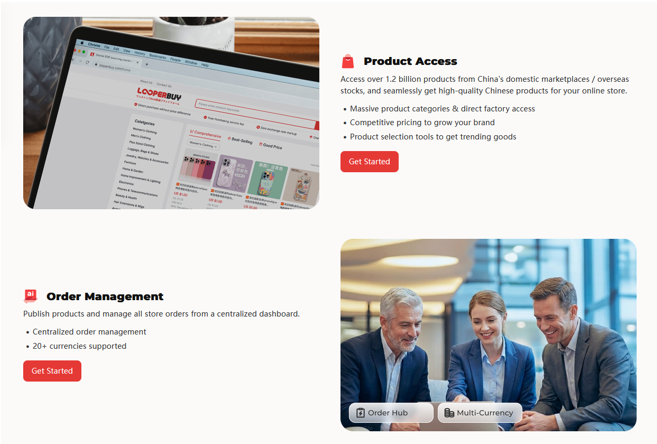
A platform such as Looperbuy can support merchants by connecting sourcing, purchasing, inspection, storage, packing, and shipment coordination in one operational workflow. Instead of managing separate suppliers, warehouse contacts, and shipping providers, sellers can build a more coordinated process around the products they want to sell.
This model can be especially helpful for merchants that want to:
– Source products from China without holding large inventory
– Test products before making larger purchasing decisions
– Combine multiple supplier items into fewer shipments
– Add product inspection before dispatch
– Use neutral or customized packaging
– Ship orders internationally through suitable logistics options
– Reduce the administrative burden of supplier coordination
– Maintain more control over order status and customer communication
The value is not simply “finding cheaper products.” It is reducing operational uncertainty.
Reliability Helps Merchants Control Total Cost
The lowest product price is not always the lowest business cost.
A supplier that offers an item for $1 less may become more expensive if it creates frequent refunds, reshipments, support tickets, disputes, negative reviews, and lost customers. Merchants should calculate total landed and operational cost, not just the factory or supplier price.
A practical way to think about supplier value is:
Total Supplier Cost=Product Cost+Shipping Cost+Defect Cost+Refund Cost+Support Cost+Lost Customer Value
A reliable supplier may not always quote the lowest visible price. But better inventory control, lower error rates, safer packing, and dependable communication can produce a better margin over time.
Build a Dropshipping Business That Can Survive Growth
The most fragile dropshipping stores are built around a single viral product, a single untested supplier, and unrealistic shipping promises. They may grow quickly, but they also fail quickly when demand rises or fulfillment problems appear.
The more durable model is different:
– Find products with genuine market fit.
– Validate the supplier before scaling.
– Use accurate product information and delivery estimates.
– Inspect high-risk or high-volume products.
– Monitor operational performance, not only ad metrics.
– Create clear policies for delivery delays, returns, and reshipments.
– Work with sourcing and fulfillment partners that can communicate transparently.
Reliable dropshipping suppliers are not a back-office detail. They are a strategic part of the customer experience.
When customers receive the right product, in good condition, with reliable tracking and delivery communication, they are more likely to trust your store again. That creates the foundation for repeat purchases, stronger reviews, higher lifetime value, and more stable growth.
Partner With Looperbuy for More Dependable Fulfillment
If you want to source products from China while reducing inventory exposure, fulfillment complexity, and supplier-management workload, Looperbuy can help create a more reliable workflow for your B2B dropshipping operations.
Focus on products your customers want. Let a coordinated sourcing, quality-checking, and shipping process help you deliver them more consistently.
Contact Looperbuy today to discuss product sourcing, order fulfillment, product inspection, packaging, and international dropshipping solutions for your business.
FAQ
1. What makes a dropshipping supplier reliable?
A reliable dropshipping supplier provides accurate inventory information, consistent product quality, realistic processing times, secure packaging, usable tracking, responsive communication, and clear solutions for exceptions such as stockouts, defects, delays, or lost parcels.
2. Is a winning product enough to build a successful dropshipping store?
No. A winning product can create initial demand, but supplier reliability determines whether customers receive the promised product on time and in acceptable condition. Poor fulfillment can quickly erase the profit generated by product demand.
3. How can I test a China dropshipping supplier?
Order samples, compare the product with listing claims, test multiple variants, review packaging and tracking, place a small batch of trial orders, ask about quality-control procedures, and evaluate how quickly the supplier resolves a real exception.
4. Why is inventory accuracy important in dropshipping?
Accurate inventory prevents merchants from advertising and selling products that are unavailable. It reduces cancellations, delayed fulfillment, customer complaints, refund requests, and wasted advertising spend.
5. Should I choose the cheapest dropshipping supplier?
Not automatically. Evaluate total business cost rather than unit price alone. A slightly higher-cost supplier may offer better quality control, faster processing, safer packaging, and fewer costly refunds or reshipments.
6. Can a sourcing agent or fulfillment platform help with dropshipping?
Yes. A sourcing and fulfillment partner can centralize supplier communication, product purchasing, quality inspection, warehousing, packing, and international shipping. This can help merchants reduce operational complexity and improve order consistency.
7. How should I communicate delivery times to customers?
Use delivery ranges based on real processing and shipping performance rather than best-case estimates. Update customers promptly when delays occur, provide tracking where available, and offer clear solutions when the promised timeline cannot be met.
References
1. Federal Trade Commission. “[Mail, Internet, or Telephone Order Merchandise Rule].”
2. Federal Trade Commission. “[Business Guide to the FTC’s Mail, Internet, or Telephone Order Merchandise Rule].”
3. Electronic Code of Federal Regulations. “[16 CFR Part 435 — Mail, Internet, or Telephone Order Merchandise].”
4. McKinsey & Company. “[What Do US Consumers Want From E-Commerce Deliveries?].”
5. Cornell Law School, Legal Information Institute. “[16 CFR § 435.2 — Mail, Internet, or Telephone Order Sales].”