Discover the key differences between B2B and B2C personalization. Learn how account-specific pricing, role-based workflows, product recommendations, sourcing data, and fulfillment options help global sellers reduce purchasing errors, speed up orders, and simplify China sourcing.
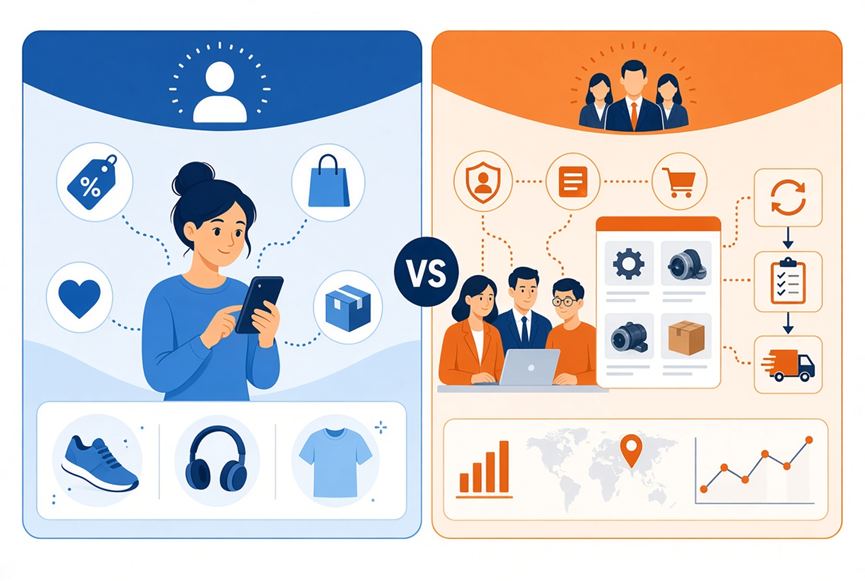
B2B personalization is not about making business buyers feel like individual consumers. It is about helping each customer account source the right products, at the right price, with the right permissions, shipping options, and replenishment logic—without adding friction.
For global B2B sellers, wholesalers, dropshippers, and online retailers, this distinction matters. A consumer may buy a product because of an attractive image, a limited-time discount, or a recommendation that feels inspiring. A business buyer usually evaluates whether an item fits a resale plan, product specification, target margin, inventory model, compliance requirement, or customer demand forecast.
At Looperbuy, we see this difference clearly in China sourcing and fulfillment workflows. A merchant sourcing products for Amazon, Shopify, TikTok Shop, a wholesale store, or an independent e-commerce business does not simply need “more products.” They need relevant sourcing options, dependable supplier communication, purchase visibility, quality checks, consolidated shipping, and fulfillment support that reduces inventory exposure.
This article explains the practical differences between B2B and B2C personalization, why role-based buying experiences matter, and how B2B platforms can use personalization to make sourcing, purchasing, and fulfillment more efficient.
Table of Contents
What Is the Difference Between B2B and B2C Personalization?
The simplest explanation is this:
– B2C personalization tries to increase relevance, engagement, and often basket size for one shopper.
– B2B personalization tries to reduce decision time, ordering errors, operational cost, and procurement friction for an organization or business account.
Both models use customer data. However, they use it for different business outcomes.
In B2C, a personalized experience may include:
– Recommended products based on browsing history
– “Frequently bought together” suggestions
– Personalized discount codes
– Product reminders and abandoned-cart emails
– Content tailored to an individual shopper’s interests
– Free-shipping incentives or limited-time promotions
In B2B, useful personalization is more operational. It may include:
– Account-specific product catalogs
– Contract or volume-based pricing
– Repeat-order suggestions
– Product compatibility recommendations
– Access restrictions by employee role
– Saved sourcing lists and approved suppliers
– Order approval workflows
– Shipping recommendations based on destination, delivery speed, and cost
– Inventory-aware replenishment alerts
– Region-specific product, tax, documentation, or logistics requirements
The key difference is that B2B buyers are rarely shopping for entertainment. They are doing a job. They want confidence, speed, accuracy, and accountability.
A 2024 McKinsey B2B Pulse report found that more than half of surveyed B2B decision-makers want a genuinely omnichannel experience, meaning they expect to move smoothly between digital self-service, sales support, and other buying channels. McKinsey also reported that data-driven commercial teams combining personalized experiences with generative AI were 1.7 times more likely to gain market share.
Why B2B Buyers Need a Different Experience
A B2C buyer is often the decision-maker, purchaser, and user of a product. In B2B, these roles are often separated.
For example, a global e-commerce company sourcing private-label accessories from China may involve several people:
| Role | Typical Responsibility | What They Need From the Platform |
| Product researcher | Finds market opportunities and products | Supplier options, product data, samples, comparable listings |
| Purchasing coordinator | Creates orders and follows supplier progress | Clear specifications, order status, communication records |
| Finance manager | Controls spend and payment approvals | Cost breakdowns, invoices, payment visibility |
| Operations manager | Oversees stock and fulfillment | Lead times, warehouse status, shipment tracking |
| Store owner or director | Makes final commercial decisions | Margin information, supplier reliability, risk visibility |
| Customer service team | Handles post-purchase issues | Order records, shipment information, return and replacement support |
Because several people may contribute to a purchase, a one-size-fits-all interface often creates mistakes. One person may need to view product specifications but not supplier payment details. Another may need to approve the purchase but not edit product quantities. A fulfillment team may need shipment tracking but not access to all commercial negotiations.
This is why B2B personalization should begin with the business account, not the individual user.
Account structure, role-based access control, contract-specific catalogs, personalized pricing, compatibility-based recommendations, and approval workflows are core elements of B2B personalization capabilities.These remain highly relevant because business purchasing has become more digital while still requiring control and governance.
B2B Buying Is Usually Nonlinear
Business purchasing rarely follows a neat path from product discovery to checkout. Buyers compare suppliers, revisit requirements, consult colleagues, adjust budgets, test samples, and seek internal approval.
Gartner describes the B2B buying journey as a set of “buying jobs” that buyers revisit rather than a simple linear funnel. These jobs include identifying a problem, exploring solutions, building requirements, selecting suppliers, validating choices, and creating internal consensus.
For a sourcing platform, this means personalization should support buyers at different stages:
– Early-stage buyers need product discovery, supplier comparison, and market insights.
– Evaluating buyers need specifications, samples, MOQ information, quality requirements, and cost estimates.
– Active buyers need order-building tools, payment visibility, shipping options, and approval controls.
– Repeat buyers need reorder suggestions, historical data, and replenishment support.
– Scaling sellers need warehouse, consolidation, labeling, inspection, and fulfillment coordination.
B2B Personalization Is About Operational Relevance
Personalization becomes valuable when it removes work. It becomes annoying when it creates distraction.
A consumer may appreciate being shown ten trending products. A business buyer may see this as noise if they are trying to reorder a proven SKU, confirm carton dimensions, compare shipping methods, or check whether a supplier can meet a deadline.
For B2B sourcing and dropshipping businesses, personalization should answer practical questions such as:
– Which products has this account sourced or ordered before?
– Which suppliers have met this buyer’s requirements consistently?
– Which products match the buyer’s target category, packaging standards, or target market?
– Which items are compatible with the selected product or fulfillment process?
– Which shipping method fits the destination, product type, urgency, and budget?
– Which products are ready for reordering based on past purchase cycles?
– Which team member can approve a supplier payment or release an order?
– Which products need inspection before international shipment?
Product Recommendations Should Reduce Errors
In B2C, recommendation engines often aim to increase order value. They may suggest accessories, upgrades, or impulse-buy products.
In B2B, recommendations should prioritize compatibility, continuity, and confidence.
For example, if a seller is sourcing custom cosmetic packaging, relevant recommendations may include:
– A compatible bottle, cap, pump, and outer carton
– Suppliers with proven experience in the same material or printing process
– A matching label or packaging insert option
– A suggested inspection checkpoint before shipment
– A consolidated shipping plan for related items
– A reorder draft based on the previous purchase quantity
This approach is especially useful for businesses sourcing from multiple Chinese suppliers. Without structured recommendations, buyers may accidentally select incompatible product components, miscalculate shipping volume, duplicate orders, or overlook a supplier requirement.
Account-Level Personalization Matters More Than Individual Preferences
A major B2B mistake is treating every user as an independent consumer.
In a business environment, a user account belongs to an organization. The organization may have negotiated prices, preferred shipping methods, product restrictions, approved suppliers, internal budgets, or quality standards. The platform should recognize the account-level context before showing options.
For Looperbuy customers, this could mean tailoring the sourcing experience around the merchant’s operating model:
– Dropshippers may prioritize low upfront inventory, fast processing, product synchronization, and individual order fulfillment.
– Wholesale buyers may prioritize bulk pricing, MOQ negotiation, carton data, inspections, and consolidated shipping.
– Private-label sellers may prioritize customization, packaging, supplier qualification, samples, and intellectual-property protection processes.
– Marketplace sellers may prioritize product compliance, labeling requirements, fulfillment preparation, and stable replenishment.
– DTC brands may prioritize branded packaging, consistent product quality, delivery visibility, and customer experience.
The right experience is not “Hello, Sarah.” The right experience is “Here are the approved products, supplier options, pricing logic, shipment choices, and next actions that fit Sarah’s company.”
Five Personalization Capabilities B2B Platforms Need
1. Role-Based Access and Approval Workflows
Not everyone in a business should have the same permissions.
A purchasing assistant may build an order. A manager may review it. A finance user may approve payment. A warehouse or logistics team may manage shipment details. A platform should enable each person to see and do only what is relevant to their role.
This improves both security and speed.
A practical workflow may look like this:
1. A sourcing specialist saves products from approved suppliers.
2. The platform creates a draft purchase order.
3. A manager reviews prices, specifications, and quantity.
4. Finance approves the payment amount.
5. The procurement team places the order.
6. The quality-control process begins before goods enter the warehouse.
7. The operations team selects consolidation, labeling, and shipping services.
8. The relevant team receives tracking and delivery updates.
2. Account-Specific Product Catalogs
Not every customer should see every product in the same way.
A business may have preferred suppliers, approved product categories, restricted materials, target markets, or contractual conditions. Personalized catalogs can reduce confusion and guide buyers toward the options that are actually relevant.
For example, a seller focused on eco-friendly household products should be able to quickly access suppliers, materials, packaging options, and certifications relevant to that category rather than searching through unrelated listings.
3. Personalized Pricing and Cost Visibility
B2B buyers need more than a unit price. They need to understand the total landed cost.
A useful sourcing platform should help buyers evaluate:
– Product unit cost
– MOQ requirements
– Sample cost
– Customization cost
– Domestic China shipping
– Inspection fees
– Warehouse handling or consolidation fees
– International shipping options
– Duties, taxes, and destination-specific costs where applicable
The goal is not simply to display a lower price. The goal is to help the buyer make a commercially sound decision.
4. Reorder and Demand-Based Recommendations
Repeat purchasing is common in B2B commerce. Sellers often reorder products based on seasonal demand, sales velocity, promotion plans, or inventory levels.
A reorder recommendation should use historical behavior carefully. It should not automatically push an order. Instead, it should present a reviewable draft with prior SKUs, quantities, supplier notes, and changes in price or availability.
For example:
> “You last purchased 500 units of this product 58 days ago. Based on your prior order cycle, you may want to review a reorder draft. Supplier lead time is currently 12–15 days.”
This kind of recommendation helps the buyer act earlier while preserving control.
5. Shipping and Fulfillment Personalization
Global sellers have different fulfillment priorities. Some need the lowest shipping cost. Others need faster delivery, branded packaging, tracking, warehouse consolidation, or direct-to-customer fulfillment.
Personalized logistics options can consider:
– Destination country or region
– Product size and weight
– Battery, liquid, fragile, or regulated-product rules
– Required delivery speed
– Order volume
– Warehouse consolidation needs
– Individual parcel fulfillment versus bulk shipment
– Packaging and labeling requirements
For Looperbuy, this is particularly important because sourcing and fulfillment are connected. Product selection without shipping context can create unexpected costs and customer-delivery problems later.
How to Build a Better B2B Personalization Strategy
B2B personalization works best when it is built around customer tasks, not marketing assumptions.
Step 1: Map the Real Customer Workflow
Start by identifying how customers actually buy, source, approve, and ship products.
Interview customers across different business models:
– New dropshippers
– Established Shopify sellers
– Marketplace merchants
– Wholesale buyers
– Brand owners
– Procurement teams
Ask what slows them down, where errors occur, and which information they repeatedly request from support teams.
Step 2: Define Useful Customer Signals
Not every data point should influence the experience. Focus on signals that improve the buyer’s next decision.
Useful signals include:
– Product categories viewed or ordered
– Repeat purchase frequency
– Supplier preferences
– Destination countries
– Preferred shipping methods
– Average order size
– Requested customization options
– Product compliance requirements
– Inspection history
– Team role and account permissions
Avoid relying only on clicks. A user may browse dozens of products without any real purchase intent. Completed orders, saved products, requests for quotation, sample requests, and supplier conversations often provide stronger business signals.
Step 3: Create Transparent Recommendation Logic
Business buyers need to understand why they are seeing a recommendation.
Use clear labels such as:
– “Previously ordered by your account”
– “Compatible with your selected product”
– “Available from an approved supplier”
– “Recommended based on your shipping destination”
– “Frequently reordered after 60–90 days”
– “Lower-volume alternative for product testing”
Transparency helps users trust the platform and makes recommendations easier to evaluate.
Step 4: Keep Buyers in Control
Good B2B personalization supports judgment. It does not remove it.
Every automated suggestion should be reviewable, editable, and dismissible. Buyers should be able to adjust quantities, choose alternatives, request quotes, add quality requirements, and compare shipping options before committing.
Step 5: Measure Business Outcomes
Clicks are not enough. Measure whether personalization improves actual business performance.
Useful performance indicators include:
– Time required to complete an order
– Repeat-order completion rate
– Quote-to-order conversion rate
– Order-error rate
– Average support tickets per order
– Supplier response time
– Inspection issue rate
– Cost savings from consolidation
– Delivery-time reliability
– Customer retention and reorder frequency
Forrester emphasizes that B2B personalization requires more than surface-level tactics. It should connect strategy, data, experience design, delivery, and measurement across the customer lifecycle.
Common Mistakes to Avoid
Treating B2B Buyers Like Impulse Shoppers
Flash sales and broad promotional banners may have a place, but they should not disrupt a buyer trying to complete a structured procurement task.
Personalizing Only Emails
A personalized email is useful, but B2B personalization should continue across the product catalog, sourcing requests, order approvals, warehouse management, shipping selection, and post-purchase support.
Using Data Without Context
A buyer who viewed a product once should not receive aggressive reminders for weeks. Strong personalization distinguishes browsing from meaningful purchase intent.
Ignoring the Buying Group
One person may research products, another may approve spend, and another may manage fulfillment. A platform that serves only one user profile can create internal friction.
Hiding Important Information
Personalization should make critical information easier to find, not obscure pricing conditions, lead times, quality requirements, supplier limitations, or shipping risks.
The Future of B2B Personalization in Global Sourcing
The future is not a louder, more automated buying experience. It is a more intelligent and dependable one.
Global B2B sellers increasingly expect digital self-service for research, product selection, order management, and routine tasks. Gartner reported in 2026 that 67% of B2B buyers preferred a rep-free experience, while its research also notes that buyers still value seller support for contextual questions, such as deciding whether an offer fits their business needs.
For sourcing from China, the strongest platforms will combine self-service tools with knowledgeable human assistance. Automation can organize product options, generate reorder drafts, suggest shipping routes, and surface account-specific information. Experienced sourcing and fulfillment teams can then help with supplier negotiation, quality control, customization, product risk, and logistics exceptions.
That combination is where B2B personalization becomes genuinely useful.
Simplify Your China Sourcing and Fulfillment Workflow
If you are building a global e-commerce business, you should not have to manage dozens of supplier conversations, separate warehouse processes, fragmented shipping arrangements, and manual fulfillment tasks alone.
Looperbuy helps B2B sellers source products from China, manage orders, reduce inventory pressure, coordinate fulfillment, and deliver products to global customers. Whether you are testing a new product, scaling a private-label catalog, operating a dropshipping business, or replenishing wholesale inventory, the right workflow can reduce complexity at every stage.
Start building a more reliable sourcing and fulfillment process with Looperbuy today.
Frequently Asked Questions
1. What is B2B personalization?
B2B personalization is the practice of tailoring a business buying experience to an organization’s needs, account history, user roles, approved products, pricing agreements, purchase patterns, and operational requirements. Its purpose is usually to reduce purchasing friction and improve accuracy.
2. How is B2B personalization different from B2C personalization?
B2C personalization usually focuses on one consumer’s preferences and aims to improve engagement or increase order value. B2B personalization focuses on the business account, multiple decision-makers, approval processes, product compatibility, pricing rules, repeat purchasing, and fulfillment requirements.
3. Why are role-based permissions important in B2B purchasing?
Role-based permissions ensure that users can only access the information and actions relevant to their responsibilities. For example, a purchasing assistant may create an order draft, while a finance manager approves payment and a logistics user manages shipment details.
4. How can personalization improve China sourcing?
Personalization can make China sourcing more efficient by showing relevant suppliers, previously ordered products, account-specific product preferences, comparable sourcing options, reorder suggestions, quality-control requirements, and shipping methods aligned with the buyer’s destination and budget.
5. Can B2B product recommendations increase purchasing accuracy?
Yes. In B2B, recommendations are most helpful when they identify compatible components, approved suppliers, repeat-order products, suitable packaging options, or shipping methods. These recommendations can reduce selection mistakes and save procurement time.
6. Should a B2B platform automatically place reorders?
No. A platform can generate a reorder recommendation or draft order based on historical purchasing patterns, but the buyer should always review quantities, pricing, supplier availability, specifications, and shipping details before approval.
7. What should global sellers look for in a sourcing and fulfillment partner?
Look for transparent pricing, supplier communication support, quality-control options, order visibility, warehouse services, shipment coordination, responsive support, and fulfillment capabilities that match your sales model, target markets, and product requirements.
References
1. Virto Commerce. “[What Are the Differences Between Personalization in B2C and B2B?]”
2. Gartner. “[B2B Buying: How Top CSOs and CMOs Optimize the Journey].”
3. Forrester. “[Explore Five Ways To Improve Personalization At Forrester’s B2B Summit North America].”
4. McKinsey & Company. “[Five Fundamental Truths: How B2B Winners Keep Growing].”
5. Gartner. “[Gartner Sales Survey Finds 67% of B2B Buyers Prefer a Rep-Free Experience].”
6. Gartner. “[Gartner Sales Survey Finds 61% of B2B Buyers Prefer a Rep-Free Buying Experience].”