Private label dropshipping vs standard dropshipping: which model actually builds a real brand in 2026? Learn key differences in margins, risk, branding, and customer experience, plus a practical roadmap to move from generic dropshipping to profitable private label with a China sourcing partner like Looperbuy.
If your goal is to build a long‑term, defensible ecommerce brand, private label dropshipping usually wins over standard dropshipping — but it also demands more capital, lead time, and operational discipline. For lean testing, cash flow, or B2B sellers who want to validate markets with minimal risk, standard dropshipping remains a powerful starting model that can later be upgraded into private label, especially when you partner with a sourcing platform like Looperbuy to handle product development and fulfillment from China. [shopify]
Table of Contents
What Is Standard Dropshipping?
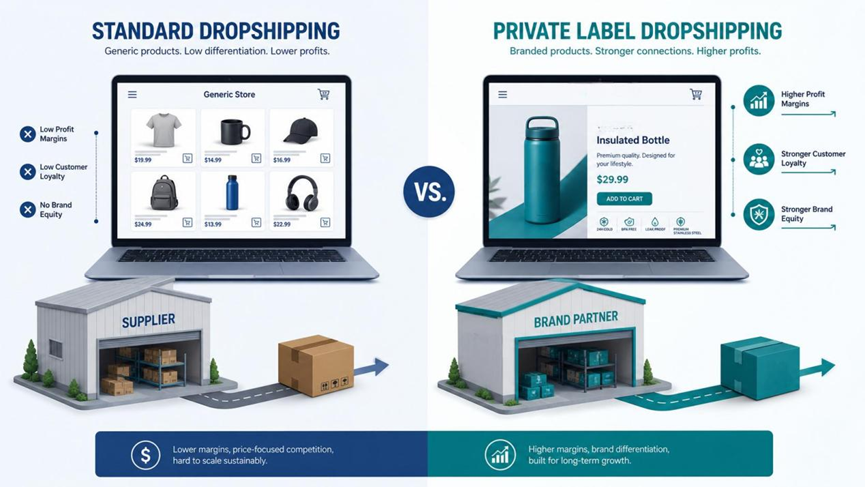
In a standard dropshipping model, you sell products online without holding inventory, and your supplier ships orders directly to your customers under their generic branding. [shopify]
Key characteristics of standard dropshipping:
– You list existing products from suppliers in your store. [shopify]
– When a customer buys, you forward the order to the supplier, who handles packing and shipping. [shopify]
– Products are usually non‑exclusive, so many other sellers can offer the same SKUs. [dropshiphubs]
– Startup costs are low because you avoid bulk inventory purchases and long manufacturing cycles. [dropshiphubs]
This model is ideal for testing niches fast, validating demand, and generating early cash flow with minimal upfront risk. [stormy]
What Is Private Label Dropshipping?
In private label dropshipping, a manufacturer or supplier produces a product specifically for your brand, with your logo, packaging, and sometimes custom formulation or features — then still ships orders directly to your customers. [shopify]
Core features of private label dropshipping:
– You collaborate with a supplier to customize the product or packaging and sell it under your own brand name. [dropshiphubs]
– SKUs can be exclusive to you, which creates clear differentiation and stronger brand identity. [shopify]
– Common in categories like beauty, supplements, fashion, and home goods where branding heavily influences buying decisions. [dropshiphubs]
– You often commit to MOQs (minimum order quantities) or structured development agreements, even if fulfillment is still “on demand”. [dropshiphubs]
This model blends the brand control of private label with some of the logistics simplicity of dropshipping, making it a compelling path for ecommerce entrepreneurs who want real brand equity without building their own warehouse network. [stormy]
Side‑By‑Side Overview: Business Model Comparison
Profit Margins and Unit Economics in 2026
From an operator’s perspective, unit economics is where the difference becomes painfully clear.
– Many standard dropshipping stores see net profit margins around 10–20%, especially in saturated niches. [stormy]
– A typical scenario in 2026: a product priced at 30 USD might cost 15 USD to source and 10 USD to acquire the customer (ads), leaving only around 5 USD in profit. [stormy]
– Private label sellers can often raise prices thanks to stronger branding and perceived value, while keeping production costs efficient through focused sourcing. [stormy]
One 2026 analysis illustrates this with the same type of product: [stormy]
– Standard dropshipping: cost 15 USD, sell 30 USD, 10 USD marketing, 5 USD profit. [stormy]
– Private label: cost 6 USD, sell 35 USD, 8 USD marketing, 21 USD profit due to brand premium and more efficient targeting. [stormy]
Data cited from business media suggests that private label brands can achieve roughly 3x higher customer lifetime value (LTV) vs generic dropshipping stores, because buyers are more likely to return, advocate, and accept upsells from a brand they recognize. [stormy]
Brand Equity: Which Model Builds a “Real Brand”?
From both a branding and exit value perspective, private label dropshipping is better aligned with building a “real brand” that investors or acquirers want to buy. [shopify]
Why standard dropshipping struggles with brand equity:
– No product exclusivity: If your product and photos can be copied within hours, you lack durable differentiation. [reddit]
– Price‑driven buyers: Customers often shop by price on marketplaces and comparison engines, not by brand name. [dropshiphubs]
– Shallow story: It’s hard to tell a compelling brand story around a generic catalog of unrelated products. [wix]
Why private label dropshipping scales brand value:
– Unique positioning: Your product features, packaging, and story are tailored to a specific audience and pain point. [wix]
– Higher perceived quality: Branded packaging, cohesive visual identity, and consistent messaging signal reliability. [youtube]
– Exit potential: Strong branding plus owned product IP make it more realistic to sell the business later. [dropshiphubs]
Community voices in the dropshipping space often highlight that anyone can copy a generic “brand” in a few hours if there is no unique product behind it — which underscores why private label is the preferred path for durable brand building. [reddit]
Operational Complexity and Risk
From a UX and operations perspective, the decision is not just about margins — it’s about how much complexity you can handle right now.
Standard dropshipping operations:
– Supplier integration and order routing are relatively simple. [shopify]
– You can scale product testing quickly, adding and removing SKUs based on performance. [shopify]
– However, quality and shipping times are less under your control, which directly impacts customer experience and reviews. [shopify]
Private label dropshipping operations:
– You need to manage samples, product specs, packaging design, and compliance (especially in regulated categories like cosmetics or supplements). [shopify]
– You may face longer lead times — it is common to add 30–60 days for manufacturing and inbound freight before dropshipping begins at scale. [shopify]
– On the positive side, once set up, you gain tighter control over quality and unboxing experience, which feeds back into better reviews and retention. [wix]
For B2B merchants sourcing from China, platforms like Looperbuy can absorb much of this operational complexity by managing supplier relationships, order management, and global shipping, making both standard and private label setups smoother. [facebook]
Customer Experience and Brand Perception
In 2026, building a recognizable brand is as much about customer experience (CX) as it is about logos and fonts. [youtube]
Standard dropshipping CX realities:
– Longer and less predictable shipping times if suppliers are not well‑optimized for your target markets. [shopify]
– Inconsistent packaging that may carry the supplier’s branding or very generic materials, weakening your own brand recall. [shopify]
– Higher risk of support issues around tracking, damaged items, and returns, especially when you work with many small suppliers. [shopify]
Private label dropshipping CX advantages:
– Consistent unboxing with your brand front and center on packaging, inserts, and product. [wix]
– Ability to standardize quality controls across batches, because you’re working deeply with one or a few core manufacturers. [dropshiphubs]
– Easier to design cohesive post‑purchase flows: QR codes, loyalty cards, and branded care guides that reinforce your positioning. [youtube]
This is where an integrated sourcing and fulfillment partner like Looperbuy adds value: by coordinating quality checks, packaging requirements, and logistics from Chinese factories to global customers, helping you deliver a branded experience even at scale. [instagram]
When Standard Dropshipping Still Makes Sense
As someone planning or operating B2B or DTC ecommerce, there are strong cases where standard dropshipping is still the rational choice.
Use standard dropshipping when you want to:
1. Validate a niche quickly
– Launch with existing products to see what gets traction before committing to inventory or custom molds. [shopify]
2. Minimize upfront capital and risk
– Ideal for early‑stage entrepreneurs or B2B sellers spinning up new verticals with limited budget. [dropshiphubs]
3. Build a catalog as a B2B buyer
– If you are a marketplace, wholesaler, or B2B platform operator, you may offer broad product selections through dropshipping to test buyers’ demand before consolidating into private label lines. [shopify]
In these cases, a platform like Looperbuy can help you source competitive SKUs from China quickly, manage multi‑supplier orders, and handle global fulfillment while you focus on market research and customer acquisition. [facebook]
When to Upgrade to Private Label Dropshipping
Once you see patterns in your data, private label dropshipping becomes a strategic upgrade to lock in margins and brand equity.
You should consider moving into private label when:
– Certain SKUs consistently outperform others and generate repeat purchases. [dropshiphubs]
– You see intense price competition and margin compression on your best sellers. [stormy]
– Customers mention your store name more than the underlying product brand in reviews or social media. [youtube]
– You want to build a sellable asset rather than just short‑term cash flow. [dropshiphubs]
At that point, working with a China‑based partner like Looperbuy allows you to:
– Transform your best‑selling SKU into a custom, branded product with revised specs or packaging. [instagram]
– Consolidate sourcing to a smaller group of trusted manufacturers for better pricing and quality. [facebook]
– Maintain dropshipping‑style fulfillment, so you still avoid warehousing while offering a fully branded experience. [facebook]
Step‑By‑Step Roadmap: From Standard to Private Label with a Sourcing Partner
Here is a practical, expert‑level roadmap you can follow, especially if you work with a B2B sourcing and dropshipping platform like Looperbuy:
1. Phase 1 – Test with standard dropshipping
– Use data from standard dropshipping campaigns to identify SKUs with strong conversions, high repeat orders, and positive reviews. [shopify]
– Track not only revenue, but also refund rate, shipping complaints, and CAC per SKU. [stormy]
2. Phase 2 – Engage your sourcing partner
– Share your target SKUs and performance data with Looperbuy, asking for alternative manufacturers with better quality, price, or customization options in China. [instagram]
– Request samples to evaluate material quality, packaging options, and potential improvements. [shopify]
3. Phase 3 – Define your private label concept
– Work with design and branding teams to create packaging, logo, and product naming aligned with your niche’s expectations. [wix]
– Collaborate with the supplier (via Looperbuy) to finalize specs, MOQs, timelines, and compliance requirements. [facebook]
4. Phase 4 – Launch your branded dropshipping offer
– Gradually switch traffic from generic product pages to your new private label listings with upgraded pricing and positioning. [wix]
– Use custom images, UGC, and branded videos to communicate the shift and justify the higher perceived value. [youtube]
5. Phase 5 – Optimize and scale
– Monitor margins, LTV, and returning customer rate; reinvest profits into new product lines within the same brand. [stormy]
– Over time, consider partial stockholding of your best sellers in strategic warehouses for even faster delivery, while still keeping dropshipping for the long tail. [shopify]
How Looperbuy Fits into Both Models
As a China‑based B2B sourcing and dropshipping platform, Looperbuy can be positioned as the infrastructure layer that empowers both standard and private label models. [instagram]
For standard dropshipping:
– Access to a wide range of Chinese suppliers and SKUs in one place. [instagram]
– Centralized order management and global shipping, which reduces logistical headaches when you test multiple products and markets. [facebook]
– Support in reducing warehousing, inventory, and logistics management costs for global B2B sellers.
For private label dropshipping:
– Assistance in finding factories that can support OEM/ODM and private label manufacturing in your target categories. [facebook]
– Coordination of branding requirements, packaging printing, and QC before orders ship to your customers. [instagram]
– Ongoing optimization of lead times and shipping routes so you maintain a premium brand experience even while sourcing from China. [shopify]
By framing Looperbuy as your long‑term sourcing partner, you position the platform not just as a product catalogue, but as a strategic solution for brand‑building from testing stage to fully‑branded private label lines. [instagram]
Actionable Recommendations: Which Path Should You Choose?
Use the following guidelines as a quick decision framework:
– Choose standard dropshipping if you:
– Are just starting, with limited capital and little validation. [dropshiphubs]
– Want to test multiple niches quickly before committing. [shopify]
– Need fast launch times and are comfortable with thinner margins. [dropshiphubs]
– Choose private label dropshipping if you:
– Have validated demand for specific products and niches via testing. [stormy]
– Aim to build a recognizable brand with higher margins and LTV. [wix]
– Can tolerate longer lead times and some upfront investment with a partner like Looperbuy guiding the manufacturing and logistics. [facebook]
For many serious ecommerce operators, the optimal approach is a hybrid:
1. Start with standard dropshipping to test.
2. Use a sourcing partner to upgrade winners into private label products.
3. Gradually phase out generic SKUs as your brand portfolio grows. [shopify]
FAQs: Private Label Dropshipping vs Standard Dropshipping
1. Is private label dropshipping more profitable than standard dropshipping?
Yes, private label dropshipping is typically more profitable per unit because you have better control over product cost and pricing, with margins often in the 40–70% range versus 10–40% for standard dropshipping. However, it requires upfront investment in product development, branding, and sometimes MOQs. [dropshiphubs]
2. How long does it take to launch a private label product?
Once you have a supplier, you should plan for at least 30–60 days for product customization, manufacturing, and inbound freight before your private label product can be shipped reliably to customers. Timelines vary by category, complexity, and factory workload. [shopify]
3. Can I build a real brand with standard dropshipping only?
You can build strong marketing and community around a standard dropshipping store, but without exclusive products or IP, competitors can copy your offers quickly. For a defensible brand with exit potential, private label or at least some level of product customization is strongly recommended. [reddit]
4. Why should I use a sourcing platform like Looperbuy instead of dealing directly with factories?
Platforms such as Looperbuy centralize supplier discovery, negotiation, order management, and global shipping for Chinese products, which reduces risk and complexity compared to working alone with multiple factories. They also make it easier to transition from standard to private label as you scale. [instagram]
5. What categories are best suited for private label dropshipping?
Private label is especially strong in beauty, skincare, supplements, fashion, and home goods, where branding and perceived quality heavily influence purchasing decisions. These categories often support higher price points and attractive margins for well‑executed brands. [stormy]
References
1. Shopify – “Private label dropshipping and business model comparison”[shopify]
2. Wix – “What is branded dropshipping?”[wix]
3. Looperbuy – Company descriptions and social profiles[facebook][instagram]
4. Shopify (Chinese) – “What is dropshipping?” and “Best dropshipping platforms 2026″[shopify][shopify]
5. DropshipHubs – “Dropshipping vs Private Label: Which Is Best for You?”[dropshiphubs]
6. Stormy – “Dropshipping vs Private Label Ecommerce: The Ultimate 2026 Guide”[stormy]
7. YouTube – “How To Build A $2M Branded Dropshipping Store In 12 Months”[youtube]
8. Reddit – “The power of building a real brand”[reddit]