Learn how to scale an ecommerce business without locking cash into excess stock. Explore proven strategies for product testing, China sourcing, dropshipping, supplier management, fulfillment automation, inventory control, customer experience, and sustainable B2B growth.
Scaling an ecommerce business is not simply about generating more orders. Sustainable growth means increasing revenue without allowing inventory, fulfillment, customer service, and logistics costs to grow faster than the business itself.
For global B2B sellers, this challenge is especially important. Expanding product catalogs, entering new markets, and processing more cross-border orders can create hidden operational pressure: cash locked in stock, warehouse fees, supplier coordination, quality issues, delayed deliveries, and fragmented payment workflows. A flexible China sourcing and dropshipping model can help businesses test demand, widen their assortment, and fulfill orders without purchasing every SKU in advance.
This guide explains how to scale an ecommerce business through stronger planning, data-led product decisions, supplier management, fulfillment automation, and a low-inventory sourcing strategy.
Table of Contents
What Does Scaling an Ecommerce Business Really Mean?
Ecommerce growth and ecommerce scaling are related, but they are not identical.
– Growth means increasing revenue, orders, traffic, customers, or product lines.
– Scaling means increasing those outputs while keeping incremental costs, errors, and operational workload under control.
For example, a store that doubles sales but also doubles warehouse space, staff workload, refund rates, and unsold stock may be growing—but it is not necessarily scaling efficiently.
A scalable ecommerce business has systems that can handle more demand without breaking the customer experience. Those systems typically include:
– Reliable product sourcing
– Accurate inventory visibility
– Standardized order workflows
– Clear supplier accountability
– Fast issue handling
– Flexible fulfillment options
– Data-driven product selection
– Repeatable customer acquisition and retention processes
For B2B merchants, wholesalers, marketplace sellers, and cross-border retailers, the objective is often not to own more stock. It is to build a more responsive supply chain that lets the business sell confidently across more products, channels, and regions.
Why Inventory Becomes a Growth Barrier
Buying inventory in bulk can appear cheaper because unit costs may be lower. However, the purchase price is only one component of the total cost.
Holding stock creates several ongoing expenses and risks:
| Inventory Cost Area | What It Includes | Business Impact |
| Capital cost | Cash tied up in unsold products | Less cash available for marketing, new product testing, or expansion |
| Storage cost | Warehouse rent, handling, insurance, utilities, and labor | Higher fixed overhead as SKU counts increase |
| Obsolescence risk | Trend changes, product updates, seasonality, expired goods | Markdown pressure and dead stock |
| Forecasting risk | Ordering the wrong quantity or variant | Lost cash and missed sales opportunities |
| Operational complexity | Stock counts, transfers, returns, replenishment | More manual work and more errors |
Inventory carrying costs often fall in the range of 20% to 30% of average inventory value per year, depending on the product, storage model, insurance, labor, shrinkage, and opportunity cost of capital.
That means a business holding $500,000 of inventory could face approximately $100,000 to $150,000 in annual carrying costs before considering advertising expenses, returns, or markdowns.
This is why many ecommerce businesses reach a difficult point: demand rises, but cash flow tightens. They have more products, more purchase orders, more warehouse tasks, and more operational exposure—yet not necessarily more flexibility.
The Better Question: Which Products Should You Own?
The answer is rarely “all of them.”
A more resilient model separates products into three groups:
| Product Category | Recommended Fulfillment Approach | Why |
| Proven fast sellers | Purchase in bulk or hold regional stock | Better unit economics and faster delivery may justify stock ownership |
| Seasonal or uncertain products | Test with order-based sourcing | Limits exposure if demand is weaker than expected |
| Long-tail catalog items | Source and ship after an order | Allows broader selection without filling a warehouse |
| High-value or specialized SKUs | Use carefully vetted suppliers and quality checks | Reduces capital risk while protecting product quality |
| New-market test products | Start with small batches or dropshipping | Validates demand before committing working capital |
This blended approach allows a business to preserve cash while maintaining the ability to scale its assortment.
Build a Scalable Ecommerce Growth Plan
Before adding suppliers, launching ads, or opening new sales channels, define what “scale” means for your business.
A scaling plan should answer five questions:
1. Which metric must improve first?
Is the priority revenue, gross margin, repeat purchase rate, average order value, new-market expansion, or fulfillment speed?
2. Which customer segment creates the strongest long-term value?
Not every order is equally valuable. Identify customers that reorder, buy higher-margin products, or refer other buyers.
3. Which products have validated demand?
Use actual sales data, search demand, customer inquiries, returns, and competitor research—not intuition alone.
4. What operational bottleneck will appear next?
It may be sourcing speed, product data quality, inventory synchronization, payment reconciliation, shipping tracking, or customer support.
5. What should remain flexible?
Decide which SKUs, markets, and fulfillment activities should avoid large fixed commitments.
A strong scaling plan is specific. Rather than stating, “We want to grow internationally,” write an operational goal such as:
> “Launch 150 tested home-and-lifestyle SKUs for North American marketplace sellers within 90 days, using order-based sourcing for new products and bulk purchasing only after each SKU reaches a defined monthly sales threshold.”
That statement includes a market, category, timeline, fulfillment approach, and decision rule.
Use Data to Choose What to Scale
One of the most expensive ecommerce mistakes is scaling a catalog before validating demand.
More products can generate more opportunities—but they can also increase product data work, supplier communication, customer-service questions, return rates, and stock risk. The goal is not maximum SKU count. The goal is a profitable, manageable assortment.
Track These Ecommerce Scaling Metrics
| Metric | Why It Matters | Practical Use |
| Gross margin by SKU | Reveals whether revenue is actually profitable | Prioritize products with sustainable margins after shipping and service costs |
| Sell-through rate | Measures how quickly products move | Identify products worth stocking or expanding |
| Return and refund rate | Signals product-quality or expectation problems | Review descriptions, samples, packaging, and supplier consistency |
| Order defect rate | Captures wrong items, damaged parcels, and late fulfillment | Evaluate supplier and fulfillment reliability |
| Average order value | Shows basket-building potential | Create bundles, quantity breaks, and complementary offers |
| Repeat purchase rate | Indicates loyalty and product satisfaction | Prioritize categories with replenishment or repeat demand |
| Supplier lead time | Determines fulfillment speed and predictability | Set customer-facing delivery expectations accurately |
| Customer acquisition cost | Shows the true cost of gaining a customer | Compare acquisition cost with margin and lifetime value |
Do not review these numbers only once per quarter. During an active growth phase, review them weekly or biweekly.
A Practical Product-Testing Framework
Use a three-stage process before committing to large purchase quantities.
1. Discover
Identify products through customer requests, marketplace trends, category gaps, supplier catalogs, competitor analysis, and search behavior.
2. Validate
Order samples, review materials and dimensions, verify packaging, inspect product photos, and test customer response through limited listings or pre-launch campaigns.
3. Scale selectively
Move only proven, repeatable products into bulk purchasing, local warehousing, or faster regional fulfillment.
This approach prevents a common problem: using warehouse inventory as a substitute for market research.
Optimize China Sourcing for B2B Scale
China remains an important sourcing market because of its manufacturing depth, supplier diversity, customization capacity, and wide product range. But sourcing at scale requires more than locating a low-price listing.
A scalable sourcing process needs controls.
What Reliable Sourcing Should Include
A sourcing partner or procurement workflow should help a seller manage:
– Supplier discovery and quotation comparison
– Product specification confirmation
– Sample ordering and evaluation
– Supplier verification
– Product inspection requirements
– Branded packaging or inserts where available
– Consolidation of multiple supplier orders
– Shipping method selection
– Tracking visibility
– Exception handling for delays, quality problems, or unavailable stock
For an online B2B purchasing platform such as Looperbuy, the value is not merely access to Chinese products. The operational value comes from helping sellers reduce the work required to source, pay for, consolidate, and ship products across suppliers.
This can be particularly useful when a merchant wants to offer a wider catalog without opening direct purchasing relationships with dozens of factories or managing fragmented domestic-China logistics.
Supplier Evaluation Scorecard
Before scaling a supplier relationship, score suppliers using a consistent process.
| Evaluation Factor | Questions to Ask | Why It Matters |
| Product quality | Does the sample match the specification and listing images? | Quality failures become your brand’s problem |
| Production consistency | Can the supplier maintain the same materials, finish, and packaging? | Prevents variation across repeat orders |
| Lead time | How long does production and dispatch normally take? | Supports accurate delivery promises |
| Communication | Are answers clear, documented, and timely? | Reduces errors during exceptions |
| MOQ flexibility | Can you test demand with small quantities? | Lowers upfront inventory risk |
| Customization capability | Can the supplier support branding, packaging, or specifications? | Helps differentiate your offer |
| Compliance documents | Can required testing, labeling, or product documents be supplied? | Important for regulated categories and destination markets |
| Backup capacity | Is there an alternative supplier for key SKUs? | Reduces single-supplier dependence |
Never scale a product solely because it has a low factory price. A lower unit cost can be erased by defects, delayed dispatch, customer complaints, chargebacks, or relabeling work.
Use Dropshipping as a Controlled Scaling Tool
Dropshipping is a fulfillment method where the seller does not keep all products in stock; instead, a supplier or fulfillment partner ships an order after it is placed. This model can lower upfront inventory requirements and reduce the need for the seller to manage warehousing directly.
However, dropshipping should not be treated as an automatic shortcut to success.
The trade-off is clear:
| Benefit | Risk | Operational Control Needed |
| Lower upfront inventory investment | Lower per-unit margins | Price products with shipping, returns, and service costs included |
| Wider product assortment | Supplier stockouts | Use frequent inventory updates and backup suppliers |
| No self-managed warehouse for every SKU | Shipping delays | Provide realistic delivery timelines and tracking |
| Faster product testing | Quality inconsistency | Inspect samples and define quality requirements |
| Easier market experimentation | Weak branding control | Use customized packaging or inserts when feasible |
Supplier delays, inaccurate stock data, and inconsistent product quality can damage customer trust. Recommended safeguards include live or frequent stock synchronization, low-stock alerts, samples and packaging checks, tracking visibility, and a documented returns process.
The strongest approach is usually not “dropship everything forever.” It is using dropshipping and order-based sourcing intelligently:
– Test new products before bulk purchase.
– Keep long-tail SKUs off your warehouse shelves.
– Use local stock for proven best sellers.
– Maintain a backup fulfillment option for essential products.
– Consolidate multiple items when possible to improve shipping efficiency.
– Set delivery promises based on real supplier and transit data, not optimistic estimates.
Standardize the Order-to-Delivery Workflow
When order volume increases, informal processes stop working.
A business may initially manage sourcing through spreadsheets, supplier chat messages, and manual tracking. At higher volume, that creates missed messages, duplicate orders, incorrect variants, late shipment notices, and difficult customer-service escalation.
Create one documented workflow from checkout to delivery.
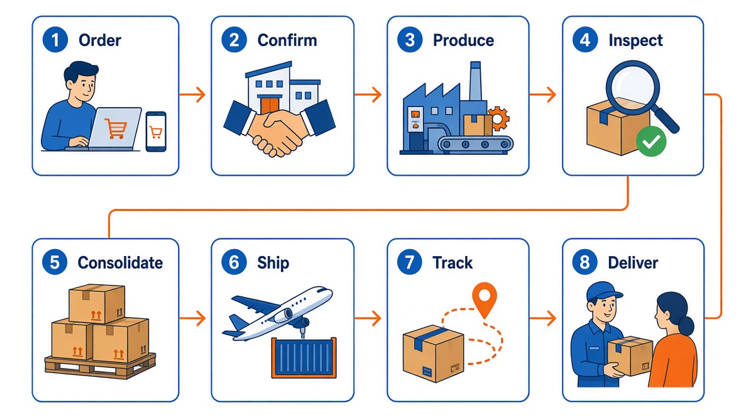
Recommended Order Workflow
1. Customer places an order through your store, marketplace, or B2B portal.
2. The order is checked for payment status, address accuracy, SKU details, and destination restrictions.
3. The sourcing team or platform confirms product availability and supplier lead time.
4. The supplier prepares the item according to approved specifications.
5. Quality checks are completed when required, especially for high-value, branded, or sensitive products.
6. Products from multiple suppliers are consolidated when this reduces shipping cost or parcel complexity.
7. The appropriate shipping method is selected based on delivery time, destination, product type, and budget.
8. Tracking information is shared with the buyer promptly.
9. Delivery performance, defects, cancellations, and returns are recorded by SKU and supplier.
10. The data is used to improve future sourcing decisions.
This type of workflow transforms fulfillment from a reactive task into a measurable business system.
Improve Customer Experience While You Grow
Customers do not care whether a delay happened at the factory, warehouse, carrier, or customs stage. They judge the seller they purchased from.
That makes transparency a competitive advantage.
Set Expectations Before Problems Occur
Your product and checkout pages should clearly communicate:
– Processing time before dispatch
– Estimated shipping range by destination
– Available tracking options
– Product specifications and measurements
– What is included in the package
– Return, replacement, and refund conditions
– Customs-duty or import-tax responsibilities where applicable
Avoid vague language such as “fast shipping” if the actual delivery timeline varies. Specific expectations reduce avoidable customer-service tickets and build confidence.
Create an Exception Management System
Not every order will go perfectly. What matters is how quickly and clearly the business responds.
Create templates and internal rules for:
– Supplier out-of-stock notifications
– Address correction requests
– Delayed dispatch updates
– Damaged-item claims
– Wrong-item replacements
– Lost-parcel investigations
– Refund or reshipment decisions
A scalable business does not promise that nothing will go wrong. It builds a reliable process for when something does.
Technology That Supports Operational Flexibility
As ecommerce operations grow, disconnected tools can become a major source of friction. A business may use one system for the storefront, another for customer data, separate supplier files, shipping software, inventory tools, analytics dashboards, and manual payment records.
The result is often duplicate work and inconsistent information.
A scalable technology stack should support:
– Centralized product information
– Order-status visibility
– Inventory and supplier data synchronization
– Customer segmentation
– Reporting by product, channel, and market
– Shipping-label and tracking workflows
– Role-based access for teams and partners
– Integration with marketplaces, stores, payment systems, and logistics providers
For a B2B seller, the key principle is simpler: choose tools that reduce manual handoffs and make order status visible to the people who need it.
A 90-Day Ecommerce Scaling Plan
Days 1–30: Diagnose and Prioritize
– Audit your top products by margin, refund rate, reorder rate, and fulfillment performance.
– Identify the three biggest operational bottlenecks.
– Review supplier lead times and quality records.
– Define which products should be stocked, tested, or fulfilled only after purchase.
– Set baseline metrics for delivery time, order defects, gross margin, and customer satisfaction.
Days 31–60: Build Repeatable Systems
– Create product specification templates and supplier scorecards.
– Standardize purchase-order, inspection, and shipping workflows.
– Implement inventory alerts and order-status tracking.
– Test 10–30 new products with limited exposure rather than large inventory commitments.
– Build customer communication templates for shipping and exception scenarios.
Days 61–90: Expand with Evidence
– Scale winning SKUs and discontinue low-performing products.
– Add backup suppliers for critical products.
– Negotiate packaging, consolidation, and shipping options.
– Expand to one additional sales channel or market at a time.
– Review results and adjust your inventory policy based on actual demand.
Final Takeaway
The most effective way to scale an ecommerce business is to grow capability before complexity.
Do not let a larger product catalog automatically become a larger inventory problem. Instead, use product data, supplier controls, flexible sourcing, standardized fulfillment, and transparent customer communication to expand with less operational risk.
For global B2B sellers, Looperbuy can support this approach by helping businesses source Chinese products, manage order-based purchasing, consolidate shipments, and arrange dropshipping fulfillment—allowing sellers to test and expand product offerings without carrying every SKU in their own warehouse.
Ready to reduce inventory pressure while expanding your catalog? Start by selecting a small group of validated products, defining your quality and delivery requirements, and building a sourcing-and-fulfillment workflow that can be repeated as order volume grows.
Frequently Asked Questions
1. What is the fastest way to scale an ecommerce business?
The fastest sustainable route is to focus on validated products, standardize order processing, improve supplier reliability, and remove manual work from fulfillment. Adding more products or spending more on ads before fixing fulfillment and margin problems can create expensive operational pressure.
2. Should an ecommerce business hold inventory or use dropshipping?
Most businesses benefit from a hybrid model. Hold inventory for stable, fast-selling products where faster delivery and lower unit costs matter. Use dropshipping or order-based sourcing for new, seasonal, specialized, and long-tail products that have uncertain demand.
3. How can B2B sellers source products from China without managing every supplier directly?
A China sourcing platform can centralize supplier discovery, purchasing, quality-control coordination, payment, product consolidation, and shipping. This can reduce the operational burden of managing multiple factories, domestic shipments, and international fulfillment workflows.
4. What are the biggest risks when scaling with dropshipping?
The biggest risks are supplier stockouts, inconsistent quality, delayed shipping, limited branding options, and thinner margins. Reduce these risks by ordering samples, setting clear specifications, using tracking, maintaining backup suppliers, and communicating delivery timelines honestly.
5. Which ecommerce metrics should I review before expanding product selection?
Review gross margin by SKU, sell-through rate, return rate, order defect rate, supplier lead time, average order value, repeat purchase rate, customer acquisition cost, and delivery performance. These metrics show whether a product is genuinely scalable, not merely popular.
6. How can I avoid dead stock when launching new products?
Start with small batches, pre-orders, limited campaigns, or order-based fulfillment. Scale into bulk purchases only after the product demonstrates repeatable demand, acceptable margins, low returns, and dependable supplier performance.
7. Why does shipping transparency matter for ecommerce growth?
Clear processing times, delivery estimates, tracking updates, and return policies reduce uncertainty. When customers understand what to expect, they are less likely to cancel orders, submit complaints, or leave negative reviews due to preventable communication gaps.
References
1. Virto Commerce. “[Mastering eCommerce Scaling: A Step-by-Step Guide].”
2. Salesforce. “[A Quick Introduction to Dropshipping].”
3. Fishbowl Inventory. “[Inventory Carrying Costs: How To Calculate and Reduce Them].”
4. ShipBob. “[Inventory Carrying Cost Formula].”
5. BigCommerce. “[Dropshipping: Does It Actually Work?].” 6. Slimstock. “[Inventory Cost: What Is It, How To Calculate, With Examples].