In the complex world of global B2B procurement, understanding the distinction between Request for Information (RFI), Request for Proposal (RFP), and Request for Quotation (RFQ) is not just procedural—it is a competitive advantage. For brand owners, wholesalers, and manufacturers navigating the international market, mastering these RFI and RFP processes is critical to streamlining supply chains, reducing costs, and mitigating risks.
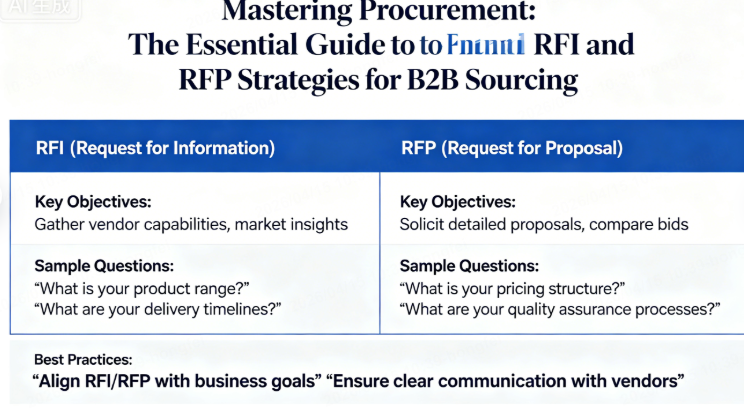
This guide provides deep insights into the RFx lifecycle, offering actionable strategies to optimize your sourcing outcomes while maintaining the agility required for modern, globalized business.
Table of Contents
H2: The Strategic Role of RFI, RFP, and RFQ in Sourcing
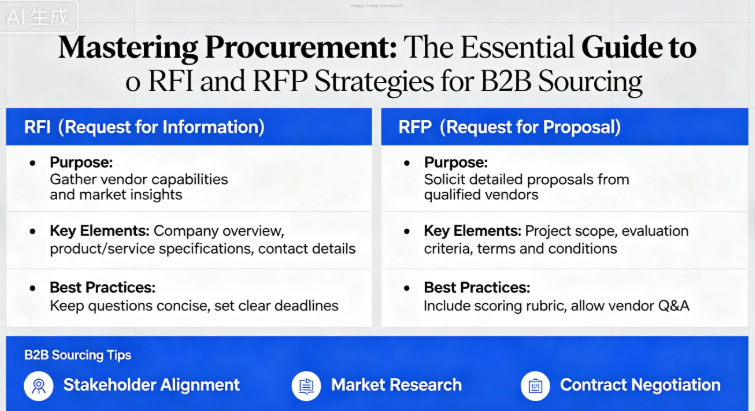
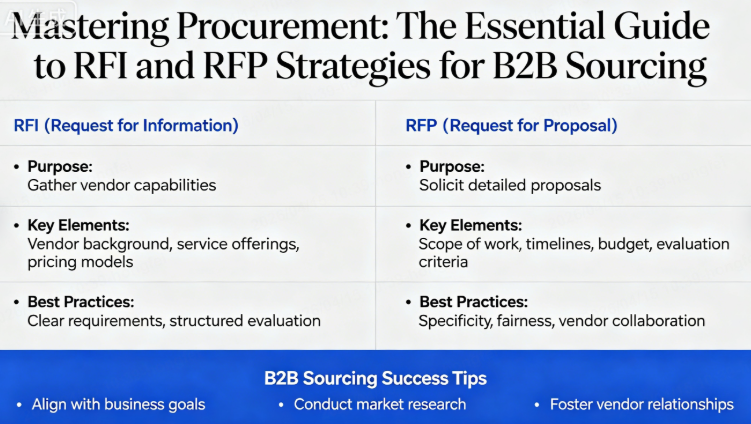
Procurement is rarely a one-step task. To move from a broad market search to a concrete contract, professional buyers employ three distinct types of “Request for…” (RFx) documentation. Each serves a specific purpose, designed to narrow the scope and increase clarity as you approach a final buying decision.
H3: RFI (Request for Information): The Foundation of Market Research
An RFI is your exploratory tool. It is not designed to solicit pricing or binding offers but rather to gather data about potential vendors, their capabilities, market offerings, and compliance standards [6, 13].
- When to use: Use an RFI early in your process when you are trying to understand the supplier landscape or define your own requirements [6, 10, 13].
- Strategic Value: It reduces risk by vetting potential partners before investing time in detailed bidding processes [13].
H3: RFP (Request for Proposal): Designing Your Solution
An RFP is used when you know the business problem you need to solve but require vendor expertise to develop the best solution [2, 3]. Unlike an RFQ, an RFP prioritizes innovation and methodology over simple unit costs [3, 7].
- When to use: When your requirements are complex, require customization, or depend on a partner’s unique technical capabilities [2, 7].
- Strategic Value: It allows vendors to suggest creative approaches you may not have considered, fostering a collaborative, value-driven partnership [3, 11].
H3: RFQ (Request for Quotation): Precision Pricing
An RFQ is the final step in the traditional procurement cycle. Here, you have clearly defined specifications (e.g., product quantity, materials, packaging, and logistics) and are seeking the best possible price [7, 12].
- When to use: When you are ready to purchase, have standardized requirements, and are comparing vendors primarily on cost and lead times [7, 8].
H2: Comparative Analysis: Choosing the Right Tool
Selecting the incorrect document type can lead to poor supplier alignment, wasted time, and inflated costs. Use this table to align your procurement strategy with your specific goals.
| Feature | RFI (Request for Information) | RFP (Request for Proposal) | RFQ (Request for Quotation) |
|---|---|---|---|
| Primary Goal | Market discovery & vetting [6, 13] | Finding a solution/partner [2, 3] | Best pricing for defined specs [7, 12] |
| Complexity | Low | High | Medium/Low |
| Detail Level | General/Broad [8, 10] | Highly Detailed [8, 11] | Highly Specific/Technical [7, 11] |
| Key Output | Vendor capabilities [10] | Proposed solutions [11] | Final unit pricing/TCO [7, 8] |
(Visual suggestion: Insert a flowchart here depicting the RFx lifecycle, moving from RFI (exploratory) to RFP (solutions) to RFQ (transactional).)
H2: Optimizing Your Procurement Workflow: Expert Insights
Beyond understanding definitions, modern procurement teams must optimize their execution to survive in a competitive global market.
H3: Leveraging AI and Digital Platforms for Efficiency
In an era where time-to-market is critical, relying on manual email chains for RFI and RFP processes is inefficient. B2B Sourcing Platforms (like LooperBuy) and dedicated e-sourcing tools allow you to:
- Standardize Questionnaires: Ensure all vendors answer the same set of critical questions, making comparison easy [14].
- Automate Communication: Use digital platforms to manage document distribution and track responses without “quote leakage” [14].
- Access Global Data: Platforms provide direct access to massive directories of verified Chinese manufacturers, allowing for rapid RFI outreach [14].
H3: Best Practices for Writing Effective RFPs
A common pitfall is providing too little context, leading to vague, unhelpful proposals. To fix this:
- Clearly Define Objectives: Explain the “why” behind the project, not just the “what.”
- Define Evaluation Criteria: Tell vendors how they will be scored (e.g., quality, sustainability, compliance, cost).
- Include Technical Specifications: Use attachments for detailed drawings, material requirements, or service level agreements (SLAs).
H2: Unique Value Proposition: Why Global Sourcing Matters
For businesses looking to optimize their supply chain, directly sourcing from Chinese manufacturers through a specialized one-stop sourcing platform offers distinct advantages:
- Unmatched Diversity: Access a massive catalog of product categories that are difficult to find locally.
- Cost Efficiency: By dealing directly with manufacturers, you cut out unnecessary intermediaries, significantly improving your margins.
- Simplified Logistics: The main barrier to global sourcing is often logistics. Modern platforms solve this by integrating reliable, low-cost international shipping directly into the sourcing process.
H2: Conclusion
The difference between a successful procurement outcome and a costly mistake often lies in the document you send to your suppliers. Using an RFI to build knowledge, an RFP to solicit innovation, and an RFQ to lock in pricing ensures you are always engaging with vendors at the right time with the right expectations.
For companies ready to scale, integrating these processes into a centralized sourcing platform is no longer optional—it is a necessity. Start by mapping out your current needs, and choose the RFx that aligns with your ultimate goal.
Ready to streamline your global sourcing process? Visit LooperBuy today to access a one-stop sourcing platform that connects you directly with top Chinese suppliers, helping you secure better products at lower costs with seamless global logistics.
H2: References
- Fairmarkit: RFQ vs. RFP vs. RFI [1]
- 1up.ai: RFI vs RFP vs RFQ: The Simplified Guide [2]
- Momentive Software: RFI, RFQ, & RFP: What’s the Difference? [3]
- Vroozi: RFI vs. RFP vs. RFQ: Which Does Your Company Need? [4]
- Pipefy: RFI, RFP, and RFQ: Definitions and Differences [5]
- Coupa: RFI vs. RFQ vs. RFP: Which Does Your Company Need? [6]
- ISM: Understanding RFP, RFQ, RFI Differences [7]
- inFlow: A Contractor’s Guide to Understanding RFI, RFP, and RFQ [8]
- VisibleThread: RFI vs RFP vs RFQ: What’s The Difference [9]
- Inventive AI: Understanding the Differences Between RFI, RFQ, and RFP [10]
- Gainfront: What are RFP, RFQ, and RFI? [11]
- Euna Solutions: Understanding the Difference Between an RFI vs RFQ vs RFP [12]
- Archlet: RFI vs RFP vs RFQ: when to use each [13]
- ProcurementFlow: Mysterious RFx [14]
H2: Frequently Asked Questions (FAQ)
1. Can I use an RFP instead of an RFQ for simple purchases?
While you can, it is generally inefficient. An RFP requires vendors to propose solutions, which takes time for both parties. If you have clearly defined specs for a standard product, an RFQ is faster and more direct.
2. At what stage of the procurement cycle should I use an RFI?
The RFI is strictly an exploratory, pre-sourcing tool. Use it when you are in the research phase, trying to understand market capabilities, or narrowing down a list of potential suppliers before inviting them to a formal bid.
3. What is the biggest mistake companies make with RFPs?
The biggest mistake is failing to perform adequate due diligence before sending the RFP. Without clear internal requirements and context, vendors cannot provide tailored solutions, often leading to misaligned proposals.
4. How can I ensure my RFQ responses are comparable?
Use a standardized template for your RFQ. Request that all vendors provide pricing based on the exact same unit quantities, packaging, and incoterms. This allows for an “apples-to-apples” cost comparison.
5. Do I need a platform to run an RFx process?
For small, infrequent purchases, email may suffice. However, for serious B2B procurement, a platform ensures professionalism, reduces risk of fraud, centralizes data, and significantly speeds up communication compared to manual email chains.
Brief Summary:
This comprehensive guide demystifies the RFI, RFP, and RFQ procurement processes. Designed for B2B sourcing professionals, it explains when to use each tool to optimize vendor selection and project success. It provides expert strategies for workflow automation, best practices for document drafting, and explores how global one-stop platforms like LooperBuy can simplify international sourcing, logistics, and cost management for brand owners and wholesalers.
Hot tags: B2B sourcing platform, global supply chain management, Request for Proposal (RFP) guide, RFI procurement process, international manufacturing, wholesale sourcing solutions, direct from factory sourcing, strategic procurement tools, global logistics and shipping, B2B vendor management.