B2B dropshipping vs traditional wholesale: which truly requires less capital in 2026? Discover startup cost benchmarks, cash‑flow risks, hybrid strategies, and how Looperbuy enables low‑capital China sourcing for serious B2B sellers.
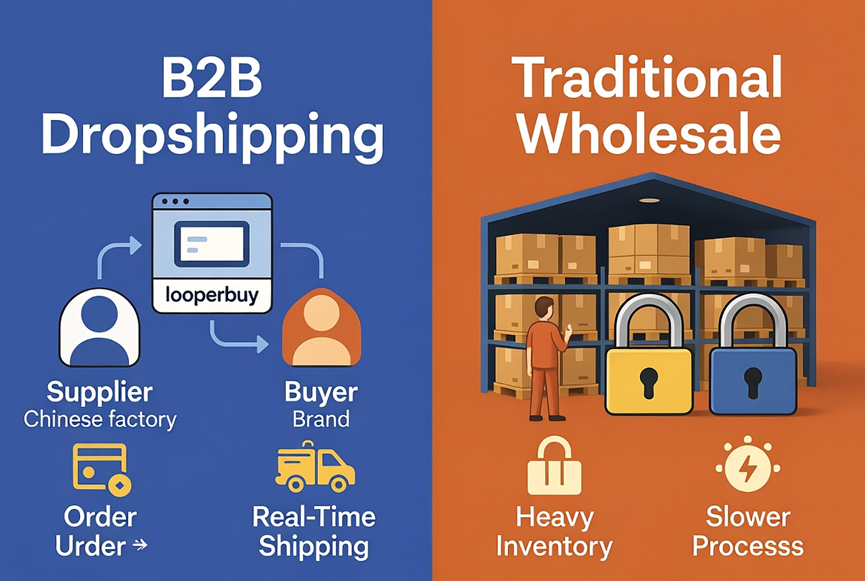
B2B dropshipping generally requires far less upfront capital than traditional wholesale, especially when you leverage a specialized China sourcing platform like Looperbuy that removes inventory, warehousing, and complex logistics from your balance sheet.
In this guide, I will compare B2B dropshipping vs traditional wholesale from the perspective of a B2B operator and supply‑chain strategist who has worked with global brands sourcing from China.
We will focus specifically on capital requirements, risk, scalability, and how platforms like Looperbuy can make a low‑capital B2B model viable in 2026 and beyond.
Table of Contents
Quick Definition: B2B Dropshipping vs Traditional Wholesale
B2B dropshipping is a model where you sell products to other businesses but only purchase from your supplier after you receive an order from your buyer.
You do not own inventory upfront; instead, a sourcing or fulfillment partner like Looperbuy handles procurement, warehousing, and direct shipping to your B2B customers.
Traditional wholesale means buying goods in bulk at discounted prices, holding them in your own (or 3PL) warehouse, and then selling them to retailers, distributors, or other B2B buyers.
The key difference is that wholesale ties capital into stock and storage, whereas dropshipping keeps your capital focused on sales, marketing, and working capital.
Startup Capital: How Much Do You Really Need?
From a capital planning standpoint, startup cost is the first big fork in the road. Industry benchmarks show that many dropshipping operations can be launched for under 500–1,000 USD, mostly for software, listing, and marketing, because you do not buy stock upfront.
By contrast, a traditional wholesale model often demands 5,000–25,000+ USD in initial inventory and storage, depending on MOQs and product category.
Typical cost structure in the first 3–6 months
– B2B dropshipping
– Website/marketplace accounts and listing fees.
– Product sampling (optional but recommended for B2B).
– Initial marketing and sales outreach.
– Small working capital buffer for payment terms gaps.
– Traditional wholesale
– Bulk inventory purchase (often tied to factory MOQ).
– Warehousing or 3PL deposit and monthly fees.
– Insurance, packaging materials, handling equipment.
– Upfront logistics and customs charges before first sale.
For capital‑constrained B2B sellers or first‑time importers, dropshipping plus a platform like Looperbuy can reduce initial cash outlay by more than 80% compared with classic wholesale.
Industry Context: Why Low‑Capital Models Are Winning in 2026
The macro trend is clear: dropshipping and asset‑light fulfillment models are scaling fast as global ecommerce grows.
Recent reports estimate that the global dropshipping market in 2026 is in the hundreds of billions of dollars, with annual growth rates often quoted above 20% thanks to low entry barriers and improved logistics.
At the same time, success rates show that execution is harder than entry: only a minority of new sellers become sustainably profitable in year one, mainly due to thin margins and shipping delays.
For B2B players, this reality makes capital efficiency and supply‑chain reliability more important than simply “getting started cheap,” which is exactly where a curated platform like Looperbuy changes the equation.
Capital Locked in Inventory vs On‑Demand Purchasing
How traditional wholesale ties up capital
In a wholesale model, you usually must commit to Minimum Order Quantities (MOQs) that justify factory pricing and production.
That can mean ordering thousands of units per SKU, plus paying for storage, insurance, and handling before you know whether the product will move.
This has three capital impacts:
1. Inventory risk – Cash is frozen in slow‑moving or dead stock.
2. Carrying cost – Warehousing and financing costs eat into margins.
3. Opportunity cost – Money in one product cannot be used to test new SKUs or channels.
How B2B dropshipping keeps capital liquid
With B2B dropshipping, you mostly pay after your buyer pays you, so inventory sits on your supplier’s or platform’s balance sheet, not yours.
This enables you to:
– Test many SKUs with minimal financial commitment.
– Allocate more budget to demand generation instead of stock.
– Pivot quickly when a product underperforms, without liquidation losses.
Platforms like Looperbuy add another layer of capital efficiency by providing low MOQs, free warehousing for limited periods, and consolidated shipping, further reducing how much cash you must park in inventory at any time.
Detailed Capital Comparison Table
The table below summarizes how much capital each model typically requires and where it gets tied up.
| Dimension | B2B Dropshipping (with Looperbuy) | Traditional Wholesale Importing from China |
| Initial inventory purchase | None or minimal samples only | Bulk purchase based on factory MOQ |
| Typical startup budget | Often under 500–1,000 USD | Commonly 5,000–25,000+ USD |
| Warehousing cost (early stage) | Often 0 (supplier/platform stock) | Own warehouse or 3PL fees from day one |
| Logistics cash outlay timing | After client orders, via platform workflows | Before selling, to ship bulk into your warehouse |
| Capital risk in unsold goods | Very low, no owned stock | High, especially with many SKUs |
| Flexibility to test SKUs | Very high, broad catalog access | Limited by budget and storage constraints |
Cash Flow, Payment Terms, and Risk Management
Capital is not only about how much but also when you pay and receive.
Wholesale: front‑loaded cash flow
In a traditional wholesale import cycle, you often:
1. Pay a deposit (e.g., 30%) to the factory to start production.
2. Pay the balance before shipment or against documents.
3. Fund freight, duties, and warehousing on arrival.
4. Wait weeks or months to sell enough inventory to recoup your investment.
This front‑loaded pattern creates significant cash‑flow pressure, especially when multiple containers or product lines are involved.
B2B dropshipping: closer to pay‑as‑you‑earn
With B2B dropshipping:
– You confirm orders with your buyers first.
– You then place and fund the order with your platform or supplier.
– Fulfillment and logistics are triggered after the sale.
Looperbuy’s model, for example, allows buyers to leverage secure payment flows, combined freight, and short‑term warehousing so they can align cash payments more closely with realized demand.
For capital‑light B2B operators, this more symmetric cash flow significantly reduces the need for large credit lines or investor funding.
Operational Complexity and Hidden Capital Costs
From my experience working with B2B importers, hidden operational costs often rival direct inventory spend.
Hidden costs in traditional wholesale
– Building and managing a warehouse team.
– Software for inventory, WMS, and order management.
– Quality control processes across batches and shipments.
– Handling returns, re‑labeling, and re‑packaging.
Each of these items either requires capital (CapEx) or locks working capital into overhead, especially when volumes are still unstable.
How dropshipping with Looperbuy externalizes complexity
A specialized B2B sourcing and fulfillment platform can centralize many of these functions:
– Supplier vetting and documentation: Looperbuy verifies suppliers and surfaces business licenses and transaction histories, reducing your due‑diligence cost.
– Inspection and real‑photo checks: You can request checks before shipping, catching major issues without owning stock yet.
– Smart consolidation and logistics: Consolidating orders from multiple suppliers into one shipment reduces per‑unit freight and administrative work.
The result is not only lower operating complexity but also less capital wasted on building infrastructure too early.
When Does Traditional Wholesale Still Make Sense?
From an expert perspective, traditional wholesale can still be the better choice once certain conditions are met, despite its higher capital requirement.
You might prefer wholesale if:
– You have proven, stable demand and clear sales history.
– You need maximum control over branding, packaging, and compliance.
– Your volumes justify lower per‑unit costs and higher margins through bulk buying.
– You have access to affordable capital or existing warehouse infrastructure.
In practice, many successful B2B sellers start with a dropshipping‑first discovery phase, then migrate their top‑performing SKUs into a hybrid model: some stock held wholesale, others fulfilled on demand.
Hybrid Strategy: Using Looperbuy to Move from Low‑Capital to Scale
Looperbuy is particularly suitable for this test‑then‑scale path.
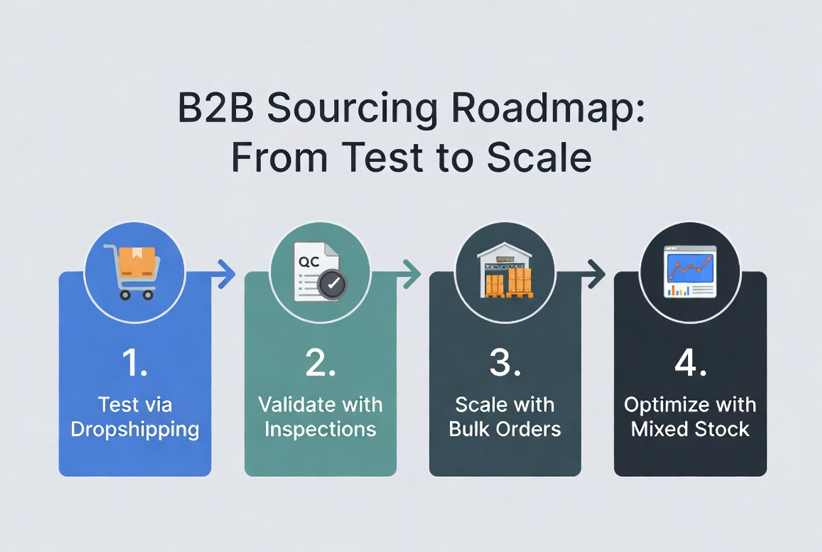
A pragmatic progression might look like this:
1. Validate demand with B2B dropshipping
Use Looperbuy’s low MOQ and on‑demand fulfillment to test product‑market fit across multiple SKUs and regions, without committing large capital.
2. Use inspections before larger commitments
Once a SKU performs well, use Looperbuy’s quality checks and real‑photo inspections to confirm consistency before scaling volumes.
3. Switch winners to bulk orders and free storage
For high‑velocity items, place larger runs and leverage Looperbuy’s free warehousing for up to 90 days to lower per‑unit logistics costs while still keeping capital efficiency.
4. Optimize logistics mixing China and overseas stock
Combine just‑in‑time China supply for margins with faster overseas stock for urgent orders, balancing cash use with service levels.
This hybrid approach turns Looperbuy into a capital‑efficient bridge between low‑risk B2B dropshipping and more traditional wholesale economics, without forcing you to build your own infrastructure too early.
Practical Steps to Launch a Low‑Capital B2B Model with Looperbuy
If you want to minimize capital while still acting like a serious B2B supplier, here is a practical workflow:
1. Define your target niche and buyers
Focus on specific product lines and B2B segments so your catalog and negotiations stay sharp.
2. Use Looperbuy’s RFQ tools to source
Submit detailed RFQs with specs, certifications, and target prices so the platform can match you to suitable Chinese manufacturers quickly.
3. Start with sample‑based validation
Invest in samples for 3–5 core SKUs rather than full stock; use them for sales presentations, photography, and early customer testing.
4. List products and negotiate terms
Use the platform to compare MOQs, lead times, and pricing; lock in payment and fulfillment terms that match your cash‑flow reality.
5. Go live using dropshipping fulfillment
Accept B2B orders and route them through Looperbuy’s fulfillment flow so you only pay for goods once you have confirmed purchase orders.
6. Scale the winners into a hybrid model
Once certain SKUs have predictable volume, transition them into bulk purchases stored at Looperbuy’s warehouse, while keeping less proven SKUs in a pure dropshipping mode.
So, Which Requires Less Capital?
From a pure capital requirement perspective, B2B dropshipping clearly requires less upfront cash than traditional wholesale, often by an order of magnitude when you factor in MOQs, warehousing, and early logistics.
However, the strategic answer is to use B2B dropshipping (via a platform like Looperbuy) as your low‑risk entry and testing layer, then selectively layer on wholesale for proven SKUs where bulk purchasing and branding justify the capital exposure.
Build a Leaner B2B Supply Chain with Looperbuy
If your goal is to grow B2B sales without tying up cash in warehouses full of untested stock, start by building a low‑capital dropshipping backbone.
Explore how Looperbuy can:
– Give you $0 upfront access to Chinese suppliers with low MOQs.
– Provide free warehousing windows and consolidated freight to keep logistics capital‑light.
– Support step‑by‑step scaling from test orders to bulk purchasing when your data proves it is safe to commit.
Position Looperbuy as your capital‑efficient operations partner, so your money stays focused where it creates real leverage: marketing, customer relationships, and product innovation.
FAQ: B2B Dropshipping vs Traditional Wholesale
1. Is B2B dropshipping really viable for serious wholesale buyers, or only for small sellers?
B2B dropshipping is increasingly used by serious sellers as a testing and expansion layer, allowing them to validate new SKUs, regions, and channels before committing to full wholesale imports.
Many mature brands now run hybrid models where only top‑performing products are stocked in bulk, while the long tail is fulfilled on demand.
2. How much capital do I realistically need to start B2B dropshipping from China?
For many business models, you can start with under 1,000 USD, mainly for samples, platform tools, and marketing, since inventory is purchased only after you receive orders.
Using Looperbuy further reduces this by providing $0 upfront access, low MOQs, and temporary warehousing, so you do not have to build your own stock infrastructure.
3. When should I shift from dropshipping to traditional wholesale?
A good rule of thumb is to consider wholesale once a SKU has predictable order volume, stable margins, and repeat B2B buyers, so lower per‑unit costs from bulk buying outweigh the capital risk.
At that point, leveraging Looperbuy’s warehousing and consolidation still helps keep logistics efficient while you capture better margin.
4. Does dropshipping always have worse margins than wholesale?
Not always. While wholesale can offer better unit pricing, dropshipping reduces overhead and unsold inventory losses, which can equal or exceed the price difference.
When you calculate profit on a cash‑invested basis, dropshipping can be more attractive in early stages because your capital turnover is faster.
5. How does Looperbuy specifically help reduce capital risk compared with going direct to factories?
Going direct to factories often forces you into higher MOQs and handling your own warehousing and freight, which ties up capital quickly.
Looperbuy aggregates suppliers, provides low‑MOQ options, offers free or low‑cost warehousing windows, and manages inspections and consolidation so you can operate with far less locked‑in capital.
References
1. Shopline – “Dropshipping vs. Wholesale: What’s the Difference?” (2026). [shopline]
2. RuntoDropship – “What Makes Dropshipping vs Wholesale Better for Beginners?” (2026). [runtodropship]
3. Looperbuy Blog – “Simplifying B2B Procurements: An Expert Review of Looperbuy’s One‑Stop Sourcing from China.” [looperbuy]
4. Looperbuy Blog – “B2B Marketplaces in 2026: How Global Buyers Win with Specialized China Sourcing Platforms like Looperbuy.” [looperbuy]
5. eCommerce Manager – “120 Dropshipping Statistics for 2026.” [ecommercemanager]
6. SellersCommerce – “Detailed Dropshipping Statistics in 2026.” [sellerscommerce]
7. Branvas – “50+ Dropshipping Statistics for 2026.” [branvas]
8. CompaniesHistory – “Dropshipping Market Statistics 2026: E‑Commerce Seller Trends.” [companieshistory]
9. Easy2SupplyChain – “The State of Dropshipping in 2026: Market Trends, Data, and Strategies for Success.” [easy2supplychain]
10. Printful – “Top Dropshipping Statistics You Need to Know in 2026.” [printful]