Learn how to test product demand before sourcing inventory. This practical guide shows dropshippers how to use Temu for discovery, validate ideas with search and social signals, assess margins and supplier risk, run controlled product tests, and scale reliable offers with flexible China fulfillment.
Testing product demand before committing capital is one of the most reliable ways to reduce inventory risk in dropshipping. Temu can be useful as a product-discovery signal, but successful sellers should validate every idea across search demand, social engagement, sourcing feasibility, unit economics, and live-store performance before scaling.
For merchants selling internationally, the goal is not to copy a listing found on Temu. The goal is to identify a customer problem, confirm that people want a solution, source a differentiated and dependable version from China, and fulfill orders without tying up cash in stock.
> Important: Treat marketplace sales badges, reviews, and rankings as directional indicators—not as audited market data. A product can perform well inside one marketplace but still fail with a different audience, price, offer, shipping promise, or creative angle.
Table of Contents
Why Product Demand Testing Matters Before Sourcing
A product can look impressive in a short video, receive thousands of marketplace orders, or attract enthusiastic comments—yet still be a poor fit for your store.
The difference is context.
A marketplace may win sales through ultra-low pricing, platform-funded discounts, app traffic, fast social discovery, or a large existing user base. Your independent store must earn attention differently. You need a clear offer, credible product presentation, dependable delivery, accurate product information, and a margin that remains viable after payment fees, advertising, refunds, and fulfillment costs.
This is why product demand testing should answer more than one question:
– Do consumers notice the product?
– Does it solve a clear, relatable problem?
– Is search and social interest stable enough to support testing?
– Can you source a version with acceptable quality and lead time?
– Can you sell it at a price that supports your acquisition cost and operating expenses?
– Will customers still be satisfied after delivery?
The broader market opportunity remains substantial. The U.S. Census Bureau estimated seasonally adjusted U.S. retail e-commerce sales at $340.2 billion in the second quarter of 2026, up 3.8% from the prior quarter. That scale also means competition is intense: merchants need disciplined testing rather than product selection based on intuition alone.
The Core Principle: Test the Problem, Not Just the Product
Experienced operators do not ask, “Is this item trending?”
They ask:
> “Which buyer problem does this solve, for whom, and why would that person buy it from my store instead of an established marketplace?”
For example, a generic cable organizer is easy to find almost everywhere. But a modular desk cable-management kit for remote workers and gaming setups creates a more precise customer promise. It supports targeted creative, clearer bundling, better landing-page copy, and potentially higher perceived value.
A winning offer usually combines:
– A specific customer segment
– A recognizable pain point
– A visible product benefit
– A credible reason to buy now
– A practical fulfillment experience
Use Temu as a Product Discovery Signal
Temu can help merchants observe consumer-facing products, recurring categories, price points, product demonstration styles, customer reviews, and high-volume visual hooks. Temu is a platform that provides insights into consumer demand patterns, rather than a general sales channel for independent merchants.
However, effective Temu product research requires a more rigorous method than simply selecting items labeled “best seller.”
Start With Category Patterns, Not Random Products
Spend time reviewing relevant categories instead of scrolling only for novelty. Look for recurring customer needs across categories such as:
– Home organization
– Pet care
– Kitchen efficiency
– Travel accessories
– Car organization
– Beauty and personal-care tools
– Fitness accessories
– Hobby and creator equipment
– Seasonal outdoor products
– Small-space living products
Create a simple research sheet with the following fields:
| Research item | What to record | Why it matters |
| Product name | Generic product category | Avoids copying branded listing language |
| Target customer | Who likely buys it | Helps you build a focused offer |
| Problem solved | Friction, inconvenience, cost, clutter, or time loss | Clarifies marketing angle |
| Visual demonstration | What can be shown in 5–10 seconds | Supports ad creative testing |
| Review themes | Repeated praise and complaints | Identifies differentiation opportunities |
| Price range | Marketplace pricing and bundle possibilities | Supports margin analysis |
| Size and weight | Estimated shipping complexity | Prevents costly fulfillment surprises |
| Seasonality | Stable, seasonal, or event-driven demand | Shapes launch timing |
| Supplier availability | Number of credible sourcing options | Reduces dependency risk |
Read the Listing Like a Merchant
A product page can reveal much more than the product itself. Review each candidate through five lenses:
1. The visual hook
Can a customer understand the benefit in a few seconds? Products that visibly save space, reduce mess, solve a frustration, or transform an object often translate well into short-form video.
2. The problem-solution fit
Does the product solve an everyday issue or merely look unusual? Novelty may generate clicks, but practical usefulness is more likely to generate repeatable demand and lower return risk.
3. The review language
Read negative reviews first. They frequently reveal issues with material quality, dimensions, assembly, packaging, color accuracy, odor, durability, or instructions.
4. The offer structure
Observe whether customers respond to single units, multi-packs, bundles, add-ons, or quantity discounts. This can inform your own average-order-value strategy.
5. The product’s operational reality
Avoid being seduced by a good video when the item is fragile, oversized, restricted, battery-powered, difficult to inspect, or expensive to ship internationally.
Validate Demand Beyond a Single Marketplace
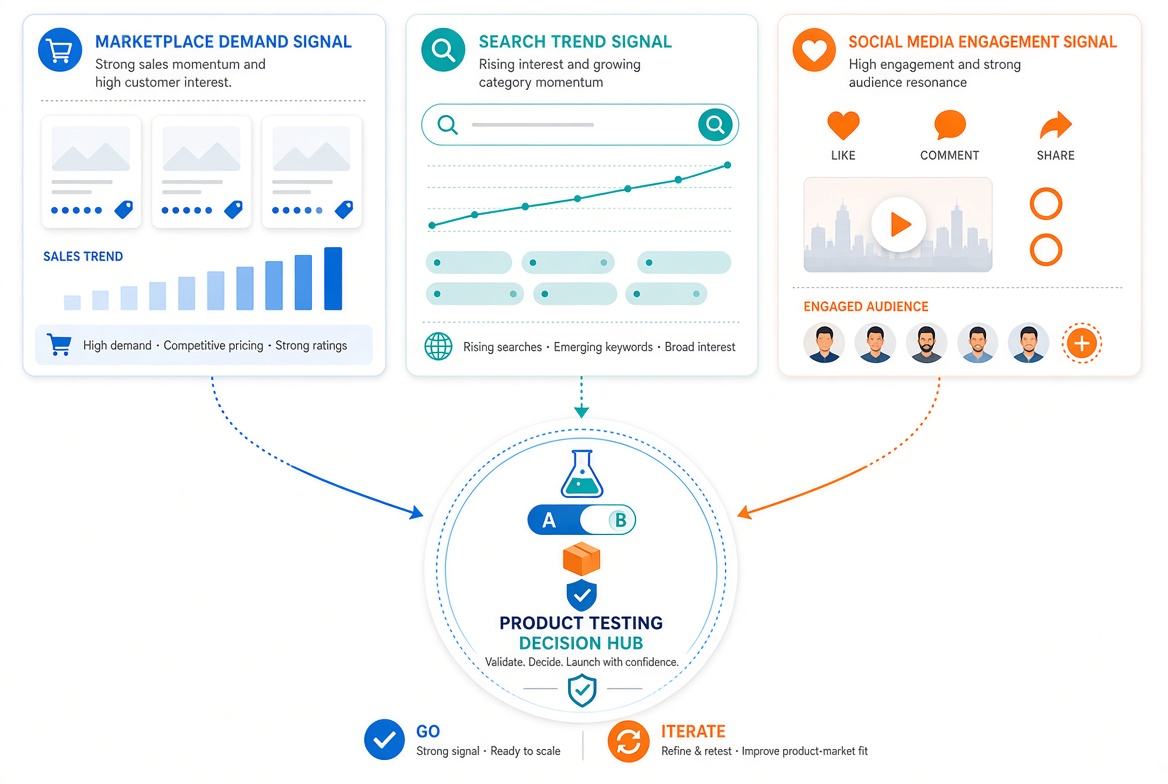
A product should not progress to sourcing because it has marketplace momentum alone. Use a cross-channel validation process that looks for independent evidence of buyer interest.
Check Search Demand With Google Trends
Google Trends is useful for comparing relative interest over time, across regions, and between product terms. But it does not show exact search volume. Google explains that Trends analyzes a sample of searches, and low-volume terms may appear as zero within a selected period.
Use Google Trends to answer practical questions:
– Is interest rising, stable, seasonal, or declining?
– Does the product attract interest in your target country?
– Are buyers searching for the generic category, a use case, or a problem?
– Are related search terms becoming more popular?
– Is the product relevant only during a short seasonal window?
Do not reject a product merely because its Google Trends line is modest. Niche B2B-adjacent products, specialized accessories, and impulse-driven items may have limited direct search demand. Instead, compare several relevant terms and look for consistency.
For example, test variations such as:
– “desk cable organizer”
– “cable management kit”
– “under desk cable tray”
– “home office desk organizer”
The search language customers use can become the basis for your product title, product page, ad hooks, and collection structure.
Review Amazon and Other Retail Listings
Amazon is especially useful for identifying mature-category competition, pricing expectations, review volume, product defects, and unmet customer needs.
Look for these signals:
– Several established listings with sustained review volume
– Common complaints that a better supplier or bundle could address
– Product images that fail to explain the benefit clearly
– Weak instructions or poor packaging
– Missing variations, sizes, colors, or accessory bundles
– A price ceiling high enough to support your economics
Do not assume that high Amazon review volume means you should enter the category. It can also mean the market is mature and expensive to compete in. Your goal is to locate a specific wedge: better positioning, a better package, clearer education, improved quality control, or a more relevant audience.
Check Social Proof and Creative Potential
Search TikTok, Instagram Reels, YouTube Shorts, Pinterest, and relevant community forums for the product category and customer problem.
Focus on evidence such as:
– Organic videos demonstrating real use
– Repeated comment questions about where to buy
– User-generated content rather than only polished advertisements
– Multiple creators independently discussing the same use case
– Different creative angles that could appeal to different customer segments
A viral video is not validation by itself. It may reflect entertainment value rather than buying intent. Stronger evidence appears when product interest persists across multiple posts, creators, formats, and channels.
Score Each Product Before You Import It
A scoring model helps teams avoid emotional product selection. Instead of asking whether a product “feels promising,” rate it against consistent criteria.
A Practical Product Demand Scorecard
Score each area from 1 to 5, then compare candidates side by side.
| Evaluation factor | Key question | Strong signal |
| Problem clarity | Is the buyer pain obvious? | The benefit is understandable immediately |
| Demonstration value | Can value be shown visually? | A clear before-and-after moment exists |
| Market validation | Is there evidence across channels? | Marketplace, search, and social signals align |
| Differentiation | Can your offer be meaningfully different? | Better bundle, positioning, content, or quality |
| Margin potential | Can the price support costs? | Healthy room after product, shipping, fees, ads, and returns |
| Shipping practicality | Is fulfillment manageable? | Compact, durable, low-risk, and simple to ship |
| Quality-control risk | Can defects be checked before dispatch? | Specifications are clear and suppliers are responsive |
| Seasonality | Is timing favorable? | Stable or predictable demand window |
| Customer-support risk | Will the product create disputes? | Low setup complexity and clear instructions |
A candidate with a high demand score but poor fulfillment economics is not a winning product. Likewise, a product with excellent margins but no convincing demand signal may consume advertising spend without generating meaningful learning.
Calculate Unit Economics Before You Launch
Use conservative assumptions. Do not calculate profit based only on supplier price and retail price.
A simplified contribution-margin calculation is:
Contribution Margin=Selling Price−Product Cost−Shipping Cost−Transaction Fees−Ad Cost per Order−Expected Refund/Replacement Cost
For instance, a $39.99 product may appear attractive if it costs $11 to source. But if shipping is $7, payment fees are $1.50, customer acquisition costs $13, and expected refunds or replacements average $2.50 per order, the contribution margin is only $4.98 before overhead.
That does not automatically make the product unworkable. It means the business must improve at least one variable:
– Raise perceived value through a bundle
– Improve conversion through better product education
– Negotiate a better sourcing price
– Reduce shipping cost through packaging optimization
– Increase average order value with relevant add-ons
– Improve creative performance and lower acquisition cost
– Choose a product with lower support and return risk
Build a Low-Risk Product Testing Sprint
Once a product passes initial research, move into a controlled live test. The objective is not to prove that a product will become a seven-figure winner in a few days. The objective is to collect enough evidence to decide whether to iterate, pause, or invest further.
Step 1: Source Samples Before You Sell at Scale
For products that matter to your brand, order samples before launching aggressively. A sample review should cover:
– Material and build quality
– Actual dimensions and weight
– Color consistency
– Product functionality
– Assembly or usage instructions
– Packaging condition
– Shipping durability
– Accuracy against supplier photos and claims
For Looperbuy users, this is where a China sourcing and fulfillment partner can reduce uncertainty. Instead of purchasing large quantities, sellers can identify comparable supplier options, request inspection support where available, consolidate suitable items, and use fulfillment workflows that avoid unnecessary stockholding.
Do not market claims you have not verified. If a supplier says an item is waterproof, medical-grade, child-safe, or compatible with a specific device, request evidence and test the claim where appropriate.
Step 2: Create a Minimum Viable Offer
Your first product page does not need to be perfect. It needs to be clear, credible, and conversion-ready.
Include:
– A benefit-led title
– A concise explanation of the problem solved
– Visual proof through photos or short demonstrations
– Accurate specifications and dimensions
– Delivery expectations that customers can understand
– Clear return and support information
– Frequently asked questions based on known objections
– A compelling but truthful offer
Avoid generic copy such as “Premium Quality” or “Best Product Ever.” Instead, make the value concrete:
– “Keeps charging cables off the floor and within reach”
– “Designed for renters who need no-drill desk organization”
– “Includes clips, sleeves, and adhesive mounts for a complete setup”
Step 3: Test One Variable at a Time
A product test becomes difficult to interpret when you change the audience, product price, page design, video, offer, and landing page at once.
Meta’s testing guidance emphasizes beginning with a measurable hypothesis, differentiating test assets sufficiently, avoiding confounding promotional moments, and continuing testing based on what is learned.
Use a simple test hypothesis:
> “A before-and-after video showing desk clutter will generate a higher add-to-cart rate among remote workers than a product-only demonstration.”
Then keep the rest of the test stable.
| Test element | Example variation | What to measure |
| Creative hook | Messy desk vs. tidy desk transformation | Click-through rate |
| Customer angle | Remote work vs. gaming setup | Landing-page engagement |
| Offer | Single unit vs. starter bundle | Average order value |
| Product page headline | Space-saving vs. productivity benefit | Add-to-cart rate |
| Price point | $29.99 vs. $34.99 | Conversion and margin |
Step 4: Use Decision Rules, Not Hope
Set stop, improve, and scale criteria before spending money.
Pause the test when:
– Visitors show little engagement with the offer
– The product page receives traffic but no meaningful add-to-cart behavior
– Customer questions reveal serious trust, delivery, or product-fit concerns
– Sample quality does not support your brand promise
– The economics cannot work even with reasonable improvements
Iterate when:
– Click-through rate is promising but the landing page is weak
– Visitors add to cart but abandon at checkout
– Reviews or customer questions reveal a solvable information gap
– A specific audience segment responds better than others
– The product works but the original creative angle does not
Scale cautiously when:
– Sales occur at a sustainable acquisition cost
– The product arrives as promised
– Early customer feedback is positive
– Fulfillment operations remain stable
– You can meet expected delivery times consistently
Improve What Competitors Often Miss
Many product-research guides stop at “find a trending product.” That advice overlooks the operational factors that determine whether short-term demand becomes a sustainable business.
Build Your Offer Around Review Mining
Negative reviews are often the fastest route to differentiation.
If customers complain that a kitchen organizer is too small, make dimensions more visible. If buyers say adhesive strips fail, source stronger mounting materials. If users struggle with setup, include a visual instruction card or a short QR-linked demonstration video.
This approach does not require inventing a new product. It requires reducing buyer friction.
Evaluate Supplier Reliability Before Scaling Ads
A high-converting product can damage your business if the supplier changes materials, runs out of inventory, ships late, or provides inconsistent packaging.
Before scaling, ask suppliers:
– What is the current production lead time?
– Is inventory ready to ship, or made to order?
– Can the supplier maintain the same material and specification?
– What are the carton dimensions and unit weight?
– Can they provide real product photos or videos?
– Can they support neutral packaging, inserts, or basic customization?
– How do they handle defective units?
– Can they provide tracking information reliably?
A strong sourcing workflow is not only about getting a low price. It is about creating a repeatable fulfillment system that protects your customer experience.
Plan for Delivery Expectations
International fulfillment can be commercially viable, but delivery communication must be honest and clear. Under-promising and over-delivering is preferable to setting an unrealistic expectation that produces chargebacks and negative reviews.
Your product page should answer:
– Where does the product ship from?
– What is the estimated processing time?
– What is the estimated transit time by destination?
– Is tracking available?
– What should customers do if an order is delayed or damaged?
Clear communication can reduce support volume and build trust even when delivery is not as fast as domestic fulfillment.
Launch Smarter With Looperbuy
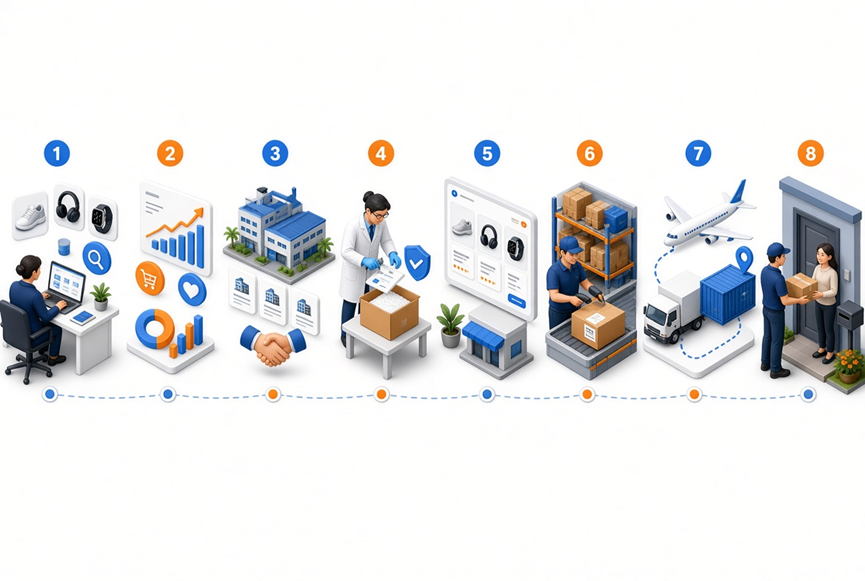
The most resilient e-commerce businesses do not depend on one viral item or one marketplace signal. They build a repeatable system:
1. Discover products through customer problems and marketplace patterns.
2. Validate demand through search, retail, and social signals.
3. Check margins and fulfillment practicality before committing budget.
4. Source and inspect samples before scaling.
5. Run controlled live tests with clear decision rules.
6. Improve the offer using customer feedback and supplier insights.
7. Fulfill orders reliably without unnecessary inventory exposure.
Looperbuy can support this process by helping global B2B sellers source China-made products, test opportunities with a lower upfront inventory commitment, and coordinate dropshipping fulfillment. Instead of investing heavily before proof of demand, merchants can focus their capital on research, creative testing, product presentation, and customer acquisition.
Ready to test your next product without locking cash into inventory? Use Looperbuy to identify sourcing options, evaluate product specifications, and create a more flexible fulfillment path for your global store.
Frequently Asked Questions
1. Can I use Temu to find products for my dropshipping store?
Yes, Temu can be used as a product-discovery and consumer-demand research source. Use it to identify product categories, visual hooks, price ranges, review themes, and apparent demand signals. Do not rely on it as your only validation source, and do not assume a marketplace listing can be copied directly into an independent store strategy.
2. How do I know whether a product has real demand?
Look for agreement across multiple signals: marketplace activity, search interest, social discussion, retail listings, customer reviews, and performance in a controlled live test. Strong demand is more credible when consumers show interest across different platforms rather than only one marketplace.
3. What is the best way to test a product without buying inventory?
Use a dropshipping or made-to-order fulfillment model, but inspect a sample before scaling whenever product quality affects your brand. Create a focused store listing, run a small paid or organic traffic test, and set decision rules based on engagement, add-to-cart behavior, conversion, customer feedback, and margin.
4. How many products should I test at one time?
For most newer stores, testing three to five products or product angles at once is manageable. Testing too many items can spread your budget and attention too thin. Test enough options to learn, but maintain sufficient traffic and budget for each test to produce meaningful evidence.
5. What makes a product difficult to dropship?
Common challenges include fragile items, oversized products, products with batteries or restricted materials, fashion items with complex sizing, low-quality items, products with unclear compatibility requirements, and items likely to create high return rates. Evaluate shipping, quality control, compliance, and customer-support needs before launch.
6. Should I choose a product with the lowest supplier price?
No. The lowest unit cost can become expensive if it causes quality complaints, late dispatch, damaged deliveries, high refund rates, or negative reviews. Choose the option that offers the best total business outcome: reliable quality, reasonable lead times, transparent communication, practical shipping, and workable margins.
7. How long should a product test run?
The correct duration depends on traffic, budget, product price, conversion cycle, and testing objective. Avoid judging a test after only a few clicks or a few hours. Give the test enough consistent traffic to identify whether the issue is ad relevance, landing-page clarity, product appeal, price, or checkout friction. Continue only when the data supports a specific improvement opportunity.
References
1. [Doba: Testing Product Demand Effectively with Temu: A Step-by-Step Guide]
2. [U.S. Census Bureau: Quarterly Retail E-Commerce Sales]
3. [Google News Initiative: Google Trends—Understanding the Data]
4. [Meta: Creative A/B Testing Best Practices]
5. [U.S. Census Bureau: Q2 2026 Quarterly Retail E-Commerce Sales Release]