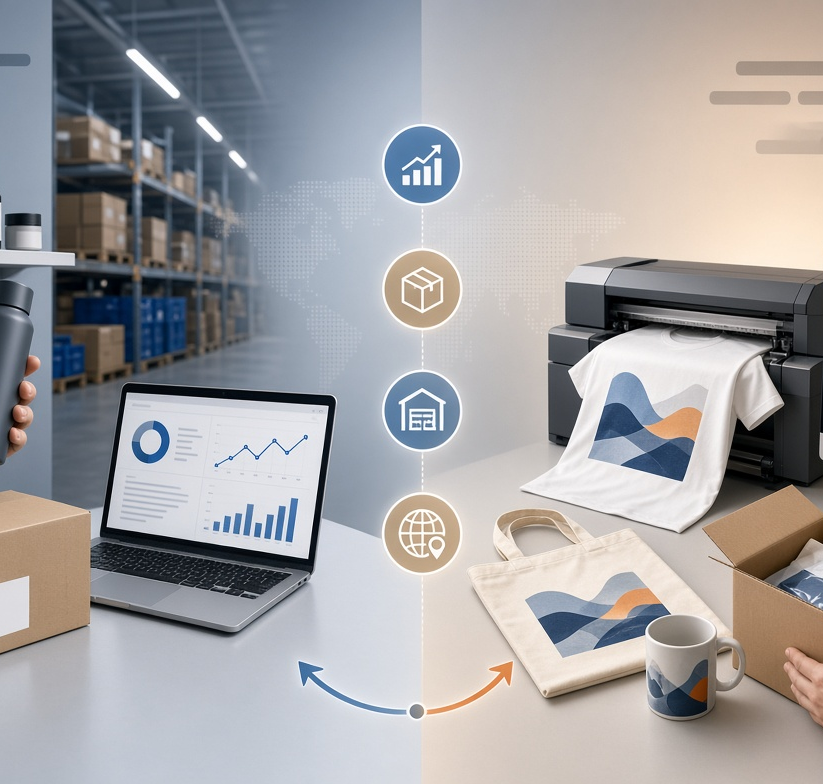
Private label dropshipping vs print-on-demand: compare margins, costs, branding, fulfillment, risks, and scaling strategies. Learn when POD is best for product testing and why private-label dropshipping can create stronger long-term pricing power and profit potential for ecommerce sellers.
Private label dropshipping usually has the higher long-term margin potential, particularly when a seller can negotiate factory pricing, build differentiated packaging, and price around a recognizable brand. Print-on-demand (POD) is typically easier and less capital-intensive to launch, but its per-order production costs can limit margin expansion.
For B2B sellers, marketplace operators, and emerging ecommerce brands, the real question is not simply “Which model has higher margins?” It is: which operating model creates enough contribution profit after product cost, shipping, platform fees, refunds, advertising, and customer support?
This guide compares private label dropshipping vs print-on-demand from a sourcing, branding, fulfillment, financial, and operational perspective. It also explains how a China sourcing and fulfillment partner such as Looperbuy can help merchants reduce inventory exposure while moving toward a more defensible private-label business.
> Key takeaway: Start with POD when you need low-risk design validation. Move toward private label dropshipping when product demand is proven and you want stronger pricing power, lower unit costs, and a brand asset that competitors cannot easily copy.
Table of Contents
What Is Private Label Dropshipping?
Private label dropshipping is a business model in which a merchant sells a product under its own brand, while a supplier, sourcing partner, or fulfillment provider stores, packs, and ships the item directly to the end customer.
Unlike generic dropshipping, private label sellers typically add one or more brand elements:
– A custom logo or brand name
– Branded packaging, inserts, or thank-you cards
– Custom product colors, materials, bundles, or accessories
– Private-label labeling or product tags
– Product photography and branded listing content
– A differentiated customer experience
The merchant does not necessarily need to manufacture the product. Instead, they work with a factory or supplier that can produce an existing product line with customized branding and packaging.
Shopify notes that private-label sellers can often achieve better margins than resellers because they source directly, avoid intermediary markups, and face less direct price competition on an identical SKU.
How Private Label Dropshipping Works
1. A seller identifies a product niche with demand and reasonable competition.
2. The seller selects a supplier or sourcing partner.
3. The product is branded with a logo, packaging, bundle, or product variation.
4. Inventory may be stored at a fulfillment warehouse or prepared in small batches.
5. Customers order from the seller’s store, marketplace, or social channel.
6. The fulfillment partner ships the branded product directly to the buyer.
For example, a seller may source a standard insulated water bottle from China, add custom colors, a laser-engraved logo, a branded gift box, and a cleaning brush bundle. The bottle itself is not necessarily invented from scratch. But the brand, presentation, positioning, and offer are proprietary.
What Is Print-on-Demand?
Print-on-demand is an ecommerce fulfillment model in which products are made only after a customer places an order. The merchant usually uploads artwork, text, or graphics to a POD supplier’s platform. The supplier then prints the design on a blank product, such as a T-shirt, hoodie, tote bag, mug, poster, phone case, notebook, or wall art.
The POD provider typically handles:
– Blank product sourcing
– Printing or embroidery
– Order production
– Packaging
– Shipping
– Tracking updates
POD gives sellers a low-risk way to sell customized products because they generally do not have to buy inventory in advance. However, the seller pays a higher unit cost because the supplier produces one item at a time rather than at wholesale scale.
Shopify’s POD guidance describes a typical margin structure in which sellers must account for the base product, printing, platform fees, payment processing, and absorbed shipping—not just the printing cost.
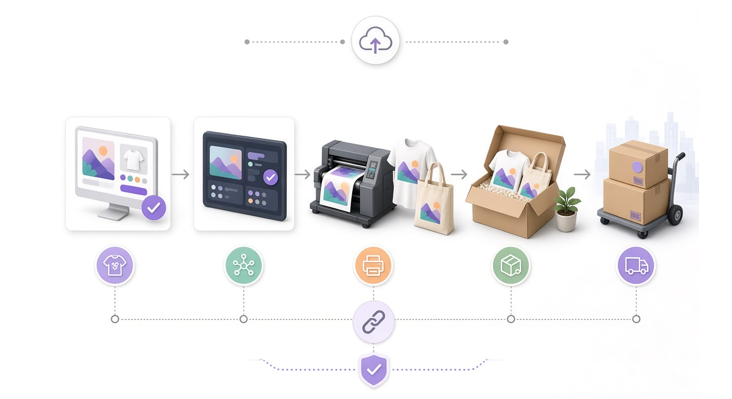
How Print-on-Demand Works
1. A seller creates an original design or licensed design concept.
2. The seller uploads the artwork to a POD platform.
3. The seller sets retail pricing and connects listings to a store or marketplace.
4. A customer places an order.
5. The POD provider prints the item after purchase.
6. The provider ships the finished product directly to the customer.
This model is especially attractive for creators, niche communities, event merchandise, seasonal campaigns, and sellers who want to test many design concepts without buying stock.
Private Label Dropshipping vs Print-on-Demand at a Glance
| Factor | Private Label Dropshipping | Print-on-Demand |
| Upfront investment | Low to moderate | Very low |
| Inventory requirement | Often small batch or warehouse stock | Usually no inventory required |
| Customization | Branding, packaging, product features, bundles | Primarily artwork, text, and print placement |
| Unit cost | Usually falls as order volume rises | Usually remains relatively high per unit |
| Margin potential | Stronger at scale | Moderate; depends heavily on price and design value |
| Speed to launch | Moderate | Fast |
| Product uniqueness | Can be high | Can be low unless designs are distinctive |
| Brand control | High | Moderate |
| Supplier dependency | High | High |
| Quality control | More controllable with inspections and samples | Depends on POD provider and facility |
| Best for | Brand builders and repeat-purchase products | Creative testing and low-risk product launches |
The practical difference is scale. POD is optimized for flexibility and low commitment. Private label is optimized for differentiation, cost control, and brand ownership.
Which Model Has Higher Margins?
Private Label Dropshipping Has Higher Margin Potential
In most categories, private label dropshipping has a stronger path to higher margins because sellers can reduce their landed cost over time.
A private-label business can improve unit economics through:
– Higher order quantities and factory negotiations
– Consolidated shipping and warehouse routing
– Product bundles with higher average order value
– Better packaging economics at scale
– Repeat purchases and subscription options
– Less direct price comparison with generic products
– Premium pricing based on brand identity and product positioning
Private label products are not automatically profitable. But they create a commercial advantage that generic listings often lack: customers are buying a branded offer rather than comparing the exact same product across dozens of stores.
Shopify emphasizes that private-label sellers have more flexibility to set prices based on their positioning because their branded products are not simply identical resale items competing across multiple retailers.
Print-on-Demand Has Lower Financial Risk
POD may have lower margins per order, but it can have a better risk profile for new sellers.
You generally avoid:
– Bulk inventory purchases
– Warehouse storage fees
– Dead-stock risk
– Packaging minimum order quantities
– Large cash commitments before demand is proven
That matters when a business is validating a niche. A seller with 100 untested shirt designs should rarely order hundreds of units of every design. POD allows the seller to identify which concepts attract clicks, conversion, repeat buyers, or organic social reach before committing capital.
However, lower risk does not automatically mean higher profitability. Each POD order includes the blank product cost, production cost, fulfillment fee, shipping cost, transaction fees, and potentially paid customer-acquisition cost.
Printify states that POD margins commonly fall in the 30%–50% range, although the outcome varies by product and pricing; meanwhile, it describes traditional dropshipping margins as commonly around 15%–20%. These are platform-reported benchmarks rather than universal industry guarantees, so sellers should model their own product-level economics.
Gross Margin vs Net Margin: The Number That Matters
Many sellers mistake gross margin for actual profit.
Gross margin tells you how much revenue remains after direct product costs. Net margin tells you what remains after all relevant expenses.
Gross Margin=(Revenue−Cost of Goods Sold)÷Revenue×100
Net Margin=(Revenue−All Business Expenses)÷Revenue×100
For an ecommerce seller, “all business expenses” can include:
– Product cost
– Branding and packaging
– Shipping and last-mile delivery
– Import duties and taxes where applicable
– Marketplace, ecommerce, and payment fees
– Advertising spend
– Returns, replacements, and chargebacks
– Customer support
– Photography, content, and creative production
– Software subscriptions
– Warehouse handling or fulfillment fees
Example: POD T-Shirt Economics
Assume a seller offers a premium niche T-shirt for $35.
| Cost Item | Example Amount |
| Retail price | $35.00 |
| Blank garment and printing | -$13.00 |
| Shipping absorbed by merchant | -$5.00 |
| Platform fee | -$0.70 |
| Payment processing | -$1.32 |
| Gross contribution before advertising | $14.98 |
| Contribution margin before advertising | 42.8% |
This example is similar to Shopify’s published POD pricing illustration, which shows a $35 product with $14.98 remaining after product, shipping, platform, and payment costs.
But if it costs $12 in paid advertising to acquire the customer, the remaining contribution profit is only $2.98—before returns, software, taxes, and support.
That is why customer acquisition cost (CAC) can make or break both POD and private label brands.
Example: Private Label Product Economics
Now assume a branded insulated bottle sells for $39.
| Cost Item | Example Amount |
| Retail price | $39.00 |
| Product cost from supplier | -$8.50 |
| Custom packaging and insert | -$1.20 |
| Pick, pack, and shipping | -$7.00 |
| Payment and platform fees | -$1.85 |
| Landed cost contribution before advertising | $20.45 |
| Contribution margin before advertising | 52.4% |
If the seller can reduce product cost, bundle accessories, raise average order value, or generate repeat purchases, the margin can improve further. This is where private label often becomes more attractive after demand has been proven.
> Expert insight: Do not select a model based on gross margin alone. Build a contribution-margin sheet for every product and include the realistic cost of getting a customer.
Why Private Label Can Become More Profitable Over Time
Lower Unit Costs Through Volume
POD suppliers manufacture one item after another, often with no bulk purchasing commitment from the seller. Private-label brands can negotiate better rates when they increase order volume or simplify production.
Even small changes matter. Saving $1.50 per unit on a product that sells 1,000 units per month adds $1,500 in monthly gross profit before marketing and overhead.
Better Pricing Power
Customers can compare generic products easily. They cannot compare your exact branded bundle as easily.
For instance, a generic pet grooming kit may compete on price. A branded “At-Home Coat Care Kit” with a custom travel pouch, care guide, packaging, and gift-ready positioning can compete on perceived value instead.
Higher Average Order Value
Private-label sellers can raise order value through:
– Multi-unit bundles
– Complementary accessories
– Refill products
– Gift packaging
– Warranty offers
– Quantity discounts
– Cross-sells and post-purchase offers
POD sellers can also bundle, but product compatibility and production workflows may be more limited.
Better Customer Retention
A private-label product can become a repeat-purchase brand. This is particularly valuable in categories such as personal care accessories, pet supplies, kitchen tools, fitness accessories, home organization, and consumable-adjacent products.
A returning customer is usually more profitable because the seller may not need to pay the same acquisition cost again.
When Print-on-Demand Can Deliver Strong Margins
POD is not merely a beginner model. It can be highly profitable when sellers build a strong audience and offer designs with real relevance.
POD can perform well when you have:
– A highly specific niche audience
– Original designs with clear emotional value
– Organic traffic from SEO, social media, email, or community partnerships
– Products with low return rates
– Premium pricing supported by brand storytelling
– Seasonal demand, such as holidays, events, or reunions
– Limited-edition campaigns that create urgency
A $35 printed shirt is not inherently valuable. But a $35 shirt that signals identity—such as membership in a niche hobby, profession, cultural community, or cause—can be valuable to the right audience.
The risk is that generic slogans, copied artwork, and trend-chasing designs create a race to the bottom.
Important POD Compliance Note
Use original artwork, properly licensed assets, and legally permitted phrases. Do not assume that a phrase, logo, celebrity reference, sports-team reference, or character-based design is safe to print simply because similar listings exist online.
Fulfillment Speed and Customer Experience
Margin is not the only decision factor. A product that produces a theoretical 55% contribution margin can still lose money if it arrives late, is damaged, or generates too many support tickets.
POD production adds time because the item must be created after purchase. Printful, for example, states that average fulfillment is generally 2–5 business days, with shipping time added afterward; it says more than 97% of its orders ship within five business days.
Private label dropshipping can be faster when inventory is pre-positioned close to buyers. A seller sourcing through China may use a warehouse model in which branded goods are inspected, stored, picked, packed, and dispatched only after an order is received.
For global sellers, a sourcing and fulfillment platform such as Looperbuy can be useful when it helps coordinate supplier sourcing, product checks, branded packaging, inventory handling, international shipping options, and order fulfillment from one operational workflow.
Customer Experience Checklist
– Display realistic processing and delivery estimates.
– Provide tracking as soon as the carrier accepts the parcel.
– Use accurate product photos and size information.
– Inspect private-label inventory before it is shipped.
– Create a clear return and replacement policy.
– Avoid exaggerated origin, material, and performance claims.
– Prepare customer support templates for late-delivery and damage cases.
If you market an item as “Made in USA,” be especially careful. The FTC’s standard for an unqualified claim generally requires that final assembly, significant processing, and all or virtually all components be U.S.-based.
A Practical Launch Strategy: Test With POD, Scale With Private Label
For many founders, the strongest approach is not choosing one model forever. It is using both models at different stages.
Stage 1: Validate Demand With POD
Use POD to test:
– Niche selection
– Design concepts
– Product types
– Selling prices
– Audience messages
– Conversion rates
– Organic social content
– Customer feedback
Do not overinterpret one viral post or a handful of sales. Look for repeatable demand.
Stage 2: Identify Winning Products
A product is a stronger private-label candidate when it has:
– Consistent sales over several weeks or months
– Low refund and complaint rates
– A clear customer profile
– Room for a better bundle or product version
– Enough price headroom to support branding and marketing
– Evidence that buyers care about quality, packaging, or repeat use
Stage 3: Build a Private-Label Offer
Once demand is proven:
1. Request samples from multiple suppliers.
2. Compare material quality, product consistency, and packaging options.
3. Calculate landed cost, not just factory price.
4. Create a branded package and unboxing experience.
5. Use quality-control checks before fulfillment.
6. Launch with limited inventory or a small production batch.
7. Track contribution margin, delivery performance, return rate, and repeat purchase rate.
This staged approach reduces one of the biggest ecommerce risks: spending heavily on inventory before confirming customers actually want the product.
How Looperbuy Supports Private Label Dropshipping
Looperbuy can support sellers who want to source products in China without taking on the full operational burden of supplier communication, inventory handling, packaging coordination, and international fulfillment.
A practical private-label workflow may include:
– Product sourcing based on a seller’s category and target price
– Supplier comparison and sample coordination
– Custom logo, packaging, inserts, or bundle components
– Product inspection before shipment
– Warehousing for selected inventory
– Order-by-order fulfillment
– International shipping options and tracking
– Consolidation of multiple products into a single branded order
For merchants moving beyond generic dropshipping, this helps create a more consistent customer experience. It can also reduce the complexity of managing different factories, packaging suppliers, warehouses, and logistics providers independently.
The strategic goal is not simply to buy cheaper products. It is to build a product offer that is difficult to compare, difficult to copy, and financially viable after all fulfillment and acquisition costs are included.
Final Verdict: Which Model Should You Choose?
Choose print-on-demand if you need speed, flexibility, and minimal upfront risk. It is ideal for testing creative concepts, selling niche merchandise, and launching without inventory.
Choose private label dropshipping if you want greater long-term margin potential and a durable ecommerce brand. It requires more work in sourcing, branding, quality control, and fulfillment planning, but it can offer better cost control, more pricing power, and stronger customer retention.
The best path for many sellers is hybrid:
– Test designs and audience demand with POD.
– Use sales data to identify profitable niches.
– Develop a differentiated private-label version.
– Fulfill through a reliable sourcing and shipping workflow.
– Reinvest improved margins into product quality, content, customer experience, and retention.
Ready to turn a validated product idea into a branded ecommerce offer? Contact Looperbuy to explore China product sourcing, custom packaging, quality checks, warehousing, and global dropshipping fulfillment designed for growing B2B sellers.
FAQ
1. Is private label dropshipping more profitable than print-on-demand?
Usually, yes—particularly at scale. Private-label sellers can negotiate lower product costs, create exclusive bundles, use branded packaging, and price based on value rather than identical-SKU competition. However, profits depend on advertising cost, returns, shipping, and product quality.
2. Can I start private label dropshipping without buying large inventory?
Yes. Some sellers begin with lower minimum order quantities, limited branded batches, or products held by a fulfillment partner. You should still confirm supplier MOQ requirements, packaging minimums, storage fees, and the cost of customizations before launch.
3. What is a good margin for a private label ecommerce business?
There is no universal target because product category, shipping zones, marketing channels, and return rates vary. As a practical planning benchmark, aim for enough gross contribution after product, shipping, and transaction costs to absorb customer-acquisition costs and still leave room for returns, overhead, and profit. Many sellers target healthy gross margins first, then optimize net margin as scale improves.
4. Why are print-on-demand margins often lower?
POD suppliers produce, print, pack, and ship one customized item at a time. Sellers generally do not receive the same bulk-production pricing available to private-label brands that order inventory in volume. POD also includes production costs that cannot always be reduced through supplier negotiation.
5. Can I use POD to test a private-label product idea?
Yes. POD is especially useful for testing niche appeal, message-market fit, and design direction. Once you identify winning customer segments and products, you can develop a private-label version with upgraded materials, branded packaging, bundles, or new features.
6. What should I ask a private-label supplier before placing an order?
Ask about minimum order quantity, sample cost, production time, logo methods, packaging options, quality-control process, defect policy, shipping options, material certifications where relevant, and whether they can support ongoing inventory and direct-to-customer fulfillment.
7. Does a China sourcing partner help improve ecommerce margins?
It can. A capable sourcing partner may help merchants compare suppliers, negotiate product pricing, organize quality checks, consolidate packaging and inventory, and manage fulfillment. The result can be better operational control, but sellers should still calculate all landed costs and evaluate supplier reliability carefully.
References
1. Shopify. “[What Is a Private Label? How Private Labels Work].”
2. Shopify. “[Private Label Products: How to Start Selling].”
3. Shopify. “[Print on Demand: What It Is & How To Start].”
4. Shopify. “[25 Best Print-on-Demand Products to Sell].”
5. Printify. “[Print on Demand vs Dropshipping: Choosing the Best Fit].”
6. Printify. “[Is Print on Demand Profitable? Your Guide to POD Success].”
7. Printful. “[How Long Does Fulfillment Take?].”
8. Federal Trade Commission guidance summarized by Holland & Knight. “[Executive Order Signals Heightened Enforcement of ‘Made in USA’ Claims].”