Explore the global B2B e-commerce market size, key growth trends, sourcing models, and practical China dropshipping strategies. Learn how online sellers can reduce inventory risk, verify suppliers, manage fulfilment, and scale cross-border sales with Looperbuy.
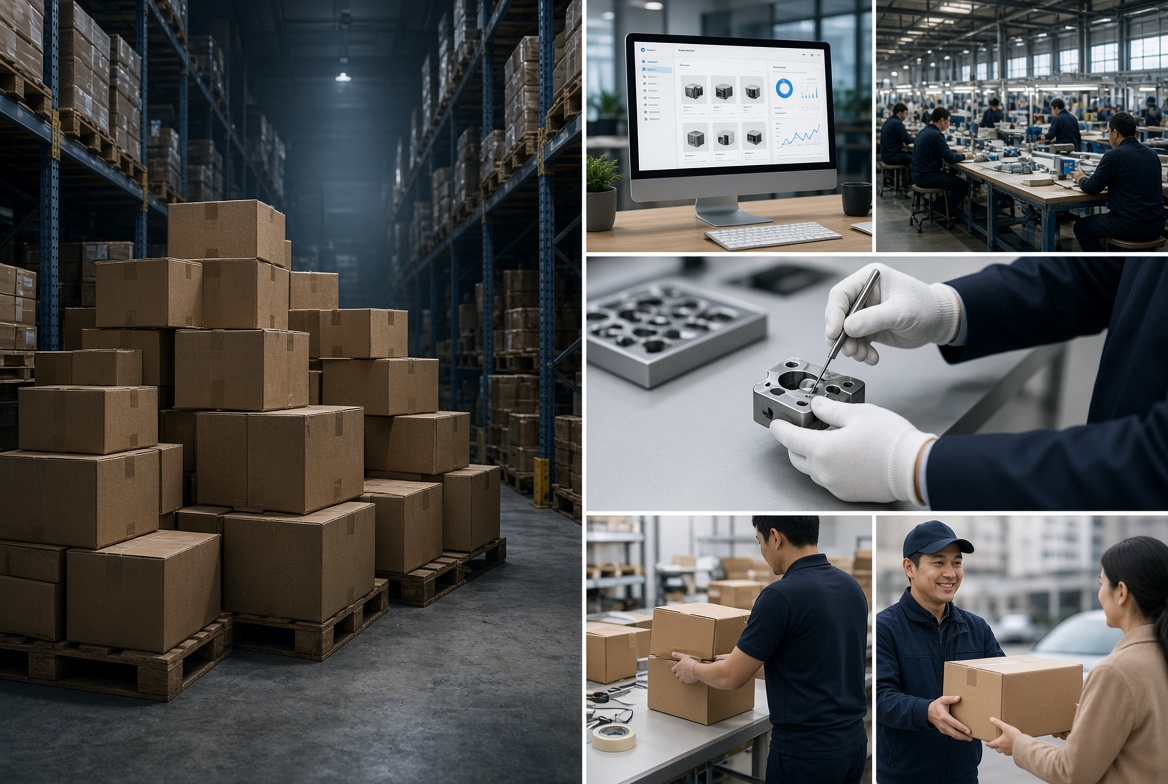
The global B2B e-commerce market has become a core operating channel for wholesalers, online retailers, distributors, and brands—not simply a digital version of traditional procurement. For businesses selling internationally, the opportunity is increasingly tied to how effectively they can source products, validate suppliers, control inventory exposure, and fulfil orders across borders.
For merchant teams, the important question is no longer, “Should we buy online?” It is: How can we build a lower-risk, faster, and more scalable purchasing and fulfilment system? A China sourcing and dropshipping partner can help answer that question by connecting product discovery, supplier communication, quality control, warehousing, and international delivery into one workflow.
> Editor’s note: Market-size estimates differ because research firms define B2B e-commerce differently. Some measure gross merchandise value across online transactions; others focus on e-commerce platform revenue, marketplace activity, or software spending. For that reason, market figures should be read as directional indicators, not interchangeable totals.
Table of Contents
Global B2B E-commerce Market Size in 2026
The B2B e-commerce market is enormous and continues to expand as companies digitize procurement, supplier management, quotation workflows, ordering, payment, and fulfilment.
One recent market estimate places global B2B e-commerce gross merchandise value at USD 36.86 trillion in 2026, rising from USD 33.02 trillion in 2025. The same forecast expects the market to reach USD 61.66 trillion by 2031, representing a projected compound annual growth rate of 10.84%.
Other market research uses a broader or different methodology. For example, one 2026 estimate values global B2B e-commerce at USD 32.1 trillion in 2025 and projects USD 62.2 trillion by 2030. The precise number varies, but the strategic conclusion is consistent: digital B2B purchasing is becoming standard commercial infrastructure.
| Market indicator | Latest cited figure | Why it matters |
| Global B2B e-commerce GMV | USD 36.86 trillion in 2026 | Shows the scale of digitally enabled business purchasing |
| Projected B2B e-commerce GMV | USD 61.66 trillion by 2031 | Indicates sustained long-term market expansion |
| Estimated global B2B e-commerce value | USD 32.1 trillion in 2025 | Supports the conclusion that online B2B trade operates at multi-trillion-dollar scale |
| U.S. retail e-commerce sales | USD 340.2 billion in Q2 2026, seasonally adjusted | Demonstrates continued digital-commerce momentum in a major consumer and business market |
| U.S. retail e-commerce annual growth | 12.2% year over year in Q2 2026 | Signals renewed acceleration in online transaction activity |
The U.S. Census Bureau reported seasonally adjusted retail e-commerce sales of USD 340.2 billion in the second quarter of 2026, up 12.2% from the same quarter a year earlier. Although this is a retail measure rather than a direct B2B-market calculation, it reinforces the broader shift toward online purchasing and digital transaction systems.
What B2B E-commerce Means for International Sellers
B2B e-commerce refers to digital transactions between businesses. Unlike a typical consumer purchase, a B2B order often involves commercial requirements such as bulk pricing, product specifications, customization, tax documentation, negotiated payment terms, repeat ordering, freight arrangements, and quality expectations.
A B2B transaction may take place through:
– A manufacturer’s wholesale website
– A supplier portal
– A third-party B2B marketplace
– An enterprise procurement system
– An electronic data interchange system
– A sourcing agent’s purchasing platform
– A dropshipping or fulfilment partner’s dashboard
The original market analysis from Virto Commerce correctly emphasizes that B2B e-commerce covers the exchange of products, services, and information between two business entities. It also identifies common platform orientations, including buyer-oriented, supplier-oriented, and intermediary-oriented marketplaces.
However, the most useful modern interpretation goes further. Today’s B2B buyers are not only looking for online catalogs. They are evaluating whether a supplier network can provide:
– Reliable product availability
– Transparent pricing and quotation support
– Clear minimum order quantity options
– Custom branding or packaging capability
– Product and supplier verification
– Fast communication across time zones
– Quality inspection before shipment
– Flexible fulfilment for individual orders or bulk inventory
– Trackable international shipping
For an online seller, these operational details often determine profitability more than product selection alone.
Why the B2B E-commerce Market Is Growing
The expansion of B2B e-commerce is driven by changes in buyer expectations, supply-chain technology, global trade access, and the economics of inventory.
Digital Procurement Has Become Normal
Business buyers increasingly expect the speed and convenience they experience in consumer e-commerce. They want searchable catalogs, product comparisons, real-time order updates, online invoices, self-service reorder functions, and accessible customer support.
This does not mean every business transaction is fully automated. Complex purchases still require negotiation and consultation. But the research, quotation, ordering, and order-tracking stages are becoming increasingly digital.
A practical example: a small online retailer in the United States may identify a niche home product, request samples from several Chinese suppliers, confirm packaging specifications, place a test order, and then route daily customer orders to a fulfilment partner. This process may involve multiple business relationships, but it can be managed through digital tools rather than repeated manual emails and offline coordination.
China Gives Sellers Broad Product Access
China remains a central sourcing market for many global merchants because of its extensive manufacturing ecosystem, supplier density, product diversity, customization capacity, and established export infrastructure.
For a B2B seller, sourcing from China can provide access to:
– Home and kitchen goods
– Consumer electronics accessories
– Beauty and personal-care tools
– Apparel and fashion accessories
– Packaging materials
– Sports and outdoor products
– Industrial parts and tools
– Pet products
– Seasonal merchandise
– Private-label and custom-manufactured goods
The benefit is not simply lower unit cost. A well-managed China sourcing strategy can also enable faster product testing, a wider assortment, and more flexible replenishment. That flexibility is especially valuable when demand is uncertain.
Inventory Risk Is Becoming More Expensive
Traditional wholesale purchasing often requires sellers to make large inventory commitments before demand is proven. That creates multiple cost pressures:
– Capital tied up in slow-moving stock
– Warehouse rent and handling fees
– Product obsolescence
– Unsold seasonal inventory
– Damage, loss, or expiry risk
– Cash-flow constraints
– Complex returns management
A sourcing and dropshipping workflow can reduce some of this exposure. Rather than purchasing large quantities immediately, merchants can begin with a smaller validation order, test demand, and scale inventory only after product-market evidence improves.
This approach does not remove risk entirely. Product quality, shipping time, customs treatment, and customer-service expectations still require careful management. But it can shift the business from an inventory-heavy model toward a more flexible operating model.
Technology Improves Transaction Visibility
Cloud-based software, integrated order management, artificial intelligence, warehouse systems, and shipping platforms are helping B2B operators manage more transactions with less manual administration.
In practice, digital operations can make it easier to:
1. Consolidate purchase orders from multiple sales channels.
2. Match product variations with supplier specifications.
3. Monitor stock levels and replenishment needs.
4. Share order status with merchants and customers.
5. Reduce data-entry errors.
6. Compare shipping options by destination and delivery speed.
7. Identify recurring quality or fulfilment issues.
The value of technology is not automation for its own sake. It is visibility. A business can make better decisions when it knows what was ordered, where it is, what it costs, and what must happen next.
B2B E-commerce Business Models
Different B2B models serve different commercial needs. Sellers should choose a model based on their order volume, cash flow, required control, product complexity, and customer-delivery expectations.
| B2B model | How it works | Best suited for | Main consideration |
| Supplier-oriented marketplace | Suppliers list products for buyers | Buyers needing broad product discovery | Product and supplier quality may vary |
| Buyer-oriented procurement platform | Buyers publish requirements and suppliers compete | Companies with defined sourcing needs | Requires strong specification control |
| Intermediary marketplace | A platform connects multiple buyers and sellers | Merchants wanting comparison and transaction support | Fees and platform rules may apply |
| Direct manufacturer sourcing | Buyer purchases directly from the factory | Private-label brands and larger-volume buyers | Requires more supplier management |
| B2B2C fulfilment model | A business sells to customers while a supplier or fulfilment partner ships orders | E-commerce sellers testing products or reducing stock | Brand experience and delivery standards must be controlled |
| Managed sourcing and dropshipping | A partner handles sourcing, consolidation, inspection, storage, and shipping | Cross-border sellers seeking operational support | Service scope and communication quality are essential |
The B2B2C model is particularly relevant for online merchants. In this structure, the merchant owns the storefront, customer relationship, marketing, and positioning, while operational partners may handle sourcing, inventory, packing, or shipment.
This separation can help sellers expand their catalog without building a large warehouse operation. Yet the customer still judges the merchant—not the supplier—when a product arrives late, differs from its photos, or lacks proper packaging. Therefore, the seller must treat supplier selection and fulfilment management as part of its own brand strategy.
The Operational Gap: Growth Does Not Guarantee Reliability
Many market reports focus on demand growth, digital adoption, and large platform activity. Those are important signals, but they do not fully address the operational problem faced by daily sellers: How do you source from China without creating avoidable supply-chain risk?
A high-growth market can still contain unreliable suppliers, inconsistent product specifications, inaccurate listing information, weak packaging, communication gaps, delayed dispatch, and unclear shipping responsibility.
This is where a structured sourcing workflow matters.
A Practical China Sourcing Checklist
Before launching a product or sending customer orders, use a repeatable process.
1. Define the product requirement clearly.
Document size, material, colors, features, certifications, packaging, target unit cost, expected order volume, and destination markets.
2. Compare multiple sourcing options.
Do not select a supplier solely because it offers the lowest quoted price. Compare responsiveness, product details, sample quality, minimum order quantity, production timing, and ability to support customization.
3. Order samples before scaling.
A sample can reveal material quality, real dimensions, usability, packaging condition, and whether the product matches listing photos.
4. Confirm product compliance needs.
Requirements differ by country and category. Products such as electronics, children’s goods, cosmetics, batteries, food-contact items, and medical-related products may require specific documentation or testing.
5. Agree on quality standards in writing.
Define acceptable tolerances, color variation, logo position, packaging method, labeling, barcode requirements, and defect handling.
6. Use inspection before shipment.
Inspection is especially important for high-value items, custom products, large orders, and goods with visible quality expectations.
7. Choose a shipping method by customer promise.
Balance cost, tracking, delivery speed, duties, parcel restrictions, and destination coverage. The cheapest method may create the highest long-term cost if it causes customer complaints or chargebacks.
8. Track supplier performance over time.
Record defect rates, response time, dispatch time, packaging issues, order accuracy, and delivery outcomes. A supplier should earn repeat volume through performance.
How Looperbuy Can Support a Leaner Global Selling Model
For cross-border merchants, the challenge is rarely finding a product listing. The harder task is coordinating the journey from supplier selection to final delivery.
Looperbuy can position its sourcing and dropshipping service around a unified operational workflow:
– Product sourcing from China based on a merchant’s requirements
– Supplier communication and quotation coordination
– Sample support and product verification
– Quality inspection before outbound shipment
– Product consolidation from different suppliers
– Warehouse handling and storage options
– Custom packaging and branding support where available
– Individual-order fulfilment and dropshipping
– International shipping coordination and tracking support
The commercial advantage is clear: merchants can focus more resources on store development, advertising, customer acquisition, and category strategy while reducing the operational burden of buying inventory, managing warehouse space, organizing packing, and coordinating international deliveries.
Example: Testing a New Product Category
Imagine an online seller wants to enter the pet-accessories category. Instead of importing 2,000 units of a single item before knowing whether it will sell, the seller can take a staged approach:
– Source several candidate products.
– Request samples and compare build quality.
– Launch a limited product test.
– Route early orders through a fulfilment workflow.
– Monitor conversion, return reasons, delivery feedback, and margins.
– Expand only the products that show repeatable demand.
– Move proven high-volume products into controlled inventory when faster delivery or lower per-unit fulfilment costs justify it.
This method supports more disciplined growth. It helps merchants make inventory decisions based on market evidence, not assumptions.
Choosing the Right B2B Sourcing Partner
A sourcing partner should be assessed as an extension of your operations team, not merely as a purchasing intermediary. Ask detailed questions before committing volume.
| Evaluation area | Questions to ask |
| Supplier access | Can the partner source beyond a single marketplace or factory network? |
| Product verification | How are samples, specifications, and supplier capabilities checked? |
| Quality control | What inspection steps are available, and how are defects documented? |
| Pricing clarity | Are product, service, warehouse, packaging, and shipping charges transparent? |
| Fulfilment ability | Can the partner handle single-item orders, bulk orders, or both? |
| Shipping coverage | Which countries, carriers, tracking options, and delivery timelines are supported? |
| Branding | Can the service support custom inserts, packaging, labels, or private-label needs? |
| Communication | Is there a dedicated contact person and a clear escalation process? |
| Data visibility | Can you access order status, shipment tracking, inventory data, and issue updates? |
| Scalability | Can operations continue smoothly when daily order volume increases? |
A credible partner should be comfortable answering these questions in detail. Vague promises of “fast shipping,” “best price,” or “high quality” are not enough. Ask for the process behind the claim.
Build a More Resilient B2B Supply Chain
The B2B e-commerce market is expanding because companies want faster purchasing, broader supplier access, better data, and more efficient fulfilment. But growth alone does not solve the day-to-day realities of international selling.
The strongest merchants combine digital opportunity with operational discipline. They validate products before scaling, document quality requirements, protect cash flow, monitor fulfilment performance, and choose partners that make cross-border commerce more transparent.
If your business wants to source products from China, test new product categories, reduce upfront inventory pressure, or ship orders directly to customers worldwide, Looperbuy can help you build a more flexible purchasing and fulfilment process.
Start with a sourcing request today: share your product link, product specification, target quantity, destination countries, and branding needs. A structured request makes it easier to evaluate costs, delivery options, and the most practical fulfilment path for your business.
Frequently Asked Questions
1. What is the global B2B e-commerce market size in 2026?
Market estimates vary by methodology. Mordor Intelligence estimates global B2B e-commerce gross merchandise value at USD 36.86 trillion in 2026, while other published estimates use different definitions and time periods. The key takeaway is that B2B e-commerce operates at a multi-trillion-dollar global scale.
2. What is the difference between B2B e-commerce and B2C e-commerce?
B2B e-commerce involves transactions between businesses, such as a retailer purchasing goods from a manufacturer or wholesaler. B2C e-commerce involves a business selling directly to an individual consumer. B2B transactions often include bulk pricing, specifications, commercial terms, and repeat procurement.
3. Can dropshipping reduce inventory risk?
Yes. Dropshipping can reduce the need to purchase and store large quantities of inventory before demand is established. However, it does not eliminate the need for supplier verification, quality control, shipping management, and customer-service planning.
4. Why should online sellers source products from China?
China offers access to a broad manufacturing base, diverse product categories, customization options, and established export supply chains. The best sourcing outcome depends on product research, supplier selection, sample testing, inspection, and clear fulfilment processes.
5. What should I check before choosing a China sourcing agent?
Review the agent’s sourcing process, product-verification method, quality-control standards, pricing transparency, warehouse capability, shipping options, communication process, and ability to support your expected order volume.
6. Is product inspection necessary for dropshipping orders?
It depends on product type, order value, customization level, and supplier reliability. Inspection is strongly recommended for custom goods, branded goods, higher-value products, bulk orders, and categories where visual quality or safety matters.
7. When should a seller move from dropshipping to holding inventory?
Consider holding inventory when a product has stable sales, predictable demand, acceptable margins, and a customer promise that requires faster delivery. A hybrid model is often effective: stock proven bestsellers while using dropshipping to test new products and maintain a broader catalog.
References
1. Virto Commerce. “[B2B eCommerce Market Size Trends].”
2. Mordor Intelligence. “[B2B E-Commerce Market Size, Share & 2031 Growth Trends Report].”
3. U.S. Census Bureau. “[Quarterly Retail E-Commerce Sales Report].”
4. Capital One Shopping Research. “[B2B E-commerce Statistics: Sales, Market Size & Growth].”
5. eMarketer. “[B2B Ecommerce Forecast 2026].”