Discover how B2B digital channels can simplify global sourcing from China. Learn how online product research, self-service ordering, transparent fulfillment tracking, live support, and connected customer dashboards help sellers reduce inventory risk, operational costs, and logistics complexity.
For B2B sellers, digital channels are no longer separate marketing touchpoints. They are the operating system of the modern buying journey—from product discovery and supplier verification to order placement, fulfillment tracking, and after-sales support. For businesses sourcing from China, the challenge is not simply to “be online”; it is to create a connected digital sourcing experience that gives buyers accurate information, responsive service, transparent costs, and dependable delivery.
At Looperbuy, we see this shift from a practical sourcing perspective. Global merchants increasingly want to test products without committing to large inventory purchases, manage supplier communication more efficiently, and ship orders without building their own warehousing or logistics infrastructure. A well-designed B2B digital channel strategy can make these goals achievable by connecting product research, purchasing, payment, fulfillment, and customer support in one clear workflow.
Table of Contents
Why B2B Digital Channels Matter in Global Sourcing
A digital communication channel is any online environment where a buyer can discover, evaluate, purchase from, or receive support from a company. For B2B commerce, these channels include websites, online sourcing platforms, search engines, product catalogs, email, social media, customer portals, order-tracking systems, live chat, and messaging tools.
A key shift in industrial procurement: buyers are increasingly initiating the purchasing process themselves. Rather than waiting for a sales representative to introduce a product, they search, compare, read specifications, assess supplier credibility, and form a shortlist independently. The supplier’s website and digital tools must therefore answer questions before a buyer is ready to speak with anyone.
This behavior has intensified. Gartner reported in March 2026 that 67% of B2B buyers prefer a rep-free experience, meaning they want to complete at least part of their buying journey independently rather than relying on sales interactions.
For global sourcing businesses, self-service is particularly valuable because customers may operate in different time zones, need to compare multiple suppliers quickly, or want to validate a product before committing capital to inventory.
The core business problem: friction
A B2B buyer may abandon a sourcing process when they cannot quickly find:
– Product pricing, specifications, materials, dimensions, or variants
– Supplier information and sourcing details
– Shipping options, estimated delivery time, and tracking visibility
– Payment methods and transaction instructions
– Clear processes for product inspection, consolidation, returns, or dispute handling
– Fast answers to pre-purchase questions
– Confidence that the sourcing partner can manage the operational details
Every missing answer creates friction. Every unclear handoff between the supplier, purchasing agent, warehouse, logistics provider, and buyer increases the chance of delay, error, or lost trust.
A high-performing B2B digital experience removes that friction before it becomes a support ticket.
The Most Important B2B Digital Channels
Not every channel deserves the same investment. The most effective mix depends on the buyer’s job, product type, order value, repeat-purchase potential, and operational complexity. For a China sourcing and dropshipping platform, the following channels typically carry the highest commercial value.
| Digital channel | Main buyer need | What a strong experience should provide | Value for global sellers |
| Website and sourcing platform | Discover products and understand services | Clear service pages, searchable catalog, pricing logic, process explanations, trust signals | Builds confidence before the buyer contacts support |
| Product search and category pages | Find relevant products fast | Filters, variants, specifications, supplier or sourcing context, related products | Speeds up product research and validation |
| Customer dashboard | Manage buying and fulfillment | Orders, payment status, inventory visibility, quality-check updates, shipment tracking | Reduces manual operations and scattered communication |
| Receive confirmations and lifecycle updates | Order updates, shipping notices, replenishment prompts, issue resolution | Keeps customers informed without requiring repeated follow-up | |
| Live chat or messaging | Get immediate answers | Fast pre-sale support, sourcing requests, order exceptions, escalation path | Improves conversion when buyers face uncertainty |
| Educational content | Learn how to source and sell successfully | Buying guides, cost explanations, product research advice, logistics information | Establishes credibility and helps buyers make better decisions |
| Social media and professional communities | Verify expertise and discover ideas | Product trends, case insights, behind-the-scenes fulfillment content, useful updates | Creates familiarity and supports long-term trust |
The important point is not to place the same message everywhere. Instead, each channel should serve a specific moment in the buyer journey.
For example:
– A search-driven visitor needs a clear explanation of how sourcing and dropshipping work.
– A first-time buyer needs reassurance about payment, product quality, shipping, and communication.
– A repeat seller needs efficient reordering, shipment visibility, and dependable operational updates.
– A high-volume merchant may need a tailored sourcing request, private labeling discussion, or inventory-planning support.
Build Digital Channels Around the Buyer Journey
The most useful improvement from the original framework is to move beyond a general “website plus communication tools” approach. B2B sourcing requires a journey-based operating model.
Do not organize your digital experience around internal departments. Organize it around what the buyer is trying to accomplish.
1. Discovery: Help buyers understand the opportunity
At the discovery stage, merchants may not yet know which product to sell, what category to test, or how a sourcing platform can reduce their operating workload.
Your content should address broad but commercially relevant questions, such as:
– How can I source products from China without holding inventory?
– What is the difference between dropshipping, wholesale, and private-label sourcing?
– How do I estimate total sourcing and shipping costs?
– How can I test a product before placing a larger order?
– What should I check before choosing a Chinese supplier?
This is where educational guides, category pages, comparison pages, and product trend content become valuable. The goal is not to force a sale immediately. The goal is to give the buyer a useful next step.
2. Evaluation: Make critical information easy to verify
Once buyers have identified a potential product or sourcing partner, they become more analytical. They want evidence, not vague claims.
Your evaluation-stage pages should make the following information easy to find:
– Product attributes and available variations
– Sourcing capabilities and service scope
– Minimum order quantity requirements, if applicable
– Quality-check or inspection process
– Estimated processing and shipping timelines
– Packaging, branding, and customization options
– Supported destinations and logistics methods
– Payment steps, platform fees, and possible additional charges
– Communication and issue-resolution process
Enterprises should provide comprehensive digital information, rather than simply treating their websites as static product brochures.That principle is especially relevant for sourcing platforms, where a buyer’s decision depends on operational clarity as much as product appeal.
3. Conversion: Replace uncertainty with clear action
Many B2B websites lose qualified prospects at the conversion stage because the next step is not obvious.
A sourcing platform should use specific calls to action based on buyer intent:
| Buyer intent | Recommended CTA |
| Exploring services | “See How China Sourcing Works” |
| Looking for a product | “Submit a Product Sourcing Request” |
| Ready to test demand | “Start Your First Product Order” |
| Comparing fulfillment options | “Get a Shipping Estimate” |
| Managing recurring orders | “Create Your Looperbuy Account” |
| Seeking custom solutions | “Talk to a Sourcing Specialist” |
Avoid generic calls to action such as “Learn More” when a more precise action is possible. A clear CTA tells the buyer what happens next and reduces decision fatigue.
4. Fulfillment: Keep buyers informed after payment
The B2B relationship does not end when an order is submitted. In cross-border sourcing, it becomes even more important after payment because buyers want visibility into what is happening across suppliers, warehouses, inspections, packaging, and international shipping.
A practical customer dashboard should help users understand:
1. Whether the product has been purchased from the supplier
2. Whether it has arrived at the warehouse
3. Whether inspection or quality checking is complete
4. Whether the order is being consolidated, packed, or labeled
5. Which shipping method has been selected
6. When tracking becomes available
7. What action is needed if an exception occurs
This type of visibility reduces repetitive support requests and strengthens buyer confidence. It also helps sellers manage their own customer expectations more accurately.
Four Experience Principles for a B2B Sourcing Platform
Make product and service information decision-ready
Information should not merely exist on the website. It should be structured so a buyer can act on it.
For product content, include practical fields such as:
– Product name and key use case
– Materials, dimensions, weight, colors, and variants
– Packaging details
– Applicable certifications or compliance notes, when verified
– Estimated sourcing or handling information
– Customization possibilities
– Common buyer questions
– Related products and alternatives
For service content, explain the process in plain English. Avoid statements such as “we offer reliable sourcing solutions” unless the page also explains what the service includes, how the workflow works, and what the buyer can expect at each stage.
Create one source of truth across channels
Inconsistent information damages trust quickly. If a product page says one processing time, a customer-service agent gives another estimate, and an email shows something different, the buyer is left to guess which statement is accurate.
A strong B2B operation needs a central source of truth for:
– Product information
– Pricing rules and fee logic
– Order status
– Shipping updates
– Customer notes and support history
– Supplier and warehouse data
– Policies and standard operating procedures
Digital systems can reduce departmental information silos by enabling a more systematic flow of information among marketing, sales, suppliers, logistics partners, and internal teams.
For Looperbuy, this means the sourcing team, warehouse team, support team, and customer-facing platform should work from consistent order data whenever possible.
Use sales support where it adds real value
Digital self-service does not mean eliminating human expertise. It means reserving human assistance for high-value moments.
A sourcing specialist can add substantial value when a buyer needs help with:
– Identifying product alternatives
– Negotiating with a supplier
– Confirming technical requirements
– Managing product customization
– Resolving quality concerns
– Selecting shipping methods for a specific market
– Planning a larger or recurring order
The best model is not “digital versus human.” It is digital for speed and transparency, human support for complexity and confidence.
Design for mobile, clarity, and global time zones
Global merchants often use mobile devices to check orders, respond to customers, review product links, and monitor shipments. A desktop-only experience creates unnecessary friction.
Key mobile priorities include:
– Fast-loading product and account pages
– Readable product specifications without excessive scrolling
– Simple order-status indicators
– Easy access to chat or support
– Clear error messages and next steps
– Mobile-friendly payment and document upload flows
For international users, also make policies, dates, currencies, shipping estimates, and business-hour expectations easy to understand. Ambiguity creates avoidable support volume.
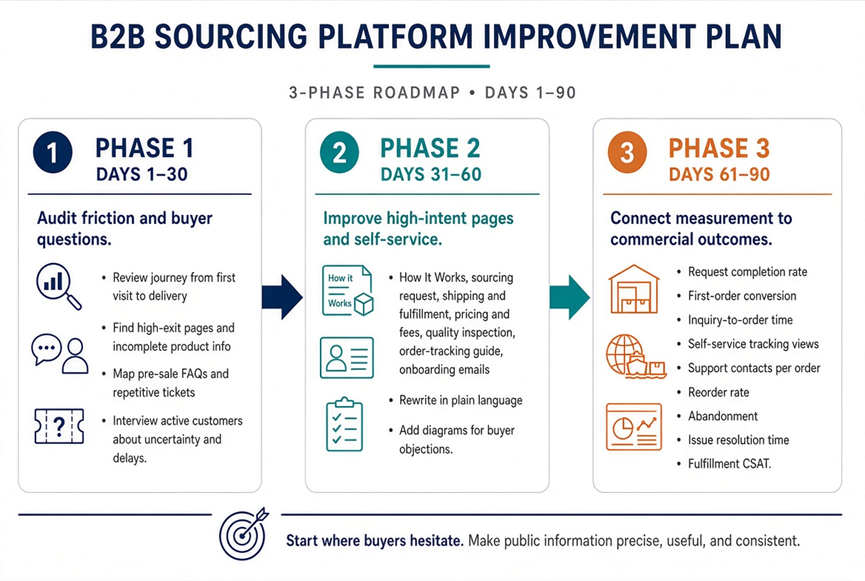
A Practical 90-Day Improvement Plan
A sourcing platform does not need to rebuild every channel at once. Start with the points where buyers are most likely to hesitate or abandon.
Days 1–30: Audit friction and buyer questions
Review the customer journey from a first visit to delivery.
Identify:
– Pages with high exits or low engagement
– Frequently asked pre-sale questions
– Repetitive support tickets
– Order-status questions that could be answered automatically
– Product information that is incomplete or difficult to compare
– Differences between website information and support-team responses
Interview a small group of active customers. Ask them where they felt uncertain, what they had to ask manually, and which part of the sourcing process took the most time.
Days 31–60: Improve high-intent pages and self-service tools
Prioritize pages closest to a sourcing request or first order:
– “How It Works” page
– Product sourcing request page
– Shipping and fulfillment page
– Pricing and fee explanation page
– Quality-inspection page
– Order-tracking guide
– New-customer onboarding emails
At this stage, rewrite content in plain language and add concise answers to buyer objections. Use screenshots or annotated diagrams when they can explain a process faster than text.
Days 61–90: Connect measurement to commercial outcomes
Measure more than website traffic. The most useful indicators connect digital activity to sourcing success.
Track metrics such as:
– Product sourcing request completion rate
– First-order conversion rate
– Time from inquiry to order
– Percentage of orders with self-service tracking views
– Support contacts per order
– Reorder rate
– Cart or order-request abandonment rate
– Resolution time for delivery or product issues
– Customer satisfaction after fulfillment
Forrester notes that AI-powered search and answer engines are changing how B2B buyers discover and evaluate vendors. Its research says 95% of B2B buyers plan to use generative AI in at least one area of a future purchase, while more than half say it has helped them consider additional vendors and save time.
The practical implication is straightforward: your public information must be precise, useful, well-organized, and consistent enough for both buyers and modern search environments to understand it.
The Competitive Advantage: Operational Transparency
The next generation of B2B sourcing platforms will not compete only on access to products. They will compete on how confidently a merchant can make decisions and manage operations.
For global sellers, operational transparency means knowing:
– What can be sourced
– How much it may cost
– What happens after an order is placed
– When products move through each fulfillment stage
– How shipping is selected and tracked
– Who can help when a problem occurs
This is why digital channels matter. They turn a complex cross-border supply process into a more understandable, manageable customer experience.
A seller who can test products without carrying large amounts of inventory, monitor order progress online, and receive support only when needed can stay focused on marketing, customer acquisition, and growth.
Start Building a Simpler Sourcing Workflow
If you sell internationally and want to reduce the burden of supplier coordination, inventory holding, warehousing, payment handling, and shipping management, Looperbuy can help centralize the sourcing and fulfillment process.
Create your Looperbuy account, submit your first product sourcing request, and build a more flexible way to source from China for your global business.
FAQ
1. What are B2B digital channels?
B2B digital channels are online touchpoints that help business buyers discover, evaluate, purchase from, and communicate with suppliers. Examples include websites, online sourcing platforms, product catalogs, customer portals, email, live chat, social media, and order-tracking systems.
2. Why do B2B buyers prefer self-service options?
Self-service gives buyers more control over timing and research. They can compare products, review specifications, understand processes, and monitor order progress without waiting for a sales representative. Gartner reported that 67% of B2B buyers prefer a rep-free experience for at least part of the purchase journey.
3. How can a sourcing platform reduce inventory risk?
A sourcing platform can help merchants test products and fulfill orders without purchasing large quantities upfront. This can reduce the capital tied up in stock, minimize warehousing needs, and make it easier to adjust product selection based on real demand.
4. What information should a B2B sourcing platform show online?
It should clearly explain product details, sourcing processes, service scope, payment steps, quality-check procedures, shipping options, estimated timeframes, order-status updates, and support channels. The more decision-critical information buyers can access independently, the smoother the purchasing process becomes.
5. How does order tracking improve the B2B customer experience?
Order tracking gives customers visibility after payment. Instead of contacting support repeatedly, buyers can see whether products have been purchased, received by a warehouse, inspected, packed, shipped, or delayed. This improves trust and reduces manual workload for both the customer and service team.
6. Should B2B businesses replace sales teams with digital tools?
No. Digital tools should handle routine research, ordering, updates, and self-service tasks. Human specialists remain important for complex sourcing requests, supplier negotiations, customization, technical requirements, and exception handling.
References
1. Virto Commerce. “[Top B2B Digital Channels at Industrial Companies].”
2. Gartner. “[Gartner Sales Survey Finds 67% of B2B Buyers Prefer a Rep-Free Experience].”
3. Forrester. “[From Keywords To Context: Impact And Opportunity For AI-Powered Search In B2B Marketing].”