The future of B2B e-commerce depends on more than online storefronts. This guide explains how global sellers can use China sourcing and dropshipping to reduce inventory exposure, improve fulfillment visibility, validate products faster, manage suppliers more effectively, and build a scalable cross-border commerce operation with Looperbuy.
The future of B2B e-commerce is not simply about launching another online store. It is about helping global sellers source products faster, test demand with lower risk, and fulfill orders reliably without tying up capital in inventory, warehouses, payment workflows, or cross-border logistics.
For merchants selling internationally, China sourcing and dropshipping can turn a traditionally asset-heavy business into a more flexible operating model. Instead of placing large inventory orders before demand is proven, sellers can use a B2B sourcing platform such as Looperbuy to identify products, consolidate procurement, manage order fulfillment, and ship to customers across markets.
> Key idea: In the next phase of B2B e-commerce, competitive advantage will come from operational speed, trusted product sourcing, transparent fulfillment, and a buying experience that reduces complexity for sellers.
Table of Contents
Why B2B E-commerce Is Moving Toward Leaner Supply Chains
E-commerce continues to grow, but the operating environment is more demanding than ever. DHL reports that global e-commerce sales are projected to reach $8 trillion by 2028, while international online sales more than doubled from $562 billion in 2019 to $1.2 trillion in 2025. This expansion creates opportunity, but it also intensifies competition, delivery expectations, and price pressure.
For many global sellers, the largest challenge is not product listing. It is the cost and complexity behind every listing:
– Buying inventory before knowing whether it will sell
– Managing supplier communication across time zones
– Handling fragmented payments to multiple factories
– Inspecting product quality remotely
– Storing slow-moving items
– Packing and shipping individual orders
– Managing customs, taxes, tracking, and delivery exceptions
– Responding to customers when orders are delayed or incomplete
Traditional wholesale works well when demand is predictable and order volume is high. However, it can be risky for sellers entering a new category, a new country, or a trend-driven market.
A lean sourcing model gives sellers another option: source products from China, validate demand through smaller order quantities or order-based fulfillment, then scale proven products with greater confidence.
Traditional wholesale vs. flexible fulfillment
| Operating area | Traditional bulk purchasing | China sourcing and dropshipping model |
| Upfront inventory | Often requires large purchase orders | Can support lower-risk testing and order-based fulfillment |
| Storage | Seller pays for warehouse space or manages stock at home | Inventory can be handled through a fulfillment partner |
| Product testing | Slow and capital-intensive | Faster testing across more product ideas |
| Supplier management | Seller coordinates with multiple factories | Platform or sourcing team centralizes communication |
| Order fulfillment | Seller packs and ships each order | Fulfillment partner can process and ship orders |
| Cash-flow pressure | Higher due to stock purchases | Lower inventory exposure when demand is uncertain |
| Global shipping | Requires logistics coordination | Consolidated fulfillment can simplify cross-border delivery |
This shift does not mean inventory is obsolete. It means inventory should be a deliberate decision, not an automatic starting point.
For example, a seller launching a pet-accessories store may initially test 20 products through a sourcing and fulfillment model. After identifying the five products with stable conversion and repeat demand, the seller can decide whether to hold small volumes for faster delivery, negotiate better factory pricing, or continue using order-based fulfillment.
The B2B Buyer Now Expects Digital Convenience and Human Reliability
The strongest e-commerce experiences combine self-service tools with responsive human support. Buyers want product information, pricing clarity, order visibility, and fast answers without needing to chase multiple contacts.
McKinsey’s 2026 Global B2B Pulse Survey found that buyers use an average of 10 channels during the purchasing journey. It also found that 71% of B2B companies now offer e-commerce, and among those companies, approximately one-third of revenue flows through digital channels.
This matters for sourcing platforms because global sellers do not want a black-box process. They need clear answers to practical questions:
– Is this supplier legitimate and capable?
– What is the real product cost?
– What is the minimum order quantity?
– Can the product be customized?
– What are the shipping options and estimated delivery windows?
– Can multiple products be consolidated into one shipment?
– Is there a quality-control option before dispatch?
– What happens if an order is damaged, missing, delayed, or returned?
A strong B2B sourcing platform should make these answers easy to obtain. The goal is not to remove people from the process. The goal is to remove unnecessary friction.
What sellers need from a sourcing partner
A reliable China sourcing partner should help sellers manage five critical layers of the buying journey:
1. Product discovery
Help sellers locate suitable products, compare suppliers, identify alternatives, and understand available customization options.
2. Supplier coordination
Reduce the burden of negotiating specifications, confirming production details, and communicating requirements with factories.
3. Quality control
Check products against agreed requirements before they are packed and dispatched, especially for products with branding, variants, packaging requirements, or higher customer-return risk.
4. Order consolidation
Combine items from different suppliers into fewer shipments when practical, helping sellers simplify inbound handling and potentially reduce per-order logistics complexity.
5. Global fulfillment visibility
Provide order status, tracking information, shipping options, and practical support when delivery issues arise.
> For sellers, trust is operational. It is built through accurate product information, documented requirements, clear pricing, visible order status, and a process for resolving exceptions.
From Trend Forecasts to Practical Commerce Operations
Earlier e-commerce trend discussions focused heavily on technology: headless commerce, artificial intelligence, mobile shopping, social media, virtual experiences, and marketplace growth. These developments remain relevant. However, for cross-border B2B sellers, technology only creates value when it improves everyday execution.
The real question is not, “Should my business use AI?” The more useful question is, “Which part of my sourcing and fulfillment workflow is costing the most time, money, or customer trust?”
Where technology should create practical value
| Business challenge | Useful capability | Expected business value |
| Too many potential products | Product research and supplier comparison | Faster selection and fewer weak product launches |
| Unclear supplier communication | Centralized specification and messaging workflow | Fewer misunderstandings and production errors |
| Difficult order tracking | Unified order-management dashboard | Better visibility and faster customer support |
| High shipping complexity | Shipping-rate comparison and route selection | More informed delivery decisions |
| Product inconsistency | Photo verification or quality inspection workflow | Lower risk of customer complaints and refunds |
| Repeat manual work | Automation for order routing and status updates | Less administrative workload |
| Uncertain demand | Small-batch testing or dropshipping fulfillment | Lower inventory risk |
For sellers sourcing from China, the missing operational layer is the link between the online storefront and the physical supply chain. A beautiful storefront cannot compensate for unreliable product quality, unclear shipping costs, or poor order visibility.
The practical role of AI in sourcing
AI can be useful, but it should support human verification rather than replace it.
For example, AI tools can help sellers:
– Generate product-title variations for different marketplaces
– Translate supplier specifications into customer-friendly English
– Group customer feedback by recurring complaint
– Identify frequently requested sizes, colors, or bundles
– Create first-draft product descriptions and FAQs
– Forecast which products deserve additional testing
– Flag unusual order patterns or shipping exceptions
However, sellers should still verify product claims, materials, dimensions, certifications, intellectual-property risks, and compliance requirements manually. A generated product description is not proof that a factory can deliver what it promises.
How to Build a Lower-Risk China Sourcing Workflow
A strong sourcing strategy begins before the first order. Sellers should treat product sourcing as a repeatable decision process, not a one-time search.
Step 1: Start with a clear product brief
Before asking a sourcing team to find products, define the commercial requirements.
Your product brief should include:
– Target customer and market
– Intended sales channel, such as Shopify, Amazon, eBay, TikTok Shop, or a B2B website
– Target retail price
– Desired product cost range
– Materials, colors, sizes, and required variants
– Packaging expectations
– Branding or private-label needs
– Expected monthly order volume
– Target delivery countries
– Quality requirements and prohibited substitutions
A precise brief reduces back-and-forth communication and makes supplier comparisons more meaningful.
Step 2: Validate the product before committing to stock
Do not assume that a popular product is profitable for your store. Evaluate its true landed cost:
Landed Cost=Product Cost+Domestic Handling+Packaging+International Shipping+Duties/Taxes+Payment Fees
Then compare that cost with your expected selling price, advertising cost, marketplace fees, refund rate, and customer-service workload.
A product with a low factory price may still be a poor choice if it is bulky, fragile, difficult to ship, or likely to generate returns.
Step 3: Order samples and define inspection standards
A sample is not just a formality. It is the first quality-control document.
Check:
– Product dimensions and weight
– Material quality and finish
– Color accuracy
– Functionality and durability
– Packaging strength
– Labeling and inserts
– Brand placement
– Compatibility with local regulations
– Whether the product matches photos and descriptions
For complex products, create an approval checklist. This makes the standard clear before repeat orders begin.
Step 4: Consolidate procurement where it makes sense
Sellers often source complementary products from different factories. Without consolidation, each supplier may ship separately, creating higher handling complexity and a fragmented customer experience.
A sourcing and fulfillment partner can help bring eligible items together before final dispatch. This can be especially useful for bundles, subscription boxes, influencer kits, and multi-product orders.
Step 5: Choose delivery options by product and customer promise
Fast shipping is valuable, but it is not always the only priority. Sellers should offer delivery options that match product margin, destination, and customer expectations.
Consider:
– Product weight and dimensions
– Product value and insurance needs
– Customer urgency
– Destination-country delivery reliability
– Customs sensitivity
– Tracking availability
– Return requirements
– The difference between economy and express shipping costs
DHL recommends that businesses clearly communicate duties and taxes, localize pricing and payment methods where possible, work with customs specialists, and test markets in phases rather than scaling prematurely.
Step 6: Monitor performance and scale evidence-based winners
Track the products and routes that produce reliable results.
Useful performance indicators include:
– Product inquiry-to-order rate
– Cost per acquired customer
– Gross margin after logistics
– Order processing time
– On-time delivery rate
– Customer complaint rate
– Return and refund rate
– Repeat-purchase rate
– Supplier defect rate
– Average response time for order exceptions
When a product proves demand, sellers can negotiate improved factory pricing, develop branded packaging, hold selected inventory, or create bundles that improve average order value.
What Global Sellers Should Prioritize in 2026
The market is becoming more crowded. DHL notes that the number of live e-commerce stores worldwide increased by 14% between 2024 and 2025. This makes product availability alone less defensible. Many competitors can find similar products. Fewer can execute consistently.
The most durable growth priorities are:
– Transparent landed-cost decisions: Know the full cost before setting a retail price.
– Reliable supplier relationships: Favor consistency and communication, not only the lowest quotation.
– Quality before scale: A product that produces refunds will destroy margin and brand credibility.
– Clear delivery expectations: Do not overpromise delivery speed or hide potential customs-related costs.
– Focused product testing: Test systematically, then invest behind the products that show real demand.
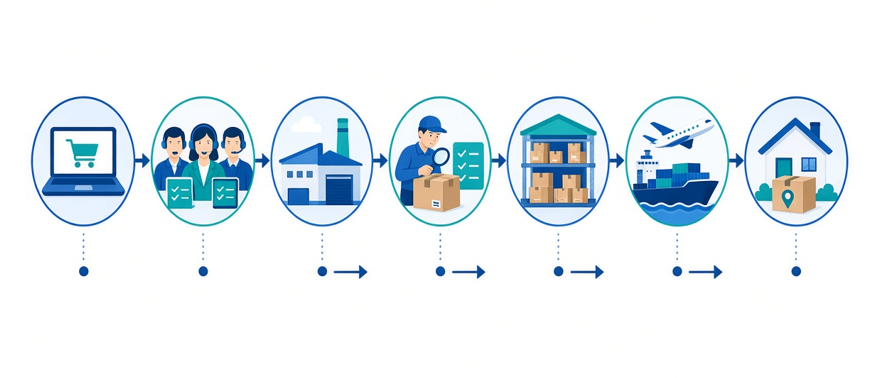
– Operational visibility: Track each order from supplier confirmation through final delivery.
– Localized customer experience: Adapt product information, currencies, payment options, shipping choices, and support for each target market.
For B2B buyers specifically, digital convenience has not eliminated the need for human trust. McKinsey finds that buyers still divide their interactions roughly across in-person, remote, and digital channels. For high-value or complex purchases, knowledgeable support remains important.
That is why the strongest sourcing platforms combine online tools with accessible expertise. Sellers want self-service when the task is simple and knowledgeable help when the situation is complex.
Build Your Sourcing Advantage With Looperbuy
Global e-commerce growth creates opportunity, but growth alone does not guarantee profitability. Sellers need a supply-chain model that helps them test products without excessive inventory exposure, coordinate sourcing efficiently, maintain quality standards, and fulfill international orders with greater visibility.
Looperbuy is built to help global B2B sellers source Chinese products and manage dropshipping fulfillment in a more practical, scalable way. Whether you are testing a new product category, building a branded store, sourcing across multiple factories, or looking to reduce logistics management workload, the right sourcing workflow can turn operations into a competitive advantage.
Ready to source smarter from China? Contact Looperbuy to discuss your product requirements, sourcing needs, quality expectations, and global fulfillment plan.
Frequently Asked Questions
1. What is a China sourcing and dropshipping platform?
A China sourcing and dropshipping platform helps sellers find products from Chinese suppliers, coordinate purchasing, arrange quality checks where available, manage warehousing or consolidation, and ship orders to customers. It can reduce the need for sellers to manage multiple suppliers and logistics providers separately.
2. Can B2B sellers use dropshipping for product testing?
Yes. Dropshipping can be useful for testing new products, target markets, and customer demand before placing larger inventory orders. Sellers should still calculate full landed costs and assess delivery times, product quality, and return risks before scaling.
3. How can sellers reduce China sourcing risk?
Start with a detailed product brief, request samples, set written quality standards, verify packaging and labeling, confirm shipping options, and monitor supplier performance. Avoid selecting a supplier based only on the lowest quoted price.
4. Should I buy inventory or use order-based fulfillment?
It depends on product demand, delivery expectations, margins, and available cash flow. Order-based fulfillment can reduce inventory exposure during testing. Holding inventory can become worthwhile once demand is predictable and faster delivery or lower unit costs justify the investment.
5. What should be included in a product sourcing brief?
Include target market, sales channel, retail price, target product cost, materials, dimensions, color options, packaging, branding requirements, expected volume, target countries, delivery expectations, and any compliance requirements.
6. Why is product consolidation important for international sellers?
Consolidation can simplify fulfillment by bringing eligible products from multiple suppliers into one coordinated shipment or order flow. It is particularly useful for bundles, multi-SKU stores, and sellers who want to reduce fragmented logistics handling.
7. What is landed cost in e-commerce?
Landed cost is the total cost of making a product ready for sale in the destination market. It generally includes product cost, local handling, packaging, freight, duties or taxes, and relevant payment or transaction fees.
References
1. Virto Commerce. “The Future of eCommerce: Online Shopping Trends 2023–2027.” Discusses marketplace growth, self-service, customer experience, commerce technology, and the evolving digital buying journey. [virtocommerce]
2. DHL. “6 E-Commerce Trends to Transform Your Business in 2026.” Covers global e-commerce sales projections, cross-border sales growth, localization, customs management, delivery expectations, and phased market expansion. [dhl]
3. McKinsey & Company. “The Surprising Economics of B2B Growth: The New Survival Threshold and What It Takes to Thrive.” Covers B2B buyer behavior, omnichannel expectations, digital commerce adoption, buyer touchpoints, and the continuing importance of trust. [mckinsey]