Learn how to start dropshipping for free with a practical comparison of Shopify, DSers, Spocket, Modalyst, and Doba. Explore real costs, supplier checks, shipping strategy, common risks, and a seven-step launch plan for building a reliable global ecommerce business.
Starting a dropshipping business with little upfront capital is possible, but “free” rarely means there are no costs at all. The most practical approach is to use free plans or low-cost trials to validate products, suppliers, and customer demand before investing in a full ecommerce stack.
For sellers targeting global customers, the platform you choose should do more than provide products. It should help you control supplier risk, manage shipping expectations, synchronize inventory, and create an order experience that customers can trust. The global dropshipping market is projected to grow from USD 583.5 billion in 2026 to USD 2.18 trillion by 2033, reflecting continued demand for inventory-light ecommerce models.
Table of Contents
What Does “Start Dropshipping for Free” Really Mean?
Dropshipping is an ecommerce fulfillment model in which you sell products without holding inventory yourself. After a customer places an order, you purchase the item from a supplier, and the supplier or sourcing partner ships it to the buyer.
Your gross profit is generally:
Selling Price−Product Cost−Shipping Cost−Payment Fees−Marketing Cost=Gross Profit
This model can reduce the need to pre-purchase stock, rent warehouse space, or process each parcel personally. However, it does not remove every operating cost.
A “free” dropshipping setup usually means one of the following:
– A free supplier-platform account with feature or order limits
– A temporary free trial for an ecommerce platform or automation tool
– A free product-importing tool that still requires a paid storefront
– No subscription fee, but product, shipping, payment-processing, advertising, and refund costs still apply
The key is to use free access as a validation phase, not as a permanent operating plan.
For example, you might publish 10–20 carefully selected products, test product pages with organic social content or a small ad budget, and only expand when you have proof that people are clicking, adding to cart, and purchasing.
The Five Criteria That Matter Most
A platform comparison should not focus only on subscription price. In our experience working with cross-border sourcing and fulfillment workflows, the most expensive problems usually come from poor supplier communication, inventory errors, unclear shipping times, and return disputes.
Evaluate each platform against these five factors.
1. The Real Cost After the Trial
Check whether “free” is permanent, temporary, or restricted.
Look for:
– Monthly subscription charges after the trial
– Order-volume caps
– Product-import limits
– Transaction fees
– Charges for branded invoices, automation, or premium support
– Storefront, domain, payment, and marketing costs
A low subscription fee is not always the cheapest option if it creates extra manual work or causes costly fulfillment mistakes.
2. Supplier Reliability and Product Quality
Your supplier’s performance becomes your customer’s experience. Before listing a product, review:
– Product photos, specifications, and variants
– Supplier order history and responsiveness
– Stock availability
– Packaging options
– Tracking quality
– Return policy
– Delivery-time consistency
Whenever possible, order a sample. A sample lets you inspect the actual item, packaging, shipping label, delivery time, and product quality before your customers do.
3. Shipping Speed and Destination Coverage
Fast delivery matters, but accurate delivery expectations matter even more.
A product shipped from China may offer lower sourcing costs and a wider catalog. A product stored in the United States or Europe may reach local buyers faster, but it can carry a higher wholesale price and narrower selection.
For global sellers, the strongest approach is often a blended model:
– Use China sourcing for broad product discovery and competitive pricing
– Use destination-market warehouses for proven products with repeat demand
– Display realistic shipping estimates before checkout
– Send tracking updates proactively after dispatch
4. Automation and Store Integration
Manual order processing may work for five orders a day. It becomes risky when sales increase.
Useful automation features include:
– One-click product importing
– Inventory synchronization
– Price-update rules
– Automatic order forwarding
– Tracking-number synchronization
– Variant mapping
– Bulk order processing
– Multi-store support
Automation should reduce repetitive work without removing your oversight. You still need to monitor stock changes, supplier substitutions, delivery exceptions, and customer complaints.
5. Customer Service and Return Handling
Customers buy from your store, not from your supplier. You remain responsible for communication, refund decisions, and issue resolution.
Before launching, define:
– Your delivery-time policy
– Lost-parcel policy
– Damaged-product policy
– Return eligibility and return address
– Refund timeline
– Response-time standard for support inquiries
5 Best Free or Free-to-Start Dropshipping Platforms
The best platform depends on your product strategy, target market, technical comfort, and available budget. The table below compares five commonly used options.
| Platform | Best For | Free Access Type | Main Advantage | Main Limitation |
| Shopify | Building a branded online store | Short free trial; promotions may vary by region | Strong store builder and app ecosystem | Not a supplier platform; subscription required after trial |
| DSers | AliExpress product testing | Free plan available | Large catalog and bulk order tools | Supplier quality and delivery performance vary |
| Spocket | US/EU-focused product sourcing | Limited free access | Products from suppliers closer to Western buyers | Higher product costs and restricted free features |
| Modalyst | Curated and niche product catalogs | Limited free plan | Simple interface and access to selected brands | Product limits and potential transaction fees |
| Doba | Managed supplier access and workflow automation | Free trial | Curated supplier network and integrations | Paid subscription needed after trial |
Shopify: Best for Building a Long-Term Brand
Shopify is an ecommerce storefront platform rather than a supplier marketplace. It is often a good choice when your priority is creating a branded store, customizing product pages, and connecting different sales and fulfillment tools.
Shopify’s available trial and promotional terms can vary by account, country, and time. Its official documentation states that new users can test Shopify plans through a free trial, so sellers should confirm the offer shown in their own account before planning a launch timeline.
Choose Shopify if you want to:
– Build a standalone brand instead of relying only on marketplaces
– Customize product pages, checkout settings, and content
– Integrate with sourcing tools, email marketing, reviews, and analytics
– Scale a successful catalog over time
Watch out for: app subscriptions. A store can quickly become expensive if you add multiple paid apps before validating sales.
DSers: Best for Wide Product Selection
DSers is widely used by sellers who source products through AliExpress. Its main appeal is product variety and tools that can simplify bulk ordering.
The Shopify App Store lists a free DSers plan and paid tiers, with free trials available for certain higher-level features. DSers also states that paid-feature trials can last 14 days.
Choose DSers if you want to:
– Test many product categories quickly
– Access a large supplier marketplace
– Import products into a connected store
– Process higher volumes of AliExpress orders more efficiently
Watch out for: inconsistent supplier performance. Do not assume a high product rating guarantees fast handling, accurate variants, or dependable packaging. Review recent buyer feedback and place test orders where possible.
Spocket: Best for Faster US and EU Delivery
Spocket focuses on connecting sellers with suppliers in regions including the United States and Europe. This can be useful if your business depends on shorter delivery windows for North American or European customers.
Choose Spocket if you want to:
– Prioritize faster delivery to specific Western markets
– Build a catalog around more localized inventory
– Reduce the friction caused by long international delivery times
– Sell products where customer trust depends heavily on quick fulfillment
Watch out for: margin pressure. Faster local fulfillment may improve conversion and reduce support tickets, but product costs can be higher.
Modalyst: Best for a Focused Niche Store
Modalyst can suit merchants who want a more curated catalog rather than thousands of generic listings. It is also commonly considered by Wix users because of its platform connection.
Choose Modalyst if you want to:
– Build a focused niche rather than a broad general store
– Test more differentiated or branded-looking products
– Keep product selection intentionally small
– Use a simple beginner-oriented interface
Watch out for: free-plan restrictions. A product cap may be enough for a narrow category test, but not for a broad product-discovery strategy.
Doba: Best for an All-in-One Supplier Workflow
Doba is designed to combine supplier access, product discovery, store integrations, order processing, and inventory synchronization. Its original comparison highlights a 30-day full-access trial, curated suppliers, and integrations with platforms such as Shopify, Amazon, eBay, and WooCommerce.
Choose Doba if you want to:
– Work with a more guided supplier network
– Reduce time spent moving between separate tools
– Use inventory and order-management automation
– Explore a structured workflow before committing to a subscription
Watch out for: subscription economics. Calculate whether the time saved and operational reliability justify the platform cost once the trial ends.
A Practical 7-Step Launch Plan
Instead of uploading hundreds of untested products, start with a controlled process.
1. Choose one customer group. Define the buyer, their problem, typical budget, and where they shop online.
2. Select 10–20 products. Favor products with clear benefits, manageable shipping size, low breakage risk, and enough margin after delivery costs.
3. Review suppliers manually. Check ratings, recent reviews, warehouse locations, dispatch promises, and return procedures.
4. Order samples for priority products. Examine actual quality, packaging, delivery speed, and whether the item matches the listing.
5. Build product pages around buying questions. Include dimensions, materials, compatibility, shipping estimates, care instructions, and realistic product photos.
6. Set customer-service rules before taking orders. Prepare response templates for delayed deliveries, damaged items, order edits, and refunds.
7. Measure before scaling. Review product-page visits, add-to-cart rate, checkout completion, customer questions, refund requests, and delivery performance.
A simple decision rule is useful: do not spend heavily to scale a product until you can fulfill it consistently and customers understand exactly what they are buying.
Why a China Sourcing Partner Can Improve the Model
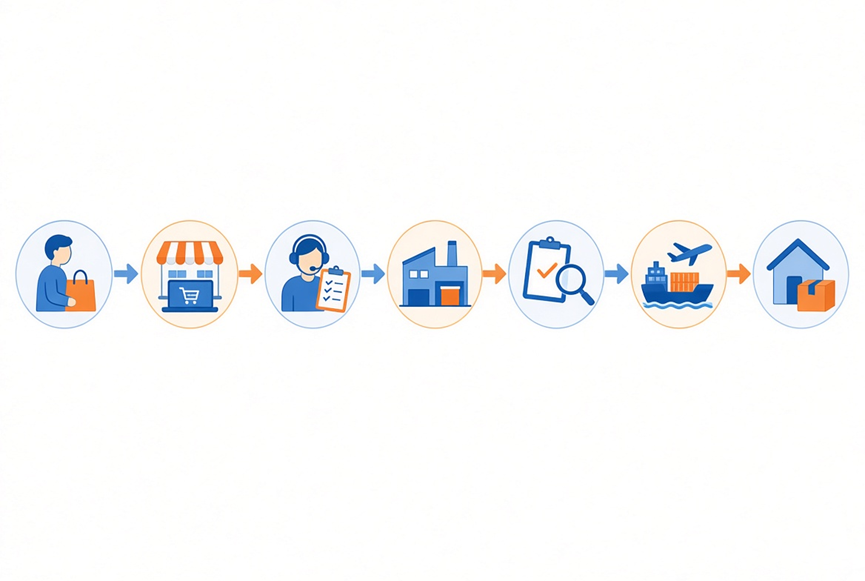
For many sellers, direct marketplace sourcing is a useful starting point but not always the best long-term fulfillment system. Once orders become consistent, a sourcing and fulfillment partner can help reduce operational friction.
Looperbuy can support global B2B sellers by helping them source Chinese products, purchase items after an order is placed, consolidate parcels, and arrange shipping. This model can help merchants reduce the need to pre-stock inventory, manage a warehouse, or coordinate multiple suppliers independently.
A sourcing partner is particularly useful when you need:
– Product sourcing beyond a single marketplace
– Supplier communication in China
– Product consolidation from multiple vendors
– Basic quality checks before dispatch
– More consistent packaging requirements
– Private-label or custom-packaging discussions
– Centralized international fulfillment coordination
The right partner does not replace your responsibility to customers. It gives you more control over the parts of the supply chain that can otherwise become difficult to manage from overseas.
Common Mistakes to Avoid
The most common failure is not choosing the wrong platform. It is launching before the operational details are ready.
Avoid these mistakes:
– Advertising “fast shipping” without verifying actual fulfillment time
– Copying supplier descriptions without checking facts
– Selling fragile, regulated, oversized, or high-return products too early
– Listing too many products before validating demand
– Ignoring landed cost, including shipping, payment fees, refunds, and ad spend
– Relying on supplier photos without testing the item
– Hiding delivery times until after the customer pays
– Treating customer service as an afterthought
Start With a Controlled Test
The best free dropshipping platform is the one that fits your current objective. Use Shopify when brand control is the priority. Use DSers for broad AliExpress product discovery. Consider Spocket or Modalyst when faster regional delivery or a curated selection matters most. Use Doba when you want a more centralized supplier and automation workflow.
For sellers who want access to China’s broad manufacturing ecosystem without holding inventory, Looperbuy can help turn validated product ideas into a more manageable sourcing and fulfillment process.
Ready to test products without buying bulk inventory? Contact Looperbuy to discuss product sourcing, order fulfillment, consolidation, and global shipping options for your B2B store.
Frequently Asked Questions
1. Can I start dropshipping with no money?
You can begin product research and use some free plans without paying a subscription, but a functioning business usually still needs money for product samples, domain registration, payment processing, order fulfillment timing, marketing, refunds, or customer support. Treat “free” as low upfront platform cost, not zero operating cost.
2. Which dropshipping platform is best for beginners?
DSers can be practical for beginners who want broad AliExpress product access and a free entry point. Shopify can be better for merchants focused on building a branded store. The best choice depends on whether you need product variety, store design, localized shipping, or automation.
3. Is dropshipping from China still profitable?
It can be profitable when you choose products carefully, calculate landed costs accurately, communicate delivery timelines clearly, and work with dependable suppliers. It becomes difficult when low product cost is the only strategy and shipping, returns, product quality, and advertising costs are ignored.
4. Should I use US or EU suppliers instead of Chinese suppliers?
Neither option is automatically better. US and EU suppliers may offer faster domestic delivery for Western customers. Chinese suppliers often provide broader selection, lower sourcing costs, and more customization potential. Your choice should reflect your destination market, product type, delivery promise, and margin target.
5. Do I need to order product samples?
Yes, especially for your main products. Samples help you evaluate quality, packaging, product accuracy, shipping speed, and the unboxing experience. This can prevent negative reviews and expensive refunds later.
6. Who handles returns in dropshipping?
Your store handles customer communication and sets the return policy. The supplier or sourcing partner may accept the returned product under agreed terms, but customers expect you to resolve the issue because they purchased from your business.
7. Can Looperbuy help with dropshipping fulfillment?
Looperbuy can support B2B merchants with China product sourcing, purchasing, consolidation, and global shipping coordination. Before listing a product, confirm product availability, quality-check options, packaging requirements, shipping routes, delivery estimates, and return arrangements with the Looperbuy team.
References
1. [Doba, “Dropshipping Free: 5 Best Platforms Compared for Success”] — Source article used for the platform comparison framework, including Doba’s stated trial, supplier, integration, and automation positioning.
2. [Shopify Help Center, “Trying Shopify with a Free Trial”] — Shopify’s official guidance on free-trial access and plan testing.
3. [Shopify App Store, “DSers: Dropship + AliExpress + AI”] — Information on DSers’ available free plan, paid tiers, and trial availability.
4. [DSers Help Center, “How to Choose Your DSers Subscription Plan”] — DSers information on its 14-day paid-feature trial.
5. [Grand View Research, “Dropshipping Market Size, Share & Trends Analysis Report”] — Market-size and growth forecast figures cited in this article.
6. [SaleHoo, “Dropshipping Statistics 2026: 47 Numbers Worth Citing”] — Secondary compilation discussing Grand View Research’s 2026 and 2030 market estimates.

-2-700x490.jpeg)