Discover how B2B contract pricing helps global sellers manage negotiated product costs, bulk discounts, sourcing terms, warehousing, and dropshipping fulfillment. Learn practical strategies for building reliable customer-specific pricing workflows with China sourcing services.
Contract pricing is the system that turns negotiated business terms into the exact prices, order rules, and fulfillment conditions a buyer sees online. For global B2B sellers sourcing from China, it is the bridge between a commercial agreement and a dependable self-service purchasing experience.
At Looperbuy, we see a closely related reality every day: international sellers need more than a product catalog and a checkout page. They need reliable sourcing, clear landed-cost visibility, flexible order quantities, stable fulfillment workflows, and pricing that reflects the commercial relationship—not a one-size-fits-all public rate.
For wholesalers, online retailers, distributors, and marketplace sellers, effective B2B contract pricing can reduce manual quoting, prevent pricing disputes, protect margins, and make repeat purchasing much easier.
Table of Contents
What Is Contract Pricing in B2B Ecommerce?
Contract pricing is a negotiated, customer-specific price and terms structure applied to a defined buyer, buyer group, region, product range, or purchasing condition.
Instead of every visitor seeing the same public price, approved business customers see the terms they have agreed with the seller. Those terms may include:
– Product-level or SKU-level prices
– Quantity-based price breaks
– Minimum order quantities
– Payment terms
– Shipping or delivery conditions
– Currency rules
– Regional availability
– Promotional exclusions
– Contract start and expiration dates
– Purchase-volume commitments
– Rebate or credit arrangements
For example, a dropshipping seller may source a standard consumer product at a public catalog price. But a high-volume retailer that commits to purchasing 5,000 units per quarter may receive a lower unit cost, priority stock allocation, custom packaging, consolidated shipping, and a separate payment arrangement.
The crucial point is that the agreement must work automatically when the buyer logs in, browses products, adds items to a cart, and places an order.
Contract pricing is the operational process of translating negotiated customer terms into rules that can be consistently applied within an e-commerce system. In practice, buyers no longer need to email their account managers to confirm the prices they have negotiated.
Contract Pricing vs. List Pricing vs. Dynamic Pricing
These pricing methods can exist together on one B2B platform, but they serve different commercial situations.
| Pricing model | Who sees it? | How the price is determined | Best for | Main limitation |
| List pricing | All visitors or all standard customers | Published rate card | New buyers, standard catalog sales | Does not reflect negotiated relationships |
| Dynamic pricing | Broad audience, with prices changing over time | Demand, inventory, competition, timing, rules | Retail, travel, marketplaces, fast-moving inventory | Can feel unpredictable for contract buyers |
| Contract pricing | Specific authenticated buyer or account | Formal negotiated agreement | Wholesale, distribution, repeat sourcing, industrial procurement | Requires accurate data and rule management |
| Tiered pricing | Customers who purchase at different quantities | Quantity threshold or membership level | Bulk purchasing and volume incentives | May not account for all contract conditions |
| Quote-based pricing | Buyer requesting a custom deal | Manual or assisted negotiation | Custom products, large orders, complex specifications | Slower to convert into repeat orders |
A mature B2B operation typically uses more than one model. Public list prices can attract and educate new buyers, while contract prices support established accounts. Dynamic adjustments may help manage temporary stock pressure, but they should not override a buyer’s agreed commercial terms without clear contractual rules.
Why Contract Pricing Matters for Global Sourcing
Contract pricing is not only a sales feature. It is a trust mechanism.
Cross-border B2B buyers are already managing supplier risk, product compliance, product quality, international payments, warehouse handling, shipping lead times, customs exposure, and customer delivery expectations. If the price shown at checkout does not match the agreed deal, the relationship immediately becomes harder to manage.
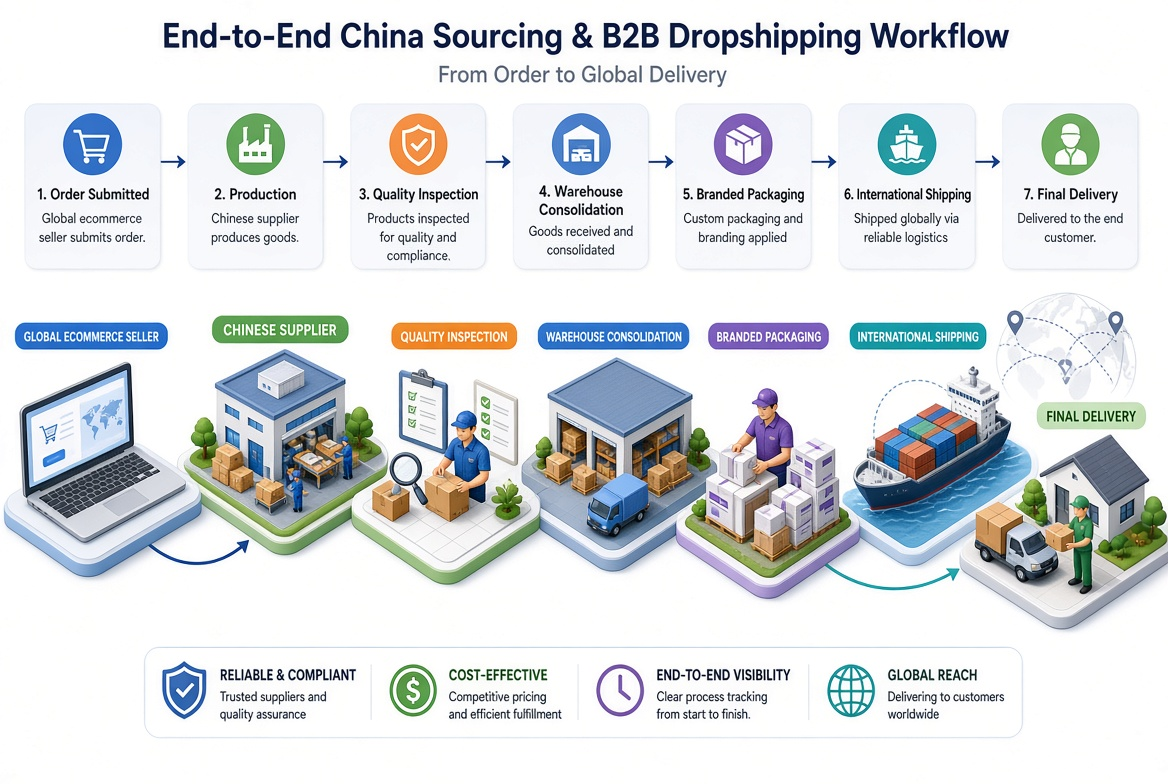
For a China sourcing and dropshipping platform, the commercial flow often involves multiple moving parts:
1. A seller selects products from Chinese suppliers.
2. The sourcing platform confirms product specifications, inventory, and supplier pricing.
3. The buyer negotiates purchase volumes, private labeling, packaging, or fulfillment requirements.
4. The platform creates an account-specific agreement.
5. The buyer places repeat orders based on the agreed price and service conditions.
6. Products are inspected, consolidated, stored if needed, and shipped to the buyer’s customer or warehouse.
Without a structured contract-pricing process, the business may rely on spreadsheets, chat records, email threads, and individual account managers. That approach can work for a small number of accounts. It becomes risky when product catalogs, order volumes, customer segments, currencies, or shipping destinations increase.
The Commercial Benefits
Well-managed contract pricing can help B2B sellers and sourcing platforms achieve the following:
– Reduce pricing errors by applying approved prices automatically
– Protect margin by preventing unauthorized discounts or outdated supplier costs
– Support self-service ordering for repeat buyers
– Improve buyer confidence with consistent pricing across product pages, carts, invoices, and account records
– Speed up reorder cycles by reducing quote-to-order friction
– Create stronger buyer retention through customer-specific commercial terms
– Improve internal control with approval workflows and change logs
– Support international growth across currencies, countries, and customer groups
This matters because B2B buyers increasingly expect to complete routine purchasing tasks digitally. Gartner reported that 61% of B2B buyers preferred an overall rep-free buying experience in a 2024 survey, while also noting that buyers still value seller support for more complex, contextual decisions.
That distinction is important. Buyers may want self-service for reordering approved products at agreed prices. They may still need a human expert when evaluating a new supplier, resolving a quality issue, comparing shipping options, or negotiating a complex private-label program.
How B2B Contract Pricing Works
A reliable contract-pricing system does not simply store a PDF agreement. It converts business rules into order-level logic.
When an authenticated buyer enters a B2B portal, the platform should identify the account and determine which commercial rules apply. The system may then adjust visible prices, product access, available payment methods, shipping options, and order requirements.
Core Contract Pricing Rules
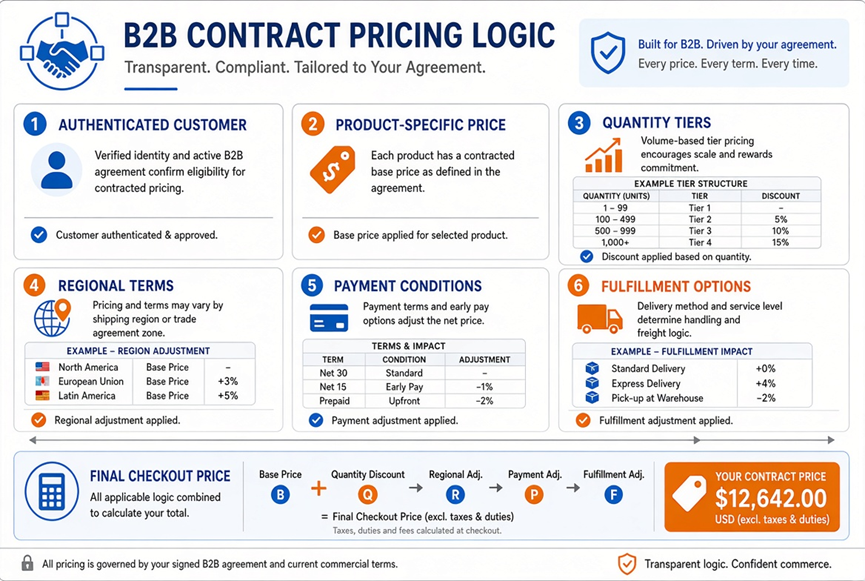
A buyer’s contract can include several layers of logic:
| Rule type | Example | Operational impact |
| Customer-specific SKU price | Buyer A pays $4.80 per unit for SKU X | Price changes only for Buyer A |
| Quantity tier | $4.80 for 1–999 units; $4.45 for 1,000+ units | Price changes when a threshold is reached |
| Product assortment | Buyer can access only approved products | Controls catalog visibility |
| Regional rule | European account sees EUR prices and EU shipping options | Supports market-specific operations |
| Time-based condition | Price valid from July 1 to December 31 | Prevents outdated terms from continuing |
| Payment term | Net 30 available only to approved accounts | Controls credit and financial exposure |
| Shipping rule | Free consolidation for orders above a monthly threshold | Encourages preferred order behavior |
| MOQ rule | Minimum order quantity of 100 units per variation | Helps maintain supplier and fulfillment efficiency |
The most difficult cases occur when one buyer has multiple active agreements. A multinational distributor, for instance, may have one contract for North America, another for Europe, and a third for a specific high-volume product category.
The platform needs a clear pricing precedence rule. A practical sequence is:
1. Product-specific contract price
2. Customer-and-category contract price
3. Customer-group price
4. Volume or tier adjustment
5. Standard list price as the fallback
This hierarchy should be documented before it is automated. Otherwise, different teams may apply different interpretations of the same agreement.
The Contract Pricing Lifecycle
The strongest programs treat pricing agreements as a lifecycle rather than a one-time negotiation.
| Stage | What happens | What should be controlled |
| 1. Buyer inquiry | Buyer asks for product, quantity, or service terms | RFQ details, product specifications, target volume |
| 2. Cost validation | Seller verifies supplier cost, shipping, fees, and margin | Updated supplier data and landed-cost assumptions |
| 3. Quote creation | Commercial proposal is prepared | Price validity, MOQ, delivery terms, exclusions |
| 4. Negotiation | Buyer and seller adjust terms | Version history and approval limits |
| 5. Contract activation | Terms become active in the buyer account | Correct customer, products, currency, start date |
| 6. Order execution | Buyer places orders under the agreement | Correct price, shipping rule, payment term |
| 7. Performance review | Seller reviews sales, volume, service, and margin | Threshold progress, disputes, stock reliability |
| 8. Renewal or revision | Contract is extended, revised, or ended | Advance alerts and new commercial terms |
In my experience with export-oriented B2B workflows, the biggest operational problem is rarely the original quotation. It is what happens afterward: supplier pricing changes, exchange rates move, a product version is replaced, shipping costs rise, or a customer’s purchasing behavior differs from the forecast.
That is why a contract should include both commercial certainty and controlled flexibility.
A Better Renewal Approach
When a contract expires, businesses usually make one of three choices:
– Revert the account to standard list pricing
– Renew automatically under the same terms
– Enter a defined renewal or grace period
The third option is often safest for repeat B2B accounts. Abruptly reverting a customer to public pricing can create checkout shock, order abandonment, or an unnecessary dispute. Auto-renewing an outdated agreement may expose the seller to margin loss.
A better process is to trigger renewal preparation 60 to 90 days before expiration. The account manager should review:
– Actual purchase volume versus commitment
– Supplier cost changes
– Product defect or return patterns
– Fulfillment performance
– Shipping-cost movement
– Currency exposure
– New product opportunities
– Buyer payment performance
– Margin by product category
Common Challenges and How to Prevent Them
1. Price Data Does Not Match Across Systems
A buyer sees one price in the portal, receives another on the invoice, and is quoted something else by sales. This is one of the fastest ways to damage confidence.
The cause is usually disconnected data across ERP, CRM, product information management, supplier files, spreadsheets, and ecommerce systems.
IBM notes that poor data quality can create financial losses, operational inefficiencies, missed opportunities, and reputational harm. Its 2025 research cited in a 2026 IBM analysis found that more than one-quarter of organizations estimated losses above $5 million annually due to poor data quality.
Practical fix: Assign a clear source of truth for each pricing field. For example, supplier base cost may originate from the sourcing system, customer discount rules from the contract system, and final sell prices from a controlled pricing engine.
2. Supplier Costs Change Faster Than Contracts
China sourcing businesses often face supplier cost changes caused by raw-material movement, exchange rates, factory capacity, seasonal demand, packaging changes, or freight volatility.
Practical fix: Include price-validity dates, cost-review triggers, and defined exceptions in the agreement. Do not promise fixed long-term pricing when supplier economics are not fixed.
3. Volume Discounts Are Calculated Incorrectly
A buyer may earn a lower price after reaching a quarterly or annual volume threshold. If that threshold is tracked manually, mistakes are likely.
Practical fix: Decide whether the discount is:
– Applied immediately at the threshold
– Applied retroactively to earlier purchases
– Paid later as a rebate or account credit
– Based on SKU volume, category volume, or total account volume
These methods produce very different margin outcomes. They must be explicit.
4. Contract Terms Are Too Vague
“Best price,” “fast delivery,” or “priority stock” can sound attractive but create operational ambiguity.
Practical fix: Replace vague promises with measurable terms. For example:
– “Order processing within two business days after payment confirmation”
– “Pre-shipment photo inspection included for orders above 500 units”
– “Quoted price valid for 30 calendar days”
– “Free consolidation available for orders shipped from the same warehouse”
– “Priority replenishment subject to supplier stock availability”
5. Contract Prices Become Visible to the Wrong Audience
Some negotiated prices should remain private because they reveal the buyer’s purchasing leverage or create conflict with other sales channels.
Practical fix: Gate customer-specific pricing behind account login. Public visitors can view products, product details, sample pricing, or request-a-quote options, while approved accounts see their negotiated terms.
A Contract Pricing Framework for Looperbuy Sellers
For Looperbuy, contract pricing should support the actual operating needs of global B2B sellers rather than copy the structure of a traditional industrial distributor.
A useful framework combines sourcing, fulfillment, and buyer-specific pricing.
Step 1: Segment Buyers by Commercial Value
Not every account needs a fully customized contract. Create clear buyer groups, such as:
– New sourcing buyers
– Standard dropshipping sellers
– High-volume ecommerce retailers
– Private-label customers
– Wholesale distributors
– Marketplace operators
– Enterprise procurement accounts
Each group can receive an appropriate level of pricing visibility, service support, payment flexibility, and fulfillment options.
Step 2: Build a Landed-Cost View
A product’s factory price is not the final commercial cost. For a cross-border buyer, the more useful calculation is:
Landed Cost=Product Cost+Inspection+Packaging+Domestic Handling+International Freight+Duties/Taxes+Payment Fees
Not every order will include every component, and import duties depend on destination, classification, and local rules. Still, showing a structured cost view helps buyers make more realistic purchasing decisions.
Step 3: Define Account-Specific Service Terms
For larger accounts, contract terms can cover more than unit price:
– Product sourcing support
– Sample handling
– Quality inspection level
– Branding or labeling requirements
– Warehouse consolidation
– Storage period
– Dropshipping packing standards
– Shipping method availability
– Returns or exception-handling process
– Dedicated account support
This is especially valuable for sellers trying to reduce inventory risk. Their real question is not only, “What does the product cost?” It is also, “Can this supply chain reliably fulfill my customer orders?”
Step 4: Make Reordering Fast
For repeat orders, buyers should be able to:
– Access saved product lists
– View approved prices
– See MOQ and inventory information
– Reorder previous products
– Select approved shipping methods
– Track sourcing and fulfillment status
– Download invoices and order records
McKinsey has emphasized the importance of digital pricing discipline, deal scoring, contract optimization, tailored offers, and ecommerce excellence across the B2B sales funnel. The practical lesson is simple: use digital tools to remove routine friction, while preserving expert support where the transaction is complex.
Final Takeaway
Contract pricing in B2B ecommerce is not just “a discount for a large customer.” It is a structured operating system for delivering the right commercial terms to the right buyer at the right time.
For global sellers using China sourcing and dropshipping services, the strongest model connects negotiated pricing with real sourcing costs, product availability, quality control, payment conditions, warehouse handling, and international fulfillment.
At Looperbuy, the opportunity is to make B2B sourcing feel less like a chain of manual messages and more like a reliable purchasing experience: buyers can source products, access appropriate pricing, reduce inventory pressure, arrange fulfillment, and scale their international business with clearer operational control.
Ready to simplify your China sourcing and fulfillment workflow? Create a Looperbuy account, share your product requirements or sourcing list, and request a tailored quote for product procurement, inspection, warehousing, and global dropshipping support.
FAQ
1. What is contract pricing in B2B ecommerce?
Contract pricing is a customer-specific pricing model based on a negotiated agreement. It can include special product prices, quantity discounts, payment terms, shipping conditions, and contract dates that apply only to approved buyer accounts.
2. How is contract pricing different from wholesale pricing?
Wholesale pricing is often a standard lower price available to all buyers who meet a minimum quantity. Contract pricing is more customized and may include buyer-specific products, fulfillment services, payment terms, volume commitments, and regional conditions.
3. Can one B2B customer have more than one contract price?
Yes. A customer may have separate agreements by product category, country, business unit, sales channel, or volume tier. The platform should use a clear priority structure to determine which price applies to each order line.
4. Should negotiated prices be publicly visible?
Usually, no. Customer-specific prices are commonly displayed only after the buyer logs in. Public visitors can see general product information, standard pricing, price ranges, or quote-request options without exposing confidential commercial terms.
5. How often should B2B contract prices be reviewed?
Most contracts should be reviewed at least quarterly, with a more formal renewal discussion 60 to 90 days before expiration. High-volatility product categories may require more frequent reviews because supplier costs, exchange rates, or freight conditions can change quickly.
6. What should be included in a China sourcing pricing agreement?
A sourcing agreement should define product specifications, quoted unit cost, MOQ, inspection requirements, packaging standards, lead times, payment terms, warehouse arrangements, shipping responsibility, price validity, and procedures for product defects or supplier changes.
7. Can contract pricing work for dropshipping?
Yes. It is especially useful for repeat dropshipping sellers because it can combine product pricing with packing standards, branding requirements, order-processing service levels, warehouse handling, and shipping-method rules.
References
1. Virto Commerce. “[Contract Pricing in B2B eCommerce: How It Works, Challenges & Management Guide].” Accessed August 18, 2026.
2. Gartner. “[Gartner Sales Survey Finds 61% of B2B Buyers Prefer a Rep-Free Buying Experience].” June 25, 2025.
3. IBM. “[The True Cost of Poor Data Quality].” January 23, 2026.
4. McKinsey & Company. “[Five Ways B2B Sales Leaders Can Win With Tech and AI].” February 13, 2025.
5. McKinsey & Company. “[Key Tactics for Successful Next-Gen B2B Sales].” March 12, 2024.