Explore global sourcing solutions for fast-growing TikTok Shops. Learn how to test products, verify China suppliers, manage quality control, calculate landed costs, and build flexible fulfillment workflows that support reliable, scalable cross-border growth.
TikTok Shop has turned product discovery into a direct buying moment. A short video, creator recommendation, or livestream can generate demand within hours—not weeks. For fast-growing sellers, the real challenge is no longer simply finding a winning product. It is building a global sourcing solution that can test products quickly, maintain consistent quality, and support reliable order fulfillment as sales accelerate.
For many TikTok Shops, China sourcing and flexible dropshipping provide a practical alternative to buying large quantities upfront. The right operating model can help sellers reduce inventory exposure, avoid unnecessary warehouse costs, and respond faster when a product suddenly gains traction.
TikTok Shop’s commercial momentum makes this operational discipline increasingly important. In the United States, TikTok Shop sales from small businesses reportedly rose 66% in 2025, while the platform counted more than 215,000 active small-business sellers. Beauty and personal-care products represented approximately 19% of U.S. TikTok Shop sales in 2025, with women’s apparel also among the leading categories.
Table of Contents
Why Fast-Growing TikTok Shops Need Better Sourcing
A conventional retail supply chain is designed for predictable demand. TikTok commerce is different.
A product may receive a small number of orders for several days. Then a creator video, affiliate post, or live-selling session can produce hundreds of orders overnight. Sellers who rely on slow supplier communication, unverified inventory, or bulk purchasing often face the same painful outcomes:
– Out-of-stock bestsellers during a demand spike
– Late dispatches that hurt customer experience
– Inconsistent product quality across repeat orders
– Capital tied up in products that never become winners
– Poor packaging that weakens brand perception
– Limited visibility into product status, shipping, and exceptions
TikTok Shop also places clear attention on fulfillment performance. Sellers must provide valid tracking information and meet dispatch and delivery service-level requirements. Failure to do so can lead to late-delivery issues, cancellations, and weaker operational performance.
The lesson is simple: viral demand does not fix a weak supply chain. It exposes one.
A scalable TikTok Shop needs sourcing decisions that balance speed, cost, quality, and delivery reliability from the beginning.
What Global Sourcing Means for TikTok Shop Sellers
Global sourcing is not merely searching for the lowest factory quotation. For a TikTok Shop, it is a structured process for identifying products, validating suppliers, organizing production or procurement, preparing orders, and coordinating delivery across markets.
For growing sellers, a useful sourcing system should support three distinct stages:
1. Product testing
Launch a small quantity or use a flexible fulfillment model to test product-market fit before committing substantial capital.
2. Growth validation
Increase stock availability after sales, content performance, customer feedback, and return patterns confirm sustained demand.
3. Scaled operations
Move proven products into a more stable replenishment plan, potentially including branded packaging, quality-control standards, and overseas inventory placement.
This approach gives sellers more control than buying large quantities too early, while providing more structure than working with random suppliers one order at a time.
The Difference Between Sourcing and Fulfillment
Many new sellers treat sourcing and fulfillment as the same task. They are connected, but they solve different problems.
| Business Function | Main Question | Common Risk if Ignored |
| Product sourcing | Can we obtain the right product at a viable cost and quality level? | Low-quality goods, unreliable suppliers, weak margins |
| Product validation | Does the product earn repeatable demand after content exposure? | Buying large quantities of unproven inventory |
| Quality control | Does each batch meet agreed specifications? | Refunds, negative reviews, damaged brand trust |
| Order fulfillment | Can each customer order be packed and dispatched correctly? | Late shipments, incorrect items, missing tracking |
| Logistics management | Can orders move through approved channels with visibility? | Delivery delays, tracking gaps, customer complaints |
A dependable sourcing partner should help sellers connect these stages instead of forcing them to manage every supplier, warehouse, and shipping exception separately.
The TikTok Shop Sourcing Challenge: Speed Without Losing Control
From an operator’s perspective, the highest-risk moment is often the period immediately after a product goes viral.
At that point, sellers are pressured to reorder fast. They may accept the first available supplier, skip sample checks, or use packaging that does not protect the product. These shortcuts can create a temporary sales lift but lead to refunds, poor reviews, and account-performance problems later.
A stronger sourcing process starts before the sales spike.
Build a Product Readiness File
Before listing a product, create a simple product readiness file. This document should contain the information a supplier, sourcing agent, warehouse team, and customer-support team all need.
Include:
– Product name and internal SKU
– Product photos and reference video
– Target retail price and target landed cost
– Required colors, sizes, materials, or variants
– Product dimensions and weight
– Packaging requirements
– Required safety or compliance documents, where applicable
– Sample approval status
– Quality checkpoints
– Backup supplier option
– Estimated replenishment time
– Preferred shipping method by destination market
This may sound basic. However, it prevents a major source of errors: relying on informal chat messages when volume rises.
Good sourcing is documented sourcing.
A Practical Global Sourcing Workflow for TikTok Shops
For TikTok sellers, the most effective model is usually not “buy everything in bulk” or “dropship everything forever.” It is a flexible system that changes as the product matures.
Step 1: Find Products That Work on Video
TikTok Shop products need more than a low procurement cost. They need a clear reason to be shown, demonstrated, compared, gifted, or discussed.
Strong product opportunities often have one or more of these characteristics:
– A visible before-and-after effect
– A problem-and-solution story
– A satisfying demonstration
– A compact size for lower shipping complexity
– A clear audience or use case
– A bundle or accessory opportunity
– A margin that can support creator commissions, returns, and fulfillment costs
For example, a standard home-organization item may not be exciting by itself. But a compact kitchen storage product that visibly transforms a cluttered drawer can work well in short-form video because viewers understand the benefit immediately.
Before sourcing at scale, ask:
– Can someone explain the value in the first three seconds?
– Is the product easy to show in use?
– Will it survive normal shipping conditions?
– Is it likely to create repeat purchases, bundles, or upsells?
– Can the product support a realistic gross margin after all costs?
Step 2: Verify Suppliers Beyond Price
A low factory price can be misleading. The lowest quote may exclude quality control, packaging, freight support, replacement policies, or communication capacity.
When evaluating a China supplier, assess the full commercial picture:
| Supplier Evaluation Area | Questions to Ask |
| Manufacturing capability | Are they a factory, trading company, or mixed operation? |
| Product consistency | Can they provide samples and repeat the same standard? |
| Minimum order quantity | Can they support testing before larger commitments? |
| Communication | Do they respond clearly and document specifications? |
| Lead time | How long for samples, replenishment, and production? |
| Quality process | What checks occur before goods leave the facility? |
| Customization | Can they add inserts, labels, bundles, or packaging? |
| Compliance | Can they provide relevant test reports or documentation? |
| After-sales support | How are defects, shortages, and incorrect products handled? |
A sourcing service can create value by comparing multiple supplier options, organizing samples, documenting specifications, and helping sellers avoid decisions based only on a product listing or a single quotation.
Step 3: Order Samples Before Scaling
Samples are not an optional expense. They are a risk-control tool.
Inspect the product as a customer would. Test it repeatedly. Unbox it. Photograph it. Record product videos. Check the material, finish, fit, color, odor, functionality, and packaging durability.
For products with multiple variants, inspect each key variant. A black version and a pastel version may not use the same material batch or finishing process.
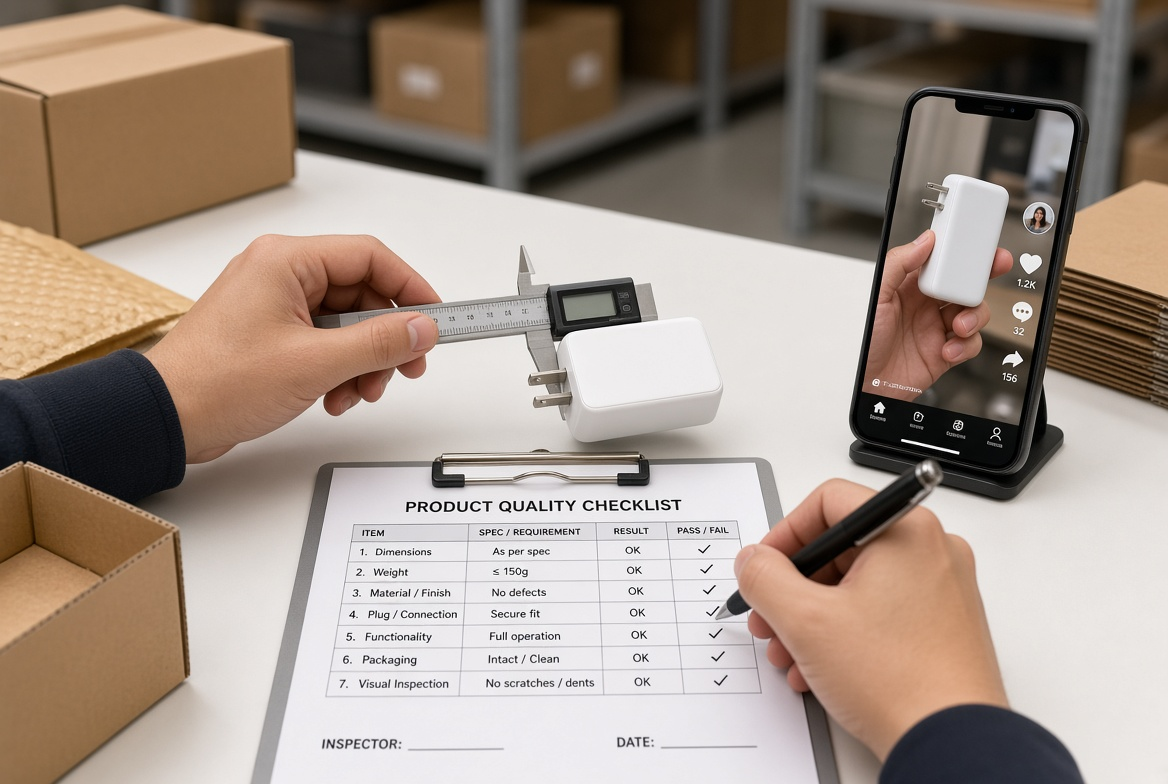
Use a simple sample approval checklist:
1. Confirm that the item matches the listing claims.
2. Check dimensions, weight, color, and material.
3. Test practical function and durability.
4. Review packaging protection.
5. Verify that accessories and instructions are included.
6. Record approved sample photos and videos.
7. Write down exact changes before placing a larger order.
The seller who approves the product before the audience sees it has far more control than the seller who discovers quality issues through refund requests.
Step 4: Start Lean, Then Replenish With Evidence
For a newly tested product, avoid letting enthusiasm replace evidence.
A lean launch can involve supplier-held inventory, small batch purchasing, or order-based fulfillment. The right choice depends on product margin, demand volatility, delivery expectations, and platform requirements.
Once the product shows consistent sales, sellers should use data to decide whether to hold stock.
Track these indicators:
– Daily order volume
– Conversion rate from content views
– Creator or affiliate performance
– Cancellation rate
– Return rate
– Defect rate
– Average delivery time
– Customer-review themes
– Stockout frequency
– Gross margin after fulfillment costs
A useful decision rule is to move toward deeper inventory only when sales are repeatable—not simply because one video performed well.
Step 5: Create a Quality-Control Standard
As order volume increases, quality cannot depend on individual judgment. It needs a repeatable standard.
Your quality-control checklist should specify:
– Product appearance and acceptable defect level
– Functional tests
– Quantity per carton or bundle
– Packaging materials and protection
– Barcode or label placement
– Insert card requirements
– Photo evidence before dispatch
– Rules for damaged or missing units
– Sampling percentage for inspections
For branded TikTok Shops, packaging is especially important. The product may be first discovered in a video, but the unboxing experience often determines whether a buyer becomes a repeat customer or shares a negative review.
Choosing Between Dropshipping, Bulk Inventory, and Hybrid Fulfillment
There is no universal fulfillment model. The best approach depends on product stage and demand reliability.
| Model | Best For | Key Advantages | Main Limitations |
| Dropshipping | New products and early testing | Low upfront inventory risk; broad catalog access | Less control over delivery speed and packaging |
| Bulk inventory in China | Proven products with stable demand | Better unit economics; easier quality control; custom packaging | Cash tied up in inventory; forecasting required |
| Overseas warehouse inventory | High-volume products in a target market | Faster local delivery; stronger customer experience | Higher inventory and warehousing commitment |
| Hybrid sourcing model | Fast-growing TikTok Shops | Combines testing flexibility with scaling control | Requires disciplined tracking and coordination |
For many sellers, the hybrid model is the most practical route.
Use flexible sourcing or dropshipping to test a product. Once demand is proven, purchase a controlled batch, add branded materials if appropriate, and plan replenishment based on sales velocity. If a product becomes a durable bestseller in one market, consider local inventory or platform-supported fulfillment options where available.
TikTok Shop currently supports different shipping arrangements, including seller shipping, TikTok-managed shipping options, and Fulfilled by TikTok in eligible circumstances. Sellers should review the latest requirements for their specific market before choosing an operating model.
The Hidden Economics of Viral Products
A product can look profitable on a supplier quotation but lose money after fulfillment. Smart sourcing decisions require a complete landed-cost view.
Use this formula:
Landed Cost=Product Cost+Packaging+Quality Control+Domestic Handling+International Freight+Duties/Taxes+Payment and Platform Costs+Returns Allowance
Then compare that figure with the selling price, creator commission, promotional discounts, and expected customer-service costs.
Example: Assessing a Potential Bestseller
Imagine a TikTok Shop sells a beauty accessory for $24.99.
| Cost Category | Example Cost |
| Product purchase cost | $4.20 |
| Packaging and insert | $0.80 |
| Inspection and handling | $0.45 |
| Shipping and fulfillment | $5.50 |
| Platform, payment, and promotion costs | $4.00 |
| Returns and defect allowance | $1.20 |
| Total estimated cost | $16.15 |
| Estimated gross contribution | $8.84 |
This is only an illustration, but it shows why a $4.20 factory price does not equal a highly profitable product. Sellers need room for creator incentives, discounts, reshipments, and operational surprises.
The best sourcing decision protects margin after the product becomes popular—not just before it launches.
How Looperbuy Supports Global TikTok Shop Growth
Looperbuy is built for sellers that want access to China’s product supply ecosystem without managing every supplier conversation, inventory movement, and fulfillment task independently.
For a growing TikTok Shop, a sourcing and fulfillment partner can help create a more controlled workflow across the product lifecycle:
– Product sourcing: Identify suitable products and supplier options based on product requirements, target cost, and order stage
– Supplier communication: Clarify specifications, variants, packaging, quantities, and replenishment expectations
– Sample coordination: Arrange product samples so sellers can validate quality before scaling
– Quality support: Check key product and packaging requirements before fulfillment
– Flexible procurement: Support testing, small-batch purchasing, and replenishment planning
– Custom packaging: Add brand inserts, labels, or packaging elements where practical
– Order fulfillment: Pick, pack, and prepare orders for shipment
– Shipping coordination: Help sellers manage fulfillment options and tracking workflows for international customers
The objective is not to make supply chains complicated. It is to give sellers a reliable process they can operate as content performance and order volume change.
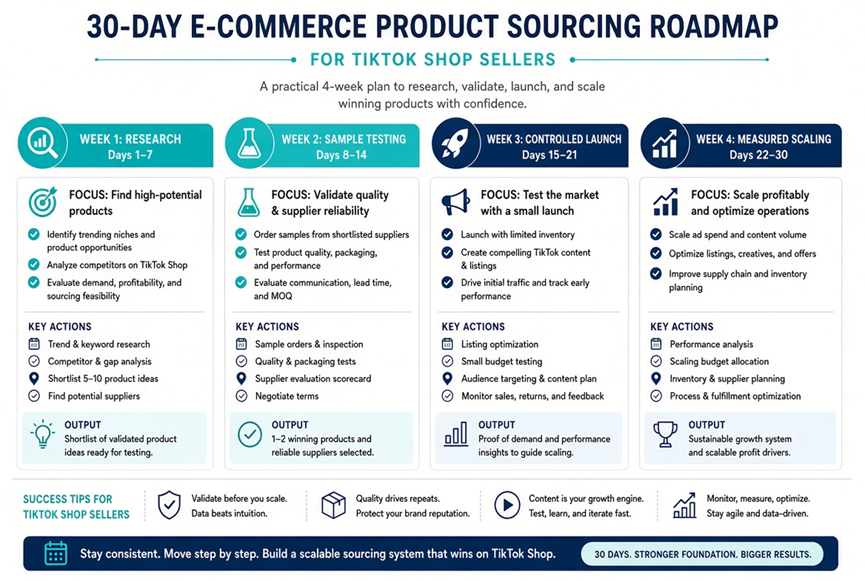
A 30-Day Sourcing Plan for New TikTok Shops
A practical launch schedule can reduce rushed decisions.
Days 1–7: Research and Product Definition
– Identify a small group of video-friendly product ideas
– Define the target customer and price range
– Estimate full landed cost, not only product cost
– Create a product readiness file
– Request supplier options and samples
Days 8–14: Sample Testing and Content Preparation
– Inspect products and test functionality
– Record original product demonstrations
– Confirm product claims are accurate
– Improve packaging requirements
– Select one or two products for initial launch
Days 15–21: Controlled Launch
– Start with manageable order capacity
– Track customer questions and content performance
– Monitor order-processing time and tracking quality
– Collect initial feedback before committing to large inventory
Days 22–30: Review and Scale Carefully
– Compare sales with return, defect, and delivery data
– Improve product pages based on customer questions
– Secure replenishment for proven products
– Build a backup supplier or alternate product plan
– Decide whether to remain flexible or hold inventory
This type of structured rollout is less glamorous than chasing every trend. However, it is far more likely to create a stable, profitable TikTok Shop.
Build a Supply Chain That Can Keep Up
TikTok Shop growth rewards speed, but sustainable growth requires control. Sellers need products that are easy to demonstrate, suppliers that can meet documented standards, fulfillment that supports accurate tracking, and inventory decisions based on real demand rather than excitement.
The most resilient sellers do not treat sourcing as a one-time buying task. They build it into their growth strategy.
If you are launching new TikTok Shop products, validating a viral item, or preparing to scale a winning SKU, Looperbuy can help you source products from China, manage quality, organize fulfillment, and reduce the operational burden of cross-border selling.
Start with a product requirement list, share your target market and order stage, and build a sourcing plan that matches your current growth—not yesterday’s assumptions.
Frequently Asked Questions
1. What is the best sourcing model for a new TikTok Shop?
For a new TikTok Shop, a flexible model is usually best. Start with samples and a small quantity or order-based fulfillment to validate product quality and demand. Shift toward managed inventory only after sales become consistent and margins support the investment.
2. How can TikTok sellers avoid buying too much inventory?
Use a staged approach. Test products with limited stock, track conversion rates and return patterns, then reorder based on verified sales velocity. Do not use one viral video as the only reason to place a large purchase order.
3. Why is product quality control important for TikTok Shop?
TikTok Shop buyers often make quick purchases based on video content. If the delivered item does not match what customers saw, sellers can face returns, complaints, poor reviews, and reduced trust. Quality checks help ensure the physical product matches the listing and creator content.
4. Can I add custom packaging to products sourced from China?
Yes. Many suppliers and sourcing partners can support options such as logo stickers, thank-you cards, branded inserts, custom boxes, and product bundles. Requirements, lead times, and minimum order quantities should be confirmed before ordering.
5. What costs should I include when calculating product profitability?
Include the product cost, packaging, inspection, handling, shipping, customs-related costs where applicable, platform fees, payment fees, promotional discounts, creator commissions, return allowances, and customer-service costs. Factory price alone is not enough.
6. Should a TikTok Shop use dropshipping or overseas warehousing?
It depends on demand maturity. Dropshipping or flexible fulfillment can lower upfront risk for product testing. Overseas warehousing becomes more attractive when a product has reliable volume in a specific market and faster delivery can materially improve customer experience.
7. How does Looperbuy help TikTok Shop sellers?
Looperbuy can support product sourcing, supplier communication, sample coordination, quality checks, customized packaging, order fulfillment, and international shipping coordination. This gives sellers a more centralized way to manage China sourcing and cross-border operations.
References
1. TikTok Shop Seller Center. “[Customer Order Shipping Requirements].” Accessed August 18, 2026.
2. TikTok Shop Seller Center. “[Fulfillment Policy].” Accessed August 18, 2026.
3. TikTok Newsroom. “[TikTok Shop Expands Across Europe: Bringing Content, Community and Commerce Together].” May 28, 2026.
4. TikTok Newsroom. “[TikTok Shop Drives Double Digit Beauty Growth in 2025].” January 26, 2026.
5. Modern Retail. “[TikTok Shop Says Sales From U.S. Small Businesses Climbed 66% in 2025].” May 19, 2026.
6. Retail Dive. “[TikTok Shop Is Driving Social Commerce Growth].” December 18, 2025.
7. Modern Retail. “[TikTok Halts Plan to End Independent Shipping for U.S. Sellers After Backlash].” February 18, 2026.