For engineers and sourcing managers navigating the fast-paced electronics manufacturing industry, the debate between FPC (Flexible Printed Circuit) and FFC (Flexible Flat Cable) is perennial [1, 2, 4]. While both technologies provide essential flexible interconnect solutions where rigid wiring fails, they are fundamentally different in their construction, performance capabilities, and ideal use cases [3, 6, 7].
As a sourcing expert at LooperBuy, I understand that selecting the wrong interconnect can lead to increased costs, assembly bottlenecks, or catastrophic product failure. This comprehensive guide breaks down the technical nuances, helping you make informed procurement decisions that balance innovation with budget constraints.
Table of Contents
Defining the Technologies: FPC vs FFC
What is an FFC (Flexible Flat Cable)?
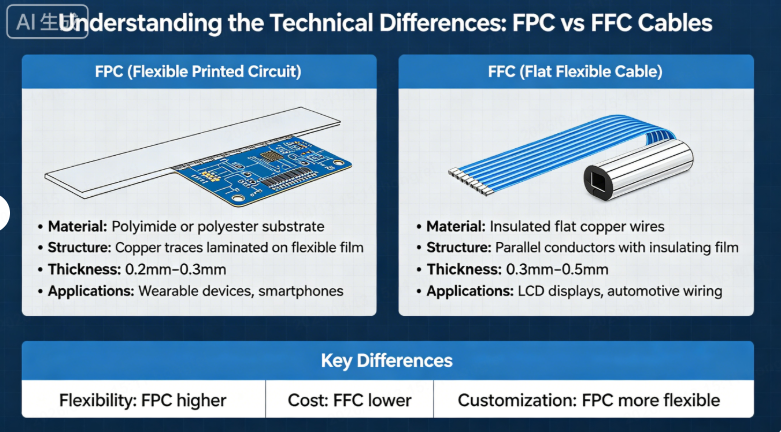
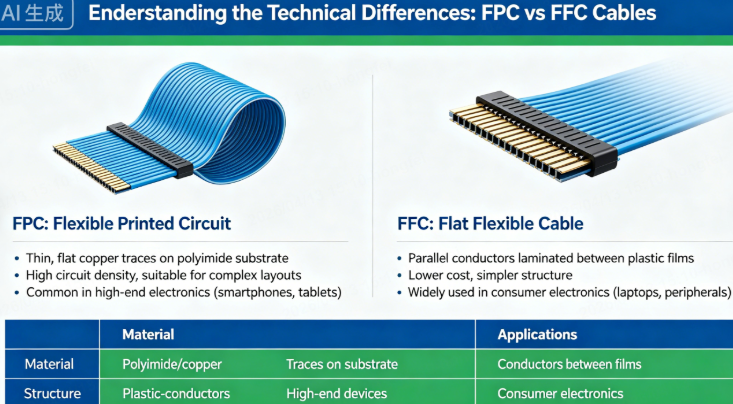
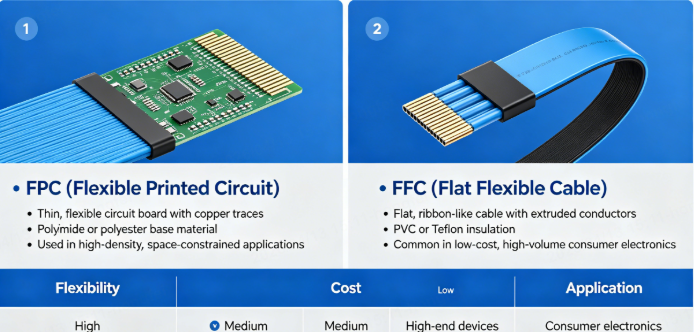
FFC cables are pre-manufactured, standardized components designed for straightforward, point-to-point connections [3, 8, 11]. They typically consist of flat copper conductors insulated between two layers of flexible polyester film [4, 11].
- Key Characteristic: They are highly standardized, often mass-produced, and offer a simple 1:1 signal transmission path [3, 8, 11].
What is an FPC (Flexible Printed Circuit)?
FPC cables are custom-engineered flexible circuit boards [3, 8, 11]. They are manufactured using complex processes—such as chemical etching—to create intricate copper traces on a flexible substrate, usually polyimide [2, 11, 13].
- Key Characteristic: They act as miniaturized circuit boards that can accommodate complex routing, multiple layers, and integrated components [3, 11].
Head-to-Head Comparison: Why Choice Matters
Understanding the structural differences is the first step toward optimization.
| Feature | FFC (Flexible Flat Cable) | FPC (Flexible Printed Circuit) |
|---|---|---|
| Construction | Flat copper traces, polyester film [4, 11] | Custom-etched copper, polyimide [2, 11, 13] |
| Circuit Complexity | Simple, 1:1 connection [3, 8] | High, complex, multi-layer [2, 3, 11] |
| Flexibility | Static or limited bending [1, 4] | Superior dynamic flexing [2, 4, 13] |
| Cost | Generally lower (standardized) [8, 13] | Higher (custom/complex manufacturing) [2, 8] |
| Best For | Volume-driven, simple connections [3, 8] | Advanced, space-constrained designs [1, 11] |
Technical Deep Dive: Selection Criteria
1. Performance Under Stress: Dynamic vs. Static Flex
If your application involves constant motion—such as a printer head, a foldable screen, or a camera gimbal—FPC is the industry standard. FPCs utilize etched traces that handle repeated stress far better than the laminated flat conductors in FFCs [1, 2, 4]. Conversely, if your cable is routed once and stays static within a laptop or display module, FFC provides a highly cost-effective and reliable solution [1, 3, 4].
2. Manufacturing Complexity and Cost
The manufacturing process is the primary cost driver. FFCs benefit from simplified, high-volume production techniques [8, 13]. FPCs require intensive steps including lamination, etching, and plating, alongside custom tooling [2, 13].
- Expert Insight: For B2B sourcing, always evaluate if your design requires the complexity of an FPC. If a simpler FFC can bridge your connection, you can significantly reduce your bill of materials (BOM) cost without compromising product functionality [8, 11].
3. Space and Miniaturization
Modern electronics demand extreme miniaturization. FPCs excel here because they can support high-density routing in extremely tight spaces [1, 11]. They can also incorporate small passive or active components directly onto the flex circuit, effectively replacing larger rigid PCBs in some modular designs [2, 3, 11].
Strategic Sourcing: Best Practices for B2B Procurement
As a sourcing platform, LooperBuy emphasizes three pillars when selecting flexible interconnects:
- Define Motion Requirements Early: Do not overestimate your flex needs. Choosing an expensive, high-flex-cycle FPC for a static application is a waste of budget [1, 11].
- Verify Connector Compatibility: FFCs and FPCs are often confused at the connector level [13, 14]. Ensure your ZIF (Zero Insertion Force) or LIF (Low Insertion Force) connectors are physically and electrically compatible with the cable’s thickness, pitch, and contact orientation (e.g., top/bottom contact) [14].
- Optimize for Volume: For high-volume consumer electronics, standardization is your friend. Leverage FFCs whenever the circuit design allows to maximize manufacturing speed and minimize unit cost [3, 8, 11].
Conclusion: Optimizing Your Electronics Design
Selecting between FPC and FFC is not about which technology is superior, but which is more appropriate for your project’s specific mechanical and electrical demands. FPC remains the choice for innovation, complex routing, and high-motion environments [2, 11], while FFC serves as the reliable, cost-effective workhorse for standard, high-volume connections [3, 8, 11].
For companies sourcing global components, understanding these nuances is critical for maintaining performance while optimizing manufacturing budgets. Whether you need standardized FFCs for display modules or custom FPCs for next-generation wearables, working with a platform that understands these technical requirements is key to your success.
Frequently Asked Questions (FAQ)
- Q: Can I replace an FFC with an FPC in my current design?
A: Generally, no. They have different physical thicknesses, electrical characteristics, and connector requirements. A design change usually requires validation. [1, 13] - Q: Which cable handles high heat better?
A: FPCs typically use polyimide (PI) substrates, which offer superior thermal resistance compared to the polyester often used in FFCs. [2, 13] - Q: What is the primary cost driver for FPCs?
A: The complex manufacturing process (etching, plating) and the cost of premium materials like polyimide film. [2, 13] - Q: Are FFCs reusable?
A: While technically possible, they are not intended for repeated removal and reinsertion, as the conductive pads can degrade, leading to connection failures. [12, 13] - Q: How do I know which connector to choose?
A: Ensure the connector pitch (e.g., 0.5mm, 1.0mm) and thickness clamp match your cable exactly. Misalignment is the most common cause of assembly failure. [14, 16]
References:
- Newhaven Display – FFC vs FPC: Understanding Flexible Cable Technologies [1, 3, 6]
- YT Electronic – FFC vs FPC: Choosing the Right Flexible Interconnect [2, 11]
- Romtronic – FFC vs FPC: The Ultimate Guide to Flexible Electronics Connectivity [3]
- Panox Display – FFC vs FPC: Flexible Cable vs Flexible Printed Circuit Guide [4]
- PCBTok – FFC vs FPC Connectors: Key Differences Explained [6, 10]
- WellPCB – Flexible PCB vs FPC vs FFC Cable Design Guide [9, 14]
- Sino-conn – FFC vs FPC Connectors: Differences, Types & Uses Guide [3, 7]
- Quadrangle Products – What is the Difference Between FFC and FPC? [10]
Hot tags: FPC manufacturing, FFC cable supplier, flexible printed circuit board, electronic component sourcing, custom FPC design, B2B electronics supply chain, PCB interconnect solutions, FPC vs FFC comparison, industrial electronics components, flexible flat cable manufacturer.