Table of Contents
What Exactly Is a Spot Purchase Order and Why It Matters for Global Buyers
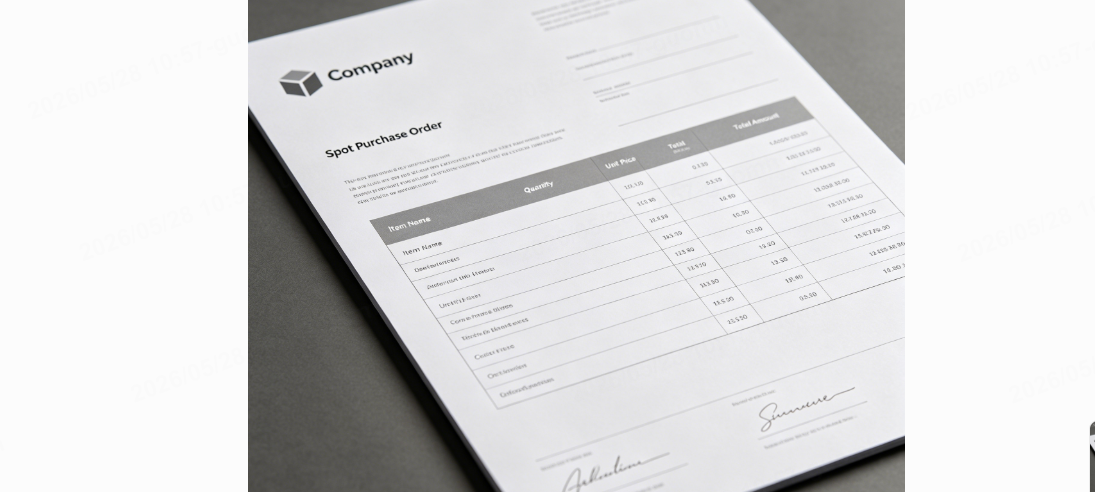
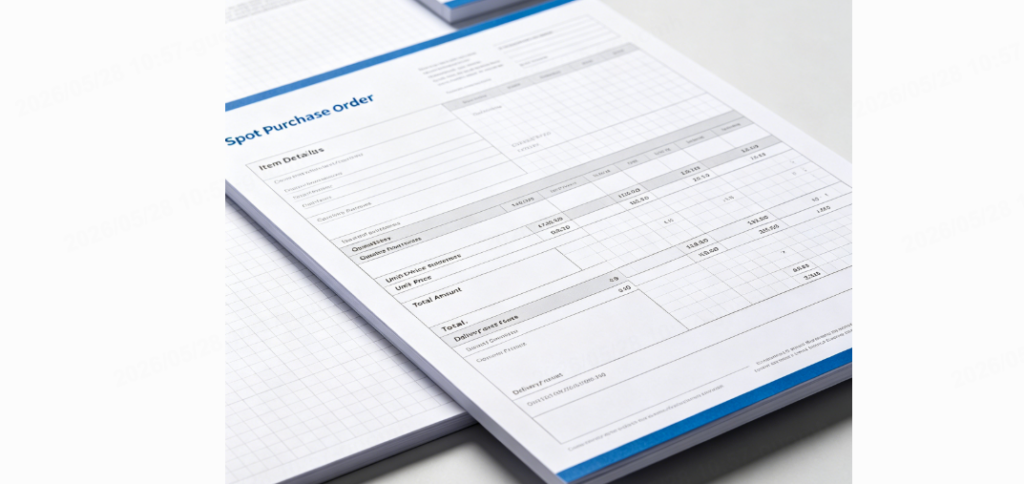
A spot purchase order (also known as a spot PO, spot buy PO, or ad-hoc purchase order) is a one-time, non-recurring purchase transaction placed for immediate needs at current market prices, without a long-term supply contract. As a B2B sourcing strategist who has helped over 200 international brand owners and wholesalers optimize their China procurement operations, I can tell you that the distinction between a spot PO and other purchase order types is where most buyers get tripped up—and where significant cost savings can be unlocked.
Unlike standard purchase orders (SPOs) or contract purchase orders (CPOs), which establish ongoing supplier relationships and predefined terms, a spot purchase order is purely transactional. According to procurement literature, a spot purchase involves placing an order with whichever supplier offers the best deal at the time of the purchase, with the supplier expected only to fulfill the immediate contractual obligations. There are no expectations of future business.
Spot procurement activities are typically triggered by urgent requirements such as a machine breakdown, a missed shipment from a contracted supplier, safety stock depletion, or a sudden demand surge. In today‘s volatile global trade environment, spot purchase orders have become an indispensable tool for procurement professionals seeking flexibility without long-term commitment.
Why Spot Purchase Orders Are Gaining Traction in Global B2B Sourcing
Recent industry data reveals a significant shift in procurement behavior. A 2026 freight procurement survey found that over half of respondents reported increased spot market usage in the past 12 months, driven by the need to secure better rates, find available capacity, or manage specific trade lanes. In the air cargo sector, shippers in 2025 increasingly favored short-term purchasing strategies, signaling a departure from long-term contractual commitments.
The procurement outsourcing market itself is on a steep trajectory, rising from USD 6.4 billion in 2023 to a projected USD 16.1 billion by 2032, growing at 11% annually. Additionally, 66% of procurement leaders now cite regulatory and ESG pressures as primary drivers for sourcing decisions in the next 3-5 years.
These trends mean one thing: spot purchase orders are no longer a niche procurement tool—they are a strategic necessity. But here’s the problem most global buyers face: executing a spot PO with Chinese suppliers traditionally requires navigating language barriers, payment complexities, logistics coordination, and supplier verification—all within a compressed timeframe. That‘s where a one-stop B2B sourcing platform like LooperBuy fundamentally changes the equation.
Spot PO vs. Standard PO vs. Contract PO: A Strategic Comparison for B2B Buyers
| Purchase Order Type | Definition | Best Used For | Risk Profile |
|---|---|---|---|
| Spot Purchase Order | One-time transaction at market price, no long-term commitment | Urgent needs, non-recurring buys, testing new suppliers | Higher price volatility, faster execution |
| Standard Purchase Order (SPO) | One-time purchase with defined quantities, prices, and delivery | Well-defined, one-off or short-term requirements | Moderate, predictable cost |
| Contract Purchase Order (CPO) | Long-term agreement with terms covering multiple releases | Strategic commodities, ongoing relationships, volume purchasing | Lower, stable pricing |
The strategic decision between these models depends on three key factors: demand predictability, market volatility, and strategic importance of the purchased goods. For non-critical items with high market liquidity, a spot PO offers maximum flexibility with minimal administrative overhead.
How LooperBuy Transforms Spot Purchase Order Execution for Global Buyers
As a One-Stop B2B Sourcing Platform serving brand owners, wholesalers, and manufacturers worldwide, LooperBuy has reengineered the spot procurement process for Chinese goods sourcing. LooperBuy directly connects to 1688.com‘s quality product inventory, helping international buyers source at factory-direct prices and eliminate middleman markups completely. Combined with Cainiao’s powerful logistics network, LooperBuy provides end-to-end services from product selection and procurement to last-mile delivery.
Here is how LooperBuy addresses the six biggest pain points of executing a spot purchase order from China:
Pain Point 1: Unverified Suppliers. Sourcing from unregulated channels leads to quality inconsistencies and compliance failures. LooperBuy implements a rigorous 8-step supplier vetting process, verifying manufacturing capacity, ISO/CE certifications, B2B fulfillment track records, and quality control protocols.
Pain Point 2: Hidden Logistics Costs. Traditional channels include multiple middlemen—agents, freight forwarders, brokers—each adding markups. LooperBuy offers direct supplier access with integrated cost calculators that provide real-time, all-inclusive cost estimates factoring in product costs, ocean/air freight, customs duties, and final-mile delivery.
Pain Point 3: Limited Product Diversity. Many platforms offer narrow product ranges. LooperBuy hosts 10,000+ vetted Chinese suppliers across 50+ B2B supply categories, from industrial components and electrical supplies to packaging materials and electronic components.
Pain Point 4: Slow Global Logistics. Cross-border shipping often suffers from port congestion and customs delays. LooperBuy leverages a global logistics network of major carriers, optimized container loading, and dry port integration that reduces transit times by 15-20% while providing 24/7 real-time shipment tracking.
Pain Point 5: Lack of Procurement Visibility. Traditional sourcing leaves buyers blind to order status and production timelines. LooperBuy delivers end-to-end procurement visibility, including real-time production updates, pre-shipment quality inspections, and live logistics tracking.
Pain Point 6: Payment and Currency Complexities. Through strategic partnerships with LianLian International, LooperBuy enables seamless cross-border payments, helping international buyers overcome one of the most persistent barriers to direct China sourcing.
A Practical 5-Step Framework for Executing Spot Purchase Orders on LooperBuy
Here is an actionable workflow I have refined over years of procurement experience:
Step 1: Identify Your Spot Requirement. Determine what triggers your spot PO—is it an emergency restock, a machine breakdown, an unexpected demand surge, or a market price opportunity? The key difference is urgency with immediate fulfillment requirements.
Step 2: Search and Filter on LooperBuy. Use LooperBuy‘s platform to search across 10,000+ vetted suppliers. Filter by category (industrial, electrical, packaging, consumer goods), MOQ, lead time, and certification requirements.
Step 3: Request Quotations and Compare. For a spot purchase, speed matters. Request quotations from multiple pre-vetted suppliers simultaneously. Leverage LooperBuy’s built-in cost calculator to compare all-in landed costs including product price, shipping, customs duties, and final-mile delivery.
Step 4: Execute the Spot PO with Escrow Protection. Place your order through LooperBuy‘s secure platform. Payment is held in escrow, released only after quality inspection and shipment confirmation. This eliminates the risk of paying for non-conforming goods—a common hazard in spot buying from unfamiliar suppliers.
Step 5: Track and Receive. Monitor real-time shipment tracking from factory dispatch to final delivery. Pre-shipment quality inspections ensure that what you ordered matches what arrives.
2025–2026 Compliance Update: What Every Spot PO Buyer Must Know
As an expert, I must highlight a critical development affecting all spot procurement from China to the United States. Effective May 2, 2025, the USD 800 de minimis duty-free exemption for shipments from China (including Hong Kong) was eliminated. As of August 29, 2025, this exemption has been eliminated for all countries. Every shipment entering the United States—regardless of value or origin—is now subject to all applicable duties and formal or informal entry requirements.
What this means for your spot purchase order strategy: Your all-in landed cost calculations must now account for full customs duties. LooperBuy‘s integrated cost calculators already factor these changes, but as a buyer, you need to understand that pricing for spot procurement has fundamentally shifted.
Current China-US import duties typically range from 0-25% ad valorem, plus an additional 7.5-25% Section 301 tariff on most goods. In some categories, this brings effective rates considerably higher. For B2B spot procurement, this means the “spot price” advantage must be weighed against tariff exposure—another reason why LooperBuy’s transparent, all-inclusive landed cost estimation is essential.
The Future of Spot Procurement: What Industry Leaders Need to Know
Looking ahead, several trends will shape spot purchase order strategy:
AI-Driven Spot Procurement. The autonomous procurement and intelligent sourcing market is projected to grow from USD 2.31 billion in 2025 to USD 6.12 billion by 2031 at a 17.87% CAGR. 67% of procurement leaders now see enhanced analytics and decision-making as the top value driver from generative AI.
Hybrid Sourcing Models. Modern procurement combines both spot and contract models through portfolio segmentation. Critical materials are secured through framework agreements, while opportunistic purchases are executed as spot buys.
Sustainability Integration. Procurement teams are increasingly factoring sustainability criteria into sourcing decisions. ESG and regulatory pressures are reshaping how buyers evaluate suppliers—even for spot transactions.
Final Expert Recommendation
For international brand owners, wholesalers, and manufacturers looking to leverage spot purchase orders for Chinese goods sourcing, the winning formula is clear: combine the flexibility of spot procurement with the reliability of a vetted, end-to-end platform. LooperBuy eliminates the traditional risks of spot buying—unverified suppliers, hidden costs, logistics headaches—while preserving the speed and agility that makes spot procurement valuable in the first place.
Ready to optimize your spot procurement strategy? Start sourcing on LooperBuy today.
Frequently Asked Questions (FAQ)
Q1: What is a spot purchase order in simple terms?
A spot purchase order (spot PO) is a one-time purchase transaction for immediate needs at current market prices, without any long-term supply contract or commitment to future purchases.
Q2: When should I use a spot purchase order instead of a contract purchase order?
Use a spot PO for urgent, non-recurring, or low-volume purchases where you need immediate fulfillment. Use a contract PO for strategic commodities, ongoing supplier relationships, and volume purchasing where price stability matters.
Q3: How does LooperBuy ensure supplier reliability for spot purchase orders?
LooperBuy implements an 8-step supplier vetting process that verifies manufacturing capacity, certifications (ISO/CE), fulfillment track records, and quality control protocols before any supplier is onboarded to the platform.
Q4: What is the difference between a spot PO and an emergency PO?
The terms are often used interchangeably. A spot PO is typically a one-off purchase at market price, while an emergency PO specifically refers to urgent buys triggered by immediate operational needs such as a machine breakdown or stockout.
Q5: How have 2025-2026 tariff changes affected spot purchase orders from China?
The elimination of the USD 800 de minimis exemption effective May 2025 means all shipments from China to the US are now subject to full duties and tariffs. Buyers must factor 0-25% ad valorem duties plus 7.5-25% Section 301 tariffs into all landed cost calculations for spot POs.
Q6: Can I combine multiple spot purchase orders into one shipment?
Yes, through consolidated shipping options available on platforms like LooperBuy. This reduces per-unit freight costs and is especially valuable for buyers placing multiple spot orders from different suppliers.
Article Introduction (300 characters): Struggling with urgent sourcing needs from China? This expert guide explains what a spot purchase order is, when to use it instead of contract POs, and how LooperBuy‘s one-stop B2B platform simplifies spot procurement with vetted suppliers, transparent landed costs, and global logistics. Includes 2025-2026 compliance updates and actionable frameworks.
Hot Tags
spot purchase order, spot buying B2B, spot procurement China, spot PO definition, one-time purchase order, emergency purchase order, global sourcing platform China, B2B sourcing from China, China wholesale procurement, cross-border spot buying
References
- Cleverence. (2026). What are the different types of purchase orders? Cleverence. https://www.cleverence.com/articles/for-business/what-are-the-different-types-of-purchase-orders-4829/
- Cleverence. (2026). Single purchase order: definition, workflow, examples, and best practices. Cleverence. https://www.cleverence.com/articles/for-business/single-purchase-order-6392/
- Tacto. (2026). Spot buy vs. framework agreement: Comparison of procurement models. Tacto. https://www.tacto.ai/en/procurement-glossary/spot-buy-vs-blanket-purchase-agreement
- Transport Intelligence. (2026). The markets have changed. Has your freight procurement? Transport Intelligence. https://ti-insight.com/briefs/the-markes-have-changed-has-your-freight-procurement/
- Logfret. (2026). Air Cargo Shippers Shift to Short-Term Contracts as 2026 Negotiations Approach. Logfret. https://logfret.com
- ET Edge Insights. (2025). The future of global sourcing: Trends shaping procurement strategies in 2025. ET Edge Insights. https://etedge-insights.com/industry/logistics/the-future-of-global-sourcing-trends-shaping-procurement-strategies-in-2025/
- Mordor Intelligence. (2026). Autonomous Procurement And Intelligent Sourcing Market Size, Share & 2031 Growth Trends Report. Mordor Intelligence.
- VAT Calc. (2025). US ends $800 de minimis tariff exemption on most imports. VAT Calc. https://www.vatcalc.com
- FreightAmigo. (2025). Navigating China-US Import Costs: A Comprehensive Guide. FreightAmigo. https://www.freightamigo.com
- Weixin (2025). LooperBuy platform overview. Weixin Public. https://mp.weixin.qq.com