Learn how to find reliable China wholesale suppliers for your B2B business. Compare sourcing channels, verify factories, evaluate samples, understand MOQ and Incoterms, control landed costs, and build a flexible low-inventory sourcing and fulfillment workflow with Looperbuy.
Finding reliable China wholesale suppliers is no longer just about locating the lowest factory quotation. For B2B sellers, importers, online retailers, and dropshipping businesses, the real challenge is building a supply chain that consistently delivers the right product quality, transparent pricing, dependable lead times, and manageable fulfillment.
At Looperbuy, we see a recurring pattern: businesses often lose money not because their product idea is wrong, but because they choose suppliers without a structured verification process. This guide explains how to find China wholesale suppliers, validate them, negotiate safely, and build an order-and-fulfillment workflow that reduces inventory, warehousing, payment, and logistics pressure.
Table of Contents
Why Choosing the Right China Wholesale Supplier Matters
China remains a major global sourcing destination because buyers can access broad product categories, manufacturing clusters, private-label opportunities, flexible packaging options, and suppliers serving both large importers and smaller e-commerce sellers.
However, a low unit price does not automatically mean a lower total sourcing cost.
A supplier quotation may exclude critical costs such as:
– Product sampling and sample shipping
– Custom packaging, labels, barcodes, or inserts
– Quality inspection and rework
– Domestic transport from factory to warehouse
– Export documentation
– International freight, customs charges, duties, and taxes
– Storage and fulfillment fees
– Replacement, return, or defect-management costs
For example, Supplier A may quote USD 2.80 per unit while Supplier B quotes USD 3.05. If Supplier A has inconsistent quality, poor communication, delayed production, and a high defect rate, the “cheaper” product can quickly become more expensive than the higher-priced alternative.
The strongest supplier relationship is therefore not the one with the lowest initial quote. It is the one that creates the most predictable landed cost, quality outcome, and delivery experience for your customers.
Six Ways to Find China Wholesale Suppliers
Online B2B marketplaces, trade shows, purchasing agents, referrals, due diligence, and Chinese search engines like Baidu remain effective, but each channel plays a different role in modern sourcing strategies.
1. Search Established B2B Wholesale Marketplaces
Online B2B platforms are usually the fastest place to begin supplier discovery. They allow buyers to compare product categories, minimum order quantities, supplier profiles, certifications, manufacturing capabilities, and quotation ranges.
Common platforms include:
– Global Sources
– Alibaba
– Made-in-China.com
– DHgate, especially for smaller quantities in selected categories
These platforms can help you create a broad supplier shortlist quickly. But a marketplace profile should be treated as a starting point, not proof that a supplier is suitable for your business.
When comparing suppliers on a marketplace, look beyond product photos and “verified” labels. Review:
– Years in business and export-market experience
– Product specialization rather than an unusually broad catalog
– Factory, trading company, or hybrid business model
– Product certifications relevant to your target market
– MOQ flexibility for test orders
– Reply quality, speed, and technical accuracy
– Sample policy and production lead time
– Ability to support packaging, labeling, and fulfillment requirements
A supplier focused on one category, such as reusable drinkware, industrial fittings, or pet accessories, may be more reliable than a company claiming to manufacture hundreds of unrelated products.
2. Attend Trade Shows to Assess Suppliers in Person
Trade shows let buyers inspect products directly, meet sales teams, compare suppliers within one category, and discuss customization face to face. The Canton Fair and Global Sources trade shows are among the well-known events where international buyers can meet Chinese manufacturers and exporters.
Trade shows are especially useful when you need to assess:
– Material quality and finishing
– Packaging quality
– Product dimensions and usability
– Supplier professionalism
– Customization possibilities
– New product trends in your category
Before attending, prepare a one-page sourcing brief. Include your product specifications, target price range, estimated order volume, preferred Incoterm, packaging requirements, required certifications, and target shipping market.
Do not make a large commitment at the booth. Collect catalogs, business cards, factory details, and samples. Then perform verification after the event.
3. Use Chinese Search Engines and Local Channels
Many capable factories do not invest heavily in English-language marketplace listings. Some rely on Chinese websites, domestic marketplaces, industry associations, WeChat, or local search visibility.
Searching on Baidu can uncover suppliers that may not rank on Google or appear prominently on international B2B platforms. Global Sources specifically notes that Chinese-language searches can be valuable because Baidu prioritizes Chinese content.
This approach can produce strong leads, but it also increases the need for language support, document verification, and clear communication. A sourcing partner can help bridge these gaps when you do not have a Chinese-speaking procurement team.
4. Ask for Referrals From Industry Contacts
A referral can save time because it comes from a buyer with direct experience. Ask importers, distributors, product-category communities, freight forwarders, inspection companies, or business contacts whether they have worked with a supplier.
Do not ask only, “Is this supplier good?” Ask specific operational questions:
– Did the supplier meet the agreed production schedule?
– Was the delivered product consistent with the approved sample?
– How did the supplier handle defects or missing items?
– Were quotations transparent about packaging and extra charges?
– Did the supplier communicate clearly during production?
– Would the buyer place another order with the supplier?
A referral is useful evidence, but it does not replace your own product testing and supplier due diligence. A factory may perform well for a large buyer but be unsuitable for a small, customized, or dropshipping-focused order.
5. Work With a Sourcing and Fulfillment Partner
A sourcing agent or sourcing partner can support supplier research, factory communication, price negotiation, sampling, inspection coordination, consolidation, warehousing, and shipping.
This model can be especially valuable for businesses that:
– Cannot travel to China regularly
– Need Chinese-language supplier communication
– Source from multiple factories
– Want to avoid holding large amounts of inventory
– Need product consolidation before international shipping
– Sell through multiple online channels
– Need pick-and-pack or direct-to-customer fulfillment
The right partner should explain its process clearly. Ask how it makes money, whether it receives supplier commissions, how it handles quality issues, what warehouse controls it uses, and how you can track order status.
For Looperbuy customers, the goal is not simply to locate a supplier. It is to create a practical workflow from supplier selection to product delivery—without requiring the seller to manage every payment, carton, warehouse movement, and shipping decision independently.
How to Verify a China Wholesale Supplier Before Paying
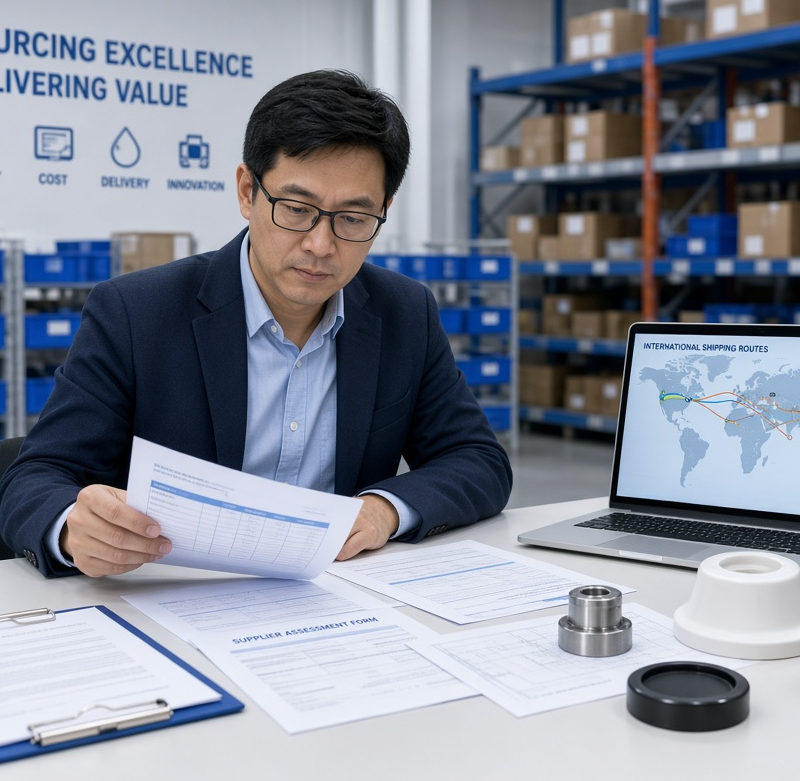
Supplier verification is where many buyers either protect their margin or create future problems. A professional-looking website, polished catalog, or fast quotation does not confirm manufacturing capability, legal registration, or quality consistency.
China’s enterprise-credit information system is one public channel used to disclose company-registration information and related records. Buyers can use available official information alongside supplier-provided documents, third-party inspections, and direct factory verification.
Supplier Verification Checklist
Before paying for a production order, verify the following:
| Verification area | What to check | Why it matters |
| Legal entity | Chinese company name, business license, registered address, legal representative | Confirms that the company exists and matches the contracting party |
| Business model | Manufacturer, trading company, or both | Helps you understand production control and pricing layers |
| Bank details | Bank-account name should match the registered company or have a documented explanation | Reduces payment-risk exposure |
| Product capability | Production lines, equipment, product range, technical knowledge | Confirms that the supplier can actually make the requested item |
| Product samples | Materials, dimensions, finish, packaging, function, labeling | A sample is your baseline for production acceptance |
| Certifications | Test reports and certifications required in your destination market | Reduces compliance and customs risk |
| Quality system | Incoming-material checks, in-process inspection, final inspection, defect process | Shows whether quality control is operational or only promised |
| Export experience | Main markets, product documentation, shipping familiarity | Helps avoid avoidable export and compliance errors |
A Safer First-Order Process
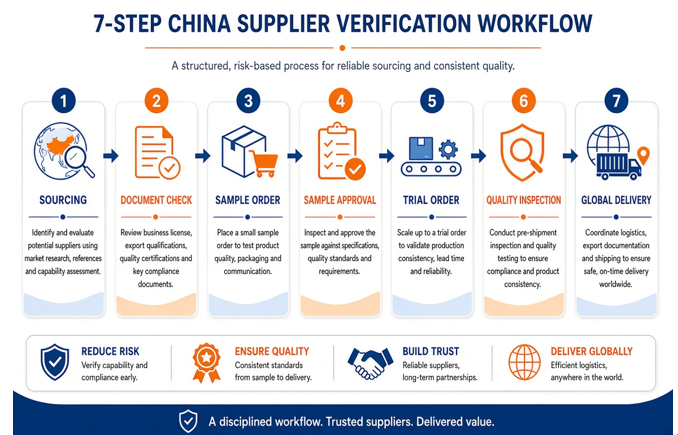
1. Create a written product specification sheet with materials, dimensions, colors, tolerances, packaging, labeling, and photos.
2. Request quotations from at least three comparable suppliers using the same specification sheet.
3. Order samples from the strongest candidates rather than relying on stock photos or chat confirmations.
4. Compare samples against your specification, not only against each other.
5. Place a limited trial order before moving to a larger purchase order.
6. Confirm the production schedule, quality standard, payment terms, shipping term, and remedy for defects in writing.
7. Arrange a pre-shipment inspection or establish a documented quality-control checkpoint before final payment.
Understand Pricing, MOQ, and Incoterms Before Ordering
A supplier’s quoted price is meaningful only when you know what it includes.
Ask for a quotation that separately states:
– Unit price and currency
– MOQ by product, color, size, and SKU
– Sample charge and refund conditions
– Tooling or mold fees, if applicable
– Packaging specifications and costs
– Private-label or custom-printing fees
– Production lead time
– Domestic delivery cost to a warehouse or port
– Shipping term
– Payment schedule
– Product warranty or defect policy
International Commercial Terms, known as Incoterms®, define responsibilities between buyers and sellers for delivery under international sales contracts. The current Incoterms® 2020 rules contain 11 standardized three-letter terms and came into effect on January 1, 2020.
For many buyers, the practical question is not which term has the shortest name, but who controls the shipment and when risk transfers.
| Term | Basic meaning | Practical consideration |
| EXW | Buyer takes responsibility from the seller’s premises | Maximum buyer control, but requires handling export-side arrangements |
| FOB | Seller delivers goods on board the vessel at the named port | Common for ocean shipments; buyer generally manages freight after loading |
| CIF | Seller arranges cost, insurance, and freight to the named destination port | Does not mean customs clearance or final delivery is included |
| DDP | Seller delivers with duties paid to the agreed destination | Convenient, but buyers should verify customs, tax, and compliance responsibilities carefully |
Do not choose a shipping term only because it sounds simple. Match it to your operational capability, customs knowledge, destination-market requirements, and desired control over freight.
Build a Low-Inventory Sourcing Model
Traditional importing often requires buying large quantities, shipping them to a local warehouse, and carrying inventory while hoping demand matches the forecast. That approach can work for established brands, but it can create cash-flow risk for newer sellers and businesses testing multiple products.
A lower-inventory sourcing model can reduce exposure by combining:
– Smaller initial test orders
– Supplier or China-based warehouse consolidation
– Product inspection before international dispatch
– Inventory visibility by SKU
– Flexible fulfillment to multiple markets
– Direct-to-customer or direct-to-channel shipping where appropriate
The World Bank’s Logistics Performance Index evaluates national trade-logistics performance based on customs efficiency, infrastructure, shipment pricing, logistics-service quality, tracking and tracing, and on-time delivery. Its 2023 survey incorporated 4,090 country assessments from 652 logistics professionals across 115 countries.
For sellers, the key implication is simple: logistics should be considered during product selection, not after the purchase order is issued. A product with attractive margins may still perform poorly if it is oversized, fragile, difficult to clear through customs, expensive to return, or slow to replenish.
Practical Example: Testing a Product Without Overbuying
Imagine an online B2B seller wants to launch custom-branded fitness accessories.
Instead of ordering 5,000 units from the first supplier:
– Source samples from three factories.
– Evaluate material, logo quality, packaging, and delivery responsiveness.
– Place a smaller trial order with the selected supplier.
– Inspect the finished goods in China.
– Store only a controlled quantity in a fulfillment warehouse.
– Send orders in batches or directly to business customers as demand develops.
– Use early sales data to decide whether to expand, modify, or stop the product line.
This approach may not produce the absolute lowest unit cost at the beginning. It can, however, lower the much larger risk of holding unsold, defective, or poorly packaged inventory.
Choose Suppliers for Long-Term Reliability
A successful supplier relationship improves over time. Once you find a capable partner, maintain structured communication and make performance measurable.
Track each supplier against a simple scorecard:
– On-time sample delivery
– Quote accuracy
– Response time
– Approved-sample consistency
– Defect rate
– Production lead-time accuracy
– Packaging compliance
– Problem-resolution speed
– Willingness to document agreements
Avoid changing suppliers solely for a small unit-price difference. A trusted supplier that understands your requirements can reduce expensive errors, shorten development time, and make scaling easier.
Start Sourcing With Looperbuy
Finding China wholesale suppliers is only the first step. Sustainable growth depends on what happens next: sample approval, supplier communication, inspection, inventory control, shipping coordination, and order fulfillment.
Looperbuy helps global B2B sellers source Chinese products, manage fulfillment, and reduce the burden of holding inventory, arranging warehouse space, handling supplier payments, and coordinating logistics.
If you are testing a new product, expanding a catalog, or looking for a more flexible China sourcing workflow, contact Looperbuy to discuss your product category, target market, and fulfillment requirements.
Frequently Asked Questions
1. How do I find reliable China wholesale suppliers?
Start with B2B marketplaces, trade shows, referrals, Chinese search tools, and sourcing partners. Then verify the supplier’s legal registration, manufacturing capability, samples, quality process, bank details, and export experience before committing to a larger order.
2. Is it better to buy from a factory or a trading company?
Neither is automatically better. A factory can offer stronger production control and potentially better pricing for specialized, higher-volume orders. A trading company may provide broader product sourcing, easier communication, and multi-factory consolidation. Choose based on the supplier’s actual capabilities and the service level your business needs.
3. What should I ask a China supplier before ordering?
Ask about MOQ, unit price, tooling costs, sample fees, production lead time, packaging options, customization, certifications, payment terms, inspection procedures, shipping terms, and defect-resolution policy. Request written answers and include key terms in your purchase order.
4. How can I avoid scams when sourcing products from China?
Do not rely only on a marketplace profile or product photos. Verify company documentation, confirm bank-account details, order samples, use a written specification sheet, begin with a trial order, and arrange product inspection before releasing final payment.
5. What is the best Incoterm for importing from China?
It depends on your shipping expertise and destination-market requirements. FOB can work well when you have a freight forwarder and want more control after port loading. DDP can be convenient when the delivery arrangement is clear, but buyers should understand exactly who handles import compliance, duties, taxes, and documentation. Incoterms® 2020 remains the current ICC framework.
6. Can I source from China without holding large amounts of inventory?
Yes. You can test products through smaller initial orders, use a China-based warehouse, consolidate goods from multiple suppliers, and use fulfillment services to ship according to actual demand. This can reduce upfront cash tied up in stock, although it may not always provide the lowest possible unit price.
7. Why should I order samples before a bulk purchase?
A sample lets you verify materials, construction, color, dimensions, branding, packaging, and usability. It also tests the supplier’s communication and ability to follow specifications. The approved sample should become the quality reference for your production order.
References
1. Global Sources. “[How to Find China Wholesale Suppliers 2026].” Accessed August 18, 2026. This source informed the foundational supplier-discovery methods, including B2B marketplaces, trade shows, sourcing agents, referrals, supplier due diligence, and Baidu-based searches.
2. International Chamber of Commerce. “[Incoterms® Rules].” Accessed August 18, 2026. This source supports the description of Incoterms® 2020, its effective date, and its 11 three-letter international trade terms.
3. World Bank. “[Logistics Performance Index: Overall—China].” Accessed August 18, 2026. This source provides the World Bank’s China-specific Logistics Performance Index data context.
4. World Bank DataBank. “[Logistics Performance Index—Glossary and Methodology].” Accessed August 18, 2026. This source supports the explanation of LPI evaluation criteria and the 2023 survey scope.
5. Beijing Municipal Government. “[Circular of Beijing Municipal Administration for Market Regulation].” Accessed August 18, 2026. This source supports the discussion of the National Enterprise Credit Information Publicity System as a public enterprise-information channel.
6. National Development and Reform Commission of the People’s Republic of China. “[Foreign Investment Law of the People’s Republic of China].” Accessed August 18, 2026. This source provides further context on enterprise-registration and enterprise-credit-information systems.