
This practical guide explains how global B2B sellers can build a stronger eCommerce operation through detailed product data, buyer-friendly ordering, personalized service, transparent landed costs, quality control, and reliable China sourcing and dropshipping workflows. Learn how Looperbuy can help reduce inventory pressure and simplify cross-border fulfillment.
B2B eCommerce is no longer simply a digital catalog or a convenient ordering channel. For global sellers, it is an operating model that can reduce inventory exposure, simplify cross-border sourcing, improve purchasing speed, and create a more reliable buying experience. The strongest B2B eCommerce businesses combine buyer-friendly storefronts with disciplined supplier, fulfillment, payment, and logistics processes.
For merchants selling internationally, the opportunity is especially clear: build a customer experience that makes complex procurement feel simple, while using a China sourcing and dropshipping partner such as Looperbuy to reduce the operational burden behind every order. Modern buyers use an average of ten channels during their purchasing journey, so product information, pricing, support, and fulfillment updates must remain consistent across every touchpoint.
> Key takeaway: B2B buyers expect the convenience of consumer shopping, but they still require business-specific capabilities such as volume pricing, repeat ordering, approvals, tax documentation, shipping choices, and dependable after-sales support.
Table of Contents
Why B2B eCommerce Has Become an Operations Strategy
The original B2B eCommerce discussion often focuses on websites, personalization, marketplaces, and flexible platforms. Those elements remain important. However, an effective strategy must go deeper: the buying interface is only the visible part of a system that includes sourcing, quotation, quality checks, inventory decisions, payments, packaging, shipping, returns, and customer service.
That distinction matters for a global seller.
A polished storefront cannot compensate for inaccurate stock data, unclear landed costs, slow supplier confirmation, or inconsistent delivery updates. Conversely, a dependable fulfillment engine can become a powerful commercial advantage when it is presented through a clear, self-service buying experience.
For many sellers, the central strategic question is not, “How do we put more products online?” It is:
How do we offer a broad, credible product range without locking capital into inventory before demand has been proven?
A sourcing and dropshipping model can help answer that question. Instead of purchasing and storing large quantities in advance, a merchant can validate demand, source products from China, and arrange fulfillment after an order is placed. This approach does not eliminate risk, but it can reduce exposure to unsold stock, warehouse overhead, and fragmented logistics management.
| Traditional inventory-heavy model | Sourcing and dropshipping-supported model |
| Buy stock before demand is confirmed | Source or replenish based on actual demand |
| Capital is tied up in inventory | More working capital remains available |
| Seller manages warehouse capacity | Fulfillment partner can handle storage and dispatch |
| Product expansion may require major upfront investment | Catalog testing can be more flexible |
| Shipping and supplier coordination are often fragmented | Order workflows can be centralized |
| Overstock and slow-moving SKU risk is higher | Inventory risk can be reduced, though not removed |
The broader market direction supports this shift toward digital, self-service, and connected commerce. McKinsey’s 2026 B2B research reports that omnichannel buying is now an expected baseline, not a differentiator; buyers move across digital, remote, and in-person interactions and expect continuity between them.
10 B2B eCommerce Best Practices That Build Buyer Trust
1. Make Product Data Detailed Enough for Business Decisions
B2B customers do not buy only with images and short descriptions. They need information that helps them assess fit, risk, compliance, margin potential, and delivery feasibility.
Each product page should clearly provide:
– Product name, model number, dimensions, materials, and technical specifications
– Minimum order quantity and available order tiers
– Unit price ranges or a clear quotation request path
– Packaging details, carton dimensions, and estimated shipping weight
– Customization options, such as branding, colors, labels, bundles, or private packaging
– Production lead time and estimated fulfillment timeline
– Product images, videos, close-ups, and use-case visuals
– Certificates, testing documents, or compliance information where applicable
– Clear information about samples, returns, and quality inspection options
Expert perspective: In cross-border commerce, missing product information becomes a support ticket, a delayed order, or a dispute. Rich product data is not merely a merchandising asset; it is a tool for reducing operational friction.
2. Design the Buying Journey Around Repeat Orders
Many B2B purchases are repetitive. A retailer may reorder a successful product every month. A distributor may replenish the same variants on a schedule. A procurement manager may need approval before submitting an order.
A business-ready ordering flow should support:
– Saved product lists and wish lists
– Fast reorder functions based on order history
– Bulk order forms and spreadsheet uploads
– Quote requests for custom or high-volume purchases
– Account-based pricing and tiered discounts
– Multiple shipping methods
– Internal purchasing approvals where relevant
– Invoice and order-document downloads
– Real-time status updates after payment and fulfillment
This is where a buyer-first approach becomes concrete. B2B customers should not need to contact support for routine tasks that an account dashboard could handle immediately.
3. Use Personalization Without Creating Complexity
Personalization in B2B eCommerce is more than placing a buyer’s name at the top of a page. It means showing information that matches the buyer’s commercial situation.
Useful forms of B2B personalization include:
– Regional product availability
– Currency and language preferences
– Customer-specific pricing or discount tiers
– Recommended replenishment products
– Relevant shipping choices by destination
– Product suggestions based on prior orders
– Customized catalogs for different buyer types
– Content tailored to resellers, retailers, wholesalers, or importers
The goal is not to make the platform feel overly automated. The goal is to remove irrelevant choices and make the next action obvious.
For example, a beauty-products retailer in the United States and a wholesaler in Europe may source similar items, but their shipping requirements, compliance concerns, packaging needs, and target margins may differ. A flexible sourcing workflow should recognize those differences rather than forcing both buyers through the same generic experience.
4. Build Trust Before Asking for a Large Order
International procurement has unavoidable uncertainty. Buyers may worry about supplier legitimacy, product consistency, payment protection, shipping reliability, customs complications, and communication delays.
Trust-building content should be visible throughout the buying journey:
– Transparent company information and service scope
– Plain-language explanation of sourcing and dropshipping workflows
– Quality-control or inspection options
– Clear payment terms and fee structure
– Authentic customer reviews and case examples
– Order tracking and proactive status notifications
– Clear policies for damaged, missing, or incorrect goods
– Responsive customer support channels
– Accurate product images and honest descriptions
A strong B2B platform does not hide complexity. It explains complexity clearly, then makes it manageable.
5. Treat Search and Filtering as Revenue Tools
A buyer who cannot find the right product quickly will often leave, even if your catalog is strong. This is particularly important for marketplaces and large sourcing platforms with thousands of SKUs.
Your search and filtering system should allow buyers to narrow results by:
– Category and subcategory
– Product attributes
– Price range
– Minimum order quantity
– Material, color, size, style, or compatibility
– Supplier or sourcing status
– Shipping destination
– Customization availability
– Lead time
– Certification or compliance requirement
Include intelligent search behavior wherever possible. For example, searches for “travel bottle set,” “cosmetic container,” and “portable toiletry bottles” should guide users toward relevant products, even if they do not use the exact catalog wording.
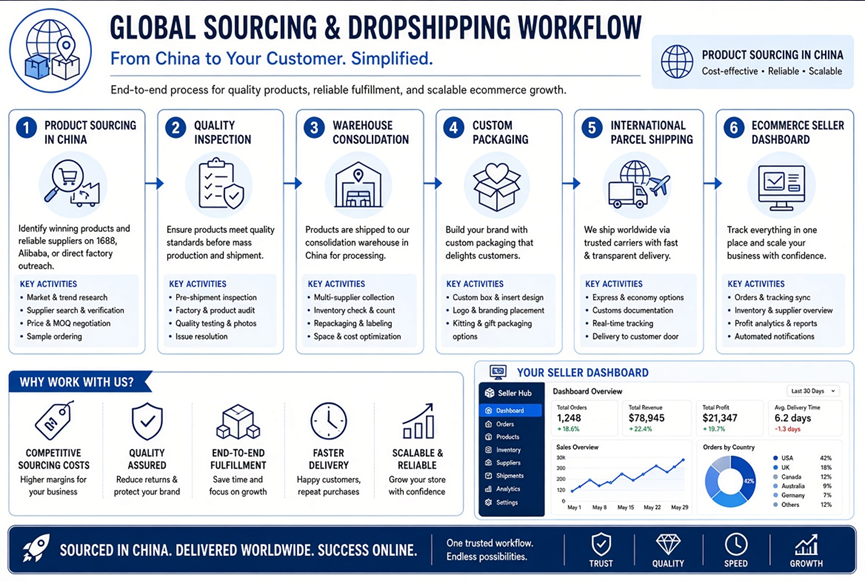
6. Create a Reliable Sourcing-to-Fulfillment Workflow
For sellers using China sourcing and dropshipping, fulfillment performance directly affects brand reputation. The operational workflow should be explicit, trackable, and standardized.
A practical workflow may look like this:
1. The seller identifies a product opportunity or submits a sourcing request.
2. The sourcing team verifies product availability, supplier capability, pricing, and lead time.
3. The seller reviews the product details, quotation, samples, or customization options.
4. The buyer places an order or funds the procurement process.
5. Products are purchased, received, checked, consolidated, or customized as agreed.
6. Orders are packed according to destination and shipping requirements.
7. The fulfillment provider ships the package and shares tracking information.
8. The seller monitors delivery and manages customer communication through a single workflow.
The value of this system is not simply convenience. It enables sellers to operate with fewer disconnected vendors and fewer manual handoffs between suppliers, warehouses, payment tools, and logistics providers.
7. Protect Margin With Landed-Cost Visibility
One of the most common mistakes in international product sourcing is evaluating only the supplier’s unit price. The actual commercial decision depends on the landed cost: the total cost to get a sellable product to the intended destination.
A more complete calculation is:
Landed Cost=Product Cost+Domestic China Shipping+Inspection+Packaging+International Shipping+Duties/Taxes+Payment Fees+Returns Allowance
For example, a product that appears inexpensive at the factory may become uncompetitive after air shipping, branded packaging, import charges, and payment processing costs. A sourcing partner should help sellers understand these cost layers before scale-up, not after margins have disappeared.
Practical recommendation: Test a small batch or controlled order before committing to a major product launch. Use the test to assess product quality, packaging, shipping speed, customer feedback, and actual delivered cost.
8. Combine Self-Service With Human Expertise
Self-service does not mean leaving business buyers alone. The best B2B experiences let customers complete simple tasks independently while making expert help easy to access when complexity rises.
Use self-service for:
– Browsing, searching, filtering, and comparing products
– Viewing order history and tracking
– Reordering standard products
– Downloading invoices and shipping documents
– Managing account preferences
Offer human assistance for:
– Custom product development
– Complex sourcing requests
– Negotiated volume pricing
– Private label and packaging projects
– Product compliance questions
– Logistics planning for larger or sensitive shipments
– Dispute resolution and exception handling
This blended approach reflects how modern B2B buyers actually work. They want speed and control, but they also want knowledgeable support at high-risk decision points.
9. Measure the Metrics That Reveal Friction
Traffic alone does not prove that a B2B eCommerce operation is healthy. Track metrics that connect the buying experience with operational outcomes.
| Metric | Why it matters | Improvement signal |
| Product-page-to-inquiry rate | Measures product information quality and buyer intent | Buyers understand the offer and take action |
| Quote-to-order conversion rate | Shows whether quotations are competitive and credible | Pricing, lead times, and communication are aligned |
| Repeat purchase rate | Indicates trust, product-market fit, and fulfillment reliability | Customers return without needing extensive persuasion |
| Average order value | Reveals cross-selling and volume-order effectiveness | Buyers add complementary or higher-volume products |
| Order processing time | Measures operational responsiveness | Less delay between payment, sourcing, and dispatch |
| On-time delivery rate | Directly affects buyer satisfaction and retention | Logistics promises match actual performance |
| Return or dispute rate | Reveals quality, listing accuracy, and packing issues | Fewer fulfillment failures and expectation gaps |
| Gross margin after landed cost | Shows whether growth is commercially sustainable | Product selection and logistics economics are sound |
Review these metrics by product category, country, shipping method, supplier, and customer segment. A single overall average can hide a serious issue in one market or SKU group.
10. Use Marketplaces and Owned Channels Together
Marketplaces can help sellers reach demand faster. An owned website, portal, or branded storefront helps create direct relationships, collect first-party customer insight, and build a long-term brand asset.
A balanced channel strategy can look like this:
– Use marketplaces to validate demand and gain visibility.
– Use your own store or buyer portal to strengthen customer retention.
– Offer account tools, content, reorder options, and tailored service in owned channels.
– Keep product, pricing, and delivery information consistent across channels.
– Use sourcing and fulfillment infrastructure to support both marketplace and direct orders.
Marketplaces are not necessarily a replacement for owned commerce. They can function as a discovery channel, while your direct B2B experience becomes the place where repeat buyers receive more control, better service, and stronger commercial support.
A 90-Day B2B eCommerce Improvement Plan
A practical improvement program should focus first on the largest sources of buyer and operational friction.
Days 1–30: Diagnose and prioritize
– Audit the top 20 revenue-driving products or categories.
– Identify missing specifications, images, lead-time information, and shipping details.
– Map the current sourcing-to-delivery process.
– Calculate landed cost for priority products.
– Review support tickets, cancellations, disputes, and negative customer feedback.
– Define baseline metrics for conversion, repeat orders, processing time, and delivery performance.
Days 31–60: Improve the buyer experience
– Upgrade product pages with complete commercial information.
– Add clear filters, comparison tools, and reorder functionality.
– Create clear sourcing, quality-check, payment, and shipping process pages.
– Introduce quote request forms for custom and volume orders.
– Build lifecycle communication for order confirmation, sourcing updates, shipment notifications, and delivery follow-up.
Days 61–90: Strengthen fulfillment and retention
– Test a controlled set of products, suppliers, and shipping routes.
– Standardize quality-control checkpoints.
– Build a simple dashboard for order status and exceptions.
– Develop customer segments for retailers, wholesalers, marketplace sellers, and private-label buyers.
– Create retention offers, replenishment reminders, and category-specific recommendations.
– Review results and expand only the workflows that meet margin and service targets.
Turn Sourcing Into a Competitive Advantage
The most successful B2B eCommerce businesses do not compete only through a larger catalog or lower headline prices. They compete by making procurement easier, more transparent, and less risky.
For global sellers, that means combining a useful buying experience with practical back-end capabilities: China product sourcing, supplier coordination, product inspection, inventory flexibility, consolidated fulfillment, international shipping, and consistent order communication.
Looperbuy helps B2B sellers source products from China and fulfill orders without carrying the full operational burden alone. Whether you are testing new products, managing repeat orders, expanding a catalog, or building a lower-inventory fulfillment model, a structured sourcing and dropshipping workflow can help you focus more resources on customers, sales, and growth.
Ready to reduce inventory pressure and simplify cross-border fulfillment? Explore how Looperbuy can support your sourcing, purchasing, and dropshipping workflow.
Frequently Asked Questions
1. What is B2B eCommerce?
B2B eCommerce is the online sale of products or services from one business to another. It may include manufacturer-to-wholesaler, wholesaler-to-retailer, supplier-to-distributor, or sourcing-platform-to-merchant transactions. Typical features include bulk ordering, negotiated pricing, account-based purchasing, invoicing, and repeat-order tools.
2. How does B2B dropshipping work?
In a B2B dropshipping model, a seller promotes or sells products without holding all inventory in advance. After an order is received, the seller or a sourcing partner purchases the product, prepares it for shipment, and sends it to the final customer. The seller remains responsible for product selection, customer experience, pricing, and brand positioning.
3. Can B2B dropshipping reduce inventory costs?
It can reduce the amount of capital tied up in unsold inventory and may lower warehouse-management needs. However, it does not remove all costs or risks. Sellers still need to manage product quality, supplier reliability, shipping costs, refunds, customer support, and margin control.
4. What should I check before sourcing products from China?
Review supplier capability, product specifications, minimum order quantity, sample quality, production lead time, packaging, compliance requirements, domestic shipping, international shipping options, payment terms, and total landed cost. For scalable products, quality inspection and clear communication procedures are essential.
5. Why is product information so important in B2B eCommerce?
Business buyers often make decisions based on specifications, compatibility, margins, logistics feasibility, and compliance requirements. Complete product information reduces uncertainty, improves conversion quality, lowers support workload, and helps prevent disputes caused by mismatched expectations.
6. What is the difference between a B2B marketplace and a B2B portal?
A B2B marketplace connects multiple sellers and buyers through a shared platform. A B2B portal is usually a branded environment operated by one company for its customers, distributors, or procurement partners. Many businesses use both: marketplaces for discovery and portals for repeat ordering, tailored pricing, and stronger account management.
7. Which metrics matter most for a B2B sourcing and fulfillment business?
Focus on quote-to-order conversion, repeat purchase rate, average order value, order-processing time, on-time delivery rate, dispute rate, and gross margin after landed cost. Together, these metrics show whether the buying experience and operational system are working as one connected business model.
References
1. Virto Commerce. “[Best Practices & Strategies for B2B eCommerce Dominance in 2024].” The source article discusses buyer experience, personalization, customer insights, B2B portals, marketplaces, automation, and adaptable commerce infrastructure.
2. McKinsey & Company. “[The surprising economics of B2B growth: The new survival threshold and what it takes to thrive].” McKinsey’s 2026 Global B2B Pulse findings report that buyers use an average of ten channels and expect seamless transitions between digital, remote, and in-person engagement.
3. U.S. Census Bureau. “[Quarterly Retail E-Commerce Sales Report].” The report provides official U.S. retail eCommerce data, including an estimated $340.2 billion in seasonally adjusted sales for Q2 2026 and eCommerce’s 17.1% share of total sales.
4. Digital Commerce 360. “[U.S. B2B sales top $15 trillion, ecommerce redefines how businesses buy and sell].” The analysis reviews U.S. B2B sales and the continued role of digital commerce in business purchasing behavior.
5. Salsify. “[2026 B2B Ecommerce Trends: Intelligence, Trust, and Buying].” The article discusses self-service buying, product information, marketplace purchasing, and omnichannel expectations in B2B commerce.