As a B2B sourcing and logistics strategist with over 15 years of experience helping global brand owners, wholesalers, and manufacturers move products from China, I’ve seen one question paralyze more supply chain decisions than any other: air freight vs sea freight cost. Which is actually cheaper when you factor in everything? And when does paying more for air make financial sense?
In this guide, I’ll break down the real air freight vs sea freight cost landscape for 2026—with live market rates, transit comparisons, hidden costs, and a decision framework that will save you thousands.
Table of Contents
Air Freight vs Sea Freight: The 2026 Cost Reality
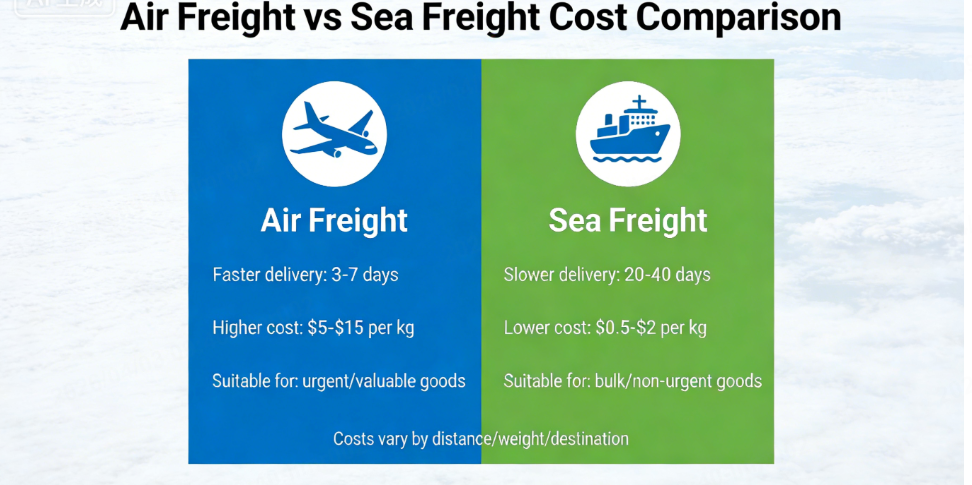
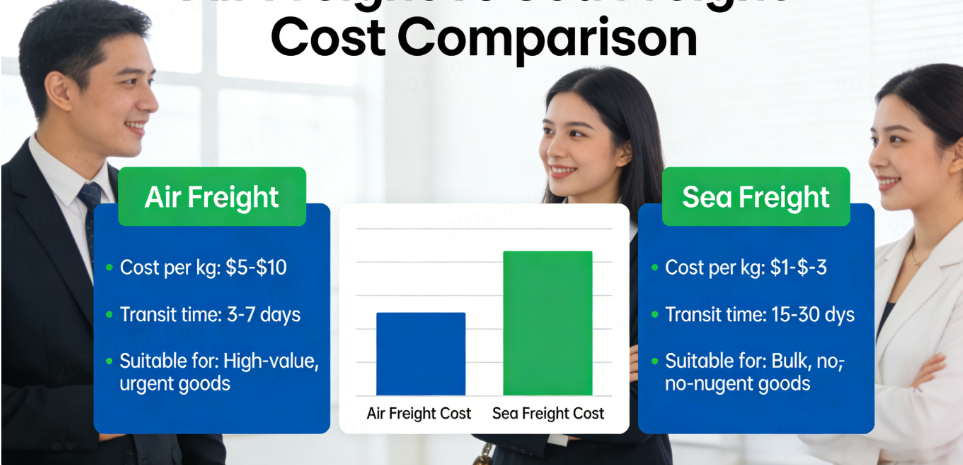
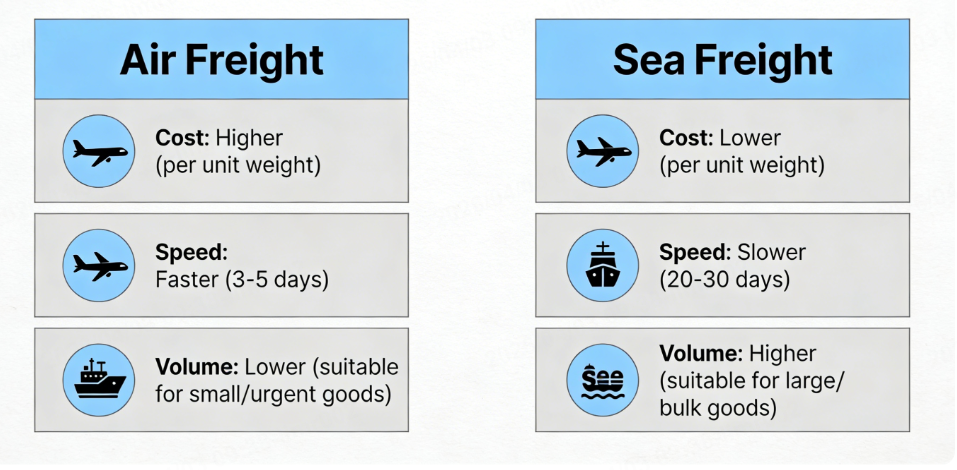
Let’s start with the headline numbers. In 2026, the air freight vs sea freight cost gap remains massive. Air freight typically costs 5–10 times more than sea freight on a per-kilogram basis[reference:0]. But that simple multiple hides enormous complexity in how each mode actually prices shipments.
Here are the current 2026 benchmarks:
Cost Factor
Air Freight (2026)
Sea Freight (2026)
Per kg rate
$3.50–$6.50 globally, $4–$8 on China-US lanes[reference:1][reference:2]
$0.50–$2 per kg for FCL, $1.80–$3.20 for DDP to US[reference:3][reference:4]
40ft container
N/A
$1,900–$3,200 (US West Coast), $3,200–$4,300 (US East Coast)[reference:5][reference:6]
Per cbm (LCL)
N/A
$110–$150[reference:7]
Fuel surcharge
$0.30–$0.80/kg additional
10–25% of base rate
Security/Handling
$0.15–$0.40/kg
Included in FCL rate
Key insight: The per-kg rate for air freight is now approaching double its pre-pandemic baseline. The gap between air and sea has actually widened since 2023, making ocean freight more attractive than ever for non-urgent bulk shipments[reference:8].
Transit Time: The Speed Premium You’re Paying For
When evaluating air freight vs sea freight cost, you can’t ignore what that extra money buys you: speed.
Metric
Air Freight
Sea Freight
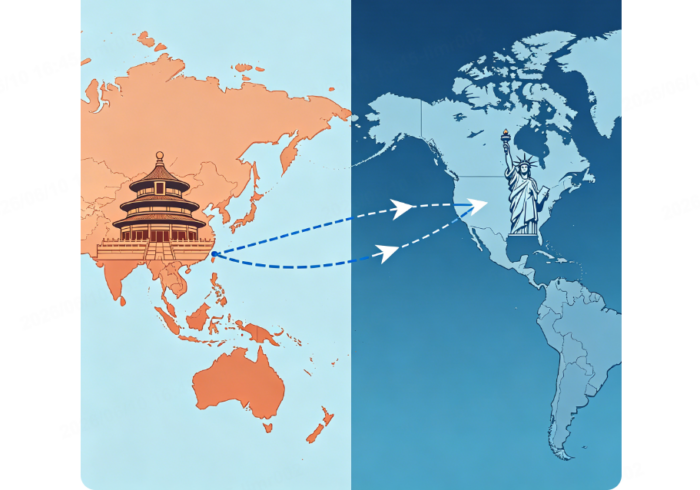
China to US West Coast
3–7 days[reference:9]
15–25 days
China to US East Coast
4–8 days
25–40 days[reference:10]
China to Europe
3–5 days
30–45 days[reference:11]
Door-to-door total
5–10 days[reference:12]
35–60 days
Real example: Shipping 500 kg of consumer electronics from Shenzhen to Los Angeles costs roughly $3,000–$4,000 by air (3–5 days) versus $400–$800 by sea (25–30 days). You’re paying a 5–8x premium to compress 4 weeks into 4 days[reference:13].
The Hidden Costs That Change Everything
A true air freight vs sea freight cost analysis must account for hidden expenses. Here’s what most guides miss:
Air Freight Hidden Costs:
Dimensional weight pricing: Bulky but light shipments get charged by volume, not actual weight—often doubling or tripling your bill[reference:14].
Express surcharges: FedEx, DHL, and UPS add $2–$4/kg for priority service.
Minimum charges: Even a 10 kg box pays a minimum of $150–$300.
Sea Freight Hidden Costs:
Demurrage and detention: $200–$500 per day after free time expires.
Port congestion fees: $150–$500 per container during peak season.
Inland trucking: Often $300–$800 from port to warehouse.
A 2025–2026 analysis reveals that ignoring dimensional weight in air freight is one of the most common budgeting mistakes B2B buyers make, often adding 30–50% to their expected costs[reference:15].
The Break-Even Calculator: When Does Air Make Financial Sense?
After analyzing hundreds of shipments, here’s my air freight vs sea freight cost decision framework:
Shipment Scenario
Recommended Mode
Why
< 100 kg, high value
Air freight
The speed premium is minimal on small packages
100–500 kg, urgent
Air freight or express
Test runs, prototypes, emergency restocks
500–5,000 kg, seasonal
Sea freight (LCL)
Bulk savings outweigh speed for planned inventory
> 5,000 kg, routine
Sea freight (FCL)
Even a 10-day delay is cheaper than air
Perishable goods
Air freight
Sea transit times risk spoilage
Heavy, low-margin goods
Sea freight
Air would eliminate all profit
The break-even point: In 2026, sea freight is typically 3–5x cheaper per unit than air on a landed cost basis[reference:16]. That means if your product’s gross margin is 40%, switching to sea instantly adds 15–25 percentage points to your net profit—provided you can wait for delivery.
Market Outlook: What’s Driving Rates in 2026
Understanding air freight vs sea freight cost trends helps you time your shipments. Here’s what’s happening now:
Ocean freight rates remain structurally low due to fleet overcapacity. As of January 2026, spot rates from Far East to US West Coast averaged $2,312 per FEU, with analysts expecting rates to stay near late-2025 levels[reference:17].
Air freight rates have been volatile. Global spot rates ended January 2026 at about $2.56 per kg[reference:18], but mid-March 2026 saw a sharp 10% weekly spike to $2.67/kg following Middle East disruptions[reference:19].
Carriers are pushing GRI increases on ocean lanes, with hikes up to $600 per container on China-US routes announced for March 2026[reference:20].
Actionable tip: Book sea freight 3–4 weeks in advance to avoid rate hikes and equipment delays[reference:21]. For air freight, rates typically dip in late January after the Lunar New Year rush.
New Section: Case Study – How a Mid-Sized Furniture Importer Saved $47,000 by Switching Modes
Let me share a real 2025 case. A US-based furniture brand was shipping 15 containers annually from Guangdong to Los Angeles exclusively by air—a legacy habit from their startup days when speed mattered most. Their annual shipping bill: $312,000.
The analysis: Their products were high-volume but not time-sensitive. Sea freight would add 25 days to lead time but cut per-unit shipping cost by 78%.
The switch:
Moved 80% of volume to sea freight (FCL), keeping 20% on air for bestsellers.
Used LooperBuy’s platform to compare landed costs across both modes.
Negotiated consolidated LCL rates for small-batch sea shipments.
The result: Annual shipping costs dropped to $265,000—a $47,000 saving. Customer satisfaction held steady because they forecasted sea arrivals accurately.
How LooperBuy Simplifies Your Air vs Sea Decision
At LooperBuy, we’ve built our one-stop B2B sourcing platform to eliminate the guesswork from air freight vs sea freight cost decisions. When you source from China through us, you get:
Side-by-side cost comparisons: See air, sea, and rail costs in one dashboard—including fuel surcharges and handling fees.
Landed cost calculator: Factor in product cost, freight, duties, and final-mile delivery before you commit.
Real-time rate tracking: We monitor market fluctuations and alert you when rates drop.
Multi-modal optimization: Our logistics engine recommends the optimal mode based on your timeline, budget, and product characteristics.
Direct carrier relationships: No middleman markups on either air or sea freight.
Client result: A LooperBuy client shipping automotive parts from Shanghai to Hamburg reduced their logistics costs by 32% in six months—simply by switching 60% of their volume from air to sea using our comparison tools.
Call to Action: Stop Guessing – Start Comparing
You don’t have to choose between speed and savings blindly. With LooperBuy, you get transparent air freight vs sea freight cost comparisons, real-time rates, and expert guidance—all in one platform.
Ready to optimize your shipping from China? [Sign up for LooperBuy] – free account, no commitment, transparent pricing across all freight modes.
Frequently Asked Questions (FAQ)
1. What is the main cost difference between air freight and sea freight?
Air freight typically costs $4–$8 per kg from China to the US, while sea freight costs $0.50–$2 per kg for full containers and $1.80–$3.20 per kg for door-to-door DDP shipments[reference:22][reference:23]. Air is roughly 5–10 times more expensive per kilogram[reference:24].
2. How much faster is air freight than sea freight?
Air freight from China to the US West Coast takes 3–7 days; sea freight takes 15–25 days. To the US East Coast, air takes 4–8 days versus sea’s 25–40 days[reference:25][reference:26].
3. What are hidden costs I should watch for in each mode?
Air freight: Dimensional weight pricing (bulky light items get charged by volume), express surcharges ($2–$4/kg), and minimum charges. Sea freight: Demurrage ($200–$500/day after free time), detention fees, port congestion fees ($150–$500), and inland trucking ($300–$800)[reference:27].
4. When does it make sense to use air freight despite higher costs?
Air freight is worth the premium for: small shipments under 100 kg, urgent restocks or emergency orders, prototypes and samples, perishable goods, and high-value items where stock-out costs exceed the freight premium.
5. How can I calculate which mode is cheaper for my specific shipment?
Use a landed cost calculator that factors in product cost, freight (actual or dimensional weight), customs duties, insurance, and final-mile delivery. LooperBuy provides this comparison automatically for every shipment.
6. Does LooperBuy offer both air and sea freight options?
Yes. LooperBuy integrates with major carriers across both air and sea freight—plus rail as a hybrid option. Our platform shows you side-by-side costs, transit times, and recommended modes based on your specific shipment characteristics.
Article Summary (299 characters)
Air freight vs sea freight cost 2026: real rates ($4–8/kg air vs $0.50–2/kg sea), transit times (3–7 days vs 25–40 days), hidden costs, break-even analysis, case study, and how LooperBuy optimizes your shipping from China.
Hot Tags
air freight vs sea freight cost, air freight cost per kg 2026, ocean freight container rates 2026, shipping from China to US cost, air vs sea freight comparison, freight cost optimization, landed cost calculation, LooperBuy logistics, B2B shipping guide, international freight rates, sea freight FCL rates, air freight dimensional weight, China export logistics 2026, freight mode decision framework
References
FreightAmigo. (2025). Air Freight vs. Sea Freight: Right Choice. Retrieved from https://www.freightamigo.com
FreightAmigo. (2026). Air Freight Cost Per KG: 2026 Rates Guide. Retrieved from https://www.freightamigo.com
Unicargo. (2026). Cheapest Way to Ship from China to Amazon FBA in 2026. Retrieved from https://www.unicargo.com
Winsky Freight. (2026). China to USA Shipping Cost 2026 | Rates & Tariffs Guide. Retrieved from https://www.winskyfreight.com
Sino Shipping. (2026). Shipping from China to US – Updated March 2026. Retrieved from https://www.sino-shipping.com
Xeneta/IndexBox. (2026). Early 2026 Container Rates Decline as Capacity Rises. Retrieved from https://www.indexbox.io
PortCalls Asia. (2026). 2026 ocean freight rates seen steady at 2025-H2 range. Retrieved from https://portcalls.com
WorldACD Market Data via Worldports. (2026). Air cargo rates climb as Iran war disrupts global capacity. Retrieved from https://www.worldports.org
FreightAmigo. (2025). Air Freight vs. Sea Freight: Navigating the Global Shipping Landscape. Retrieved from https://www.freightamigo.com
LooperBuy. (2026). Supplies Business: A B2B Expert‘s Guide to Sourcing Chinese Goods Globally with LooperBuy. Retrieved from https://blog.looperbuy.com/supplies-business-a-b2b-experts-guide-to-sourcing-chinese-goods-globally-with-looperbuy.html