Learn the real difference between dropshipping agents and dropshipping suppliers. Compare sourcing, pricing, quality control, branding, shipping, and fulfillment support, then discover when your online store should use a supplier, an agent, or a hybrid approach.
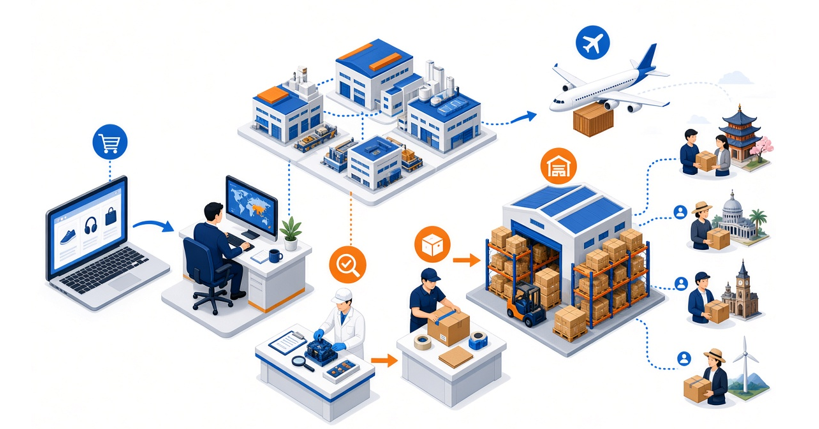
The difference between dropshipping agents and dropshipping suppliers is not simply a matter of who ships an order. A dropshipping supplier typically sells products from an existing catalog and fulfills orders, while a dropshipping agent acts as an operational partner that can source products, negotiate with factories, coordinate quality checks, manage branding, consolidate orders, and arrange shipping.
For a new store, a dropshipping supplier can be the fastest route to launch. For a growing brand with repeat sales, product requirements, and rising customer-service pressure, a dropshipping agent may offer more control over the parts of fulfillment that directly affect margin, delivery experience, and long-term reputation.
Table of Contents
What Is a Dropshipping Supplier?
A dropshipping supplier is the business that holds, produces, or obtains the goods you sell and ships those goods to your end customer after receiving an order.
In a conventional model, the workflow is straightforward:
1. You select a product from the supplier’s catalog.
2. You list it on your online store.
3. A customer places and pays for an order.
4. The order information goes to the supplier.
5. The supplier packs and ships the product directly to the customer.
Shopify defines dropshipping as a fulfillment method in which a seller offers products without holding inventory; after a customer orders, the supplier prepares and ships the item directly to that customer. Suppliers may be responsible for product sourcing or production, storage, packaging, and delivery coordination.
What Suppliers Usually Do Well
A reliable dropshipping supplier is valuable because it makes market entry easier. Instead of purchasing a large volume of stock before proving demand, a seller can test products with lower upfront inventory risk.
Common supplier services include:
– Access to a pre-existing product catalog
– Product availability and inventory storage
– Standard product photos and descriptions
– Basic order processing
– Pick, pack, and shipping operations
– Tracking-number generation
– Sometimes branded invoices or limited packaging options
– Basic stock synchronization through an app or platform
This model is particularly useful for merchants who are still validating a niche, testing creatives, or learning which products convert.
Where the Supplier Model Can Become Limiting
The same simplicity that makes suppliers attractive can become a disadvantage as a store grows.
Most catalog-based suppliers serve many sellers at once. That means the product, images, packaging, shipping method, and supply availability may be similar—or identical—for multiple competing stores. A supplier’s main objective is usually to fulfill available items efficiently, not to build your unique brand.
Typical limitations include:
– Limited customization: You may be restricted to existing colors, bundles, packaging, or product versions.
– Less product control: You may have little influence over factory selection, materials, inspection standards, or batch consistency.
– Inventory uncertainty: An item shown as available may become unavailable after a sudden demand spike.
– Standardized shipping: Shipping choices may not match your target market’s expectations.
– Minimal pre-shipment quality control: A supplier may pick and ship an item without an inspection process designed for your brand.
– Shared products: Competitors can often source the same product from the same listing.
These risks do not mean suppliers are poor partners. They mean merchants must choose the model that matches their current operating stage.
What Is a Dropshipping Agent?
A dropshipping agent is an intermediary or fulfillment partner that supports sellers beyond a single supplier catalog. The agent may identify suitable factories, negotiate product pricing, verify product details, organize inspection, consolidate items, add branding, and coordinate international shipping.
In practical terms, an agent is often the bridge between an overseas seller and the China-based manufacturing and fulfillment ecosystem.
A capable agent does not necessarily manufacture products. Instead, the agent creates a managed process around product sourcing and order fulfillment. This can include working with multiple factories, warehouses, packaging vendors, freight partners, and last-mile delivery channels.
The Core Services of a Dropshipping Agent
The exact service level varies, but a full-service dropshipping agent can support the following:
| Service Area | Typical Dropshipping Agent Role | Why It Matters |
| Product sourcing | Finds factory or supplier options for a requested product | Gives sellers more choices than a fixed catalog |
| Price negotiation | Negotiates unit prices, shipping costs, and order terms | Can improve gross margin as volume grows |
| Product verification | Confirms dimensions, materials, variants, and specifications | Reduces listing inaccuracies and customer complaints |
| Quality control | Checks selected orders or batches before shipment | Helps catch visible defects, wrong variants, and packaging errors |
| Branding | Adds custom inserts, labels, packaging, or thank-you cards | Creates a more consistent customer experience |
| Order consolidation | Combines multiple products into one shipment | Can reduce duplicate shipping costs and parcel confusion |
| Fulfillment | Picks, packs, labels, and dispatches customer orders | Keeps daily operations moving as sales rise |
| Logistics coordination | Matches parcels with available shipping lines | Balances delivery speed, cost, destination, and tracking needs |
| Exception handling | Helps resolve stock, address, tracking, and fulfillment issues | Protects customer experience when something goes wrong |
An agent is especially helpful when a seller’s business no longer fits a “click product, import listing, forward order” workflow.
Dropshipping Agent vs. Supplier: Side-by-Side Comparison
The most useful way to compare a dropshipping agent vs. dropshipping supplier is to look beyond the product price. The real question is: who is responsible when a product, order, shipment, or customer experience needs active management?
| Factor | Dropshipping Supplier | Dropshipping Agent |
| Main role | Provides products and fulfills orders | Manages sourcing, fulfillment, and operational coordination |
| Product selection | Usually limited to a public or platform catalog | Can source products from multiple factories or suppliers |
| Best for | New stores and simple product testing | Growing brands, repeat sellers, and more complex requirements |
| Pricing | Often fixed or platform-based | May be negotiated based on order volume and requirements |
| Product customization | Usually limited | Often more flexible for packaging, inserts, labels, bundles, and variants |
| Quality control | May be limited to standard warehouse handling | Can arrange order-level or batch-level inspection processes |
| Branding | Often generic fulfillment | Can support branded packaging and unboxing materials |
| Multi-product orders | May require separate shipments from different suppliers | Can potentially consolidate products before dispatch |
| Communication | Platform tickets, dashboards, or general support | More direct account-oriented communication in many cases |
| Shipping strategy | Standard options selected by the supplier | Can compare routes based on destination, parcel type, cost, and service needs |
| Scalability | Suitable for low-complexity operations | Better suited to stores building repeatable fulfillment systems |
| Risk profile | Lower setup effort, less operational control | More setup and coordination, potentially greater control |
The key distinction is this: a supplier fulfills a transaction; an agent helps manage a system.
When a Supplier Is the Better Choice
A dropshipping supplier may be the right option when your business is still small, early-stage, or highly experimental.
Choose a supplier-first model if you:
– Are testing several products with small order volumes
– Need fast access to a broad catalog
– Do not yet know which niche or product will scale
– Prefer simple app-based product importing
– Have no immediate need for private labeling or custom inserts
– Want to avoid building a complex sourcing process too early
– Sell straightforward, low-risk products with few variants
For example, a new merchant testing five home-organization products may not need a dedicated agent on day one. The immediate goal is to learn whether customers respond to the offer, creative angle, price point, and product positioning.
In this situation, simplicity has real value. It allows the merchant to validate demand before investing time into customized packaging, factory negotiations, or branded fulfillment.
Shopify notes that merchants can start through supplier networks, dropshipping apps, or direct supplier relationships, and can later build relationships that support custom products, negotiated pricing, and tailored fulfillment arrangements.
When You Should Work With a Dropshipping Agent
A dropshipping agent becomes more valuable when fulfillment is no longer a background task. If delivery experience, quality consistency, inventory planning, or brand presentation is affecting sales and retention, operational support can become a competitive advantage.
Consider moving to an agent when you notice these signals:
– You receive consistent daily order volume for one or more products.
– You have found a product worth scaling but need better unit economics.
– Your customers ask about long delivery times, tracking delays, or split packages.
– You need custom packaging, branded inserts, or private-label details.
– You want to bundle multiple products in one parcel.
– You have recurring quality complaints, wrong-variant complaints, or damaged-item claims.
– Your winning product is frequently out of stock.
– You want a product sourced outside a standard marketplace catalog.
– You need more responsive communication during campaign spikes.
– You are expanding into multiple countries with different delivery expectations.
A Practical Migration Example
Imagine a store selling a trending travel accessory.
At the beginning, the store uses a standard supplier listing. The seller receives a few orders each day, and the generic package is acceptable. After several weeks, the store’s content performs well and daily orders rise.
Then operational issues appear:
– Some customers receive different product shades.
– Delivery times vary widely by country.
– The packaging does not match the premium brand positioning.
– A second complementary item ships separately.
– Refund requests start increasing after customers receive inconsistent products.
At that point, the store does not necessarily need to hold inventory in its own country. But it may need a fulfillment partner that can verify product consistency, consolidate items, add a branded insert, and select a more suitable shipping line.
That is where a dropshipping agent can make the customer journey more predictable.
The Cost Question: Compare Total Landed Cost
Many sellers compare agents and suppliers using only the product’s unit price. This is a common mistake.
The better metric is total landed cost per successfully delivered order.
A useful framework is:
Total Landed Cost=Product Cost+Packaging Cost+Inspection Cost+Shipping Cost+Payment Fees+Refund and Replacement Cost
A product that costs less at a supplier may become more expensive if it produces late deliveries, avoidable refunds, repeated reshipments, or poor reviews.
For example:
| Cost Element | Standard Supplier Model | Managed Agent Model |
| Product cost | $8.00 | $7.40 |
| Standard packaging | Included | $0.25 |
| Basic inspection | Not specified | $0.20 |
| Shipping | $5.50 | $5.00 |
| Estimated avoidable replacement cost | $1.20 | $0.45 |
| Total estimated cost per delivered order | $14.70 | $13.30 |
This is only an illustration, not a universal pricing benchmark. The lesson is that the cheapest quote is not always the most profitable fulfillment model.
A transparent partner should explain what is included in its quote, including product cost, packaging, inspection scope, shipping method, tracking, customs-related responsibilities where applicable, and handling for unavailable stock or damaged parcels.
How to Evaluate a Dropshipping Agent
Not every business calling itself a “dropshipping agent” offers the same depth of service. Before sharing high-volume orders, test the relationship carefully.
Use This Seven-Step Vetting Process
1. Request product sourcing evidence
Ask for product specifications, pricing options, sample photos, available variants, and realistic lead times. Do not rely only on copied marketplace images.
2. Order samples to your own address
Check the real product, packaging quality, transit time, tracking updates, and delivery condition. Shopify also recommends placing a small order when researching supplier options, including from competitors where appropriate.
3. Define quality-control expectations
Ask what the team checks: product color, size, model, quantity, visible defects, accessories, packaging condition, or functionality. Confirm whether checks happen for every order or through sampling.
4. Clarify stock handling
Ask whether the agent can reserve inventory, monitor factory availability, or offer warehouse storage for proven products. Stockouts during a successful ad campaign can quickly erase momentum.
5. Confirm shipping options by destination
Request shipping estimates for your top markets, such as the United States, United Kingdom, Canada, Australia, and European countries. Ask about tracking availability, delivery windows, restricted items, and peak-season changes.
6. Test communication quality
Send specific questions. Reliable fulfillment requires clear responses to product changes, shipping delays, address corrections, and customer-return issues.
7. Get written terms before scaling
Confirm payment terms, minimum order requirements, inspection standards, packaging costs, storage rules, turnaround time, refund procedures, and dispute handling.
Supplier, Agent, or Both?
The choice does not always have to be either-or.
Many successful merchants use a hybrid approach:
– Use suppliers or product platforms to discover and test products.
– Identify the products that produce stable sales and acceptable customer feedback.
– Move winning products to an agent-supported sourcing and fulfillment workflow.
– Keep experimental products on a lower-commitment supplier model.
This approach reduces early risk while giving the business a clear path toward better control when a product proves itself.
It also aligns with how e-commerce businesses tend to mature. The U.S. Census Bureau estimated U.S. retail e-commerce sales at $340.2 billion in the second quarter of 2026, up 12.4% from the same quarter a year earlier. As online demand expands, reliable fulfillment and customer experience become increasingly important differentiators—not just product selection.
Build a Fulfillment Model Around Your Growth Stage
A dropshipping supplier is often the right starting point because it gives sellers speed, variety, and low inventory exposure. A dropshipping agent becomes more valuable when your store needs accountability across sourcing, quality, branding, and international fulfillment.
The best choice depends on your current business model:
– Testing products? Start with a reliable supplier.
– Scaling a proven product? Explore an agent for sourcing, inspection, and shipping optimization.
– Building a recognizable brand? Prioritize custom packaging, quality checks, and a consistent delivery experience.
– Selling multiple items per order? Consider an agent that can consolidate parcels and manage fulfillment more closely.
At Looperbuy, we help global B2B sellers source products from China, organize fulfillment workflows, and ship customer orders without requiring sellers to manage large inventory commitments, warehouse operations, or fragmented logistics coordination. If you have a product idea, a growing store, or a fulfillment problem that needs a practical solution, contact Looperbuy to discuss your sourcing and dropshipping requirements.
Frequently Asked Questions
1. Is a dropshipping agent the same as a dropshipping supplier?
No. A dropshipping supplier typically provides products and fulfills orders. A dropshipping agent can coordinate sourcing, supplier communication, product inspection, branding, consolidation, and shipping on behalf of the seller.
2. Do I need a dropshipping agent to start a store?
No. Most new sellers can begin with a supplier or dropshipping platform. An agent is often more useful after you have identified products with stable demand or need more control over quality, packaging, and delivery.
3. Can a dropshipping agent help with private labeling?
Many agents can help arrange private-label elements, such as branded packaging, inserts, stickers, labels, or customized bundles. The available options depend on product type, factory capabilities, order volume, and production lead time.
4. Are dropshipping agents cheaper than suppliers?
Not always on the initial product quote. However, an agent may lower total landed cost through factory negotiation, consolidated shipping, better product checks, lower replacement rates, and more suitable logistics options.
5. How do I know whether a dropshipping agent is reliable?
Start with samples and small test orders. Verify product quality, shipping performance, communication speed, tracking accuracy, pricing transparency, and how the agent handles problems before sending larger order volumes.
6. Can an agent source products that are not listed in a marketplace catalog?
Yes, this is one of the main reasons sellers use agents. A sourcing-focused agent can search for factories or alternative suppliers based on product photos, specifications, target cost, materials, dimensions, and customization requirements.
7. Who handles customer service in dropshipping?
The store owner is normally responsible for customer-facing support, refunds, and brand communication. The supplier or agent provides the operational information needed to resolve fulfillment-related issues, such as stock availability, tracking updates, damaged items, or delivery exceptions.
8. Can I use a supplier and an agent at the same time?
Yes. Many merchants use suppliers to test products and then shift successful products to an agent for more controlled sourcing, quality management, branded packaging, and fulfillment.
References
1. Shopify. “[What Is Dropshipping and How Does It Work?]”
2. Shopify. “[Dropshipping on Shopify: Complete Beginner’s Guide]”
3. Shopify. “[16 Best Dropshipping Suppliers for Your Store]”
4. Shopify Help Center. “[Dropshipping and Print on Demand App Recommendations]”
5. U.S. Census Bureau. “[Quarterly Retail E-Commerce Sales Report]”
6. Federal Trade Commission. “[Business Guide to the FTC’s Mail, Internet, or Telephone Order Merchandise Rule]”