
A practical guide to dropshipping in the UAE for global sellers. Learn how to choose products, calculate landed costs, verify China suppliers, manage compliance, improve delivery reliability, and build a scalable UAE fulfillment workflow with smarter sourcing and inventory control.
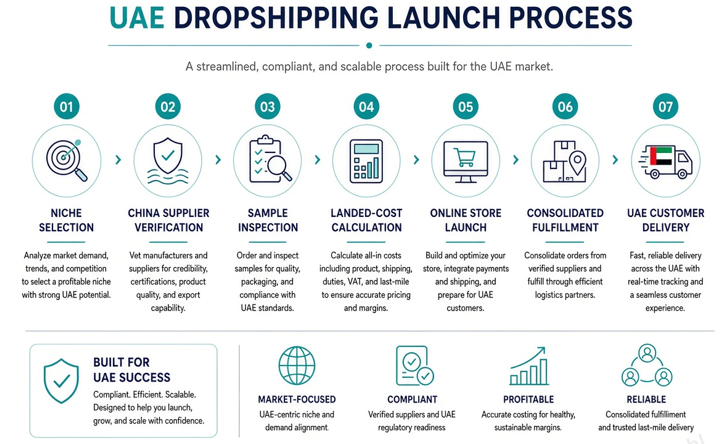
The UAE remains one of the Middle East’s most attractive markets for online retail, but successful dropshipping in the UAE is no longer about uploading random products and hoping for sales. It is about building a compliant, customer-first supply chain that combines the right products, verified suppliers, transparent delivery promises, and disciplined fulfillment.
For sellers targeting Dubai, Abu Dhabi, Sharjah, and the wider GCC, China sourcing can create a strong cost advantage. However, the real competitive edge comes from reliable product sourcing and order execution, not simply from finding the lowest factory price. Looperbuy helps B2B sellers source products from China, consolidate inventory, manage fulfillment, and ship orders without requiring large upfront stock commitments.
> Important note: This guide is for general business education, not legal or tax advice. Confirm licensing, tax, customs, and product-specific requirements with qualified UAE advisers and the relevant authorities before launching.
Table of Contents
Why Dropshipping in the UAE Still Matters
Dropshipping is an ecommerce model in which a seller markets products without holding all inventory in its own warehouse. When a customer places an order, the seller arranges for a supplier or fulfillment partner to prepare and dispatch the product.
The seller remains responsible for the customer experience:
– Product selection and merchandising
– Storefront, pricing, and payment flow
– Customer support
– Delivery communication
– Returns, refunds, and complaint handling
The supplier or fulfillment partner typically handles:
– Product procurement
– Quality inspection
– Storage or order consolidation
– Pick-and-pack operations
– Shipping handover and tracking support
The UAE is attractive because it combines digitally connected consumers, high purchasing power in major cities, mature logistics infrastructure, and a strategic location between Asia, Africa, and Europe. The U.S. International Trade Administration has described the UAE as one of the region’s most advanced ecommerce markets and previously cited a forecast of $8 billion in ecommerce sales by 2025.
Yet market potential does not make every product viable. In my experience working with cross-border commerce models, the sellers who last are those who control three things early: product quality, delivery expectations, and unit economics.
Where traditional dropshipping breaks down
Many beginners choose marketplace listings based only on a low product price. This often produces avoidable problems:
– Inconsistent product quality between orders
– Generic or inaccurate product descriptions
– Slow dispatch from multiple sellers
– No pre-shipment inspection
– Packaging that does not match the brand experience
– Difficult returns and unclear responsibility
– Margin erosion caused by shipping, payment fees, refunds, and ad costs
For the UAE market, buyers may accept cross-border delivery when the value is clear, but they do not accept misleading delivery dates or products that differ materially from the listing. A dependable sourcing workflow is therefore a commercial necessity, not an operational luxury.
UAE Dropshipping Compliance: What Sellers Must Prepare
Dropshipping is not exempt from the obligations that apply to other ecommerce businesses. Your legal setup depends on factors such as where the business is established, which emirate or free zone is involved, whether goods enter the UAE, your sales activity, and the products you offer.
A commercial license is generally central to operating an ecommerce trading activity in the UAE. Sellers should confirm that their selected activity, license type, location, import arrangements, and online selling process align with the business they actually intend to run.
Core compliance areas to review
| Area | What your business should address | Why it matters |
| Business licensing | Appropriate commercial or ecommerce activity and entity setup | Allows the business to operate within its approved scope |
| VAT | Registration status, invoicing, records, pricing treatment | VAT compliance affects cash flow and customer-facing prices |
| Corporate tax | Taxable income, registration, filings, relief eligibility | Tax exposure depends on the entity and business circumstances |
| Customs | Product classification, import documentation, duties, restricted goods | Delays and unexpected landed costs can destroy margins |
| Consumer protection | Accurate pricing, descriptions, delivery terms, returns, warranties | Your store—not your supplier—is accountable to the customer |
| Data and payments | Secure payment processing and responsible customer-data handling | Protects customers and reduces operational risk |
The UAE applies VAT at a standard rate of 5% on taxable supplies. UAE-resident businesses must generally register when taxable supplies and imports exceed AED 375,000 over the prior 12 months or are expected to exceed that level in the next 30 days. Voluntary registration may be available from AED 187,500. Rules for non-resident businesses differ and can apply regardless of value where no other UAE party is responsible for VAT.
For corporate tax, the Federal Tax Authority states that the regime applies to financial years beginning on or after 1 June 2023. The basic rate is 9%, while taxable profits up to AED 375,000 are subject to a 0% rate.
Consumer protection rules also apply to ecommerce transactions. The UAE government states that protection extends to goods and services sold through UAE-registered ecommerce platforms, including across mainland and free zones.
Build transparent product pages
At a minimum, product pages should clearly disclose:
– Total customer price and applicable charges
– Product specifications, variations, and materials
– Country of origin where relevant
– Estimated processing and delivery windows
– Return, refund, and cancellation conditions
– Warranty terms where applicable
– A reachable customer-support channel
For UAE selling practices, U.S. trade guidance also emphasizes accurate information and clear prices in AED, with Arabic included alongside other languages for sales materials.
Do not use ambiguous phrases such as “fast shipping” if the actual delivery time may be 10–15 business days. A realistic promise protects conversion quality, reduces “Where is my order?” tickets, and limits chargeback risk.
How to Start Dropshipping in the UAE
A disciplined launch is more valuable than a large catalog. Start narrow, validate demand, then expand only after you understand your product, supplier, and customer-service data.
1. Select a product category with operational logic
Look for products with enough margin to absorb the full cost of selling, not only the factory cost.
Good early-stage characteristics include:
– Lightweight and compact for cross-border shipping
– Non-fragile and easy to package
– Low sizing complexity
– Clear product benefits that can be demonstrated visually
– Low regulatory risk
– Few compatibility or warranty complications
– Room for bundles, accessories, or repeat purchases
Be cautious with products such as cosmetics, food, supplements, medical devices, batteries, branded goods, and children’s products. These categories may involve additional approvals, labeling, safety, customs, or intellectual-property requirements.
2. Calculate landed cost before setting a retail price
Your product cost is only one line in the financial model. Use a landed-cost calculation:
Landed Cost=Product Cost+China Domestic Shipping+Inspection+Packaging+International Freight+Customs/Duties+Payment Fees
Then estimate contribution margin:
Contribution Margin=Selling Price−Landed Cost−Marketing Cost−Refund/Support Allowance
For example, a $10 product that appears profitable at a $29 selling price may become unprofitable after shipping, payment processing, a $7 customer-acquisition cost, and refund allowances. Build your pricing around the delivered customer experience, not the supplier’s list price.
3. Verify suppliers before you scale ads
A supplier should pass more than a messaging test. Ask for evidence and test the workflow.
Use this supplier-validation checklist:
1. Request product specifications, real photos, and available variants.
2. Order samples to evaluate materials, finish, functionality, and packaging.
3. Confirm the actual processing time—not only the advertised time.
4. Check whether the supplier can maintain product consistency.
5. Ask about stock availability and substitution procedures.
6. Verify whether branded or regulated items have supporting documentation.
7. Agree on defect handling, replacement rules, and communication channels.
8. Conduct a small pilot order before running high-volume campaigns.
A sourcing agent or fulfillment partner can add value by inspecting goods before dispatch, combining items from multiple factories, applying branded packaging, and creating a single operational contact point. This is particularly useful when a seller wants to avoid buying and storing large quantities independently.
4. Choose a fulfillment model that matches demand
| Model | Best for | Main trade-off |
| Direct supplier-to-customer shipping | Testing products with minimal commitment | Less control over packaging, quality, and dispatch |
| China consolidation fulfillment | Multiple suppliers, bundles, branded inserts, inspection needs | Requires a stronger operations partner |
| UAE local inventory | Fast delivery and scalable repeat sales | Requires inventory planning and capital |
| Hybrid model | Validated bestsellers plus broad catalog testing | More complex inventory and reporting management |
For B2B sellers, a hybrid model is often the most practical. Test products through China-based sourcing and fulfillment, then hold selected fast-moving SKUs closer to your customers once sales are predictable.
5. Launch with a controlled product test
Do not launch 500 untested SKUs. Start with 10–30 products within a focused category and track:
– Product-page conversion rate
– Add-to-cart rate
– Average order value
– Cost per acquisition
– Delivery time by shipping method
– Refund and defect rate
– Customer-service reasons
– Repeat purchase rate
This data identifies whether the problem is product-market fit, pricing, creative, trust, fulfillment, or support.
A Better China Sourcing Workflow for UAE Sellers
The supplier platform is not the supply chain. Reliable results come from a repeatable system that turns a product link or sourcing request into a delivered order with documented checks.
Recommended operating workflow
1. Send a precise sourcing brief
Include product images or links, target specifications, expected order volume, target cost, packaging needs, and destination market.
2. Compare more than unit prices
Assess MOQ, sample availability, lead time, communication quality, materials, packaging, certifications, and defect-resolution terms.
3. Approve a sample or production reference
Keep photos, measurements, variant details, and accepted quality standards in writing.
4. Inspect before shipment
For higher-value or repeat products, inspection should cover quantity, appearance, function, labeling, packaging, and obvious defects.
5. Consolidate where it reduces total cost
Combining orders from several suppliers can reduce duplicate shipping charges and simplify customer delivery.
6. Create tracking and exception rules
Establish what happens when an order is delayed, lost, damaged, or delivered with an incorrect item.
7. Use performance data to decide inventory
Move only proven products toward bulk purchasing or local fulfillment.
Looperbuy’s model is designed around this operational gap. Rather than requiring sellers to manage multiple Chinese suppliers, payment coordination, warehousing, and dispatch separately, the platform can support product sourcing, purchasing, storage, order fulfillment, and shipping coordination for global B2B merchants.
Expert perspective: Optimize for certainty, not the lowest quote
The cheapest supplier can become the most expensive supplier when quality failure, rework, slow responses, and refunds are included. In cross-border ecommerce, every avoidable exception consumes customer trust and support time.
The goal is not merely to buy cheaply. It is to build an order flow where you can confidently answer three buyer questions:
– Is the product exactly as described?
– When will it arrive?
– What happens if something goes wrong?
When your operations can answer these questions clearly, you can invest in advertising and customer acquisition with much greater confidence.
Common UAE Dropshipping Mistakes
Selling regulated products without checks
A product may be easy to source but difficult to import or sell legally. Confirm requirements before listing—not after receiving orders.
Copying generic supplier content
Supplier images and descriptions are rarely optimized for local buyer trust. Create clearer product pages, original visuals, accurate specifications, and Arabic/English customer-facing information where appropriate.
Underestimating delivery communication
A delayed shipment is not always a failed order. A silent delay often is. Send confirmation emails, tracking updates, dispatch notices, and proactive exception messages.
Treating returns as an afterthought
Returns must be part of your cost model and customer policy. Define the conditions for returns, evidence requirements for defects, refund timing, and responsibility for shipping costs.
Scaling advertising before operations are proven
Before increasing marketing spend, place test orders, review packaging, measure actual transit time, and ensure your support team can resolve common questions quickly.
Build a More Reliable UAE Fulfillment Operation
Dropshipping in the UAE can be a practical route into a high-potential regional ecommerce market, especially for sellers who want to avoid excessive upfront inventory. But sustainable growth depends on compliance, product validation, transparent delivery commitments, and a supply chain that you can actively manage.
If you are building a UAE-focused store or supplying international merchants, Looperbuy can help you source China-made products, inspect quality, consolidate orders, manage fulfillment, and ship globally without the burden of operating your own warehouse.
Start with a product sourcing request through Looperbuy and turn your next catalog idea into a tested, trackable fulfillment workflow.
FAQ
1. Is dropshipping legal in the UAE?
Dropshipping can be operated in the UAE, but sellers need to ensure their business activity, licensing, tax position, product category, customs process, and consumer-facing practices comply with applicable requirements. Obtain professional legal and tax advice for your specific setup.
2. Do UAE dropshipping businesses need to register for VAT?
For UAE-resident businesses, VAT registration is generally mandatory once taxable supplies and imports exceed AED 375,000, or are expected to exceed that amount within 30 days. Voluntary registration may be possible above AED 187,500. Non-resident rules differ.
3. What products are best for dropshipping in Dubai?
Good starter products are often compact, lightweight, durable, visually demonstrable, and not heavily regulated. Validate demand, shipping cost, competitor pricing, and compliance requirements before committing to a category.
4. How long does China-to-UAE dropshipping take?
Delivery times depend on the supplier’s processing speed, selected shipping route, customs handling, order consolidation, and final-mile service. Publish a realistic estimated range, test it with actual orders, and avoid promising delivery dates you cannot consistently meet.
5. Can I sell products from multiple Chinese suppliers?
Yes. However, using multiple suppliers can create separate shipments, inconsistent packaging, and uneven product quality. A consolidation partner can help combine products and standardize fulfillment before international dispatch.
6. Should I hold inventory in the UAE?
Local inventory can improve delivery speed for proven bestsellers, but it creates inventory and storage costs. A hybrid model—testing through China fulfillment, then stocking validated SKUs locally—often reduces risk.
References
1. [Virto Commerce — Discover How to Start Dropshipping in the UAE and Find Suppliers]
2. [U.S. International Trade Administration — United Arab Emirates: eCommerce]
3. [U.S. International Trade Administration — United Arab Emirates: Selling Factors and Techniques]
4. [UAE Government Portal — Value Added Tax (VAT)]
5. [Federal Tax Authority — VAT Registration]
6. [Federal Tax Authority — Corporate Tax FAQs]
7. [Federal Tax Authority — Corporate Tax Awareness Campaign for SMEs]
-700x490.jpeg)