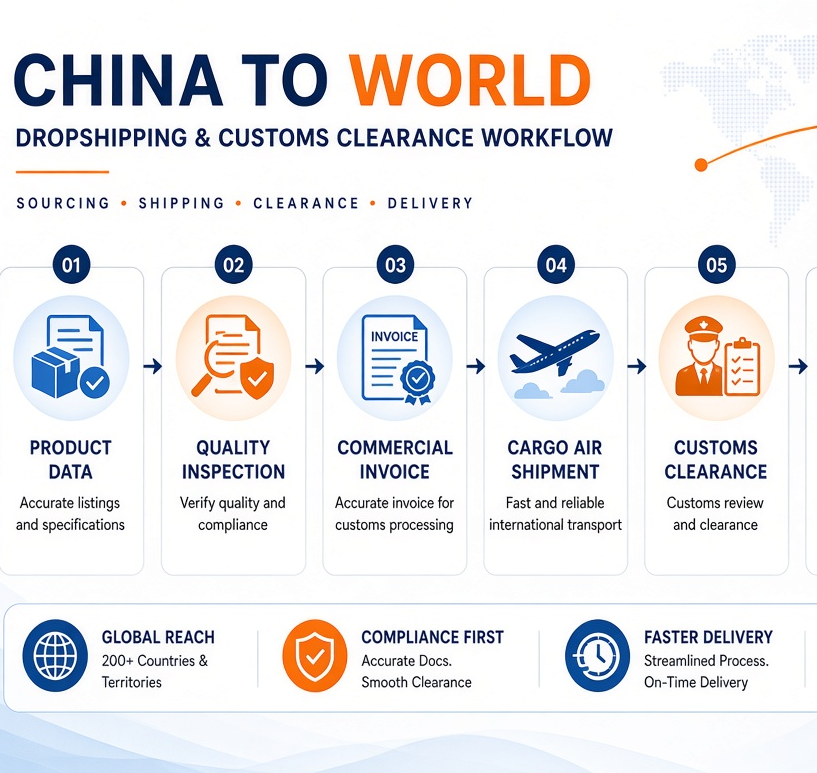
International dropshipping customs delays are usually preventable when sellers control product data, tariff classification, declared value, documentation, taxes, and buyer communication. This guide explains how B2B sellers can build a customs-ready workflow, screen high-risk products, clarify duty responsibility, and improve fulfillment reliability with better supplier and shipping coordination.
International dropshipping can make global selling more capital-efficient, but customs clearance can quickly become the weak point in the customer experience. A shipment may leave China on time, yet still be held because the product description is vague, the declared value is inconsistent, the recipient data is incomplete, or the goods require additional compliance documents.
For B2B sellers, avoiding customs delays in international dropshipping is not about finding shortcuts. It is about building a repeatable shipping process with accurate product data, transparent declarations, suitable delivery terms, and a sourcing partner that can coordinate fulfillment before parcels leave the warehouse. Customs compliance should be designed into the order workflow—not handled after a parcel has already been stopped.
> Practical note: Customs rules, taxes, restricted-product lists, and entry procedures change frequently. Always validate destination-specific requirements with a licensed customs broker, carrier, or qualified trade adviser before shipping.
Table of Contents
Why Customs Delays Happen in International Dropshipping
A customs delay occurs when border authorities, carriers, or clearance agents need more information before they can release a shipment. This can happen before arrival, at the border, or after the shipment enters the destination country.
In dropshipping, the risk is higher because orders are often:
– Shipped individually rather than as bulk commercial freight
– Sent to many different countries
– Fulfilled by multiple suppliers
– Subject to changing import tax rules
– Processed under tight customer-delivery expectations
– Dependent on accurate data from the supplier, seller, warehouse, and carrier
The World Customs Organization emphasizes the role of advance cargo information in helping authorities identify risk before cargo is loaded or arrives. In practical terms, this means that incomplete or inconsistent shipment data can create friction before the parcel reaches the destination border.
The most common customs-delay triggers
| Customs issue | What it looks like | Why it causes delays | Best preventive action |
| Vague product descriptions | “Gift,” “parts,” “sample,” or “accessories” | Customs cannot identify the item, use, or tariff classification | Use specific, plain-language item descriptions |
| Incorrect HS code | Wrong or overly broad tariff code | Duties, restrictions, and admissibility may be assessed incorrectly | Verify codes for each product category before launch |
| Under-declared value | Invoice value does not match product reality | Authorities may suspect evasion or request proof of payment | Declare a defensible transaction value |
| Missing recipient details | No phone number, email, tax ID, or address detail | Carrier cannot contact the importer or complete entry | Validate recipient data at checkout |
| Restricted products | Batteries, cosmetics, food, medical devices, branded goods | Extra permits, certifications, or inspections may apply | Screen products before listing them |
| Tax and duty confusion | Buyer does not know who pays import charges | Parcel may be held until payment is made | Set clear delivery terms and tax treatment |
| Incorrect origin marking | Product lacks required country-of-origin marking | Import requirements may not be met | Confirm labeling rules for key markets |
The core lesson is simple: most delays originate upstream. They begin with poor product information, weak supplier controls, or unclear responsibility—not at the customs counter.
Build a Customs-Ready Product Data File Before Selling
The most effective way to reduce customs holds is to create a product-level compliance record before the first order is shipped.
Do not wait until a carrier requests information. By then, the shipment may already be delayed and the customer may already be asking where their order is.
The minimum data every SKU should have
For each product, maintain a centralized record containing:
– Accurate commercial product name
– Product material and main function
– Product dimensions and net weight
– Country of origin
– Correct HS code or commodity code
– Declared unit value and sales value
– Battery, liquid, magnetic, chemical, or wireless status
– Brand and intellectual-property status
– Required certifications or test reports
– Destination-market restrictions
– Packaging and origin-marking requirements
– Recommended shipping method
– Duty, VAT, GST, or sales-tax handling notes
For example, “wireless earphones” is better than “electronics,” but it may still be incomplete for customs review. A stronger description would be:
> “Bluetooth wireless earphones, rechargeable lithium-ion battery included, plastic housing, for consumer audio use.”
This description gives the carrier and customs authorities a much clearer picture of the product. It also alerts your operations team that battery transport rules may apply.
Avoid generic descriptions on commercial invoices
Weak invoice descriptions often create unnecessary questions.
| Avoid this | Use this instead |
| Clothes | Men’s knitted polyester T-shirt |
| Toy | Children’s plastic building-block set |
| Electronics | USB rechargeable LED desk lamp |
| Accessories | Stainless-steel watch strap |
| Beauty product | Non-aerosol facial cleansing brush |
| Sample | Stainless-steel kitchen utensil sample, not for resale |
A good commercial description answers three questions:
1. What is the product?
2. What is it made of?
3. What is it used for?
When customs officers can answer these questions immediately, clearance is usually more efficient.
Verify HS Codes, Values, and Country of Origin
A Harmonized System code, commonly called an HS code, is one of the most important pieces of data in international dropshipping. It affects duty calculations, import restrictions, licensing requirements, trade remedies, and customs risk screening.
An incorrect code can lead to:
– Higher or lower duty assessments
– Reclassification by customs
– Requests for technical specifications
– Penalties in some jurisdictions
– Delayed delivery
– Seizure or return of the shipment in serious cases
Use HS codes as a product-control tool
Do not simply copy a code from a competitor listing or an old supplier invoice. Product classifications can vary based on materials, construction, purpose, technical features, and country-specific tariff schedules.
For higher-risk categories, ask for supporting information such as:
– Product specification sheet
– Bill of materials
– Product photos from multiple angles
– User manual
– Battery declaration
– Ingredient list
– Safety test report
– Brand authorization letter
– Manufacturer details
A supplier might describe an item as a “smart watch,” while customs classification may depend on whether the product functions primarily as a timepiece, communication device, fitness tracker, or data-processing accessory. The marketing name alone is not always sufficient for classification.
Declare realistic and consistent values
Customs authorities may compare declared values against product type, shipment data, previous entries, marketplace pricing, and other information available to them.
Avoid these high-risk practices:
– Declaring every parcel at the same low value
– Marking commercial orders as gifts
– Using a value that conflicts with the order record
– Splitting one order into multiple parcels only to avoid duties
– Omitting freight or insurance elements where customs valuation rules require them
– Using “$1 sample” for goods that are clearly commercial merchandise
A defensible value does not necessarily mean using the consumer retail price in every situation. It means using a value that accurately reflects the transaction and can be supported by records if requested.
Keep these records accessible:
– Order confirmation
– Supplier invoice
– Payment record
– Product page or quotation
– Shipping invoice
– Packing list
– Customer invoice where applicable
Choose Delivery Terms That Match Your Customer Promise
Many customs disputes are actually responsibility disputes.
The buyer may assume duties are included. The seller may assume the buyer will pay. The carrier may contact the recipient for payment, but the recipient may refuse or fail to respond. The parcel then sits in a clearance facility.
This is why delivery terms matter.
The International Chamber of Commerce explains that Incoterms® rules clarify responsibilities between buyers and sellers, including obligations related to carriage and import/export clearance. For dropshipping sellers, the critical question is straightforward:
> Who is responsible for import duties, import VAT, brokerage fees, and customs paperwork at destination?
DAP versus DDP in dropshipping
| Delivery approach | Import charges | Customer experience | Operational consideration |
| DAP / Delivered at Place | Usually paid by the buyer on arrival | Lower upfront price, but possible delivery interruption | Customer must be informed before purchase |
| DDP / Delivered Duty Paid | Seller arranges and pays applicable import charges | More predictable checkout and delivery experience | Requires stronger tax, carrier, and compliance controls |
| Tax-paid marketplace model | Tax may be collected through marketplace processes | Can simplify buyer communication | Rules differ by marketplace and destination |
Neither method is universally better. The right choice depends on your product category, destination, margin, average order value, and customer expectations.
For low-value consumer parcels, surprise import charges can result in refusal, return, or chargebacks. For B2B buyers, DAP may be acceptable when the buyer has its own importer registration, broker relationship, and established import process.
Make import-cost responsibility visible
Your store, quotation, and order confirmation should clearly state:
– Whether duties and taxes are included
– Whether buyers may need to provide tax identification or importer details
– Whether the recipient is responsible for import charges
– What happens if the recipient refuses to pay
– Whether remote-area, customs-processing, or return costs may apply
– Which party acts as importer of record where applicable
Clear communication reduces disputes, but it also prevents avoidable customs delays because the recipient is prepared to respond to carrier requests.
Screen High-Risk Products Before Listing Them
Not every product is suitable for cross-border dropshipping. A product may be easy to source and profitable to sell, yet difficult to import into certain markets.
Product categories that need extra attention
– Lithium batteries and battery-powered products
– Cosmetics, skincare products, and personal-care items
– Food, supplements, beverages, and agricultural goods
– Medical devices and health-related products
– Children’s products and toys
– Chemicals, liquids, aerosols, and flammable goods
– Wireless and radio-frequency devices
– Branded products and goods using third-party logos
– Apparel, textiles, and footwear
– Wood, plant, animal, or natural-material products
– Knives, tactical goods, and controlled items
For these categories, customs is only one part of the compliance process. Products may also be reviewed by consumer-safety authorities, food and drug agencies, communications regulators, environmental agencies, or intellectual-property enforcement teams.
A practical product-risk matrix
Before adding a product to your catalog, evaluate it across four areas:
| Risk area | Key question | Example of a possible issue |
| Customs classification | Is the HS code confirmed? | A product is classified under the wrong material category |
| Transport eligibility | Can the carrier accept it? | A lithium battery is shipped without required documentation |
| Import compliance | Does it need certification or registration? | A wireless device lacks local approval |
| Intellectual property | Is the product authentic and authorized? | A branded item is detained as suspected counterfeit merchandise |
A reliable sourcing workflow should flag risk before a customer places an order. This is particularly important when adding new product categories, changing suppliers, or expanding into a new market.
Prepare the Commercial Invoice and Packing List Correctly
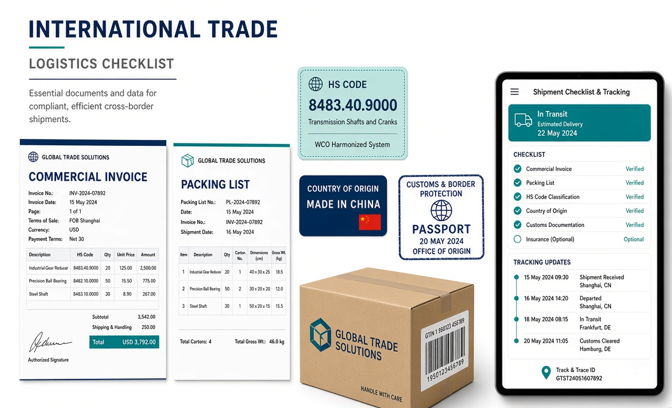
The commercial invoice is not merely an administrative document. It is one of the main records customs uses to understand the shipment.
A customs-ready invoice should normally include:
– Seller name and complete address
– Buyer or consignee name and complete address
– Recipient phone number and email where required
– Invoice number and invoice date
– Detailed product descriptions
– Quantity of each item
– Unit price and total value
– Currency
– Country of origin for each product line
– HS code where required or recommended
– Gross and net weight
– Shipping cost and insurance cost when applicable
– Delivery terms
– Tax identification number, EORI number, VAT number, or importer number when required
– Reason for export
– Signature or declaration where applicable
The packing list should match the invoice. If the invoice says two units but the package contains three, customs may stop the parcel for additional review.
Expert checkpoint: data consistency matters more than document quantity
A shipment does not become safer simply because it has more paperwork. It becomes safer when the information is consistent across every record.
Check that the following match:
– Store order
– Supplier invoice
– Commercial invoice
– Packing list
– Carrier booking
– Electronic shipping data
– Product label
– Customs declaration
One small mismatch can create a manual review. In large dropshipping operations, these discrepancies often come from manual data entry, supplier substitutions, or a warehouse using outdated product information.
Use Destination-Specific Tax and Import Workflows
A global shipping policy cannot be treated as one universal process. The United States, European Union, United Kingdom, Canada, Australia, Gulf countries, and Latin American markets all have different import procedures, tax mechanisms, and product restrictions.
United States: prepare for stricter low-value parcel controls
The United States has historically been a major destination for low-value e-commerce shipments, but the regulatory environment has evolved significantly. Recent U.S. actions have reduced the availability of duty-free de minimis treatment for many shipments, increasing the importance of accurate entry data, tariff classification, declared value, and duty planning.
For U.S.-bound orders, pay close attention to:
– Country-of-origin marking
– Accurate HTS classification
– Product admissibility
– Section 301, Section 232, antidumping, or countervailing duty exposure where relevant
– Partner government agency requirements
– Importer-of-record arrangements
– Duty and tax calculation in the checkout or fulfillment workflow
U.S. Customs and Border Protection states that foreign-origin articles entering the United States generally must be legibly marked with the English name of the country of origin unless an exception applies. Do not treat “Made in China” marking as a packaging afterthought.
European Union: plan VAT before the shipment moves
For distance sales of imported low-value goods, the EU’s Import One-Stop Shop, or IOSS, is designed to simplify VAT declaration and payment for qualifying consignments not exceeding €150.
For EU shipments, sellers should confirm:
– Whether IOSS applies to the order
– Whether VAT is collected at checkout
– Whether the IOSS number is transmitted securely through the carrier data flow
– Whether the consignment value is within the relevant threshold
– Whether the destination product has special restrictions
– Whether the customer will face additional charges on delivery
When tax collection, invoice data, and carrier declarations are aligned, the buyer is less likely to receive an unexpected payment request.
Create a Pre-Shipment Customs Control Process
The best way to avoid customs delays in international dropshipping is to make clearance readiness part of fulfillment quality control.
A seven-step pre-shipment checklist
1. Validate the destination country. Confirm whether the item can be imported and whether special rules apply.
2. Confirm product identity. Match the physical item to the SKU, product title, material, and declared description.
3. Verify HS code and origin. Use the correct tariff classification and country of origin for the actual product.
4. Check value accuracy. Ensure that the declared value aligns with order and supplier records.
5. Review required documents. Add invoices, permits, certificates, battery declarations, or authorization letters when needed.
6. Confirm recipient data. Verify name, full address, postal code, phone number, email, and importer/tax identifier if required.
7. Select a suitable carrier service. Use a shipping channel that accepts the product type and supports the destination’s customs process.
This process is especially useful for orders that contain multiple SKUs, high-value goods, regulated products, or first-time shipments to a new country.
Work With Suppliers and Fulfillment Partners That Control Data Quality
In my experience working with cross-border supply chains, customs performance is closely tied to supplier discipline. A seller can have a polished storefront and strong customer service, but still experience repeated shipment holds if product details are copied loosely from supplier listings.
A strong fulfillment partner should be able to help you standardize:
– Product specifications
– Supplier invoices
– SKU-level customs data
– Packaging requirements
– Shipping-method selection
– Photo verification
– Country-of-origin labels
– Quality checks before dispatch
– Exception handling when a carrier requests information
For example, imagine a seller launches a collection of rechargeable LED desk lamps. The supplier initially describes them as “table lamps.” That may work for a product listing, but the fulfillment team should identify that the shipment includes rechargeable lithium batteries. The product file should then be updated with the battery type, capacity, transport eligibility, accurate product description, and suitable shipping channel.
That small operational correction can prevent a large number of delayed, returned, or rejected parcels.
Reduce Delays With Better Customer Communication
Customs clearance sometimes requires action from the customer. The carrier may need a tax number, proof of identity, import authorization, or payment of duties and taxes.
If the recipient does not respond quickly, the parcel can remain on hold.
Send proactive order messages
Your order confirmation and shipping notification should tell customers:
– Their shipment may be subject to local customs procedures
– The carrier may contact them for additional information
– They should monitor phone calls, emails, and tracking updates
– Import taxes or duties may apply if not included in the order price
– They should respond promptly to avoid storage fees or return
– Delivery timelines can be affected by government inspections outside the carrier’s control
This does not eliminate every delay. However, it improves the odds that customers respond before the carrier’s deadline expires.
Final Checklist for Faster Customs Clearance
Before your next international dropshipping shipment leaves the warehouse, confirm the following:
– The product can legally enter the destination market
– The commercial description is specific and accurate
– The HS code has been verified
– The declared value is realistic and documented
– The country of origin is correct
– The commercial invoice and packing list match
– The recipient’s address and contact details are complete
– The buyer understands duty and tax responsibility
– Required labels, certificates, and permits are ready
– The selected shipping channel accepts the product
– The warehouse has checked the physical item against the order data
Customs delays cannot always be eliminated. Random inspections, changing regulations, border congestion, and agency reviews can still affect delivery. But a disciplined product-data and pre-shipment process can dramatically reduce preventable holds.
Looperbuy helps B2B sellers source products from China, verify orders, coordinate fulfillment, and ship internationally with a more controlled workflow. If you want to reduce inventory pressure while improving order accuracy, build your dropshipping operation around verified product data, practical shipping options, and clear customs responsibility from the start.
FAQ
1. What is the most common reason for customs delays in dropshipping?
The most common reasons are incomplete or inaccurate shipment information. Vague product descriptions, incorrect HS codes, inconsistent values, missing recipient contact details, and unclear country-of-origin information can all trigger additional review.
2. Can I declare a lower value to reduce import duties?
You should not intentionally under-declare a shipment. Customs authorities may request supporting records, reassess the value, impose penalties, or seize the goods in serious cases. Use a truthful and documented transaction value.
3. Does every dropshipping parcel need a commercial invoice?
Most international commercial shipments require an invoice or equivalent customs declaration data. Requirements vary by carrier and destination, but an accurate commercial invoice is a standard part of international shipping compliance.
4. What information should be included in a customs product description?
Include the product name, main material, intended use, and relevant features. For example: “Stainless-steel insulated water bottle for beverage storage” is much clearer than “bottle” or “gift.”
5. Who pays duties and taxes in international dropshipping?
It depends on the agreed delivery terms and the destination market. Under a DAP-style arrangement, the buyer commonly pays import charges. Under DDP, the seller arranges and pays applicable charges. Make the responsibility clear before checkout.
6. Can branded products cause customs delays?
Yes. Customs authorities may detain goods if they suspect counterfeiting or unauthorized use of trademarks. Work only with legitimate suppliers and keep authorization documents for branded goods when applicable.
7. How can I avoid customs delays when shipping to the European Union?
Use accurate customs data, confirm VAT handling, evaluate whether IOSS applies to qualifying low-value orders, send the required data through the carrier, and ensure the customer understands whether taxes are included in the order price.
8. What should I do if a package is already held by customs?
First, check the carrier’s tracking details and contact the carrier or customs broker promptly. Provide requested documents, such as an invoice, proof of payment, product specifications, certification, or recipient tax information. Do not submit altered or inaccurate documents to force release.
References
1. World Customs Organization. “Release and Clearance of Goods.”[wcoomd.org]
2. World Customs Organization. “Advance Cargo Information Implementation Guidelines.”[wcoomd.org]
3. International Chamber of Commerce. “Incoterms® 2020.”[iccwbo.org]
4. U.S. Customs and Border Protection. “Marking of Country of Origin on U.S. Imports.”[cbp.gov]
5. European Commission. “VAT One Stop Shop: Import One Stop Shop.”[vat-one-stop-shop.ec.europa.eu]
6. The White House. “Continuing the Suspension of Duty-Free De Minimis Treatment for All Countries.” February 21, 2026.[whitehouse.gov]
7. GOV.UK. “Declare Commercial Goods You’re Bringing into Great Britain.”[gov.uk]