Chinese tire brands are now key players in global fleets and retail networks. This expert guide explains how B2B buyers can select and source Chinese tires by segment, match brands to use cases, manage quality risk, and build profitable assortments using modern procurement platforms.
Chinese tires used to be treated as “budget back‑ups”; now they anchor entire product lines for distributors, e‑commerce sellers and fleet operators across Asia, Europe, Africa and the Americas. For buyers using platforms like Looperbuy or Global Sources, the challenge is no longer finding Chinese tires, but selecting the right brands and SKUs, then managing risk, logistics and quality at scale.
From my experience helping international retailers and fleet managers source in China, the most successful B2B buyers follow a structured approach: they map their market segments first, then match each segment to a focused set of Chinese brands instead of chasing the lowest unit price.
Table of Contents
Why Chinese Tire Brands Matter for Modern B2B Sourcing
Chinese manufacturers now account for a dominant share of global tire production, with China producing well over one‑third of the world’s tires and supplying nearly two‑fifths of global demand. Export volumes of new pneumatic rubber tires have hit historic highs since 2024–2025, driven by strong overseas demand and aggressive capacity expansion in major tire clusters like Shandong and coastal provinces.
For B2B buyers, this scale creates three key advantages:
– Price‑performance balance: You can combine mid‑range brands like Linglong or Sailun with budget labels like Goodride or Wanli to cover multiple price points without sacrificing basic safety or durability.
– Segment depth: Major groups such as ZC Rubber and Linglong operate multiple brands, giving access to passenger car, truck, bus, OTR, agricultural and off‑road tires under one umbrella.
– Logistics flexibility: Dense manufacturing zones and export‑oriented operations allow consolidated shipments, mixed‑container loading and more resilient supply for cross‑border e‑commerce and regional distribution.
Understanding Chinese Tire Brands by Category
Instead of treating “Chinese tires” as a single category, B2B buyers should group brands by their core strengths and typical use cases. Below is a practical, procurement‑oriented view building on the Global Sources brand overview.
Balanced and All‑Round Performance Brands
These brands suit general retail, multi‑brand dealerships and fleets looking for solid, all‑round tires without premium pricing.
– Linglong – Offers a broad lineup for passenger cars, SUVs, trucks and buses, with a well‑known focus on durability and fuel efficiency.
– Triangle – Known for strong durability, puncture resistance and consistent performance in demanding conditions, often used in commercial applications.
– Giti – Positioned as a well‑balanced option with reliable tread life and fuel economy for daily use and regional fleets.
– ZC Rubber (Westlake, Goodride, Chaoyang, etc.) – A huge portfolio covering budget to mid‑range segments, suitable for distributors who need wide choice under one supplier group.
In practice, I’ve seen retailers pair Linglong or Triangle for “main shelf” SKUs and use ZC Rubber sub‑brands to fill gaps in size or budget‑sensitive segments.
High‑Performance and Enthusiast‑Focused Brands
For B2B buyers selling into performance or tuning markets, grip and handling matter more than extreme price competitiveness.
– Sailun – Delivers high‑performance tread designs and compounds, making it attractive for sportier passenger cars and value‑oriented performance enthusiasts.
– Kinforest – Targets performance car owners with exceptional grip and high‑speed stability, often used in tuning communities and export markets.
– Blacklion – Positioned at the higher end with ultra‑high‑performance patterns designed for precise handling and stability at speed.
These brands fit well for online shops that educate customers on tire specs and can justify a modest premium over basic budget brands.
Commercial, Off‑Road and OTR Specialists
For fleets, mining, construction and agriculture, tire failure is a direct cost, so durability and load capacity dominate buying decisions.
– Double Coin – A veteran commercial brand, recognized for heavy‑duty truck and bus tires with strong load capacity and casing strength.
– Longmarch – Focused on high‑load and long‑haul applications where tread life and robustness are critical.
– Armour and Haida – Off‑road oriented brands with aggressive tread patterns and puncture resistance suitable for SUVs, light trucks and off‑road vehicles.
At recent industry expos and market reports, Chinese OTR and off‑road tires have been highlighted for rapid innovation in intelligent monitoring and electric‑drive compatibility, which is relevant for future‑proofing large fleets.
Budget‑Friendly Everyday Driving Brands
Budget brands allow you to cover entry‑level price points without falling below reasonable quality benchmarks if you pick reputable producers.
– Goodride, Sunny, Landsail, Wanli, Fullrun, Joyroad, Duraturn – All provide affordable options aimed at everyday passenger car use, basic comfort and safety, and broad size coverage for popular models.
Many e‑commerce sellers build their highest‑volume listings around these brands, using reliable Chinese suppliers to ensure consistent batches and packaging while keeping margins attractive.
How to Choose the Right Chinese Tire Brand for Your Market
Selecting the right brand mix starts with your application profile and customer expectations. Below is a simple decision framework I use with clients.
Key Evaluation Dimensions
1. Vehicle types in your portfolio
– Passenger cars and SUVs
– Light trucks and vans
– Heavy trucks and buses
– OTR, agricultural, industrial equipment
2. Typical driving conditions
– Urban commuting, highway, mixed city–highway
– Heavy‑load logistics and long‑haul routes
– Off‑road sites (construction, mining, forestry)
– Extreme climates (snow, heat, monsoon)
3. Customer priorities
– Lowest total cost per kilometer
– Comfort and noise reduction
– High grip and responsive handling
– Brands with visible international reputation
4. Budget level and segment strategy
– Entry‑level SKUs for price‑sensitive buyers
– Mid‑range “value” SKUs as your main volume
– Niche premium or high‑performance lines
5. Risk and compliance
– Required certifications (DOT, E‑mark, CCC, ISO)
– Warranty expectations in your market
– Import and homologation rules in target countries
Chinese manufacturers have invested heavily in R&D and quality systems, but performance still varies brand by brand, so it’s essential to tie these factors to specific suppliers rather than generalized assumptions.
Brand Selection Matrix for B2B Tire Buyers
The table below combines the Global Sources comparison with additional procurement‑focused insight to help you align brands with segments.
| Brand / Group | Typical price level | Strengths for B2B buyers | Best use cases | Notes for sourcing |
| Linglong | Midrange | Good durability and fuel economy with broad catalog coverage. | Retail chains, regional fleets, general distributors. | Suitable as a core “anchor” brand with mixed fitments. |
| Triangle | Midrange | Strong construction and puncture resistance for demanding routes. | Long‑haul trucking, buses, mixed‑use fleets. | Consider for markets where longevity is a key selling point. |
| Sailun | Midrange | High‑performance patterns plus export‑oriented operations. | Sporty passenger cars, performance‑oriented retail. | Good choice for online shops targeting enthusiast segments. |
| ZC Rubber (Westlake, Goodride, Chaoyang) | Budget to midrange | Huge portfolio, multiple brands, strong export experience. | Distributors needing many SKUs and sizes at varied price points. | Ideal for building layered assortments under one supplier group. |
| Double Coin | Midrange | Proven track record in heavy‑duty and commercial segments. | Truck, bus and logistics fleets, industrial vehicles. | Use where casing retreadability and load integrity are crucial. |
| Aeolus | Midrange | Focus on comfort with extended tread life | Passenger cars and light commercial fleets. | Works well when you market ride quality as a key benefit. |
| Kinforest | Mid to high | Strong grip and high‑speed stability. | Performance tuning shops, motorsport‑adjacent markets. | Requires careful customer education on proper fitment. |
| Blacklion | High | Ultra‑high‑performance positioning with precise handling. | Premium and performance vehicle owners. | Limited volume but high margin; treat as niche line. |
| Armour / Haida | Midrange | Aggressive treads for off‑road plus puncture resistance. | Off‑road SUVs, pickup trucks, light‑duty construction. | Ideal for markets with rural roads or recreational off‑roading. |
| Goodride / Sunny / Landsail / Wanli / Fullrun / Joyroad / Duraturn | Budget | Everyday driving, wide sizing, attractive pricing. | Entry‑level SKUs, online marketplaces, private labels. | Select from reputable factories and insist on certification proofs. |
Practical Sourcing Steps for Importers and Dropship Sellers
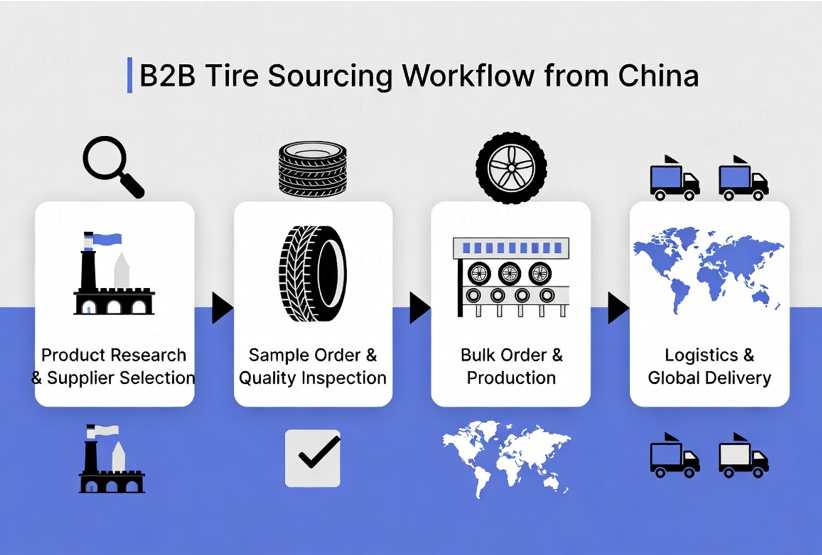
From a B2B operator’s perspective, getting Chinese tire sourcing right is less about a single “best brand” and more about repeatable process. Here is a step‑by‑step approach that works well for importers, marketplace sellers and regional distributors.
Step 1 – Define Your Product Map
1. List the top 20–50 tire sizes and patterns demanded in your target market (e.g., SUV sizes vs. small car sizes, TBR vs. PCR).
2. Group these into three tiers: entry‑level, core volume, and premium or specialty.
3. Decide where Chinese brands will play: some clients use Chinese tires for all three tiers; others combine Chinese mid‑range with global premium brands.
Step 2 – Match Segments to Chinese Brands
1. Assign 1–2 Chinese brands per tier based on strengths: for example, Linglong + ZC Rubber for mid‑range, Goodride + Wanli for entry‑level, Sailun for performance.
2. Verify availability of needed sizes and load ratings before finalizing the matrix.
3. Use supplier catalogs and platform filters (e.g., Global Sources, Alibaba, dedicated procurement platforms) to confirm SKUs.
Step 3 – Validate Suppliers and Certifications
1. Request documentation for DOT, E‑mark, CCC, ISO9001, ISO14001, and any local regulatory markers required in destination markets.
2. Check whether the manufacturer or exporter is part of recognized industry associations or has “verified supplier” status on major platforms.
3. Where volumes justify it, conduct third‑party inspections or factory audits, especially for truck, bus and OTR tires.
Step 4 – Pilot Orders and Performance Tracking
1. Start with pilot orders across a limited set of SKUs in each brand.
2. Monitor return rates, customer reviews and on‑road performance data over at least one season.
3. Use this data to adjust your brand mix, phasing out underperforming lines and expanding winners.
For online dropship models, integration with platforms like Looperbuy allows you to push new SKUs quickly and test response without locking up capital in inventory.
Building a Tire Assortment with Chinese Brands Through Looperbuy
From the perspective of an online B2B procurement platform, the goal is to provide reliable access to the most relevant Chinese brands while reducing the operational burden on overseas buyers. When I design assortments and procurement workflows for clients, the following elements typically drive success.
Inventory‑Light and Logistics‑Smart Strategy
– Use Chinese tire brands with proven export performance and stable production to underpin a dropship or low‑inventory model.
– Consolidate orders from multiple brands (e.g., Linglong, Triangle, Goodride) through a single platform to cut handling and documentation complexity.
– Rely on platform‑managed warehousing and logistics to reduce the need for overseas clients to manage container loads, domestic trucking or multi‑warehouse distribution themselves.
Data‑Driven Brand and SKU Selection
– Base brand choice on market data such as local vehicle parc, regional driving conditions and historical sales patterns rather than only unit price.
– Use platform analytics to track SKU performance in real time—click‑through, conversion, return and review metrics—to refine the Chinese brand portfolio continuously.
– Align promotional campaigns with the strongest performing categories, such as mid‑range SUV tires or popular truck sizes from well‑known Chinese manufacturers.
By combining these elements, B2B buyers can enjoy the cost advantages of Chinese tires while keeping operational risk and complexity under control.
Chinese tire brands today offer a powerful combination of scale, specialization and value that B2B buyers cannot ignore. By structuring your sourcing decisions around vehicle types, driving conditions, customer expectations and compliance, you can build a portfolio where Chinese tires support profitable growth instead of adding risk.
If you are planning your next sourcing cycle or building a new product line, start by mapping your top SKUs and identifying where Chinese mid‑range and budget brands can safely replace or complement existing suppliers, then work with a trusted B2B procurement platform to test and scale that brand mix without tying up capital in inventory.
FAQs about Chinese Tire Brands for B2B Buyers
Q1. Are Chinese tire brands suitable for long‑haul truck fleets?
Yes, several Chinese brands focus specifically on truck and bus segments, including Double Coin, Triangle, Longmarch and selected ZC Rubber lines, offering heavy‑duty casings, good load capacity and competitive tread life when correctly specified and maintained.
Q2. How can I manage quality risk when importing Chinese tires?
Choose manufacturers with recognized certifications, documented export performance and verified status on leading B2B platforms, then use pilot orders and performance tracking to validate real‑world quality before scaling.
Q3. Are budget Chinese brands safe for everyday passenger cars?
Budget brands like Goodride, Sunny, Landsail, Wanli and Joyroad are widely used for everyday driving; when sourced from reputable factories with proper certification and fitted to appropriate vehicles, they can offer safe, cost‑effective performance for typical urban and highway use.
Q4. How do I decide between mid‑range and high‑performance Chinese brands?
Base the decision on the target customer: mainstream drivers mainly value durability and comfort, which mid‑range brands provide, while enthusiasts and premium vehicle owners benefit more from performance‑focused brands like Sailun, Kinforest or Blacklion.
Q5. Can I build private‑label tires using Chinese manufacturers?
Many Chinese manufacturers support OEM and private‑label programs, especially in passenger car and light truck segments; you’ll need to agree on patterns, sidewall branding, packaging and minimum order quantities and ensure quality and certifications match your target markets.
References
1. Global Sources – “Top Chinese Tire Brands – The Rise of Chinese Tire Brands, Brand List and Comparison Chart.” [european-rubber-journal]
2. IndexBox – “China’s Tyre Market Report 2026 – Prices, Size, Forecast, and Insights.” [indexbox]
3. Delphy Group – “China Rubber Tire Output and Export Data, Q1 2024.” [delphygroup]
4. Qingdao Oxplo Tire – “China’s Giant Tires Navigate Global Waters: Export Scale and Market Share.” [qdoxplo]
5. Brand Finance via CITEXPO – “Tyres 25 Report – Fastest‑Growing Tire Brands and Chinese Brand Value Growth.” [citexpo.com]
6. Golden Star Tire – “Chinese Tire Brands and Their Market Impact – Overseas Performance and Rankings.” [goldenstartire]
7. Accio – “Tyre Import from China: Best Suppliers & Deals – Industry Zones and Supplier Evaluation Framework.” [accio]
8. Global tire procurement case materials – “About Us – SOURCE VALLEY International Co., Ltd.” [sourcevallytire]