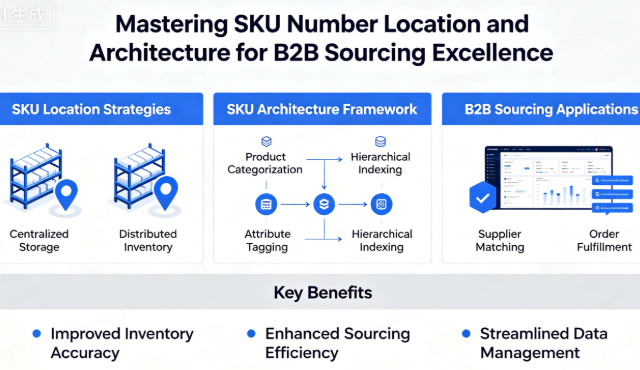
In the fast-paced world of global B2B sourcing, efficiency is the currency of success. Whether you are a brand owner sourcing high-volume components or a wholesaler managing diverse inventory, the ability to track, categorize, and locate products with precision is non-negotiable. At the heart of this operational discipline lies the SKU number location—not just as a physical tag, but as a strategic anchor in your digital inventory architecture.
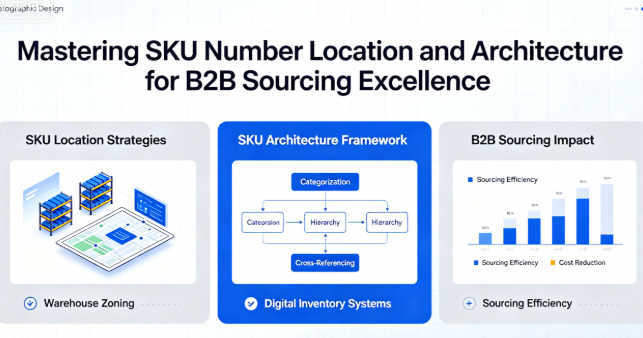
Stock Keeping Units (SKUs) are more than just alphanumeric strings; they are the DNA of your product catalog. When properly structured, they bridge the gap between global supply chain complexity and streamlined fulfillment. This guide explores the strategic importance of SKU architecture and how optimizing your system can transform your B2B sourcing operations.
Table of Contents
Understanding the SKU Architecture: Beyond the Basics
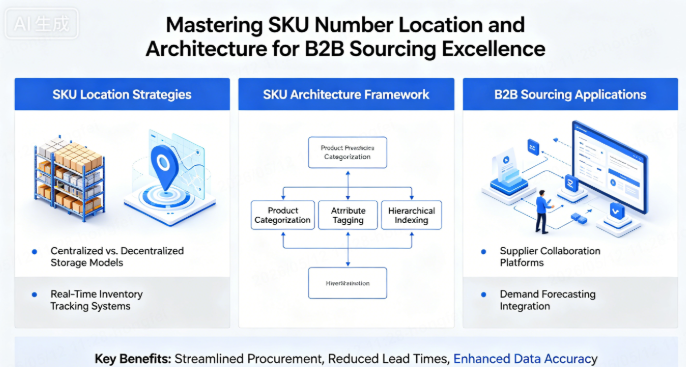
A SKU (Stock Keeping Unit) is a unique, company-specific alphanumeric code assigned to every product variant in your inventory. Unlike global identifiers like UPCs (Universal Product Codes) or GTINs, which are standardized and used externally, SKUs are internal identifiers 1.
- Personal/Expert Perspective: From a supply chain management view, SKUs are your primary language for “speaking” to your warehouse management system (WMS). If your SKU structure lacks logic, your warehouse team spends more time decoding than picking, which directly increases operational costs and decreases fulfillment velocity.
Why SKU Number Location Matters in Inventory Management
The term “SKU number location” can refer to two distinct concepts: where the code physically resides on packaging or a shelf, and, more importantly, how the code is structured to reveal the location or attributes of the item.
Strategically designed SKUs act as a map for your logistics team. By embedding critical data—such as warehouse zone, product category, or supplier code—into the string itself, you enable:
- Instant Identification: Staff can identify the product category and sub-category simply by reading the SKU prefix 1.
- Streamlined Picking: When the middle characters represent specific attributes (size, color, material), pickers can verify product variants without cross-referencing external databases.
- Reduced Errors: A well-structured SKU system acts as a built-in validation mechanism, reducing picking errors that plague high-volume B2B operations.
Optimizing Your SKU Strategy for B2B Success
To move beyond basic tracking, your B2B platform needs a robust architecture. Here is how you can refine your system for maximum impact:
1. Implement Logical Hierarchies
Avoid random numbering. Structure your SKUs from left to right, moving from general to specific information.
- Top-level identifier (Positions 1-3): Department or product category.
- Unique identifiers (Middle positions): Specific traits like material type, power capacity, or finish.
- Sequential identifier (Final positions): A simple numerical sequence (e.g., 001, 002) to differentiate versions 1.
2. Avoid Common Pitfalls
- No Special Characters: Avoid symbols (
/,@,&) or spaces, as these often cause technical errors in ERP systems or barcode scanners 1. - Limit “O” and “I”: These characters are easily confused with numbers “0” and “1” 1.
- Keep it Concise: While descriptive, don’t over-populate the SKU. Aim for 8-12 characters for optimal readability and technical compatibility 1.
Industry Insights: Data-Driven SKU Management
For B2B platforms like LooperBuy, the goal is to provide a seamless bridge between global manufacturers and buyers. Efficient SKU management allows us to offer granular insights into stock availability.
| Metric | Manual Management | Automated/System-Integrated |
|---|---|---|
| Data Accuracy | High risk of human error | Near-perfect consistency |
| Fulfillment Speed | Slower, requires manual verification | Rapid, automated picking paths |
| Scalability | Limited by staff capacity | Virtually unlimited |
| Inventory Insight | Lagging, fragmented data | Real-time visibility |
Actionable Steps for B2B Sourcing Efficiency
If you are scaling your business, you must transition from manual spreadsheets to automated inventory modules. Integrated platforms enable real-time tracking, ensuring that when you source from China via a B2B platform, the status of your goods is updated immediately upon entry into your system.
Pro Tip: Audit your SKU architecture quarterly. As your product range expands, your SKU logic should evolve to accommodate new categories without breaking the existing framework.
Conclusion
Mastering the SKU number location and its logical architecture is not just a technical task—it is a competitive advantage. By treating your SKUs as a strategic tool for logistics, forecasting, and inventory optimization, you empower your business to scale globally. For those looking to streamline their B2B sourcing, robust SKU management integrated with your platform is the bedrock of operational excellence.
References
- 1 Virtocommerce. (2021, December 4). What Is a SKU Number: How to Use SKU Codes to Boost Business. Retrieved May 12, 2026, from https://virtocommerce.com/blog/what-is-a-sku-number
Frequently Asked Questions (FAQ)
1. Is a SKU number the same as a UPC code?
No. A SKU is an internal, company-specific identifier, whereas a UPC (Universal Product Code) is a standardized, 12-digit global code used to identify products across different retailers 1.
2. How many characters should a SKU number be?
Ideally, a SKU should be between 8 to 12 alphanumeric characters. Keeping it within this range ensures compatibility with most scanning equipment and management software 1.
3. Should I include supplier information in my SKU?
Including a top-level identifier—such as a supplier or department code—in the first three characters of your SKU is a highly recommended practice for better inventory organization 1.
4. What are the benefits of automating SKU management?
Automation eliminates human error, provides real-time stock visibility, lowers inventory holding costs, and improves fulfillment speed by integrating directly with your POS or WMS 1.
5. How do I fix a confusing SKU system?
Start by standardizing your architecture: adopt a logical structure (category-attribute-sequence), remove all special characters, and migrate your data into an automated inventory management system to ensure consistency moving forward 1.
Summary:
This article provides an in-depth guide on SKU number location and architecture for B2B sourcing. It defines SKUs, distinguishes them from UPCs, offers practical advice for creating a logical SKU system, and highlights how B2B platforms like LooperBuy leverage these structures to enhance global inventory efficiency, fulfillment speed, and overall business scalability.
Hot tags: B2B sourcing platform, SKU management, inventory control software, supply chain optimization, global wholesale procurement, product identification codes, warehouse efficiency, B2B inventory tracking, SKU architecture, manufacturing sourcing solutions.
-700x490.jpeg)