Discover the 18 best dropshipping websites for U.S. sellers in 2026. Compare suppliers, U.S. fulfillment options, niche platforms, POD services, costs, returns, compliance, and sourcing strategies to build a reliable online store without holding inventory.
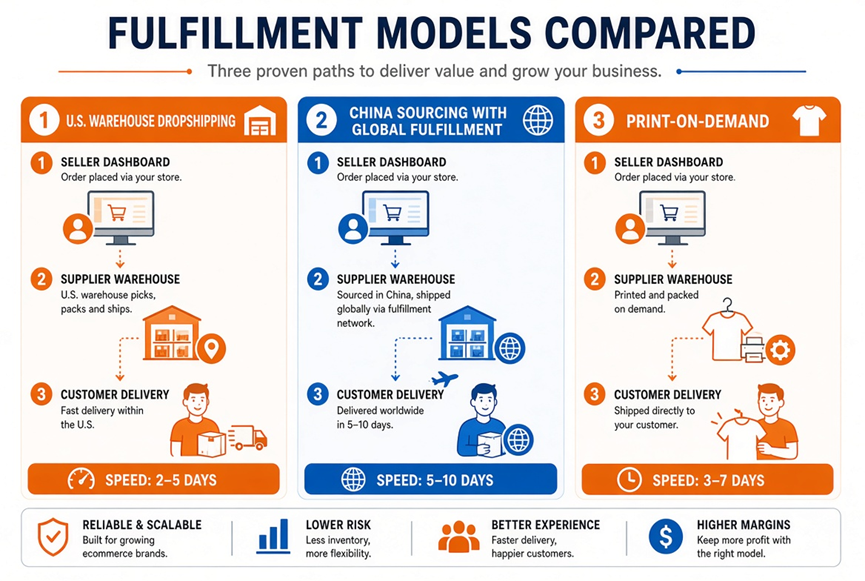
Choosing the right dropshipping supplier is no longer just about finding the lowest product price. For U.S.-focused sellers, the best dropshipping websites combine dependable fulfillment, accurate inventory, usable product data, clear return workflows, and tools that reduce the daily operational burden.
The opportunity remains substantial: U.S. retail e-commerce sales reached an estimated $326.7 billion in Q1 2026, up 9.7% year over year. But as the market grows, customers also become less forgiving of late delivery, vague tracking, and inconsistent product quality. This guide reviews 18 leading dropshipping websites and explains how to select suppliers that support sustainable growth—not just short-term product testing.
> Note: Platform features, pricing, product availability, fulfillment locations, and eligibility rules can change. Always verify current terms and place a sample order before adding a supplier’s products to your live store.
Table of Contents
Why Supplier Choice Determines Dropshipping Success
A supplier is part of your customer experience, even when customers never see its name.
They influence:
– Delivery speed and tracking reliability.
– Product quality and packaging consistency.
– Stock accuracy and backorder risk.
– Return handling and refund speed.
– Product margins after shipping, fees, ads, and returns.
– Brand perception after the first order arrives.
For many stores, the most expensive failures are not product costs. They are customer-service tickets, chargebacks, negative reviews, replacement shipments, and wasted ad spend on products that cannot be fulfilled reliably.
A U.S.-warehouse supplier can help shorten delivery routes for American customers. However, “U.S. supplier” and “U.S. warehouse” are not interchangeable. A platform may be headquartered in the United States while individual products ship from other countries. Confirm the fulfillment origin for each SKU, not simply the supplier’s company address.
Quick Comparison: 18 Dropshipping Websites
| Dropshipping Website | Best For | Key Advantage | Watch Out For |
| Spocket | Shopify and WooCommerce sellers | U.S. and EU supplier options, branded invoicing | Free plan limitations |
| SaleHoo | Supplier research | Vetted supplier directory and research tools | Directory and automation are separate products |
| DropCommerce | Premium product positioning | Curated North American brands | Smaller catalog than mass marketplaces |
| Syncee | Broad catalog sourcing | Large global supplier network and direct communication | Requires careful filtering by shipping location |
| Doba | Multi-channel sellers | Centralized catalog, integrations, inventory tools | Subscription-based service |
| Worldwide Brands | Direct wholesaler relationships | Certified directory and lifetime-access model | Manual supplier outreach and order handling |
| Zendrop | Branding-focused stores | Custom packaging and subscription options | Advanced features may require paid plans |
| Modalyst | Fashion and trend-led catalogs | Independent and established brands | Product limits and transaction fees on some plans |
| Trendsi | Women’s fashion | Fulfillment, returns, and product imagery support | Focused primarily on women’s apparel |
| Tasha Apparel | Boutique fashion | Los Angeles fashion wholesale selection | More manual workflow |
| FragranceX | Fragrance and beauty stores | Large catalog of established fragrance brands | Approval may be required |
| Fast Furnishings | Furniture and home goods | U.S. home-goods specialization | Manual ordering process |
| GreenDropShip | Natural and wellness categories | Large selection of natural and organic products | Membership cost |
| Essential Pet Products | U.S. pet-supply sellers | Broad pet product catalog | Program may be limited to U.S.-based sellers |
| Megagoods | Consumer electronics | Straightforward electronics distribution | Smaller range and limited automation |
| Printful | Premium print-on-demand brands | Reliable quality and integrations | Higher unit cost than some alternatives |
| Printify | Product variety and cost testing | Multiple print-provider choices | Quality can vary between providers |
| Shopify Collective | Shopify-native brand partnerships | Curated collaboration with other Shopify brands | Eligibility and ecosystem restrictions |
Best All-in-One Dropshipping Platforms
1. Spocket
Spocket is a practical option for sellers using Shopify or WooCommerce who want access to products from U.S. and European suppliers. Its main appeal is convenience: sellers can import products into their store and use features such as branded invoicing.
Best for: Stores where delivery speed and a more polished post-purchase experience matter.
Evaluate before committing: Check product-level fulfillment locations, shipping charges, and margins. A supplier network can include products shipped from multiple regions.
2. SaleHoo
SaleHoo is known for supplier discovery and market research. It suits sellers who prefer to research suppliers before committing to a catalog or who want to build long-term direct sourcing relationships.
Best for: Product researchers and sellers who want more supplier due diligence.
Evaluate before committing: SaleHoo’s supplier directory and its store-integration tools may be offered separately, so clarify which workflow you need before paying.
3. DropCommerce
DropCommerce positions itself around North American brands and premium product selection. This can be useful when a store wants to avoid competing on the lowest possible price.
Best for: Niche retailers building a curated, higher-value collection.
Evaluate before committing: A smaller catalog is not necessarily a disadvantage. It may improve quality control, but you should ensure the available range fits your niche and expansion plans.
4. Syncee
Syncee offers a wide supplier network and allows merchants to search for products across different markets. It can work well for stores that need category depth or want to compare several supplier options.
Best for: Sellers who need catalog breadth and supplier communication tools.
Evaluate before committing: Use fulfillment-location filters carefully. A large catalog becomes useful only when you can identify products that meet your delivery and margin standards.
5. Doba
Doba operates as a centralized dropshipping platform, giving sellers access to supplier catalogs while helping manage product discovery, order processing, and inventory synchronization. According to Doba’s guide, the platform integrates with more than 10 sales channels, including Shopify, Amazon, and TikTok, and provides product-discovery features such as AI Picker and curated product lists.
Best for: Sellers managing multiple channels or those who want to reduce manual supplier coordination.
Evaluate before committing: Review the subscription level, product costs, shipping terms, inventory update frequency, and whether its available catalog matches your intended category.
6. Worldwide Brands
Worldwide Brands is a supplier directory rather than a full automation platform. Sellers receive supplier contacts and then manage the commercial relationship directly.
Best for: Operators who value direct wholesaler relationships and can manage a more hands-on workflow.
Evaluate before committing: Confirm minimum order quantities, resale-document requirements, shipping terms, and whether each wholesaler truly supports individual-order fulfillment.
7. Zendrop
Zendrop appeals to sellers interested in custom packaging, private-label direction, or subscription-box models. Those features can be meaningful if your goal is repeat business and a distinctive brand experience.
Best for: Higher-volume sellers moving beyond generic product listings.
Evaluate before committing: Verify the exact fulfillment location and delivery expectations for the products you plan to sell. Branding features only add value when the underlying fulfillment is dependable.
8. Modalyst
Modalyst offers fashion-oriented and trend-driven products from a range of brands and independent suppliers.
Best for: Fashion stores that need visually differentiated merchandise.
Evaluate before committing: Review listing limits, transaction fees, product availability, and resale permissions. Fashion is seasonal, so stock consistency matters as much as catalog quality.
Best Niche Dropshipping Suppliers
9. Trendsi: Women’s Fashion
Trendsi focuses on women’s apparel and supports sellers with product imagery, fulfillment, and returns. For boutique stores, ready-to-use visuals can reduce launch time.
Best for: Women’s fashion boutiques that need a relatively simple operating model.
10. Tasha Apparel: Boutique Clothing
Tasha Apparel offers access to fashion goods associated with the Los Angeles wholesale market.
Best for: Boutique sellers comfortable with manual ordering in exchange for more distinctive fashion inventory.
11. FragranceX: Beauty and Fragrance
FragranceX provides a category-specific route into branded fragrances and beauty products.
Best for: Stores with a clear fragrance or beauty niche.
Important: Verify approval requirements, brand restrictions, shipping rules, and product-authenticity documentation before advertising branded products.
12. Fast Furnishings: Furniture and Home Goods
Furniture and home goods can produce higher average order values, but they also bring greater shipping, damage, and return complexity.
Best for: Home décor, outdoor-living, and furniture-focused stores.
Practical advice: Order a sample or inspect packaging specifications before running ads. For large items, one damaged shipment can erase the profit from several successful orders.
13. GreenDropShip: Organic and Natural Products
GreenDropShip offers products in categories such as natural, organic, and wellness goods.
Best for: Health-conscious, eco-focused, and specialty wellness stores.
Important: Avoid unsupported health claims. Ensure your product pages accurately reflect supplier documentation and applicable labeling requirements.
14. Essential Pet Products: Pet Supplies
Pet products can support repeat purchases, especially in consumable or accessory categories.
Best for: U.S.-based sellers building a focused pet-products store.
Evaluate before committing: Test product safety, packaging, and durability. Pet owners often make purchasing decisions based on trust, reviews, and repeat experience.
15. Megagoods: Consumer Electronics
Megagoods offers consumer electronics and gadgets through a relatively straightforward distribution model.
Best for: Sellers experienced with electronics product data and customer support.
Important: Electronics can create high support volume. Confirm warranty handling, compatibility information, return windows, and who pays for defective-item returns.
Best Print-on-Demand Websites
16. Printful
Printful is often selected by sellers prioritizing product quality, brand control, and a smooth integration experience.
Best for: Branded apparel, accessories, and merchandise businesses where print consistency matters.
Trade-off: Higher unit cost can reduce gross margin. Build pricing around product cost, shipping, platform fees, payment fees, returns, customer acquisition, and desired profit—not just the blank product price.
17. Printify
Printify provides access to multiple print providers, allowing sellers to compare product options and prices.
Best for: Merchants who want variety and are willing to test providers.
Non-negotiable step: Order samples from every provider you intend to use. The same design can look different depending on the garment, printer, placement, and production process.
18. Shopify Collective
Shopify Collective enables eligible Shopify merchants to collaborate with other brands and add selected products to their store.
Best for: Established Shopify stores that want complementary products from aligned brands.
Evaluate before committing: Confirm eligibility, product margin, partner communication, inventory synchronization, return responsibilities, and customer-support ownership.
How to Choose a Dropshipping Supplier
Do not choose a supplier based on catalog size alone. Use a structured evaluation process.
1. Verify the Actual Ship-From Location
Look at the product-level shipping details. Ask:
– Where is this specific SKU stored today?
– Which carrier will handle the shipment?
– Is tracking uploaded automatically?
– What is the normal processing time before dispatch?
– Does the shipping promise apply during seasonal demand spikes?
A sample order is the best reality check. It lets you assess packaging, tracking, delivery speed, product quality, inserts, and the final customer experience.
2. Calculate the Real Landed Cost
Use this formula before listing a product:
Landed Cost=Product Cost+Shipping+Platform Fees+Payment Fees+Expected Return Cost
Then compare the result with your planned selling price and advertising cost.
For example, a product that costs $18, ships for $7, and carries $4 in combined operating costs already has a $29 landed cost before advertising. Selling it for $39 may look profitable, but one return, discount, or paid acquisition cost can quickly eliminate the margin.
3. Review Returns Before You Launch
A clear return policy protects both your business and your customers. Confirm:
– The return address.
– The return window.
– Restocking fees, if any.
– Whether the supplier accepts damaged or defective returns.
– Who pays for return shipping.
– The refund timeline.
– Whether you, the platform, or the supplier handles customer messages.
Your store policy should never promise more than your fulfillment partner can deliver.
4. Test Inventory Synchronization
Overselling is one of the fastest ways to damage a new store. Check whether inventory updates occur in real time, at intervals, or manually. If updates are delayed, consider setting a stock buffer rather than publishing every available unit.
5. Check Support Before Problems Occur
Send a pre-sales question. Measure the clarity and speed of the response. Ask about a real operational scenario, such as an address change, a damaged order, or a stockout.
The supplier’s response during a quiet weekday often reveals how responsive it may be when an urgent customer issue arises.
Build a Supplier Scorecard Before Launching
A simple scorecard helps prevent emotionally driven product decisions. Score each supplier from 1 to 5 in these categories:
| Evaluation Area | What to Measure |
| Fulfillment reliability | Processing time, carrier quality, tracking accuracy |
| Product quality | Sample inspection, materials, packaging, defect rate |
| Margin potential | Landed cost, target selling price, promotional flexibility |
| Inventory accuracy | Stock-update frequency, backorder process |
| Return workflow | Return address, refund speed, damage policy |
| Integration quality | Order sync, inventory sync, product-data quality |
| Brand potential | Custom packaging, bundles, exclusive products, content assets |
| Support quality | Response time, clarity, escalation process |
Prioritize suppliers with reliable operations over those with the largest selection. A smaller catalog of well-tested products usually creates fewer customer-service issues and gives you more time to improve product pages, email flows, creative assets, and retention.
Compliance and Customer Expectations
Selling to U.S. customers requires more than connecting a product feed to a storefront.
Sales Tax
Sales-tax obligations can depend on where your business has physical or economic nexus, where your supplier has nexus, and where the customer receives the product. In dropshipping arrangements, responsibility can vary based on the specific transaction structure and whether the seller provides an appropriate resale certificate.
Because rules differ by state and business structure, work with a qualified tax professional or use a tax-compliance provider as your sales volume grows.
Shipping Promises
Do not advertise delivery times you cannot reasonably support. Under the FTC’s Mail, Internet, or Telephone Order Merchandise Rule, sellers need a reasonable basis for shipment within the advertised period; if no time is stated, the default expectation is generally within 30 days. When a seller cannot meet the promised timeframe, notification and refund or consent requirements may apply.
For sellers, the operational lesson is simple: base product-page delivery estimates on tested supplier performance, not best-case estimates.
Product Claims and Safety
Avoid copying exaggerated supplier copy into your product pages. Review product claims, materials, compatibility notes, warnings, certifications, and usage instructions. This is especially important for electronics, beauty, children’s goods, health-adjacent products, and pet products.
From Product Listing to Trusted Store
The best dropshipping business is not a random collection of trending products. It is a store with a clear customer, a consistent product selection, honest shipping expectations, and suppliers that can support the promise you make.
For global merchants sourcing from China, Looperbuy can help simplify the operational side of this model. Instead of purchasing large quantities upfront, sellers can source Chinese products, arrange fulfillment, and ship orders without managing their own warehouse, supplier payments, or international logistics workflow.
A practical starting approach is:
1. Choose one category with clear customer demand and manageable return risk.
2. Shortlist three to five suppliers or sourcing options.
3. Order samples and document actual delivery performance.
4. Create product pages using original, accurate descriptions and visuals.
5. Launch with a small product range.
6. Scale only the products that maintain margin, quality, and customer satisfaction.
Ready to source products from China without tying up capital in inventory? Explore Looperbuy’s product sourcing and dropshipping fulfillment services to build a more flexible, scalable supply chain.
Frequently Asked Questions
Is dropshipping still profitable in the U.S. in 2026?
It can be, but profitability depends on product selection, true landed cost, advertising efficiency, fulfillment reliability, and repeat-purchase potential. The strongest stores compete through niche expertise, customer experience, bundles, content, and brand positioning rather than price alone.
How do I know whether a dropshipping supplier ships from the United States?
Check the individual product listing for warehouse location, processing time, carrier, and delivery estimate. Then place a sample order. A supplier’s headquarters location does not prove that every product ships from a U.S. warehouse.
Should I use a U.S. supplier or source products from China?
Choose based on your customer promise and unit economics. U.S. fulfillment may support faster delivery and easier returns for U.S. customers. China sourcing can provide more product variety, customization opportunities, and competitive product costs. A sourcing and fulfillment partner such as Looperbuy can help sellers use China-based supply without holding their own inventory.
Do I need an LLC to start dropshipping?
Requirements depend on your country, sales channels, suppliers, banking setup, and local regulations. Many sellers begin as sole proprietors where permitted, but some suppliers may request business documentation, tax details, or resale certificates. Seek local legal and tax advice for your specific situation.
How can I reduce returns in a dropshipping store?
Order samples, use original photos where possible, write accurate size and compatibility information, display clear delivery estimates, publish a realistic return policy, and avoid overstating product features. Most preventable returns start with unclear expectations before checkout.
What is the best way to test a dropshipping product?
Test the complete buyer journey: place a sample order, inspect packaging and product quality, verify tracking notifications, time the delivery, test the supplier’s support response, calculate full landed cost, and review the return workflow before spending heavily on advertising.
References
1. Doba. “[18 Best Dropshipping Websites in the USA (2026 Guide)].” Supplier categories, platform features, selection considerations, and supplier descriptions. [doba]
2. U.S. Census Bureau. “[Quarterly Retail E-Commerce Sales Report].” U.S. retail e-commerce sales estimate for Q1 2026 and annual growth comparison. [census]
3. Avalara. “[What Is a Drop Shipper and How Does Drop Shipping Affect Sales Tax?].” Overview of sales-tax nexus and dropshipping tax considerations. [avalara]
4. Stripe. “[A Guide to Nexus and Sales Tax Nexus].” Explanation of nexus as the business connection that can create sales-tax collection and remittance duties. [stripe]
5. Efulfillment Service. “[What Is a Backorder? Meaning, Examples & How It Works].” Summary of FTC shipping-delay obligations and the Mail, Internet, or Telephone Order Merchandise Rule. [efulfillmentservice]