Learn the real difference between a global sourcing company and a manufacturer directory. Compare supplier verification, quality control, pricing, fulfillment, logistics, and risk management to choose the best China sourcing model for your B2B business.
Choosing between a global sourcing company and a manufacturer directory is one of the most important decisions a B2B seller can make when sourcing products from China. Both can help you locate suppliers, but they solve very different problems: a directory gives you supplier access, while a global sourcing company provides managed procurement execution.
For online B2B sellers, wholesalers, marketplace merchants, and dropshipping businesses, the distinction affects more than product price. It determines who verifies suppliers, manages samples, inspects quality, consolidates inventory, arranges shipping, handles payment risk, and responds when an order goes wrong. For businesses that want to reduce inventory, warehousing, payment, and logistics-management burdens, a sourcing partner such as Looperbuy can add operational value beyond supplier discovery.
Table of Contents
Global Sourcing Company vs Manufacturer Directory at a Glance
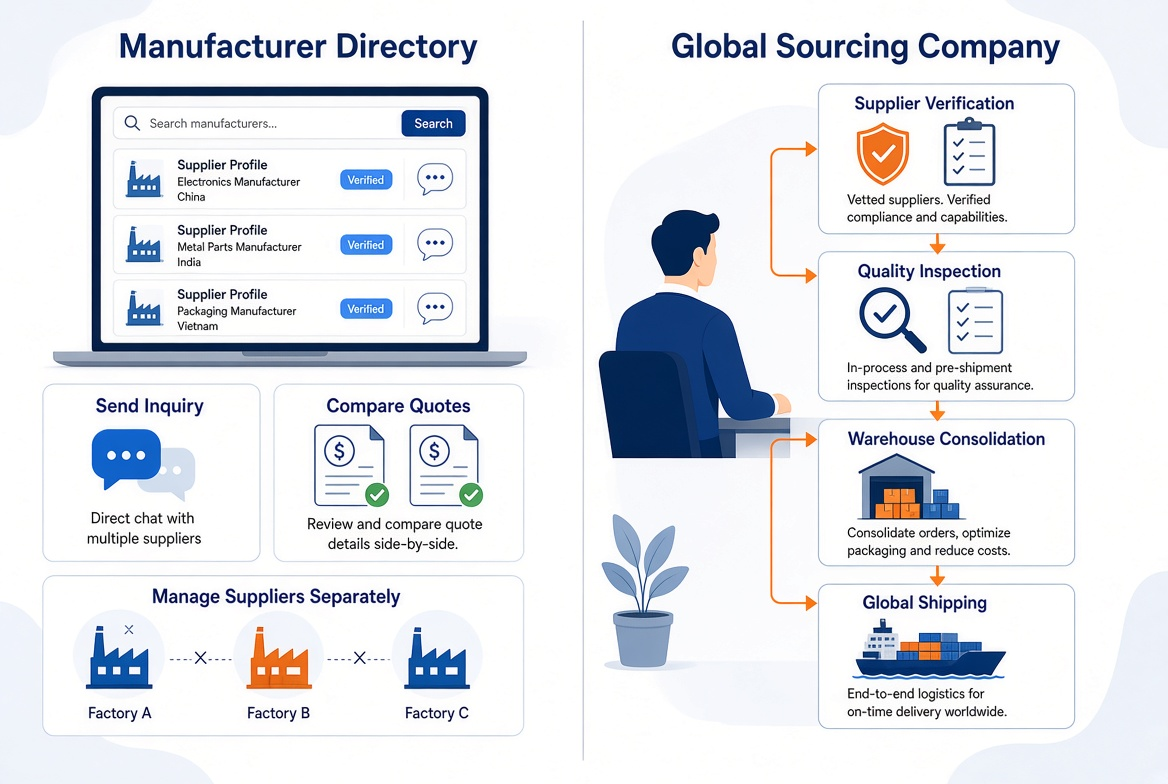
A manufacturer directory is primarily a searchable database or marketplace where buyers can discover factories, trading companies, wholesalers, and product listings. It helps you find potential suppliers.
A global sourcing company is a service provider that actively helps buyers source products and manage the process from supplier selection through shipment. Depending on the provider, this may include supplier research, quotation comparisons, negotiation, sample coordination, quality inspections, packaging, warehouse consolidation, and international fulfillment.
| Comparison Area | Global Sourcing Company | Manufacturer Directory |
| Primary function | Manages or supports the sourcing process | Helps buyers find supplier leads |
| Supplier discovery | Researches and recommends suppliers | Buyer searches supplier listings independently |
| Supplier verification | Often included or available as a service | Varies; buyer must conduct independent verification |
| Product negotiation | May negotiate prices, MOQs, packaging, and terms | Buyer negotiates directly |
| Quality control | Can arrange inspections and follow up on defects | Usually the buyer’s responsibility |
| Communication | Local or multilingual team may communicate with factories | Buyer communicates with suppliers directly |
| Warehousing and consolidation | Often available through sourcing and fulfillment partners | Usually not included |
| Shipping coordination | May manage freight, export paperwork, and tracking | Buyer arranges logistics or hires a separate forwarder |
| Best for | New importers, growing sellers, multi-SKU businesses, dropshippers | Experienced buyers with direct sourcing capabilities |
| Typical trade-off | Service fees or margin may apply | Lower intermediary cost, but higher internal workload and risk |
The core difference is simple: a directory is an information and supplier-discovery tool. A sourcing company is an execution and risk-management partner.
That distinction matters because global trade does not end when a buyer finds a factory. A sourcing decision also involves validating product specifications, confirming company identity, checking compliance documents, approving samples, controlling production quality, coordinating packing, and ensuring goods move reliably across borders.
UN Trade and Development notes that more than 80% of world trade by volume moves by sea, making international sourcing closely tied to transportation resilience, port capacity, route disruptions, and freight conditions.
What Is a Global Sourcing Company?
A global sourcing company helps businesses identify, evaluate, negotiate with, and manage suppliers in foreign markets. In practical terms, it becomes an extension of a buyer’s procurement team.
A capable sourcing partner does not simply send a list of Alibaba-style supplier links. It helps turn an initial product idea or requirement sheet into a controlled purchasing workflow.
Typical services provided
A global sourcing company may offer:
– Product and supplier research based on your target category, budget, quality level, and order quantity
– Factory screening to distinguish manufacturers from trading companies or unverified sellers
– Quotation comparison across multiple suppliers
– MOQ negotiation for test orders, private-label launches, or scaling brands
– Sample coordination and sample-quality review
– Product customization support, such as logo printing, colors, packaging, inserts, labels, or bundle configurations
– Production follow-up to reduce communication gaps and missed deadlines
– Quality inspection before shipment
– Warehouse consolidation for orders from multiple suppliers
– Dropshipping fulfillment or bulk shipping coordination
– Export and logistics support, including shipping options, documentation, and tracking
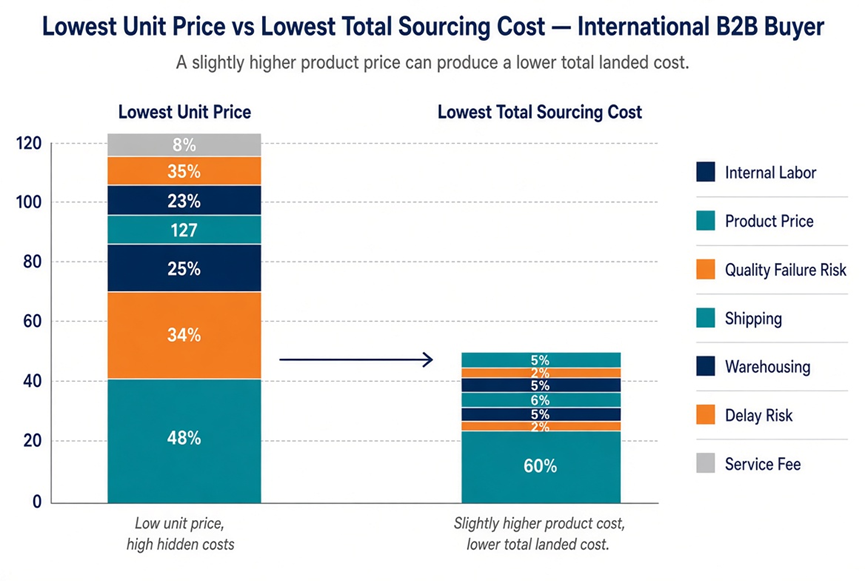
For a B2B seller, the value is not merely finding a lower quoted factory price. The value is reducing the total landed-risk cost of sourcing.
A supplier with a slightly higher unit price may still be the better choice if it delivers consistent quality, clear communication, correct packaging, stable production capacity, and fewer post-shipment issues.
The sourcing company’s role in real operations
Imagine a U.S.-based online merchant sourcing 15 different home-organization SKUs from China. If the merchant contacts factories directly, they may need to manage:
1. Fifteen supplier conversations
2. Fifteen separate quotation sheets
3. Different payment terms
4. Multiple sample shipments
5. Product inspections from different locations
6. Separate cartons and labeling requirements
7. Multiple supplier delivery dates
8. A consolidation warehouse
9. Freight booking
10. Customs and final-mile delivery coordination
A global sourcing company can centralize many of these steps. For sellers operating with limited staff, this can reduce the administrative load and help avoid holding unnecessary inventory.
What Is a Manufacturer Directory?
A manufacturer directory is an online platform that lists suppliers by product category, region, certifications, trade activity, minimum order quantity, manufacturing capability, or other filters.
Directories can be useful starting points for finding factories, exporters, and wholesalers. They are particularly valuable when a buyer already understands the product, knows how to evaluate suppliers, and has a procurement process in place.
What a manufacturer directory does well
Manufacturer directories are useful for:
– Finding a broad range of potential suppliers
– Comparing product categories and listed prices
– Reviewing supplier profiles, certifications, and export markets
– Identifying factories in a specific region
– Requesting quotations from multiple companies
– Researching niche or specialized manufacturing capabilities
– Building an initial supplier longlist
For example, an experienced buyer looking for stainless-steel fastener factories may use a manufacturer directory to locate suppliers by production region, material grade, certification, annual capacity, and export experience.
This self-service approach fits the wider direction of B2B buying. Buyers increasingly prefer independent research before engaging a sales representative, and 6sense reports that first supplier contact has moved earlier in the purchase journey, from about 69% of the journey in 2024 to 61% in 2025.
What a manufacturer directory does not automatically do
A directory profile should not be treated as complete supplier validation.
Even when a supplier has professional photos, certifications, product videos, a long platform history, or a “verified” label, the buyer still needs to confirm important details independently:
– Is the company the actual manufacturer or a trading company?
– Does the factory produce the specific product itself?
– Are listed certificates current and relevant to the product?
– Can the supplier meet your required quality standard?
– Is the quoted price based on the same specification and packaging?
– Does the supplier have stable export experience to your market?
– Can it meet labeling, testing, safety, or regulatory requirements?
– Is the quoted lead time realistic during peak season?
– What happens if the goods fail inspection?
The U.S. International Trade Administration recommends due diligence because carefully selecting foreign partners helps businesses reduce problems, losses, and liability.
The Real Difference: Discovery vs Execution
The easiest way to understand the global sourcing company vs manufacturer directory comparison is to separate the sourcing journey into two stages:
1. Finding suppliers
2. Managing suppliers and product delivery
A manufacturer directory is strongest in the first stage. A global sourcing company is designed to support both.
Manufacturer directory: You own the workflow
When you use a directory, you usually remain responsible for:
– Writing product specifications
– Filtering suppliers
– Verifying company information
– Reviewing certification claims
– Requesting and comparing quotes
– Negotiating prices and terms
– Managing samples
– Confirming production details
– Conducting factory audits or inspections
– Resolving quality issues
– Consolidating products
– Booking logistics
– Tracking shipping and customs progress
This model can work very well for established importers with dedicated sourcing managers, quality-control staff, local offices, or trusted freight-forwarding partners.
However, it can become expensive in hidden ways. The cost is often not only a bad supplier. It is the time spent on follow-up, product corrections, rework, delayed launches, fragmented shipments, and customer complaints.
Global sourcing company: You delegate selected tasks
When working with a sourcing company, you still make the major commercial decisions. You define the product, quality expectations, target market, budget, and brand requirements.
However, the sourcing partner can handle the operational work between your request and your shipment.
This is especially useful when:
– You are launching a product in a category you do not know well
– You need multiple product variations or suppliers
– You do not speak the supplier’s language
– You need private-label packaging or bundling
– You sell through online channels and need fulfillment flexibility
– You have small or medium order volumes
– You want to test products before committing to large inventory
– You want one point of contact for sourcing, storage, and shipping
For an online B2B platform such as Looperbuy, the advantage is most relevant when sellers want to source from China while reducing the operational burden of inventory holding, warehouse management, payment coordination, and logistics execution.
Cost Comparison: Unit Price Is Not the Whole Story
Many buyers assume direct factory sourcing through a manufacturer directory is always cheaper. Sometimes it is. But that comparison can be misleading if it looks only at the initial unit price.
A more useful calculation is:
Total Sourcing Cost=Product Cost+Service Cost+Quality Failure Cost+Shipping Cost+Inventory Cost+Internal Labor Cost+Delay Risk Cost
A manufacturer directory may reduce intermediary fees, but it can increase the buyer’s internal workload and exposure to costly mistakes. A sourcing company may add a visible service fee, but potentially reduce quality failures, shipping inefficiencies, communication delays, and warehouse duplication.
Example: A low-price supplier is not always low cost
Suppose Supplier A offers a product at $4.20 per unit, while Supplier B offers it at $4.50 per unit.
Supplier A appears cheaper. But Supplier A has inconsistent packaging, unclear lead times, and no reliable inspection arrangement. Supplier B has proven export experience, offers better packaging control, and delivers on schedule.
If Supplier A creates a 5% defect rate, forces a partial rework, or delays a sales campaign, the $0.30 unit-price difference may disappear quickly.
The best sourcing decision is rarely the lowest quote. It is the supplier and operating model that delivers the best combination of quality, reliability, speed, and total landed cost.
When Should You Use a Manufacturer Directory?
A manufacturer directory may be the better choice if your business has strong internal sourcing capabilities.
Choose a manufacturer directory when:
– You have an experienced procurement team
– You already know the exact product specifications
– You can evaluate factories independently
– You have reliable local inspection resources
– You can communicate directly with suppliers
– You have established freight, customs, and warehousing processes
– You are sourcing high volumes with predictable demand
– You want to build direct, long-term factory relationships
– You are comfortable managing supplier disputes yourself
For larger businesses, direct factory relationships can improve control and sometimes improve margins over time. It can also help when the product is technically complex and requires direct engineering communication.
However, direct sourcing is not automatically better simply because it removes an intermediary. The buyer must be prepared to take over the intermediary’s work.
When Should You Use a Global Sourcing Company?
A global sourcing company is usually the better model when you want to move faster, reduce sourcing complexity, or operate leanly.
Choose a global sourcing company when:
– You are new to sourcing from China
– You are testing a new product category
– You need help finding reliable suppliers
– You lack local factory-audit or inspection capability
– You source from multiple factories
– You sell online and need flexible fulfillment
– You want to avoid overstocking inventory
– You need product consolidation before shipping
– You need support with customized packaging or private labeling
– You need help coordinating international logistics
This approach is especially useful for cross-border merchants that want to sell products globally without building a large in-house China procurement team.
The World Bank’s Logistics Performance Index framework emphasizes customs, infrastructure, international shipment arrangements, logistics-service quality, tracking and tracing, and delivery timeliness as core logistics dimensions. In other words, supplier selection is only one part of successful cross-border sourcing.
How to Evaluate Either Option
Whether you use a sourcing company or a manufacturer directory, use a structured selection process.
Step 1: Define your sourcing requirements
Create a sourcing brief that includes:
– Product name and reference images
– Materials and technical specifications
– Product dimensions and tolerances
– Target quantity and reorder forecast
– Target price range
– Packaging requirements
– Branding and logo requirements
– Required certificates or compliance standards
– Destination market
– Delivery deadline
– Quality acceptance criteria
A vague request produces vague quotations. The more specific your brief, the easier it is to compare suppliers fairly.
Step 2: Build a shortlist, not a single option
Do not choose the first supplier that answers quickly.
Compare at least three viable options based on:
– Product expertise
– Factory versus trading-company status
– Quotation clarity
– MOQ flexibility
– Sample quality
– Communication speed
– Production lead time
– Quality-control process
– Export-market experience
– Payment terms
– Packaging capability
– Responsiveness to technical questions
Step 3: Validate claims before paying
Ask for evidence rather than relying only on profile statements.
Useful verification materials include:
– Business registration details
– Factory photos and live video walkthroughs
– Production-line videos
– Relevant certificates
– Product test reports
– Sample photos and physical samples
– Export references where appropriate
– Inspection reports
– Packaging specifications
– Written product and quality agreements
Step 4: Inspect before shipment
Pre-shipment inspection is one of the most practical controls in international procurement.
Confirm:
– Quantity
– Appearance
– Dimensions
– Material or component requirements
– Functionality
– Packaging
– Labels and barcodes
– Carton markings
– Random defect rate
– Product consistency against the approved sample
Step 5: Plan fulfillment before production ends
Do not wait until the goods are ready to decide where they will go.
Decide in advance whether products will be:
– Sent in bulk to your warehouse
– Consolidated with goods from other suppliers
– Shipped directly to B2B customers
– Used for dropshipping fulfillment
– Stored temporarily for staged fulfillment
– Distributed to multiple countries or sales channels
This is where an integrated sourcing and fulfillment partner can be particularly valuable.
Expert Insight: The Best Model Is Often Hybrid
The choice is not always either-or.
Many mature buyers use a hybrid sourcing model:
– Use manufacturer directories to discover the market and identify potential factories
– Use a sourcing company to verify suppliers, manage sampling, inspect products, consolidate goods, and coordinate shipping
– Build direct relationships with proven factories over time
– Retain external sourcing support for new categories, smaller orders, and multi-supplier fulfillment
This approach gives you the market visibility of a directory while reducing execution risk.
It also supports better supply-chain resilience. UNCTAD reported that disruptions around major maritime routes, including the Red Sea, Suez Canal, and Panama Canal, created rerouting, delays, and higher costs; by mid-2024, container-ship demand rose 12% because of diversions. Businesses that rely on international sourcing should therefore evaluate not only supplier price, but also shipping flexibility, inventory strategy, and fulfillment alternatives.
Final Verdict: Which Option Is Right for Your Business?
A manufacturer directory is a tool for finding suppliers. A global sourcing company is a partner for managing the sourcing journey.
If your company has sourcing expertise, quality-control systems, logistics resources, and enough time to manage suppliers directly, a manufacturer directory can give you broader access and greater direct control.
If you want to source Chinese products while reducing workload, avoiding unnecessary inventory, consolidating orders, improving quality visibility, and simplifying shipping coordination, a global sourcing company may offer better operational value.
For global B2B sellers, the right question is not simply, “Which option has the lowest product price?” The better question is:
> “Which sourcing model gives my business the best balance of product quality, speed, supply-chain visibility, customer experience, and total cost?”
Ready to simplify your China sourcing workflow? Work with Looperbuy to explore supplier sourcing, product purchasing, order consolidation, warehouse support, and global delivery options designed for B2B sellers that want to grow without carrying unnecessary operational complexity.
FAQ
1. Is a global sourcing company the same as a sourcing agent?
Not always, but the terms are closely related. A sourcing agent may focus on finding suppliers and negotiating with factories, while a global sourcing company may offer a wider range of services, such as supplier verification, quality inspection, warehousing, order consolidation, and international shipping coordination.
2. Are manufacturer directories safe to use?
Manufacturer directories can be useful, but they should not replace due diligence. Buyers should independently verify the supplier’s legal identity, manufacturing capability, certificates, product quality, communication reliability, and export experience before placing a major order.
3. Is it cheaper to buy directly from a manufacturer?
It can be cheaper on a unit-price basis, especially for high-volume, repeat purchases. However, direct buying may require more internal resources for supplier vetting, negotiation, inspection, freight coordination, customs, and problem resolution. Evaluate total sourcing cost, not just the factory quote.
4. Can a sourcing company help with dropshipping?
Yes. Some sourcing companies and B2B procurement platforms can help source products, consolidate inventory, store goods, fulfill individual orders, and coordinate shipping to end customers. Confirm service scope, handling fees, shipping destinations, order-processing times, and tracking availability before choosing a partner.
5. How do I know whether a Chinese supplier is a factory or a trading company?
Ask for the company’s business registration information, factory address, production-line photos or videos, product-specific manufacturing details, and relevant certifications. You can also request a video call, arrange a factory audit, or use a local sourcing partner to verify the facility.
6. What should I include in a supplier quotation request?
Include product specifications, dimensions, materials, colors, quantity, packaging, branding requirements, compliance needs, target destination, delivery date, expected order frequency, and the Incoterm you want quoted. Clear requests make supplier quotations easier to compare.
7. Should I inspect goods before shipping from China?
In most cases, yes. A pre-shipment inspection can help identify quantity shortages, defects, incorrect packaging, labeling problems, or deviations from the approved sample before the goods leave the factory. It is generally less expensive to solve problems before shipment than after arrival.
References
1. [UN Trade and Development (UNCTAD) — Review of Maritime Transport 2024].
3. [International Trade Administration — Perform Due Diligence].
4. [World Bank — Logistics Performance Index].
5. [World Bank DataBank — Logistics Performance Index Glossary].
6. [World Bank — Connecting to Compete 2023: Trade Logistics in an Uncertain Global Economy].