Discover the best countries for international product sourcing in 2026. Compare China, Vietnam, India, Mexico, Turkey, and more by product category, supplier capability, cost, logistics, lead time, and fulfillment flexibility. Build a resilient global sourcing strategy with practical supplier-selection steps.
Choosing the best countries for international product sourcing in 2026 is no longer simply a question of finding the lowest factory price. B2B sellers must balance product capability, supplier reliability, lead times, trade exposure, quality control, payment terms, and fulfillment flexibility. The strongest sourcing strategy often combines a primary production market with a backup country and a fulfillment model that prevents unnecessary inventory risk.
For global sellers, China remains the most versatile sourcing destination because of its unmatched supplier depth, product range, manufacturing clusters, and mature export ecosystem. At the same time, Vietnam, India, Mexico, Turkey, and several Southeast Asian markets have become important alternatives for category-specific sourcing and regional supply-chain diversification.
For a business using a purchasing and fulfillment partner such as Looperbuy, the goal is not to select one “perfect” country. It is to create a sourcing structure that gives you dependable products, manageable landed costs, lower inventory exposure, and a practical path to shipping orders globally.
> Expert viewpoint: The best sourcing country is the one that can repeatedly meet your product specification, minimum order requirements, compliance needs, replenishment speed, and end-customer expectations—not simply the one with the cheapest quotation.
Table of Contents
How to Choose a Product Sourcing Country
Before comparing countries, define what “best” means for your business. A country that performs well for private-label electronics may not be suitable for fashion accessories, handmade goods, heavy industrial components, or fast-moving e-commerce products.
A well-designed international sourcing decision should consider the following factors.
| Evaluation Factor | Why It Matters | Questions to Ask |
| Product specialization | Manufacturing ecosystems develop deep expertise in certain categories | Does the country have established factories for my exact product type? |
| Supplier availability | More qualified suppliers improve negotiation and backup options | Can I compare several credible factories instead of relying on one? |
| Cost structure | Unit cost is only one part of landed cost | What are the costs of materials, labor, packaging, shipping, duties, and defects? |
| MOQ flexibility | High minimum order quantities increase inventory pressure | Can I start with small batches, test products, or consolidate multiple SKUs? |
| Quality consistency | Product variation can cause returns, chargebacks, and brand damage | Does the supplier have clear quality-control processes and inspection options? |
| Logistics capability | Shipping reliability affects customer experience and cash flow | Are there efficient ports, air freight routes, warehouses, and export services? |
| Compliance readiness | Product rules vary by destination market | Can the supplier provide documentation, labeling, testing, and traceability where required? |
| Supply-chain resilience | Overdependence creates risk | Is there a backup supplier, region, or alternative material source? |
| Fulfillment compatibility | Sourcing is only half the operational challenge | Can products be stored, consolidated, labeled, packed, and shipped efficiently? |
The World Bank’s Logistics Performance Index evaluates trade logistics through factors including customs performance, infrastructure, international shipments, logistics competence, tracking, and timeliness. Its findings reinforce an important practical point: strong logistics systems can materially reduce uncertainty even when a country’s factory price is not the lowest.
Calculate Landed Cost, Not Factory Price
Many first-time buyers compare only EXW or FOB quotes. This creates avoidable surprises later. A lower product price can become expensive after freight, inspections, rework, storage, import duties, and returns are included.
Use this simplified landed-cost formula:
Landed Cost per Unit=(Product Cost + Packaging + Inspection + Freight + Duties + Handling)÷Saleable Units
For example, a supplier offering a product at $4.20 per unit may appear cheaper than a supplier offering it at $4.80. However, if the lower-priced option has higher defect rates, larger MOQs, inefficient packaging, and slower replenishment, its true cost can be substantially higher.
Match Country to Product Category
The most successful procurement teams source by category strength, not by broad country reputation.
– Electronics and accessories: China, Vietnam, South Korea, Taiwan, and Malaysia.
– Apparel and footwear: China, Vietnam, India, Bangladesh, Turkey, and Indonesia.
– Home goods and general merchandise: China, India, Vietnam, Turkey, and Indonesia.
– Jewelry and handmade products: India, China, Thailand, Turkey, and Indonesia.
– Automotive components and industrial supply: China, Mexico, Germany, Japan, South Korea, and Turkey.
– Furniture and décor: China, Vietnam, India, Indonesia, Poland, and Turkey.
– Beauty packaging and custom packaging: China, South Korea, Turkey, India, and selected European suppliers.
– Private-label e-commerce products: China is often the best starting point because of product variety, customization options, and supplier density.
China: Best Overall for Product Variety
China remains the leading choice for international product sourcing in 2026, particularly for businesses that need broad product selection, customized packaging, flexible supplier comparisons, and access to established export infrastructure.
China’s 2025 goods exports reached 26.99 trillion yuan, increasing 6.1% year over year, while total goods trade reached 45.47 trillion yuan. The scale is important because it reflects the depth of China’s commercial manufacturing and export network across consumer goods, machinery, components, household products, textiles, electronics, and packaging.
Why China Leads Global Sourcing
China’s biggest advantage is not merely low cost. It is manufacturing density. In many product categories, buyers can find material suppliers, component factories, assembly plants, packaging producers, printing providers, inspection services, freight forwarders, and export agents within connected industrial regions.
Key sourcing clusters include:
– Shenzhen and Dongguan: Consumer electronics, accessories, smart devices, cables, LED products, and hardware.
– Yiwu: Small commodities, fashion accessories, gift items, home products, party goods, and low-volume assortment buying.
– Guangzhou: Fashion, beauty products, handbags, footwear, personal-care packaging, and textiles.
– Foshan: Furniture, lighting, ceramics, building materials, and household items.
– Ningbo: Tools, stationery, home goods, small appliances, and export-oriented consumer products.
– Zhejiang: Hardware, socks, textiles, machinery, household products, and industrial components.
– Jiangsu and Shanghai region: Industrial goods, medical-related manufacturing, machinery, electronics, and high-value components.
China Is Best For
– Sellers testing multiple products and SKUs.
– Private-label businesses that need custom packaging, inserts, labeling, or product modifications.
– E-commerce merchants selling home goods, gadgets, accessories, beauty tools, toys, pet supplies, and lifestyle products.
– B2B buyers seeking factory comparisons in a concentrated supplier ecosystem.
– Merchants that need product consolidation from several suppliers before shipment.
– Companies that want to avoid holding large amounts of stock before demand is proven.
Considerations When Sourcing From China
China is not automatically the right answer for every product. Buyers must manage supplier verification, specifications, quality checks, intellectual-property precautions, shipping options, and product compliance for their target market.
A practical workflow is:
1. Define product specifications before requesting quotations.
2. Shortlist suppliers based on category expertise, export experience, and evidence of production capability.
3. Order samples from more than one supplier.
4. Confirm materials, dimensions, tolerances, packaging, branding, and labeling in writing.
5. Use pre-shipment inspection for larger orders or high-risk products.
6. Consolidate products where possible to reduce fragmented shipping costs.
7. Reorder based on proven demand instead of speculative stock.
For sellers who buy from multiple Chinese factories, a sourcing and fulfillment partner can simplify the process by helping with purchasing, quality checks, storage, consolidation, repacking, labeling, and global order fulfillment.
Vietnam: Best for Export Manufacturing Growth
Vietnam has become one of the most important sourcing countries for businesses looking to diversify production in Asia. It is especially strong in electronics assembly, apparel, footwear, furniture, textiles, and selected consumer goods.
Vietnam’s exports reached approximately US$475 billion in 2025, with processed industrial products representing 88.7% of export value. Electronics, machinery, footwear, textiles, and wood products continue to play major roles in its export economy.
Vietnam Is Best For
– Apparel, sportswear, footwear, and textile-based products.
– Furniture, wood products, and home décor.
– Electronics assembly and established technology supply chains.
– Buyers diversifying part of their China-dependent production.
– Brands with larger, more stable order volumes.
– Companies with clear quality standards and predictable production schedules.
Vietnam’s Strengths and Limits
Vietnam offers strong export orientation and growing manufacturing capability. However, its supplier ecosystem is generally less broad than China’s for highly customized, low-volume, or niche product development.
In practical terms, Vietnam can be a powerful second source for established products. It may be less convenient for a merchant who wants to test ten different product ideas with very small order quantities.
Best strategic use: Source repeatable, stable-volume product lines from Vietnam while using China for rapid prototyping, accessory sourcing, packaging, product development, and multi-SKU consolidation.
India: Best for Textiles, Crafts, and Specialized Goods
India is a strong option for businesses sourcing products with labor-intensive craftsmanship, textile expertise, natural materials, or distinctive design character. It has a large manufacturing base and is especially relevant for buyers who want product differentiation rather than standardized mass-market goods.
India Is Best For
– Cotton textiles, bedding, towels, and home furnishings.
– Leather goods, bags, footwear, and accessories.
– Jewelry, gemstones, silver products, and fashion accessories.
– Handmade décor, artisan products, candles, and gifts.
– Organic or natural-fiber product categories.
– Pharmaceutical and selected chemical-related supply chains for qualified buyers.
Why India Can Create Brand Differentiation
Many merchants compete on price alone. India can be more valuable when a brand needs a story-led product assortment—for example, handwoven textiles, artisan décor, sustainable-fiber goods, or jewelry with distinctive materials.
However, buying teams should be especially disciplined about sample approval, production timelines, quality specifications, color consistency, and shipping documentation. Handmade and labor-intensive production can create variation. That is not always negative, but it must be anticipated and communicated properly.
Practical Sourcing Advice for India
– Request production samples, not only showroom samples.
– Define acceptable tolerances for size, color, finish, and materials.
– Allow more buffer time for handcrafted or seasonal products.
– Check whether materials and dyes meet destination-market requirements.
– Build a supplier scorecard after each order to assess quality, responsiveness, and delivery performance.
Mexico: Best for North American Nearshoring
Mexico is a strategic sourcing location for sellers and importers serving the United States and Canada. Its geographic proximity, North American production links, and manufacturing strength make it particularly relevant for companies prioritizing shorter transit times and regional resilience.
Mexico’s exports have been increasingly led by machinery, electrical equipment, transportation equipment, automotive components, and industrial manufacturing. Manufacturing represented 85.5% of Mexican exports in 2023, according to analysis based on INEGI data.
Mexico Is Best For
– Automotive components and industrial products.
– Appliances, electronics assembly, and electrical equipment.
– Heavy or bulky goods that are expensive to ship from Asia.
– Products for fast replenishment into the U.S. market.
– Brands requiring closer factory collaboration and regional supply continuity.
– Buyers who benefit from North American trade arrangements, subject to product-specific rules.
When Mexico Is Worth the Higher Unit Cost
Mexico may have a higher factory cost than some Asian markets. Yet it can be commercially attractive when freight is expensive, replenishment urgency is high, or products are heavy and bulky.
Consider Mexico for products such as:
– Furniture components.
– Industrial tools.
– Automotive accessories.
– Large appliances.
– Construction-related products.
– Custom parts with short lead-time requirements.
The sourcing decision should compare total lead time, not just ocean transit. This includes sampling, production, port handling, customs clearance, inbound delivery, and the cost of running out of stock.
Turkey: Best for Europe-Focused Supply
Turkey is a valuable sourcing country for companies selling into Europe, the Middle East, and nearby markets. It has well-developed capabilities in textiles, apparel, footwear, home textiles, ceramics, furniture, food-related products, and selected industrial sectors.
Turkey Is Best For
– Fast-fashion and mid-market apparel.
– Towels, bedding, home textiles, and textile accessories.
– Ceramics, tableware, tiles, and decorative household items.
– Leather goods, shoes, and fashion accessories.
– Furniture and interior-related products.
– Buyers that value shorter transport routes to European customers.
Turkey can be particularly useful when brands require faster production cycles than long-distance Asian sourcing can offer. Its regional position supports shorter delivery times into Europe, although cost comparisons should include currency movements, duty treatment, freight, and capacity availability.
Other Sourcing Countries to Watch
No sourcing map is complete without acknowledging several highly capable specialist markets.
| Country | Strong Product Categories | Best Fit |
| South Korea | Cosmetics, skincare packaging, electronics, beauty devices | Premium beauty and technology products |
| Taiwan | Electronics, components, machinery, bicycles, precision manufacturing | Quality-sensitive technical products |
| Thailand | Food products, rubber goods, automotive parts, beauty, homeware | Southeast Asia diversification |
| Indonesia | Furniture, rattan goods, footwear, textiles, home décor | Natural materials and lifestyle products |
| Malaysia | Electronics, medical devices, rubber products, components | Regulated or technical product categories |
| Bangladesh | Apparel and basic garments | High-volume garment sourcing |
| Poland | Furniture, appliances, industrial products, European manufacturing | EU-focused distribution and quality control |
| Germany | Machinery, industrial components, premium engineering goods | High-specification B2B procurement |
The World Trade Organization’s merchandise-trade datasets provide a useful starting point for comparing countries by product categories and trade flows. However, trade volume alone should not determine your sourcing choice. A country can be a major exporter while still being unsuitable for your MOQ, quality, customization, or fulfillment requirements.
The Best Country by Sourcing Goal
The following framework helps buyers make a faster initial decision.
| Your Main Goal | Best Starting Countries | Why |
| Broad product selection | China | Deep supplier base across nearly every consumer and industrial category |
| Low-MOQ product testing | China | Large number of wholesalers, factories, trading companies, and consolidation options |
| Custom private-label products | China, South Korea, Turkey | Strong packaging, customization, and product-development capabilities |
| Apparel and footwear | Vietnam, China, India, Bangladesh, Turkey | Strong textile and footwear ecosystems |
| Handmade or natural-material goods | India, Indonesia, Turkey | Artisan production and distinctive material options |
| U.S. replenishment speed | Mexico, United States | Regional supply and shorter delivery routes |
| European replenishment speed | Turkey, Poland, Germany | Proximity to major European markets |
| Electronics and components | China, Vietnam, Taiwan, South Korea, Malaysia | Mature technology and component ecosystems |
| Furniture and home décor | China, Vietnam, India, Indonesia, Turkey, Poland | Broad capability from mass-produced to artisan styles |
| Premium beauty and cosmetics | South Korea, China, Japan | Advanced beauty manufacturing and packaging ecosystems |
Build a More Resilient Sourcing Model
The strongest international sourcing model in 2026 is rarely based on one supplier, one country, or one shipping route. Supply disruptions, changing demand, seasonal capacity constraints, product quality issues, and freight volatility can expose businesses that depend on a single channel.
A Three-Layer Sourcing Strategy
Consider organizing your supply chain into three layers:
1. Core sourcing country
Use this location for your main products, strongest supplier relationships, and repeatable high-volume SKUs.
2. Secondary sourcing country
Develop alternatives for critical items or categories with high sales velocity. This creates a contingency option if your core supplier experiences delays or capacity problems.
3. Flexible fulfillment layer
Use purchasing, storage, consolidation, order processing, and shipment support to avoid sending every product directly from every supplier to every customer.
For many global online sellers, China can serve as the core product-discovery and sourcing market, while Vietnam, India, Mexico, or Turkey provide category-specific diversification. A fulfillment partner can then reduce operational complexity by consolidating products, checking orders, managing packaging requirements, and shipping to international customers as orders are placed.
Why Inventory Flexibility Matters
Inventory can be one of the most expensive hidden costs in a growing e-commerce business. It ties up cash, creates storage fees, increases the risk of dead stock, and can force discounting when demand changes.
A flexible sourcing and fulfillment model can help merchants:
– Test new products before committing to large inventory purchases.
– Combine items from several suppliers into one customer order.
– Store fast-moving items closer to the fulfillment process.
– Reduce repetitive international parcel shipping from separate factories.
– Add branded inserts, custom packaging, or labels before dispatch.
– Improve visibility over incoming stock and outgoing orders.
– Replenish based on actual demand rather than assumptions.
> Industry insight: A lower inventory commitment often improves cash-flow resilience more than a small reduction in unit cost.
A Practical Supplier Selection Process
Country selection brings you to the right market. Supplier verification determines whether the sourcing project succeeds.
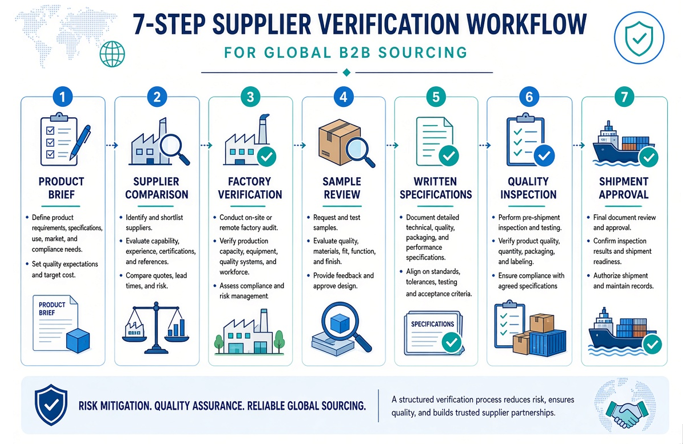
Use this seven-step process before placing meaningful volume.
1. Write a product brief
Include materials, dimensions, colors, performance standards, packaging, branding, target price, required documentation, and acceptable defect thresholds.
2. Compare multiple suppliers
Avoid making a decision based on the first attractive quotation. Compare production capability, communication quality, sample quality, lead time, and commercial terms.
3. Validate supplier capability
Ask for relevant production photos, factory information, product catalogs, export-market experience, certifications where relevant, and references or transaction history when available.
4. Order samples strategically
Evaluate more than appearance. Test packaging strength, functionality, fit, finish, materials, labels, durability, and customer-facing presentation.
5. Create a written specification sheet
Verbal agreements create disputes. Confirm product requirements in a clear document that both parties can follow.
6. Use inspections for higher-risk orders
Pre-shipment checks can identify defects, missing quantities, incorrect packaging, and specification deviations before goods leave the factory.
7. Start with a controlled order
Scale after the supplier demonstrates consistent quality, on-time delivery, and reliable communication.
Frequently Asked Questions
1. Which country is best for international product sourcing in 2026?
China is the best overall country for international product sourcing when you need broad product variety, competitive manufacturing, customization, supplier choice, and flexible purchasing options. However, Vietnam, India, Mexico, and Turkey can be better choices for specific categories, regional delivery needs, or diversification goals.
2. Is China still good for sourcing products in 2026?
Yes. China remains highly competitive because of its extensive supplier networks, manufacturing clusters, export infrastructure, packaging services, and ability to produce both standardized and customized goods. It is especially useful for private-label sellers, multi-SKU stores, and businesses testing products at controlled volumes.
3. What is the best country for sourcing clothing and textiles?
Vietnam, China, India, Bangladesh, and Turkey are major sourcing choices for clothing and textiles. Vietnam is strong for export-oriented apparel and footwear, India is ideal for cotton textiles and artisan products, Turkey supports European-focused fashion supply, and China offers extensive fabric, accessory, packaging, and garment-manufacturing options.
4. Which country is best for sourcing products for the U.S. market?
Mexico is often attractive for U.S.-focused businesses that need faster replenishment, industrial products, automotive components, bulky goods, or regional production. China can still be the better option for broad product selection, private-label customization, and lower-volume product testing.
5. How can I reduce sourcing risk when buying from overseas suppliers?
Reduce risk by comparing multiple suppliers, ordering samples, documenting specifications, checking product quality before shipment, avoiding overly large initial orders, and building backup supply options. You should also calculate landed cost rather than relying only on factory price.
6. Should I source from more than one country?
Yes, especially when you rely on a small number of high-volume products or sell into volatile markets. A multi-country approach can reduce disruption risk, but it should be managed carefully. Start with a strong primary supply base and add alternatives only where they provide clear commercial value.
7. Can a sourcing and fulfillment partner help reduce inventory costs?
Yes. A capable partner can support purchasing, supplier coordination, product consolidation, storage, repacking, labeling, quality checks, and order fulfillment. This can help sellers avoid purchasing excessive inventory before they understand real market demand.
Make Sourcing Work for Your Business
The best countries for international product sourcing in 2026 depend on your product category, customer location, desired order size, compliance needs, and growth stage. China remains the most flexible all-round sourcing market. Vietnam, India, Mexico, and Turkey strengthen a diversified strategy when their category expertise or geographic advantages match your business requirements.
If you sell globally and want to source Chinese products without carrying unnecessary stock, managing multiple suppliers, or handling each fulfillment step yourself, Looperbuy can help centralize purchasing, product consolidation, quality coordination, storage, and international order fulfillment. Start with a focused product brief, validate suppliers through samples, and scale only after real demand proves the opportunity.
References
1. World Bank. [Logistics Performance Index].
2. World Bank. [Connecting to Compete 2023: Trade Logistics in an Uncertain Global Economy].
3. World Trade Organization. [Statistics on Merchandise Trade Dataset].
4. General Administration of Customs of the People’s Republic of China. [China Customs Statistics].
5. State Council Information Office of the People’s Republic of China. [China’s Imports and Exports in 2025].
6. UN Trade and Development. [World Investment Report 2025].
7. Vietnam National Statistics Office. [Import and Export Statistics].
8. Vietnam Briefing. [Vietnam’s Economy in 2025: GDP, FDI, and Trade].
9. BBVA Research. [Nearshoring and Export Diversification in Mexico].
10. Mexico Projects. [Nearshoring in Mexico].