Product quality issues are one of the biggest risks in B2B dropshipping, especially when sellers source from overseas suppliers and ship directly to customers. This guide explains how to prevent defects, inspect products, manage supplier accountability, respond to customer complaints, reduce transit damage, and build a reliable refund and replacement process. Learn practical quality-control strategies for China sourcing, global fulfillment, and scalable B2B dropshipping operations.
Product quality issues in B2B dropshipping can quickly damage customer trust, increase refund costs, and weaken your brand’s long-term profitability. The most effective approach is not simply reacting to complaints—it is building a repeatable quality-control system that prevents defective, incorrect, damaged, or inconsistent products from reaching your customers in the first place.
For B2B sellers sourcing from China, quality management should cover the entire order lifecycle: supplier selection, pre-launch sampling, product specifications, inspection, packaging verification, shipping evidence, customer communication, and supplier accountability. A reliable sourcing and fulfillment partner such as Looperbuy can help sellers centralize these steps while avoiding the inventory, warehousing, payment, and logistics-management burden of traditional wholesale purchasing.
Table of Contents
Why Product Quality Issues Matter in B2B Dropshipping
In a conventional wholesale model, a seller may inspect a full shipment before sending products onward to customers. In B2B dropshipping, the process is different: suppliers or fulfillment partners often ship individual orders directly to end buyers. That makes quality problems harder to catch after an order leaves the warehouse.
A product defect is not just a sourcing problem. It can become a customer-service, payment-dispute, logistics, legal-compliance, and reputation-management issue.
Common B2B dropshipping quality issues include:
– Wrong product variants, such as incorrect color, size, plug type, material, or model.
– Manufacturing defects, including broken components, poor stitching, loose parts, leaks, scratches, or incomplete assembly.
– Inconsistent quality between the approved sample and later production batches.
– Misleading product specifications, such as inaccurate dimensions, capacity, weight, material claims, or compatibility information.
– Poor packaging, which may cause damage during international transit.
– Missing accessories, manuals, adapters, replacement parts, or branded inserts.
– Unsafe or non-compliant products, particularly in categories such as electronics, children’s goods, cosmetics, food-contact items, and personal protective equipment.
– Shipping-related damage, including crushed cartons, moisture exposure, breakage, or label errors.
For sellers, the commercial impact often extends beyond the cost of a refund. A poor-quality delivery can lead to negative reviews, lost repeat orders, chargebacks, marketplace penalties, and a lower conversion rate on future product pages.
Shopify recommends ordering product samples because they allow sellers to assess product quality, packaging, supplier communication, processing, and the real fulfillment experience before selling at scale. It also suggests ordering multiple samples under different names to test consistency rather than relying on a single successful order.
The Core Principle: Prevent Before You Compensate
The strongest way to handle product quality issues in B2B dropshipping is to make prevention part of your sourcing workflow.
Many sellers make the mistake of treating quality control as a final inspection step. In reality, quality begins before the product is listed in your store. If the specification is vague, the supplier is unverified, the sample is not approved, or packaging expectations are unclear, inspection alone cannot fully protect the order.
A practical quality-management system has five layers:
| Quality-Control Layer | Main Goal | Key Action |
| Product selection | Avoid high-risk products | Choose products with clear specifications and stable supply |
| Supplier verification | Reduce sourcing uncertainty | Review capabilities, communication, quality processes, and references |
| Sample approval | Validate the actual product | Test materials, function, packaging, and customer experience |
| Pre-shipment inspection | Catch errors before dispatch | Check quantity, variant, condition, accessories, and labels |
| Complaint resolution | Protect customer relationships | Respond quickly, document evidence, and prevent recurrence |
The best customer complaint is the one that never occurs. However, when a problem does occur, the seller must respond with speed, transparency, and a documented resolution process.
Start With a Clear Product Quality Standard
A supplier cannot consistently meet a standard that has never been clearly defined. Product titles, listing photos, and informal chat messages are not enough. Before you begin selling, create a simple but detailed Product Quality Standard Sheet for every important SKU.
This document should describe exactly what an acceptable product looks like and what defects are unacceptable.
What to include in a quality standard sheet
– Product name and SKU.
– Product photos from multiple angles.
– Material requirements.
– Color reference or Pantone code, when relevant.
– Dimensions, tolerances, and unit measurements.
– Weight range.
– Functional requirements.
– Required accessories and components.
– Packaging type and carton protection requirements.
– Barcode, label, and shipping-mark requirements.
– Logo, insert card, or branded packaging requirements.
– Acceptable minor defects.
– Critical defects that require rejection.
– Required inspection photos or videos before shipment.
For example, if you sell rechargeable desk lamps, “works properly” is too vague. A better standard would specify the charging port type, battery capacity, brightness modes, included cable, plug standard, color, scratch tolerance, packaging drop protection, and whether the product must be tested before dispatch.
This level of clarity reduces disputes between the seller, sourcing agent, fulfillment warehouse, and supplier.
Order Samples Before Listing Any Product
A product can look excellent in a supplier’s catalog but fail in real use. Images may hide material quality, weak construction, poor packaging, inaccurate sizing, unpleasant odors, low battery performance, or a mismatch between the advertised and delivered item.
That is why sample testing should be mandatory for products that will represent your brand.
When evaluating a sample, do not only ask, “Is this product acceptable?” Ask, “Would a customer feel the product matches the price and promise on my website?”
A practical sample-testing checklist
1. Inspect the product visually.
Check finish quality, color consistency, logos, seams, scratches, print alignment, and material feel.
2. Test the core function.
Turn on electronic products, test moving parts, verify connections, check waterproof claims where appropriate, and confirm compatibility.
3. Measure key specifications.
Compare actual dimensions, weight, capacity, and other specifications against the product listing.
4. Review the packaging.
Examine inner protection, external carton strength, label accuracy, and whether the package is suitable for international shipping.
5. Check all accessories.
Confirm that every promised item is present, including manuals, screws, cables, adapters, batteries, and replacement parts.
6. Assess the unboxing experience.
Consider what the final buyer sees first. Is the product clean, protected, correctly packed, and aligned with your brand position?
7. Test delivery performance.
Track how long the sample takes to arrive, how clearly shipping updates are communicated, and whether the delivered package matches expectations.
Shopify’s supplier guidance emphasizes that samples help sellers evaluate actual quality and shipping experience, while manufacturer-selection guidance recommends keeping approved samples as a quality reference for future production.
Use a “golden sample”
After you approve a product, keep a signed, dated, and photographed reference unit. This is often called a golden sample.
Your golden sample becomes the benchmark for future inspections. If a later order differs from the approved material, dimensions, finish, color, accessory set, or packaging, you have a documented standard for escalation.
For higher-volume or higher-risk products, keep:
– One sample at your office.
– One sample with your sourcing or fulfillment partner.
– High-resolution photos and video records.
– A digital specification sheet linked to the SKU.
Choose Suppliers Based on Reliability, Not Just Price
Low unit cost can be attractive, but the cheapest supplier is often expensive once refunds, reshipments, chargebacks, and lost customer trust are included.
A supplier should be evaluated based on its ability to deliver consistent quality at scale, not simply its ability to send one good sample.
Supplier questions B2B sellers should ask
– What is your normal defect rate for this product?
– What quality checks do you perform before shipment?
– Can you provide current factory, warehouse, or product-inspection photos?
– How do you handle defective units?
– Can you maintain the same material and component standard across repeat orders?
– What happens if a component becomes unavailable?
– Can you provide product certifications when required?
– How quickly do you notify partners about stock changes or production delays?
– Can you support customized packaging, labeling, or inserts?
– What is your replacement or compensation policy?
A reliable supplier should provide direct, specific answers. Vague replies such as “quality is guaranteed” are not enough. Ask for proof: inspection records, production images, certification documents where applicable, prior customer references, or test reports.
When working with a China sourcing and fulfillment partner, request a clear explanation of its supplier-screening process, inspection scope, photo or video evidence options, and escalation policy. A platform should make it easier—not harder—to identify who is responsible when product quality fails.
Build an Inspection Process for Every Order
Not every product requires the same inspection intensity. A low-cost, low-risk accessory may need a basic visual and quantity check. A fragile, branded, electrical, customized, or high-ticket product may require a more thorough inspection.
The goal is to match inspection effort to the financial and reputational risk of the SKU.
Three inspection levels for dropshipping orders
| Inspection Level | Best For | Typical Checks |
| Basic check | Low-value, stable, low-risk items | SKU, quantity, color, obvious damage, shipping label |
| Standard check | Most consumer products | Appearance, accessories, dimensions, packaging, basic function |
| Enhanced check | Electronics, fragile goods, customized products, premium items | Functional testing, detailed photos/video, branding, packaging strength, compliance documentation |
For example, a standard inspection for a kitchen organizer could include the correct color, item count, visible scratches, dimensions, and packaging condition. An enhanced inspection for a wireless device should also include power-on testing, charging verification, button functions, cable type, battery or electrical labeling, and accurate plug configuration.
Use photo and video evidence
Visual records are valuable for both prevention and dispute resolution. Before dispatch, ask for evidence such as:
– Product front, back, and side photos.
– Close-up photos of labels, color, logo, and accessories.
– Photos of the item inside its packaging.
– Photos of the shipping label and carton.
– Short functional video for relevant products.
– Weight or measurement photos for high-dispute SKUs.
This evidence can help you confirm the order before shipping. It can also help distinguish whether a later complaint resulted from a warehouse error, supplier defect, carrier damage, or customer misunderstanding.
How to Respond When a Customer Reports a Quality Problem
Even the best sourcing system cannot eliminate every defect. What separates a trusted seller from an unreliable one is how the seller responds when something goes wrong.
A strong response should be fast, empathetic, evidence-based, and easy for the customer to understand.
Step 1: Acknowledge the issue quickly
Do not wait until you have every answer from the supplier. Acknowledge the complaint and tell the buyer what will happen next.
Example:
> “Thank you for letting us know. I’m sorry that the product did not arrive as expected. Please send us clear photos or a short video showing the issue, along with the order number and packaging label. We will review this immediately and provide a resolution.”
Avoid defensive wording. Do not accuse the customer of misuse before reviewing the evidence.
Step 2: Collect the right evidence
Ask for only the information needed to make a fair decision:
– Order number.
– Photos or video of the defect.
– Photo of the outer packaging if shipping damage is suspected.
– Photo of the shipping label.
– Description of the issue.
– Confirmation of whether the product was used, assembled, or altered.
– A short video for functional problems.
For high-value products, evidence requirements should be included in your published return and refund policy. This creates a predictable process for both your team and customers.
Step 3: Classify the problem
Use consistent categories so you can identify recurring issues later.
| Issue Category | Example | Recommended First Response |
| Wrong item | Incorrect model, color, size, or variant | Reship correct item or provide refund |
| Missing item | Accessory, component, or quantity missing | Send missing item, partial refund, or replacement |
| Defective item | Product does not function as promised | Replacement, refund, or troubleshooting support |
| Damaged in transit | Broken, crushed, wet, or scratched product | Replacement or refund; file carrier claim if applicable |
| Listing mismatch | Product differs materially from description | Refund, replacement, and immediate listing review |
| Customer expectation gap | Buyer misunderstood a clearly stated feature | Clarify, offer reasonable support, improve listing content |
Step 4: Offer a clear resolution
The appropriate remedy depends on the product value, urgency, defect severity, return-shipping cost, and customer relationship.
Common options include:
– Reshipment: Best when the item is incorrect, missing, or defective and the customer still wants it.
– Full refund: Appropriate for severe defects, materially incorrect products, or long delivery failures.
– Partial refund: Useful for minor cosmetic damage when the product remains functional and the customer agrees to keep it.
– Replacement part: Efficient for products with a missing or broken low-cost component.
– Return and refund: Better for high-value goods, safety concerns, or cases where the returned unit needs investigation.
– Store credit: Can be offered as an optional goodwill gesture, but should not replace a legally required refund.
For US-bound online orders, sellers must have a reasonable basis for advertised shipping times. If they cannot ship within the stated timeframe—or within 30 days when no timeframe is stated—they must notify the buyer, provide an updated shipment date, and give the buyer the option to cancel for a prompt refund.
Step 5: Close the loop internally
After resolving the customer’s issue, do not stop at the refund or replacement. Record the root cause.
Ask:
– Was the supplier’s product defective?
– Did warehouse staff pick the wrong SKU?
– Was the product damaged before dispatch?
– Did packaging fail during transit?
– Was the product description inaccurate?
– Did the buyer receive an outdated product version?
– Is the issue appearing across several orders?
This final step turns an individual complaint into operational learning.
Create a Product Quality Issue Escalation System
B2B dropshipping businesses need a structured escalation system because not all complaints have the same risk level.
A minor scratch on a low-cost item may require a quick partial refund. A safety complaint about an electrical product should trigger an immediate review of every open order and active listing.
Suggested escalation rules
Level 1: Isolated customer issue
– One complaint.
– No obvious pattern.
– Resolve directly with refund, replacement, or partial compensation.
– Record the issue against the SKU and supplier.
Level 2: Repeated SKU issue
– Multiple complaints about the same product, variant, or batch.
– Pause new promotion for the SKU.
– Increase inspection frequency.
– Request supplier explanation and new samples.
– Update product listing if the issue stems from unclear specifications.
Level 3: Critical quality or safety issue
– Injury risk, electrical hazard, counterfeit concern, major compliance issue, or widespread defects.
– Immediately pause sales and fulfillment.
– Review shipped and unshipped orders.
– Inform affected customers where appropriate.
– Request corrective action from the supplier.
– Seek legal or compliance advice for regulated categories and markets.
A practical internal rule is to monitor complaint rate by SKU weekly. If one product generates a significantly higher rate of refunds, replacements, or negative reviews than your store average, investigate before increasing advertising spend.
Use Customer Complaints as Product Intelligence
Customer complaints are often treated as a cost center. In reality, they are a source of product data.
For every complaint, capture:
– SKU and variant.
– Supplier and factory, if known.
– Order date and delivery date.
– Destination market.
– Problem category.
– Photo or video evidence.
– Resolution offered.
– Refund or reshipment cost.
– Customer sentiment.
– Root cause.
– Preventive action taken.
Over time, this data helps you answer important commercial questions:
– Which suppliers create the highest after-sales cost?
– Which product colors or variants have the highest defect rate?
– Which shipping routes produce the most damage?
– Which products cause expectation gaps because of unclear descriptions?
– Which SKUs should be discontinued, repriced, repackaged, or inspected more heavily?
Example: Turning complaints into a better product page
Imagine a seller receives repeated complaints that a “large” storage bag is smaller than expected. The product may not be defective. The real issue may be that the listing uses lifestyle images without a size comparison.
The corrective action could include:
– Add exact dimensions in inches and centimeters.
– Add a photo with the product beside a common object.
– Add a capacity example, such as “fits approximately 12 folded T-shirts.”
– Add a clear note that measurements may vary slightly.
– Update the product title and variant labels.
This reduces returns without changing the product itself.
Improve Packaging to Reduce Transit Damage
A product can leave the supplier in perfect condition and still arrive damaged. International B2B dropshipping often involves multiple handling points, longer transit times, customs processing, and final-mile delivery.
That makes packaging part of quality control.
Packaging improvements to discuss with suppliers
– Stronger outer cartons for fragile products.
– Bubble wrap, foam, air columns, or molded inserts.
– Waterproof bags for moisture-sensitive products.
– Corner protection for boxes and framed items.
– Separate compartments for accessories.
– Tamper-evident seals.
– Clear handling labels when appropriate.
– Compact packaging that reduces dimensional shipping cost without reducing protection.
– Branded inserts that improve the customer experience.
For fragile or premium products, test packaging through sample shipments to several locations. A box that survives domestic delivery may not perform the same way during cross-border transportation.
Build a Fair Refund and Replacement Policy
Your policy should be easy to find, easy to understand, and aligned with the markets you serve. Customers should not have to negotiate basic rules after a defect occurs.
A clear policy should explain:
– What counts as a damaged, defective, incorrect, or missing item.
– How customers should submit evidence.
– The timeframe for reporting quality problems.
– Whether a return is required.
– When replacements are available.
– When full or partial refunds are available.
– How long refunds may take to appear.
– How shipping-delay cancellations are handled.
– Whether return shipping is covered for supplier-caused errors.
– How customized or personalized products are handled.
Do not promise return procedures that are impractical for cross-border orders. For low-value goods, asking a customer to return a defective item internationally may cost more than sending a replacement or refunding the order. Your policy should reflect actual operational capability.
How Looperbuy Can Support Quality Management
For B2B sellers sourcing from China, working with a centralized sourcing and fulfillment partner can reduce the complexity of managing multiple suppliers, payments, warehouse processes, and shipping channels.
Looperbuy can position its service around a practical quality-control workflow:
– Help sellers source products from China based on defined specifications.
– Support sample requests before sellers launch or scale a SKU.
– Coordinate supplier communication and product requirements.
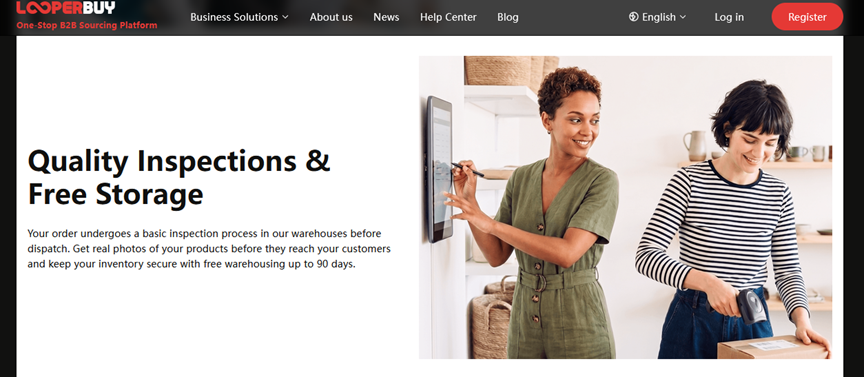
– Provide product-checking options before fulfillment.
– Support photo or video verification for selected orders.
– Assist with packaging, labels, inserts, and brand presentation.
– Consolidate sourcing, fulfillment, and international shipping workflows.
– Help sellers identify recurring product or supplier issues through order-level feedback.
The key is to set expectations clearly. A quality-control service should specify what is checked, what evidence is provided, what cannot reasonably be detected, and how exceptions are handled. This transparency allows sellers to choose the inspection level that fits their products, margins, and customer promises.
Final Thoughts
Handling product quality issues in B2B dropshipping requires more than issuing refunds after a customer complains. The strongest businesses prevent problems through approved samples, detailed specifications, reliable suppliers, order inspections, packaging controls, and transparent customer-service processes.
When problems do occur, respond quickly, collect evidence, offer a fair solution, and document the root cause. Every refund, replacement, and complaint should improve the next order.
For global B2B sellers sourcing products from China, Looperbuy can help create a more controlled sourcing and fulfillment process—so you can focus less on inventory, warehousing, supplier coordination, payment complexity, and logistics management, and more on growing a dependable brand.
Ready to improve your B2B dropshipping quality-control process? Contact Looperbuy to discuss product sourcing, inspection requirements, branded fulfillment, and international shipping solutions for your business.
Frequently Asked Questions
1. What is the most common product quality issue in B2B dropshipping?
The most common issues are incorrect variants, damaged products, missing accessories, poor material quality, and products that do not match the listing description. Many of these problems can be reduced with approved samples, clear product specifications, and pre-shipment checks.
2. Should I inspect every dropshipping order?
It depends on product risk. Low-cost and stable products may only need periodic checks, while high-value, fragile, customized, electronic, or branded items often require inspection before every shipment. Use more intensive checks when the cost of a defect is high.
3. How do I handle a defective dropshipping product?
First, acknowledge the complaint quickly. Then request photos or video evidence, verify the order details, classify the issue, and offer a clear resolution such as a replacement, partial refund, full refund, or replacement part. Record the issue and investigate the supplier or fulfillment root cause.
4. Should customers return defective products to China?
Not always. For low-value products, international return shipping can cost more than the product itself. In many cases, a replacement, refund, or partial refund is more practical. For high-value goods, safety issues, or products that require investigation, a return may be appropriate.
5. How can I make sure a supplier maintains the same quality over time?
Keep an approved golden sample, create a written quality standard sheet, request regular inspection evidence, monitor complaint data by SKU, and re-test samples when suppliers change materials, factories, packaging, or components.
6. What should be included in a dropshipping quality-control checklist?
A quality-control checklist should include SKU, variant, quantity, appearance, color, dimensions, function, accessories, packaging, labels, branding, shipping marks, and photo or video evidence requirements. The checklist should be customized for each product category.
7. How quickly should I refund a customer for a quality issue?
You should resolve quality complaints as quickly as possible based on available evidence and your published policy. For US online orders affected by shipping delays, the FTC requires sellers to provide cancellation and prompt-refund options when they cannot meet the promised shipping schedule.
References
1. Federal Trade Commission. “[Business Guide to the FTC’s Mail, Internet, or Telephone Order Merchandise Rule].”
2. Federal Trade Commission. “[Mail, Internet, or Telephone Order Merchandise Rule].”
3. Federal Trade Commission. “[Selling on the Internet: Prompt Delivery Rules].”
4. Shopify. “[Product Sourcing Guide: How To Get Started].”
5. Shopify. “[How to Find a Manufacturer for Your Product in 8 Steps].”
6. Shopify. “[Dropshipping Inventory Management: 5 Best Practices].”
7. Shopify. “[Try Before You Buy: Requesting Product Samples].”