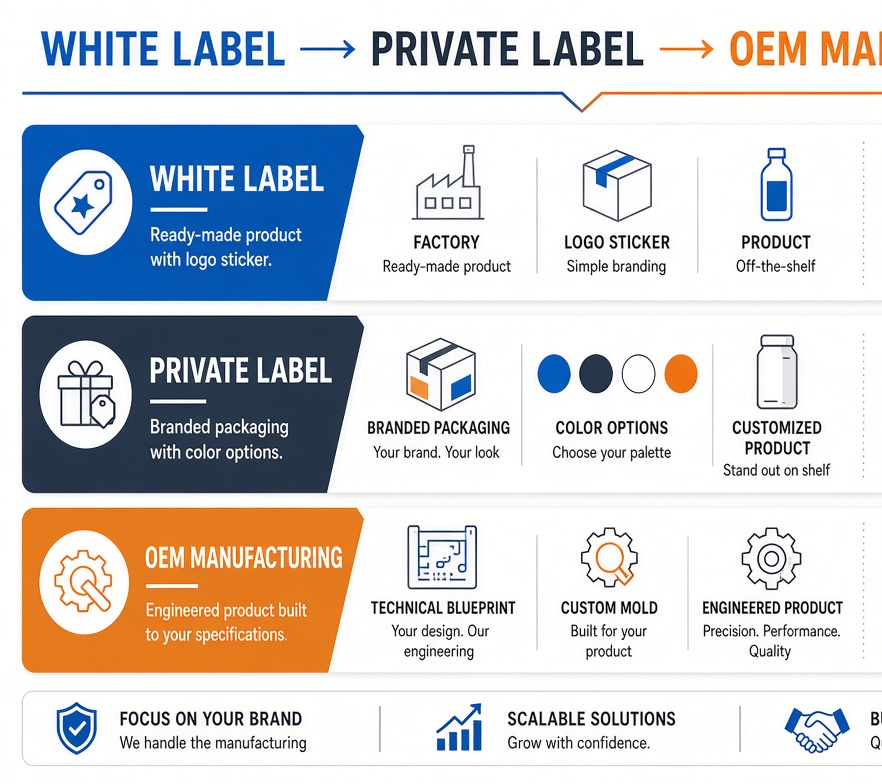
Learn the difference between white label, private label, and OEM manufacturing. This guide explains customization, ownership, MOQ, sourcing risk, compliance, supplier control, and fulfillment considerations, helping B2B sellers choose the right China sourcing model to test products, build a brand, and scale with confidence.
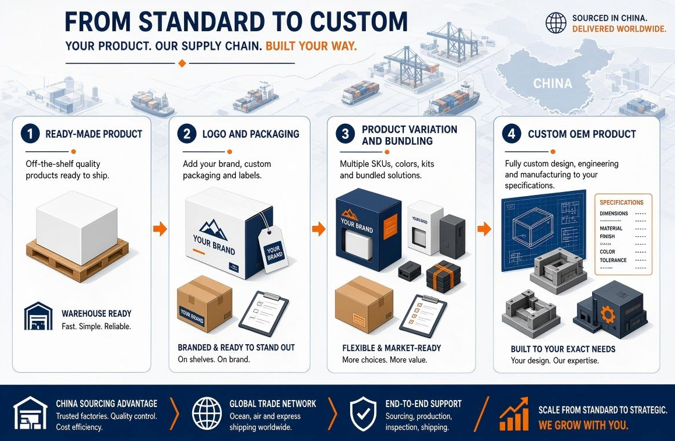
White label, private label, and OEM manufacturing are three distinct ways to sell products under your own business identity. The right choice depends on how much control you need over the product, how quickly you want to launch, the capital you can commit, and the level of risk your business can manage.
For global B2B sellers sourcing from China, the terminology is often used loosely. That creates expensive misunderstandings. A “private-label supplier” may only offer logo printing. An “OEM manufacturer” may require you to provide full technical specifications. A white-label product may be available immediately—but offer little room to differentiate.
This guide explains the practical difference between white label vs. private label vs. OEM manufacturing, including ownership, customization, minimum order quantities, lead times, compliance, intellectual property, and sourcing strategy. It is written for wholesalers, marketplace sellers, distributors, retailers, and growing brands that want to reduce inventory pressure while building a more defensible product business.
> Key takeaway: White label is the fastest way to test demand. Private label is usually the best balance between speed and brand building. OEM manufacturing provides the deepest control but requires the strongest product capability, capital, and quality-management process.
Table of Contents
White Label vs. Private Label vs. OEM at a Glance
The terms refer to different levels of control over an existing or newly developed product.
| Model | Who designs the product? | What can you customize? | Typical launch speed | Differentiation level | Best for |
| White label | The manufacturer | Brand name, logo, packaging, sometimes color | Fast | Low | Testing products, small sellers, fast catalog expansion |
| Private label | Usually the manufacturer, with brand input | Branding, packaging, bundle, formula/specification options | Medium | Medium | Retailers, online brands, distributors |
| OEM manufacturing | The buyer or brand owner provides the design/specification | Product architecture, materials, features, tooling, packaging, branding | Slowest | High | Established brands, technical products, differentiated lines |
The real decision is not simply about selecting a manufacturing label. It is about selecting the right operating model for your stage of growth.
A seller that has not validated customer demand may lose money by jumping directly into custom OEM tooling. On the other hand, a brand that has already demonstrated strong demand may outgrow generic white-label products because competitors can sell virtually identical items.
What Is White Label Manufacturing?
White label manufacturing means a manufacturer produces a standard, ready-made product that multiple businesses can sell under different brand names.
The product is generally already designed, tested, and in production. Your company adds its own brand identity through a logo, label, outer box, insert card, barcode, or product listing.
How white label works
A supplier may manufacture a standard insulated tumbler, LED desk lamp, resistance band, pet accessory, phone case, or kitchen organizer. Multiple buyers can purchase the same base product and apply their own branding.
For example:
– Factory Product: A standard 500 ml stainless-steel water bottle.
– Brand A: Adds a logo and sells it as a gym accessory.
– Brand B: Adds a minimalist package and sells it as a corporate gift.
– Brand C: Pairs it with a cleaning brush and sells it as an eco-friendly travel kit.
The physical item may be substantially the same. The selling proposition, packaging, bundle, distribution channel, and customer experience can be different.
Advantages of white label products
Fast market entry is the main appeal. The factory has already completed the product-development phase, so buyers avoid lengthy design work, prototype cycles, and tool development.
Other benefits include:
– Lower development costs than a fully customized product.
– Faster sample approval because the core product already exists.
– Simpler supplier selection for common categories.
– Useful demand testing before a larger brand investment.
– Lower operational complexity for sellers building a broad product catalog.
– Potentially lower MOQs than OEM projects, depending on packaging requirements.
White label works especially well when customers care more about availability, convenience, delivery speed, bundle value, or a trusted seller than about unique product engineering.
Limitations of white label manufacturing
The weakness is obvious: other brands can source the same item.
Your competitive advantage may therefore depend on:
– Better product positioning.
– More useful bundles.
– Stronger product photography and content.
– Better packaging.
– Reliable fulfillment.
– Faster customer support.
– A more specific target customer.
– Distribution relationships that competitors cannot easily replicate.
A white-label product can be profitable. But it is rarely protected by the product itself. When several sellers list similar products, price competition often increases quickly.
> Expert perspective: White label is a business model for learning quickly—not necessarily for staying generic forever. Use it to identify winning products, customer objections, preferred colors, bundle opportunities, and recurring quality issues. Then use that evidence to decide whether private label or OEM investment is justified.
What Is Private Label Manufacturing?
Private label manufacturing involves selling a product under your own brand, typically with more customization than white label. The manufacturer still usually owns or controls the underlying product design, but the buyer can often influence its commercial presentation or selected product specifications.
Private label sits between white label and OEM. It is one of the most practical models for B2B sellers who want to build a recognizable brand without starting product development from zero.
What can be customized in private label?
Private-label options differ widely by supplier and product category. Common options include:
– Logo placement, such as printing, engraving, embossing, embroidery, or woven labels.
– Retail packaging, including boxes, pouches, hang tags, manuals, inserts, and barcode labels.
– Colorways and finishes, such as matte, glossy, metallic, recycled-material, or custom color options.
– Bundles, accessories, replacement parts, and gift sets.
– Product dimensions or minor feature changes when the factory supports them.
– Formulas, fragrances, ingredients, or active concentrations in certain beauty and personal-care categories.
– Product naming and brand story for a distinct market segment.
For example, a supplier may already produce a basic skincare serum. A private-label buyer may select from several tested base formulas, choose a fragrance-free option, design a custom bottle and carton, and market the product under its own brand. The buyer may not own the original formula or production process, but the end product can be meaningfully differentiated.
When private label is the better choice
Private label is often a strong fit when your business has identified a market opportunity but does not need to invent a new product from scratch.
Choose private label when you want to:
– Build repeat recognition under your own trademark.
– Improve margins compared with reselling existing brands.
– Control retail packaging and product presentation.
– Create category-specific bundles.
– Target a particular niche, such as hospitality, pet owners, fitness studios, new parents, or corporate buyers.
– Test several product variants before funding deeper customization.
– Create a product line that can be reordered consistently.
The private-label ownership question
A common sourcing mistake is assuming that “private label” means the buyer owns the product design.
That is not always true.
In many private-label relationships, the factory retains ownership of the base product, formulation, mold, production method, or artwork template. Your company may own the brand name, trademark, packaging artwork, and customer relationships, but not necessarily the product intellectual property.
Before placing an order, clarify in writing:
1. Who owns the logo artwork and packaging files?
2. Who owns any new mold, tooling, or formula created for the project?
3. Can the factory sell the same configuration to another buyer?
4. Is geographic or channel exclusivity available?
5. What happens to your inventory, tooling, and design files if the relationship ends?
6. Can you move production to another approved supplier later?
These questions matter more as your sales volume grows.
What Is OEM Manufacturing?
OEM manufacturing traditionally means a manufacturer produces goods according to a buyer’s own design, technical requirements, drawings, specifications, or branded product concept.
In an OEM project, the buyer generally has more responsibility. You may provide technical drawings, a bill of materials, performance requirements, approved materials, tolerances, product samples, packaging specifications, compliance needs, and quality criteria.
The factory’s role is to manufacture the product accurately and consistently.
OEM manufacturing example
Imagine a commercial lighting distributor that wants a specialized warehouse light fixture.
The buyer may define:
– Required wattage and lumen output.
– Housing material and corrosion resistance.
– Heat-dissipation design.
– Driver specifications.
– IP rating.
– Operating temperature range.
– Mounting system.
– Required test reports.
– Brand marking.
– Packaging drop-test standards.
The supplier may then engineer the product for manufacturability, create tooling, produce prototypes, conduct testing, and manufacture the approved design at scale.
This is far more involved than selecting a standard product and adding a logo.
The strengths of OEM manufacturing
OEM can create a product that is harder to compare directly and harder for competitors to copy. It can also help brands solve a specific customer problem that off-the-shelf products do not address.
Key benefits include:
– Greater product differentiation.
– Control over key materials and features.
– Potentially stronger long-term margins.
– Custom quality requirements and inspection criteria.
– More relevant product-market fit for a defined audience.
– Better ability to build a proprietary product line.
– Potential intellectual-property value, when contracts and registrations are structured properly.
The demands of OEM manufacturing
OEM is not just a purchasing decision. It is a product-management commitment.
Expect more work in the following areas:
– Product design and engineering.
– Technical documentation.
– Supplier capability evaluation.
– Prototype review.
– Tooling and mold investment.
– Reliability and performance testing.
– Quality-control plans.
– Change-management approval.
– Regulatory review.
– Forecasting and inventory planning.
– Intellectual-property protection.
A factory can make a product exactly to specification only when the specification is clear. “High quality,” “premium feel,” or “similar to this competitor’s item” are not enough. OEM projects need measurable requirements.
Better requirement: “Housing must withstand a 1-meter drop test with no functional failure and no crack longer than 5 mm.”
Weak requirement: “Please make the housing durable.”
The Core Differences That Affect Your Business
The table below turns the terminology into commercial decisions.
| Decision factor | White label | Private label | OEM manufacturing |
| Product uniqueness | Usually low | Moderate | High |
| Brand control | Basic | Strong | Strongest |
| Product design control | Minimal | Limited to moderate | High |
| Tooling investment | Rare | Sometimes required | Often required |
| Typical MOQ | Low to medium | Medium | Medium to high |
| Lead time | Short | Moderate | Longer |
| Upfront capital | Lowest | Moderate | Highest |
| Technical expertise needed | Low | Moderate | High |
| Quality-control complexity | Basic product inspection | Product and packaging inspection | Full specification, process, and performance control |
| Intellectual-property exposure | Higher copy risk | Moderate | Lower if ownership is clearly documented |
| Best strategic use | Test and sell | Build a brand | Build a differentiated product platform |
Important: These are commercial patterns, not fixed rules. A factory might offer white-label orders with high MOQs, or an OEM supplier may accept small pilot runs if it already has compatible tooling. Always request product-specific terms.
A Practical Decision Framework for B2B Sellers
The best manufacturing model depends on the evidence you have—not simply on ambition.
Choose white label if you need speed
White label is usually the right first step if you are:
– Testing a new category.
– Selling trend-sensitive products.
– Managing limited working capital.
– Launching a broad wholesale catalog.
– Evaluating several suppliers at once.
– Selling products where branding is less important than availability.
– Using dropshipping or low-inventory fulfillment to validate demand.
A practical approach is to launch a focused white-label assortment, measure sales performance and return reasons, then invest in the products that show repeat demand.
Choose private label if you need brand value
Private label works best if you have already identified:
– A defined customer segment.
– A clear price position.
– A brand identity.
– Repeatable demand.
– A meaningful packaging or bundling opportunity.
– Customer feedback that points to specific improvements.
For example, instead of selling a generic pet grooming kit, a private-label seller could develop a “mobile groomer refill kit” with travel packaging, specific accessory combinations, multilingual instructions, and reorder-friendly replacement components.
The base products may already exist. The commercial offer becomes more useful and difficult to replace.
Choose OEM if the product itself is your advantage
OEM manufacturing becomes appropriate when your product needs a unique technical, functional, or industrial feature.
This may include:
– Custom machinery components.
– Specialized electronics.
– Ergonomic tools.
– Packaging with proprietary dimensions.
– Industrial consumables.
– Products requiring specific materials or durability.
– A new combination of functions that standard suppliers do not provide.
Do not move to OEM merely because it sounds more prestigious. Move to OEM when your data shows that a unique product feature can win customers, support a premium price, or secure an important B2B account.
How to Reduce Risk When Sourcing From China
The manufacturing model does not remove sourcing risk. It changes the type of risk you must manage.
For white label, the main risk is product sameness and inconsistent quality between batches. For private label, packaging accuracy and brand consistency become more important. For OEM, technical execution, tooling ownership, and production change control become critical.
Use a structured supplier-validation process
Before committing to a supplier, use a repeatable process:
1. Define the product brief. Document the target customer, intended use, required features, materials, packaging, and target landed cost.
2. Screen supplier capability. Confirm product specialization, export experience, production capacity, quality systems, and communication responsiveness.
3. Request comparable samples. Do not judge only from photos or catalog descriptions.
4. Create a written specification. Include measurements, materials, colors, labeling, packaging, acceptable defects, and test requirements.
5. Confirm commercial terms. Document MOQ, unit price, tooling cost, sample fees, lead time, payment schedule, and warranty process.
6. Clarify ownership. Record who owns artwork, molds, design files, formulas, and improvement ideas.
7. Inspect before shipment. Use pre-shipment inspections for higher-value, higher-risk, or customized orders.
8. Track batch performance. Monitor defect rates, returns, customer feedback, delivery performance, and supplier corrective actions.
Quality management should be evidence-based rather than assumption-based. ISO 9001 describes a quality-management framework built around leadership, customer focus, documented information, risk-based thinking, measurement, and continual improvement. Those principles are useful even when a buyer does not require formal certification.
Build a supplier scorecard
A supplier scorecard turns sourcing into a measurable operating system.
Track each supplier against criteria such as:
| Metric | Why it matters | Example measurement |
| Sample approval rate | Indicates whether the factory understands requirements | Approved samples ÷ total samples |
| On-time delivery | Protects customer commitments | On-time orders ÷ total orders |
| Defect rate | Measures production consistency | Defective units ÷ inspected units |
| Response speed | Helps resolve urgent production issues | Average response time |
| Documentation accuracy | Reduces customs and labeling risk | Error-free document rate |
| Corrective-action closure | Shows accountability after defects | Days to close quality issue |
This approach is particularly valuable for private-label and OEM projects. A low unit price can become expensive if poor quality triggers returns, rework, chargebacks, or lost wholesale accounts.
Compliance, Product Claims, and Import Responsibilities
A manufacturer can produce your goods, but outsourcing production does not automatically outsource your business responsibilities.
If you sell products under your own brand, you should confirm which entity is responsible for product labeling, safety documentation, certifications, import declarations, and customer-facing claims in each destination market.
For U.S. imports, the importer of record is responsible for using reasonable care to enter, classify, and value imported goods, and to provide information needed for Customs and Border Protection to determine whether legal requirements have been met.
If you make objective advertising claims, such as “clinically proven,” “reduces pain,” “waterproof to 30 meters,” “biodegradable,” or “kills 99.9% of bacteria,” make sure you have evidence that matches the claim. The Federal Trade Commission states that advertising claims must be truthful, non-deceptive, and supported by evidence.
For regulated categories, the stakes are higher. In the United States, businesses that manufacture or market cosmetics have legal responsibility for product safety and proper labeling, even where manufacturing is outsourced.
> Practical rule: Never treat a supplier’s verbal statement—”This product is certified” or “This label is compliant”—as final proof. Ask for the exact report, certificate, scope, issuing body, validity date, model number, and applicable market.
From Product Test to Scalable Brand
A reliable path for many B2B sellers is not choosing one model forever. It is moving through the models as evidence grows.
A three-stage product strategy
Stage 1: Validate with white label
Start with ready-to-source products. Keep initial complexity low. Focus on demand, customer feedback, return reasons, and product-market fit.
Stage 2: Differentiate with private label
Apply your brand identity. Improve packaging. Create bundles. Select variants that reflect customer demand. Build a consistent catalog and reorder process.
Stage 3: Defend with OEM
Invest in features, materials, tooling, performance requirements, or design changes that customers value and competitors cannot easily duplicate.
This progression prevents a common mistake: spending heavily on OEM development before the market has proven that buyers want the product.
For example, an online retailer could begin with white-label desk organizers, identify that customers repeatedly request cable management and modular stacking, introduce a private-label bundle with upgraded packaging, then create an OEM modular system with proprietary interlocking dimensions for business buyers.
How Looperbuy Supports Product Sourcing and Fulfillment
For global B2B sellers, product selection is only one part of the equation. The operating burden also includes supplier communication, product sourcing, payment coordination, inspection planning, storage, order processing, and international shipping.
Looperbuy helps global B2B sellers source reliable China-made products and arrange fulfillment without requiring them to manage every supplier and logistics task independently.
This can be particularly useful when you want to:
– Test white-label products without carrying excessive stock.
– Consolidate products from multiple China suppliers.
– Add branded inserts, labels, or packaging components before dispatch.
– Coordinate product inspection before goods move internationally.
– Reduce the operational burden of warehousing and order fulfillment.
– Create a flexible path from product testing to private-label development.
If you are deciding between white label, private label, or OEM manufacturing, begin with a sourcing brief rather than a product photo alone. Define your target customer, intended selling channel, target cost, customization level, expected order volume, and fulfillment requirements. That gives suppliers—and your sourcing partner—a clear basis for evaluating feasibility.
Ready to source products from China with less inventory and fulfillment complexity? Contact Looperbuy with your product requirements, target market, customization needs, and expected volume to build a practical sourcing plan.
Frequently Asked Questions
1.Is white label the same as private label?
No. White label usually means buying a standard product and applying your branding with limited changes. Private label usually allows more control over branding, packaging, product variants, bundles, or selected specifications. The exact scope depends on the supplier agreement.
2.Is OEM better than private label?
Not automatically. OEM is better when your company needs a unique technical product, custom materials, performance specifications, or proprietary features. Private label is often a more practical choice for businesses that want brand differentiation without the high cost, complexity, and lead time of full product development.
3.Can I start with white label and later move to OEM?
Yes. This is often a lower-risk strategy. Start with white-label products to validate demand, collect buyer feedback, and identify commercial opportunities. Then move to private label or OEM when you have evidence that customization can support higher sales, stronger margins, or a premium price.
4.Who owns the product design in a private-label arrangement?
It depends on the contract. The factory often owns the original product design, mold, or formula, while the buyer owns the trademark, logo, packaging artwork, and brand assets. Always document ownership and exclusivity terms before you pay for customization or tooling.
5.What is a typical MOQ for private label and OEM products?
There is no universal MOQ. It depends on the product, production process, materials, packaging requirements, and whether new tooling is needed. White-label orders may be available at lower quantities, while custom packaging, color production, formulas, or molds can raise the minimum order requirement.
6.Do I need product testing before importing private-label products?
In many cases, yes. Requirements depend on the product category and destination market. Product testing, safety documentation, labels, certifications, and customs paperwork may be required or commercially necessary. Verify requirements for the exact product and sales market rather than relying only on a supplier’s general claims.
7.Can a sourcing partner help with both private label and fulfillment?
Yes. A sourcing partner can help coordinate supplier communication, sample collection, branding components, inspections, product consolidation, storage, and shipping. The exact service scope should be confirmed before you place an order, especially for customized products with multiple suppliers or packaging components.
References
1. International Organization for Standardization. [ISO 9001 explained]
2. International Organization for Standardization. [ISO 9001:2015 — Quality management systems]
3. U.S. Customs and Border Protection. [Reasonable Care]
4. U.S. Customs and Border Protection. [Marking of Country of Origin on U.S. Imports]
5. Federal Trade Commission. [Advertising and Marketing Guidance]
6. Federal Trade Commission. [Health Products Compliance Guidance]
7. U.S. Food and Drug Administration. [Small Businesses & Homemade Cosmetics: Fact Sheet]
8. U.S. Food and Drug Administration. [Cosmetics Labeling Guide]