Discover the best wholesale shoe websites for retailers, including B2B marketplaces, supplier directories, and trend-research platforms. Learn how to compare suppliers, order samples, manage footwear compliance, avoid counterfeit risk, reduce inventory exposure, and create a more efficient sourcing-to-fulfillment workflow.
Finding the right wholesale shoe websites is not just about locating the lowest factory price. For retailers, marketplace sellers, and growing footwear brands, the real objective is to find products with reliable quality, workable order quantities, clear compliance documentation, and a supply chain that does not force excessive inventory risk.
The global footwear market remains substantial and competitive. Athletic footwear is forecast to outpace other categories in growth, while online retail continues to expand as a footwear sales channel. That makes fast product testing, disciplined supplier selection, and dependable fulfillment increasingly important for sellers entering the category.
This guide reviews 15 platforms commonly used to source shoes, separates true B2B sourcing options from retail trend-research sites, and provides a step-by-step process for buying shoes from China and other markets more safely.
Table of Contents
What Makes a Good Wholesale Shoe Platform?
A useful wholesale shoe platform should help buyers compare suppliers, product specifications, minimum order quantities (MOQs), prices, customization options, and delivery expectations. A large product catalog is valuable, but it does not replace product inspection or supplier verification.
When evaluating a platform, look beyond the displayed unit price:
– Supplier transparency: Business details, factory capability, certifications, export experience, and response quality.
– Product fit: Materials, size range, outsole type, packaging, target customer, and seasonal relevance.
– Commercial flexibility: MOQ, sample policy, customization cost, payment terms, and production lead time.
– Risk controls: Buyer protection, documented specifications, quality-control options, and dispute procedures.
– Fulfillment readiness: Whether products can be consolidated, labeled, stored briefly, and shipped directly to customers.
For sellers testing a new footwear niche, the best supplier is often not the factory offering the cheapest price. It is the one that can deliver a consistent product, respond clearly to revisions, and support a manageable first order.
15 Wholesale Shoe Websites Worth Reviewing
The following list includes B2B marketplaces, supplier directories, wholesale-focused platforms, and several retail websites that can be useful for product and price research. Global Sources’ original comparison identifies these 15 destinations, but they should not all be treated as equal sourcing channels.
| Platform | Best use | Buyer consideration |
| Global Sources | Finding Asian suppliers and product customization | Review supplier profiles, product details, MOQ, and lead times |
| DHgate | Testing lower-volume product ideas | Vet seller ratings, photos, and materials carefully |
| Made-in-China | Comparing Chinese factories across categories | Request samples and clarify factory-versus-trading-company status |
| ShoeDazzle | Trend and retail-price research | Not a conventional wholesale sourcing platform |
| JustFab | Fashion and subscription-model research | Better for monitoring styles than bulk procurement |
| Markato | Curated fashion brands and Asian retail buyers | May have higher prices and a narrower selection |
| Wholesale Fashion Shoes | Women’s fashion footwear | Confirm wholesale terms and replenishment capability |
| Lulus | Trend, merchandising, and price benchmarking | Primarily a direct-to-consumer retailer |
| Tobi | Fashion trend research | Primarily retail-focused rather than B2B wholesale |
| TradeIndia | Exploring Indian footwear suppliers | Validate export experience and product consistency |
| IndiaMART | Accessing a broad Indian supplier base | Compare quotes and verify business credentials |
| ExportersIndia | Finding Indian exporters | Use samples and detailed specifications before bulk buying |
| Wholesale Central | Discovering US-oriented wholesalers | Check the underlying supplier, not only the directory listing |
| Wholesale Hub | Broad wholesale product browsing | Confirm inventory ownership and shipping responsibility |
| Alibaba | Large-scale supplier discovery and RFQs | Narrow choices with documented quality and compliance requirements |
1. Global Sources
Global Sources is a long-established B2B sourcing platform focused heavily on suppliers in China and other Asian manufacturing markets. Its supplier information, product-category structure, customization features, and buyer-oriented marketplace tools make it a strong starting point for retailers seeking athletic shoes, casual footwear, sandals, boots, or private-label products.
Its value is greatest when buyers use filters to build a shortlist, then move into direct due diligence. Ask suppliers for factory photos, material specifications, past export markets, test reports where relevant, and a production timeline tied to your specific model.
2. DHgate
DHgate can be useful for sellers who want broad product choice and potentially lower initial purchasing thresholds. It is particularly relevant when testing generic accessories, fashion shoes, or unbranded styles in limited quantities.
However, listings can vary considerably in product quality and seller reliability. Treat photos as initial inspiration—not proof of what you will receive. Order samples before committing to a larger purchase.
3. Made-in-China and Alibaba
Made-in-China and Alibaba are two major destinations for identifying Chinese manufacturers and trading companies. Both can be valuable for comparing footwear designs, requesting quotations, and finding suppliers open to custom colors, logos, materials, or packaging.
A productive request for quotation should state the shoe type, target price, order volume, size run, upper and outsole materials, destination market, required packaging, and target delivery date. Vague requests usually result in vague quotations.
4. TradeIndia, IndiaMART, and ExportersIndia
These platforms are useful for buyers who want to explore footwear suppliers in India, including leather footwear, sandals, safety shoes, and regional designs. They also give retailers an alternative sourcing geography when product differentiation matters.
The same sourcing discipline applies: establish who owns the factory, whether the supplier has export experience, and whether the quoted product matches the samples. Communication quality before the order is often an early indicator of how problems will be handled later.
5. Wholesale Fashion Shoes, Wholesale Central, and Wholesale Hub
These wholesale-oriented websites can help retailers find ready-to-sell inventory without developing a product from scratch. This can reduce design and development time, especially for boutiques that refresh their assortments frequently.
The trade-off is usually less control over branding, exclusivity, packaging, and stock continuity. Before listing an item online, confirm whether it is in stock, whether replenishment is possible, and whether the supplier permits marketplace resale.
6. Markato
Markato is a more curated marketplace model, which may appeal to stores that prioritize distinctive product selection over the largest possible catalog. Curated platforms can save time, but they may have higher price points or fewer options in a specific category.
Use this type of platform when your retail concept depends on design differentiation, not only price competition.
7. ShoeDazzle, JustFab, Lulus, and Tobi
These are mainly retail or direct-to-consumer fashion sites, rather than primary wholesale shoe websites. Their strategic value is in observing visual merchandising, color stories, retail price points, customer-facing product descriptions, and recurring style themes.
Use them to answer questions such as: Which heel shapes are being featured? Are minimalist sneakers gaining visibility? What product bundles or promotional messages are competitors using? Do not assume that a retail bestseller is automatically a safe product to source.
How to Source Wholesale Shoes Without Overbuying
Many new footwear sellers make the same mistake: they purchase too many units before validating demand. Shoes create additional complexity because each design may require multiple sizes, colors, and variants. A 300-pair order can quickly become fragmented inventory.
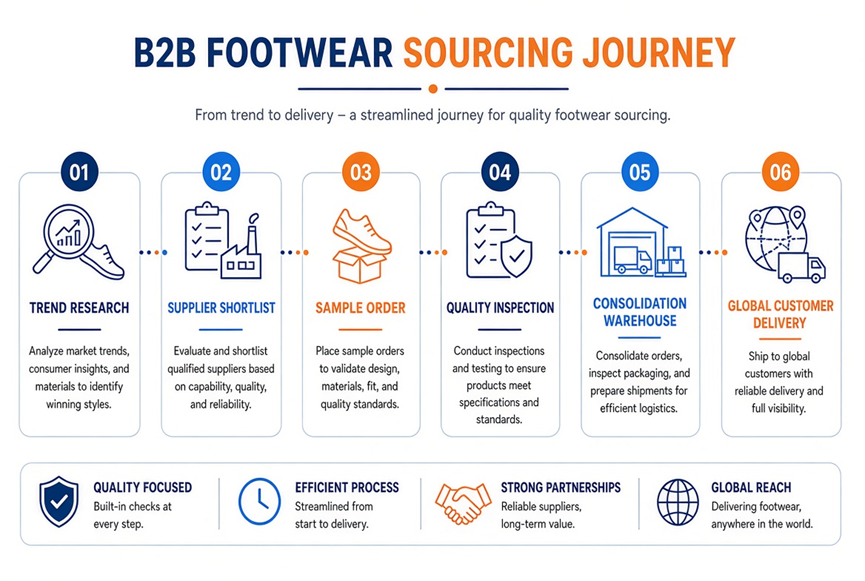
Use this five-step purchasing workflow:
1. Choose one customer and one category. For example, “women aged 25–40 seeking lightweight office-to-weekend loafers,” rather than “fashion shoes for everyone.”
2. Build a comparison sheet. Include price, MOQ, sample fee, material, size range, logo options, production time, carton dimensions, and supplier response time.
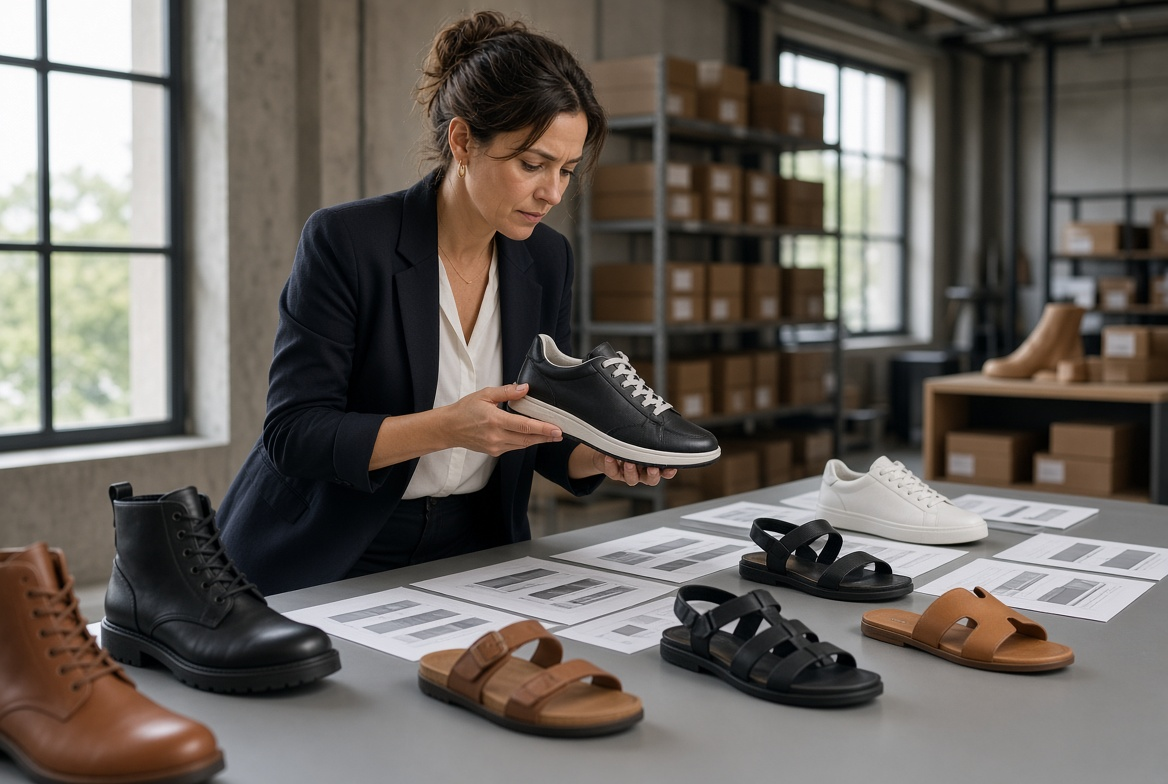
3. Order and inspect samples. Check stitching, odor, glue marks, color consistency, flexing, sole adhesion, size accuracy, and packaging.
4. Approve a written specification. Include product photos, measurements, materials, acceptable defect level, carton markings, and delivery terms.
5. Start with a controlled launch. Buy only the quantity needed for initial validation, then reorder based on actual sales data.
For example, a retailer selling a white lifestyle sneaker should not approve a sample merely because it looks good in photos. The buyer should verify whether the upper yellows after handling, whether the outsole picks up stains easily, whether the size chart matches the target market, and whether the shoe remains comfortable after a short wear test.
Compliance and Brand Protection Before You Sell
Footwear may involve chemical, labeling, consumer-safety, intellectual-property, and import requirements that vary by destination. In the European Union, footwear businesses using chemicals in manufacturing can have obligations under REACH, while the European Commission notes that the sector is subject to specific EU footwear legislation.
Do not source products bearing another company’s logo, trademark, or recognizable protected design unless you have clear authorization. In the United States, trademark owners can record eligible registered marks with Customs and Border Protection to help intercept infringing imports.
Before placing a bulk order, request:
– Material composition and color information.
– Applicable testing reports or declarations for the intended market.
– Packaging and labeling artwork.
– Written confirmation that logos, graphics, and patterns do not infringe third-party rights.
– A product-inspection plan before final payment.
– Commercial invoice, packing list, and shipment details prepared accurately.
Compliance is not a document you request after the goods arrive. It should be part of product selection and supplier communication from the first quotation.
Turn Sourcing Into a Lean Fulfillment Model
Traditional wholesale buying often creates three cost pressures: capital tied up in inventory, warehouse space, and time spent packing individual customer orders. A leaner model separates product sourcing from customer fulfillment.
After samples and supplier quality are approved, sellers can use a sourcing and fulfillment partner such as Looperbuy to help purchase China-sourced products, consolidate goods, coordinate packing, and ship orders to customers. This approach can be especially useful for cross-border sellers that want to test products without operating their own warehouse in China.
A practical operating model looks like this:
– Source and validate a small group of footwear SKUs.
– Send approved products to a consolidation point instead of shipping every supplier order separately.
– Use consistent packaging, labeling, and order checks.
– Replenish proven sizes and colors based on sales—not forecasts alone.
– Keep suppliers, inspection records, and fulfillment data in one operating workflow.
Ready to reduce sourcing complexity? Start by selecting three potential shoe suppliers, ordering comparable samples, and building a launch plan around the product that meets your quality, delivery, and margin requirements. Looperbuy can support the next stage: purchasing, consolidation, and fulfillment for your international customer orders.
Frequently Asked Questions
1. What is the typical MOQ for wholesale shoes?
MOQ varies widely by supplier and product. Some ready-made styles may be available in small quantities, while private-label footwear often requires larger quantities because materials, molds, colors, and size runs need to be planned together. Global Sources examples show orders ranging from very small quantities to hundreds or thousands of pairs.
2. Should I buy samples before ordering wholesale shoes?
Yes. A sample lets you check materials, construction, fit, sizing, color, packaging, and overall product quality. It is far less expensive to reject a poor sample than to manage a defective bulk order.
3. Are wholesale shoe websites safe to use?
They can be useful discovery tools, but platform presence is not a replacement for due diligence. Verify the supplier, obtain a written specification, order samples, document agreements, and arrange inspection when the order value justifies it.
4. Can I sell branded shoes sourced from wholesale marketplaces?
Only when you have legitimate authorization and can verify the supply chain. Avoid listings using logos or branding that you are not authorized to sell; counterfeit or infringing goods can be detained or seized by customs authorities.
5. How can I avoid holding too much shoe inventory?
Test a narrow range of styles, colors, and sizes before scaling. Use actual sales data to guide replenishment, and consider a consolidation and fulfillment workflow that reduces the need to store all inventory in your own facility.
6. Which shoes are easiest for a new retailer to test?
Start with products that have clear demand, fewer fit-related complications, and a manageable number of variants. Casual sneakers, slides, sandals, and simple fashion footwear may be easier to test than highly technical athletic shoes or styles requiring extensive size customization.
References
1. Global Sources. “[Top 15 Wholesale Shoe Websites for Retailers and Business Owners Worldwide].” Platform comparison, supplier features, MOQ examples, and product categories.
2. European Commission. “[Footwear Industry].” EU footwear-sector overview and REACH-related obligations.
3. United States Patent and Trademark Office. “[U.S. Customs and Border Protection Services for Trademark Owners].” Guidance on trademark recordation and border enforcement.
4. Mordor Intelligence. “[Footwear Market Size & Share Analysis].” Footwear market segmentation and online-retail growth projections.
5. Centre for the Promotion of Imports from Developing Countries (CBI). “[What Requirements Should Footwear Comply With to Be Allowed on the European Market?].” Footwear safety and chemical-restriction guidance.
-700x490.jpeg)