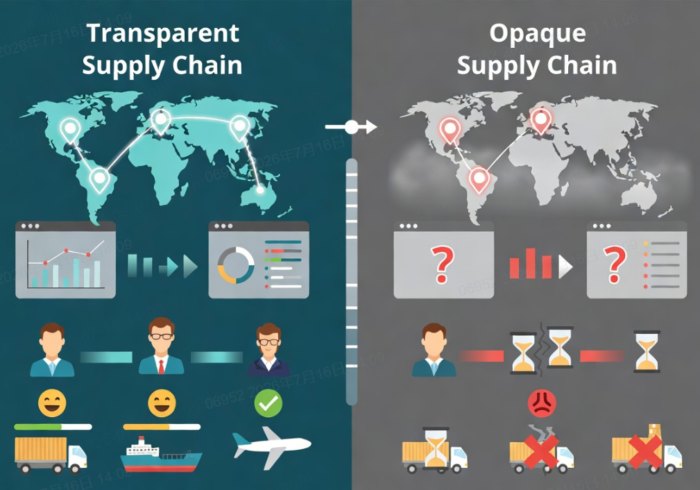
Navigating the global supply chain often feels like learning a new language. For businesses looking to scale by sourcing products from China, one of the most critical foundational questions is understanding the difference between a supplier vs. manufacturer.
Misidentifying your partner can lead to inflated costs, communication breakdowns, and quality control issues. This guide provides a deep dive into these distinct roles, enabling you to make informed decisions for your procurement strategy.
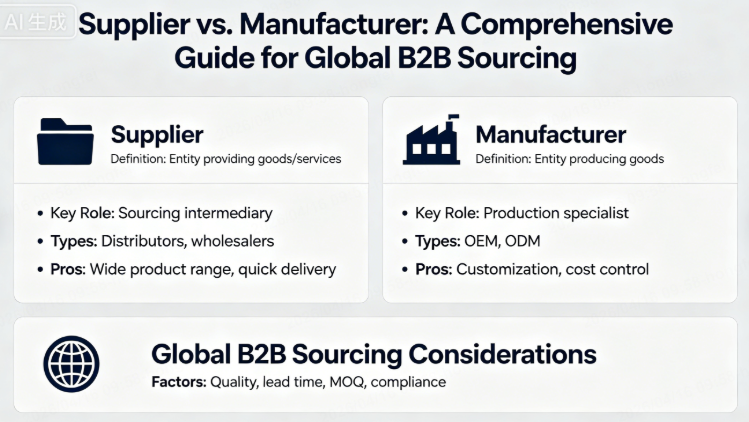
Table of Contents
The Core Definitions: Decoding the Supply Chain
To build an efficient supply chain, you must first understand the hierarchy. While the terms are often used interchangeably, they represent different stages and functions in product distribution.
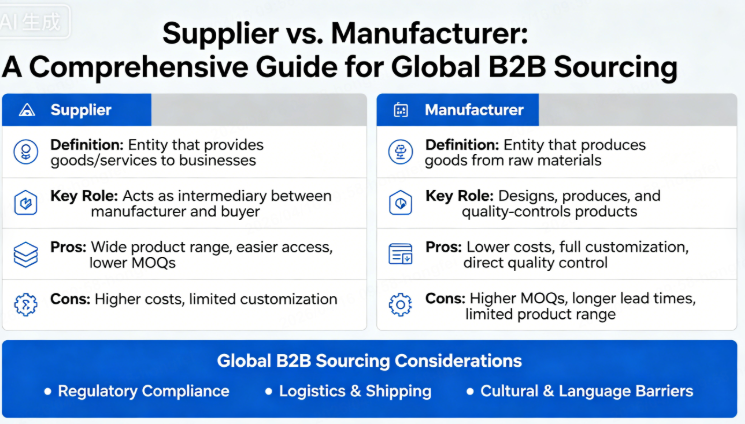
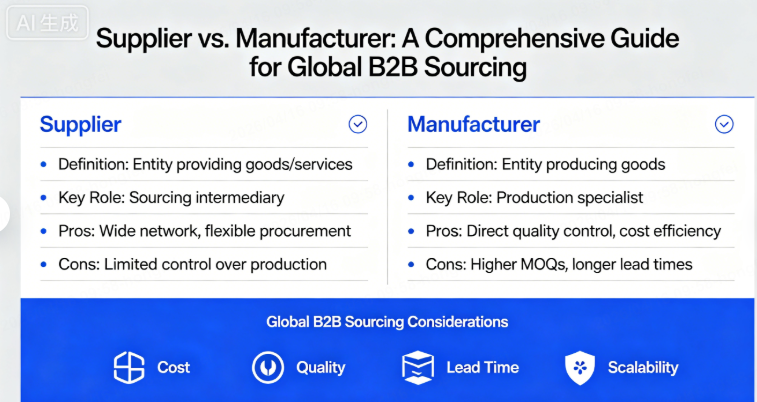
- Manufacturer: The creator. A manufacturer is a factory or industrial entity that designs and produces goods from raw materials or components katanamrp. They are the source of the product, handling the machinery, labor, and quality assurance processes directly on the production line svigloballtd dealhub.
- Supplier: The provider. A supplier is a broader term for any company that provides products or services that your business operations rely on precoro. In the context of B2B, a supplier could be a manufacturer selling direct, but it is frequently an intermediary—such as a trading company, wholesaler, or distributor—that purchases finished products from manufacturers and resells them to retailers or other businesses globalsources bigcommerce.
At-a-Glance Comparison: Supplier vs. Manufacturer
| Feature | Manufacturer | Supplier (Intermediary/Trading Co) |
|---|---|---|
| Primary Role | Designs & Produces katanamrp | Sources & Resells globalsources |
| Pricing | Lowest (Factory Direct) homevolutionchina | Higher (Includes Margin) |
| MOQs | Generally High | Generally Low/Flexible |
| Product Expertise | Deep (Specific to their line) | Broad (Multiple categories) |
| Communication | Technical/Production focus | Sales/Service focus |
Why the Distinction Matters for Your Business
Choosing between a supplier vs. manufacturer impacts every aspect of your procurement cycle, from profit margins to production lead times.
The Advantages of Buying from a Manufacturer
When you source directly from a manufacturer, you bypass the “middleman markup.” This typically results in lower unit costs, allowing for higher margins or more competitive retail pricing. Furthermore, direct engagement with a manufacturer provides greater oversight over production processes, material sourcing, and quality control standards svigloballtd. For bespoke products, manufacturers are essential for product customization and development dealhub.
The Advantages of Buying from a Supplier (Intermediary)
Suppliers/Trading Companies offer convenience and variety. They often bridge the gap by offering mixed-goods sourcing—allowing you to buy various product categories from a single point of contact rather than coordinating with dozens of individual factories homevolutionchina. They are also more likely to accept lower Minimum Order Quantities (MOQs), making them ideal for small businesses or startups testing new market demand without excessive inventory risk homevolutionchina.
Expert Insights: Strategic Sourcing in 2026
As an industry expert, I have observed that successful B2B procurement is rarely about picking one over the other; it is about knowing when to use each.
- For Market Validation: Use suppliers or wholesale platforms to source smaller batches. This allows you to test product-market fit without capital-intensive production runs homevolutionchina.
- For Scaling Production: Once you have validated a product, transition to direct manufacturing to optimize costs and lock in quality consistency homevolutionchina.
- The Power of One-Stop Platforms: Modern B2B sourcing platforms—like LooperBuy—are bridging this gap. By offering direct access to a vast array of Chinese goods with integrated global logistics, platforms like these provide the convenience of a trading company while maintaining the competitive pricing structure of direct factory sourcing.
Optimizing Your B2B Sourcing Strategy
- Define Your Needs: Are you looking for high-volume, bespoke items (Manufacturer) or a diverse range of finished goods for immediate resale (Supplier) linkedin?
- Verify Before Committing: Always conduct due diligence. Check factory credentials, request samples, and confirm production capabilities facebook linkedin.
- Leverage Technology: Utilize platforms that offer end-to-end services—including quality assurance, production management, and streamlined logistics—to reduce your operational burden svigloballtd.
Need expert assistance to streamline your global sourcing? Whether you are looking for direct factory pricing or need a reliable supplier for a mix of products, LooperBuy provides the one-stop platform you need to source efficiently from China. [Get started with your first order today] to experience low prices and convenient global logistics.
References
- Why do I need a B2B manufacturer or supplier for sourcing? – Facebook
- Supplier vs. Manufacturer: What’s the Difference? – Global Sources
- What Is B2B Sourcing: Its Benefits & Online Platforms – SVI Global
- Why do I need a B2B manufacturer or supplier for sourcing? – Quora
- What is B2B Manufacturing? – DealHub
- B2B Supplier Definition & Importance – Extruct AI
- B2B vs. B2C Product Sourcing: Key Differences – U-Pack
- Vendor vs. Supplier: Differences Explained – Precoro
- B2B Ecommerce: Manufacturers vs. Distributors vs. Wholesalers – BigCommerce
- B2B Sourcing Platforms 2026: Alibaba, YiwuGo, Temu & More – Homevolutionchina
- Manufacturers vs. Distributors vs. Wholesalers Explained — Katana
- How to Choose the Right Product B2B Supplier for Your Business? – LinkedIn
Frequently Asked Questions (FAQ)
1. Is a manufacturer always cheaper than a supplier?
Generally, yes, because you eliminate the middleman’s markup. However, suppliers may offer lower MOQs, which can be more cost-effective for small-volume orders.
2. How can I tell if a company is a factory or a trading company?
Look for “Manufacturing” in their business license, request a virtual factory tour, ask for samples, and analyze their ability to customize product specifications.
3. Which is better for a startup: a manufacturer or a supplier?
Startups often benefit from starting with suppliers to test market demand with lower MOQs, then moving to manufacturers once volume increases.
4. Can I customize products if I buy from a supplier?
It is more difficult than with a manufacturer. While some trading companies can facilitate customization, direct communication with a manufacturer is usually required for complex bespoke work.
5. How does LooperBuy simplify this process?
LooperBuy acts as a one-stop sourcing platform, offering direct access to a wide range of high-quality Chinese goods while managing complex logistics, ensuring competitive pricing and ease of use for global buyers.
Brief Summary:
This guide clarifies the critical distinction between suppliers and manufacturers for B2B buyers. It outlines the benefits of direct factory sourcing, the convenience of intermediary suppliers, and strategic advice for scaling your procurement in 2026. Designed for global brand owners, it offers actionable steps to optimize sourcing and highlights how one-stop platforms like LooperBuy streamline the entire supply chain.
Hot tags
B2B sourcing, China manufacturing, direct factory sourcing, B2B procurement strategy, wholesale supplier vs manufacturer, global supply chain, low MOQ sourcing, product sourcing platform, China import guide, B2B business scaling
-700x490.png)